
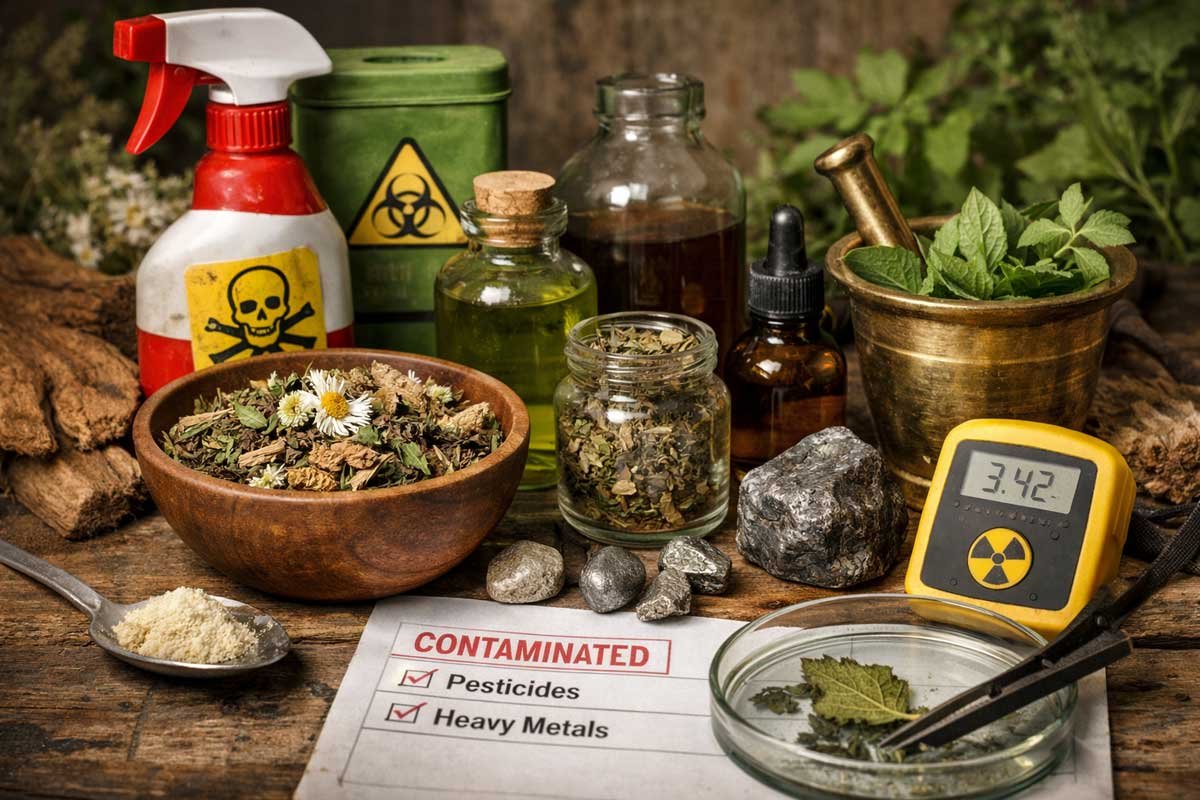
A Tangled Root: Why Pesticides and Heavy Metals Matter in Your Herbs
People reach for medicinal plants for a simple reason. They want something closer to nature. Something cleaner. Something that feels safer than a pill with a folded leaflet full of warnings. Herbs are associated with meadows, forests, small farms, and traditions passed down quietly, not factories and warning labels. Yet that comforting image often hides a messier reality. Many medicinal plants today carry traces of pesticides and heavy metals that have nothing to do with healing.
This matters because herbs are not used like food. You might eat a strawberry once and move on. Medicinal plants are taken repeatedly, sometimes daily, sometimes for months or years. Teas, tinctures, capsules, powders. Roots, leaves, flowers. When pesticides are present, even at low levels, repeated exposure changes the equation. What looks negligible on paper can add up in the body.
Table of Contents

Pesticides are designed to kill or disrupt life. In agriculture, that life is insects, fungi, weeds. In the human body, those same compounds can interact with enzymes, hormones, and nervous system pathways in ways that were never part of the original safety conversation. Regulatory limits exist, but they are usually set with food crops in mind, not concentrated medicinal preparations. An herbal extract can represent the chemical footprint of kilograms of raw plant material reduced into a few milliliters.

Heavy metals complicate the picture further. Unlike pesticides, they do not degrade over time. Lead, cadmium, arsenic, and mercury persist. Once they enter the soil, they tend to stay there. Plants absorb them quietly through their roots, often without any visible sign of stress. A plant can look vibrant and healthy while carrying a chemical burden that has nothing to do with its medicinal value.
The uncomfortable truth is that medicinal plants are particularly vulnerable. Many are grown in regions where soil quality is poorly regulated or historically contaminated. Some are harvested wild, from roadsides, industrial margins, or former agricultural land with a long memory of chemical use. Others are cultivated intensively to meet global demand, exposed to the same pesticides used on commodity crops. The plant does not care why a chemical is present. It absorbs what is available.
This is where the conversation usually becomes polarized. On one side, you hear that the amounts are too small to matter. On the other, that herbs are dangerously contaminated across the board. Reality sits in the middle and it is less dramatic but more troubling. Pesticides are present often enough to deserve attention, and heavy metals are present consistently enough to raise real safety questions, especially with long term use.
There is also a psychological layer that cannot be ignored. People trust medicinal plants more than conventional products precisely because they are perceived as natural. That trust lowers skepticism. Few consumers ask for laboratory reports. Fewer still understand what those reports actually mean. The word organic is often taken as a blanket guarantee, even though organic standards focus on farming practices, not on historical soil contamination or airborne pollution.
Consider how medicinal plants are actually consumed. A chamomile tea before bed, night after night. A turmeric capsule every morning. A blend of adaptogenic herbs during stressful periods. Each dose may carry pesticide residues below legal thresholds. However, thresholds are calculated on a per-substance, per-product, and per-day basis. The body experiences exposure cumulatively. Different pesticides share metabolic pathways. Heavy metals compete with essential minerals. These interactions are rarely part of regulatory models.
Another overlooked issue is vulnerability. Not everyone processes toxins the same way. Children, pregnant women, people with impaired liver or kidney function, and those already exposed to environmental pollutants carry a different risk profile. Medicinal plants are often recommended precisely to these groups. That irony rarely surfaces in marketing language.
The problem is not that medicinal plants are inherently unsafe. Quite the opposite. Many have well documented benefits and long histories of use. The problem is that modern growing conditions are no longer aligned with the environments in which traditional knowledge developed. Soil was cleaner. Air carried fewer industrial residues. Water sources were less burdened. The plant chemistry we rely on evolved under different conditions.
Pesticides enter this story as a matter of convenience and economics. Growing medicinal plants without chemical intervention is harder. Yields are lower. Losses are higher. Global demand pushes producers toward shortcuts. A fungicide applied early in the season may prevent visible crop loss, but residues can persist into harvest. In some regions, pesticides banned elsewhere are still legally used, creating uneven safety standards across international supply chains.
Heavy metals tell a longer story. Industrial activity, mining, traffic emissions, and the historical use of leaded fuels and arsenic based pesticides have left a legacy in many soils. Medicinal plants grown today absorb yesterday’s pollution. Washing, drying, and processing do not remove metals that are bound within plant tissues. Extraction can concentrate them further.
This is why the question is not whether contamination exists, but how often, at what levels, and under what conditions it becomes meaningful for human health. Dismissing concerns because herbs have been used for centuries misses the point. The context has changed. So has exposure.
Understanding pesticides and heavy metals in medicinal plants is not about fear. It is about clarity. It is about aligning expectations with reality. When someone chooses an herb, they are making a health decision. That decision deserves the same level of transparency and scrutiny as any other intervention that enters the body.
There is also a responsibility gap. Responsibility shifts easily from farmer to supplier to brand to regulator to consumer. In the end, the person drinking the tea carries the exposure. Without accessible information, that exposure is invisible. The plant tastes the same. The capsule looks the same. Only a lab instrument tells the rest of the story.
If medicinal plants are to remain credible tools for health, quality and safety cannot be treated as afterthoughts. Pesticides and heavy metals are not abstract issues reserved for academic debate. They are part of what people are really consuming, whether acknowledged or not. The tangled root is not just botanical. It is ethical, environmental, and deeply practical.
The Invisible Load: How Pesticides Enter Medicinal Plants
What Pesticides Are and How They Work
Pesticides are not a single thing. They are a broad class of chemical substances designed to interfere with biological processes. In agriculture, that interference is intentional. Kill the insect. Stop the fungus. Suppress the weed. The mechanisms vary, but the logic is always the same: disrupt life just enough to protect the crop.
In medicinal plant cultivation, the most common categories are insecticides, fungicides, and herbicides. Insecticides often target the nervous system. Organophosphates and carbamates inhibit acetylcholinesterase, an enzyme essential for nerve function. Pyrethroids keep sodium channels in nerve cells open longer than they should, leading to paralysis and death in insects. Fungicides interfere with cell membrane synthesis or energy production in fungal cells. Herbicides disrupt photosynthesis or amino acid synthesis.
The problem is not that these mechanisms exist. The problem is that biological systems share similarities across species. Humans do not have chloroplasts, but we do have nervous systems, detoxification enzymes, and hormonal signaling pathways that can be affected by the same compounds, especially with repeated exposure. Pesticides are tested for acute toxicity, but medicinal plants introduce a different exposure pattern: low dose, repeated intake, often in concentrated form.
Another misconception is that pesticides are applied once and then disappear. Some degrade quickly. Others persist. Systemic pesticides are designed to be absorbed by the plant and distributed throughout its tissues. That includes the parts used medicinally. Leaves, roots, flowers, seeds. When a plant takes up a systemic pesticide, washing the surface does nothing. The compound is already inside.
Even contact pesticides, which remain on the surface, can bind tightly to plant waxes or penetrate the cuticle over time. Drying does not neutralize them. Grinding does not remove them. Extraction can change their concentration, sometimes reducing it, sometimes increasing it, depending on the solvent and process.
From a functional standpoint, pesticides are efficient. From a safety standpoint, that efficiency becomes a liability when the treated plant is later consumed for its pharmacological activity.
Routes of Entry into Medicinal Plants
The most obvious route is direct application. A farmer sprays a field. The plants are exposed. That is the scenario most people imagine, and it is only part of the story.
Soil is a major pathway. Many pesticides bind to soil particles and persist for months or years. Roots absorb water and dissolved substances continuously. If the soil contains pesticide residues from previous seasons or neighboring fields, medicinal plants can take them up without ever being sprayed directly. Crop rotation does not reset the chemical history of a field.
Water is another route that is often underestimated. Irrigation water can carry pesticide runoff from upstream agricultural areas. Even organic farms are not isolated systems. Chemicals move with water. A field downhill from conventional agriculture does not stay clean by intention alone.
Airborne drift adds another layer. Fine droplets and dust particles travel beyond the target area during spraying. Medicinal plants grown near conventional farms, roads, or industrial zones can receive pesticide exposure simply by being nearby. This is especially relevant for wild harvested plants, which are often collected from unmanaged landscapes assumed to be pristine.
Seed and planting material also matter. Some seeds are treated before planting with fungicides or insecticides to protect early growth. In food crops, this is widely documented. In medicinal plants, it receives less attention, even though the practice exists. A plant can carry residues from its earliest developmental stage.
Then there is post harvest handling. Storage facilities are sometimes treated with pesticides to control insects and rodents. Dried herbs stored in these environments can absorb residues over time. Packaging materials can be another source, especially when herbs are shipped long distances and stored for extended periods.
Each route on its own may seem minor. Together, they form a network of exposure that is difficult to trace. By the time a medicinal plant reaches a consumer, the chemical story behind it is rarely visible or documented in a way that is easy to interpret.
Pesticide Residues — From Field to Formula
Residues are what remain after the intended effect has done its job. They are measured in parts per million or parts per billion, numbers that sound reassuringly small. But context matters.
Medicinal plants are often processed into extracts. Extraction concentrates specific compounds, but it can also concentrate pesticide residues, especially if they share similar solubility properties. Alcohol extracts tend to pull different residues than water infusions. Supercritical CO2 extracts behave differently again. A raw herb and its extract are not chemically equivalent, even if they come from the same batch of plant material.
Dosage patterns amplify this issue. A person may drink one cup of herbal tea made from a few grams of dried plant. Another may take capsules standardized to a specific active compound, derived from large amounts of raw material. The second scenario compresses exposure into a smaller volume. Residue limits are often set for raw agricultural products, not for concentrated medicinal preparations.
There is also the issue of multiple residues. Regulatory frameworks usually evaluate pesticides one at a time. In reality, plants often contain several residues simultaneously. These compounds can share metabolic pathways in the human body, placing cumulative strain on detoxification systems such as the liver’s cytochrome P450 enzymes. The science on combined low dose exposure is evolving, but caution is warranted.
Another blind spot is degradation products. When pesticides break down, they do not necessarily become harmless. Some metabolites are biologically active and can persist in plant tissues. Standard testing may not always include these compounds, depending on the testing panel used.
Quality control varies widely across the herbal industry. Some producers test extensively and reject batches that exceed strict internal limits. Others rely on supplier assurances or minimal compliance testing. For imported medicinal plants, enforcement becomes even more complex. Different countries apply different standards. What is acceptable in one jurisdiction may be rejected in another.
Consumers rarely see this complexity. Labels do not disclose pesticide profiles. Marketing language emphasizes tradition, purity, and nature. The gap between image and reality is not usually malicious. It is structural. Testing is expensive. Supply chains are opaque. Demand for low prices pushes compromises into the background.
The invisible load of pesticides is not about a single dramatic exposure. It is about quiet, repeated contact with substances designed to interfere with life processes. In medicinal plants, that contradiction deserves attention. The same plant that delivers therapeutic compounds can also deliver residues that undermine the very health goals people are trying to support.
Understanding how pesticides enter medicinal plants changes how safety is evaluated. It shifts the focus from labels to processes, from assumptions to evidence. Once that shift happens, quality stops being a buzzword and starts becoming a measurable, testable standard.
Through the Soil: Heavy Metals in Medicinal Plants
What Counts as a Heavy Metal
The term heavy metals is used loosely, and that creates confusion. In the context of medicinal plants and safety, it usually refers to elements that have no biological role in the human body and are toxic even at low levels, or elements that are essential in trace amounts but harmful when accumulated. The most commonly discussed are lead, cadmium, arsenic, and mercury. Aluminum is sometimes included because of its prevalence and debated biological effects, though it is regulated differently.
Lead has no safe level of exposure. It interferes with neurological development, impairs cognitive function, and disrupts multiple enzymatic systems. Cadmium accumulates in the kidneys and bones and has an exceptionally long biological half life. Arsenic exists in organic and inorganic forms, with inorganic arsenic being particularly toxic and associated with cancer risk. Mercury, especially in its organic forms, affects the nervous system and accumulates over time.
What makes heavy metals different from pesticides is persistence. They do not break down. They do not evaporate. They do not lose potency because a season has passed. Once present in soil or water, they become part of the growing environment. Plants cannot tell the difference between a mineral nutrient and a toxic metal if the chemistry is similar enough. The uptake mechanisms are shared.
Medicinal plants are especially efficient accumulators. Many species used therapeutically are valued precisely because they interact strongly with minerals and secondary metabolites in their environment. Deep roots, large surface areas, and high metabolic activity make them good at pulling substances from soil. That strength becomes a liability when the soil contains unwanted elements.
There is also a regulatory mismatch. Limits for heavy metals are often defined for finished products, not for raw plant material. Different countries set different thresholds. Some focus on daily intake, others on concentration per kilogram. For herbs that are taken regularly, even levels within legal limits can become relevant over time.
How Soil and Water Contaminate Herbs
Soil contamination rarely announces itself. Fields do not glow. Plants do not wilt. A medicinal plant can thrive in contaminated soil and look indistinguishable from one grown in pristine conditions.
The sources are often historical. Industrial activity, mining, smelting, coal combustion, and traffic emissions have deposited heavy metals into soils over decades. In many regions, arsenic based pesticides were used extensively in the past. Leaded gasoline left residues along roadsides that persist long after its ban. Flooding can redistribute contaminated sediments across agricultural land.
Water adds another layer. Irrigation water drawn from contaminated rivers or groundwater introduces metals directly to plant roots. In some areas, natural geology contributes to elevated arsenic or cadmium levels in water sources. This is not a farming choice. It is an environmental condition that carries consequences.
Medicinal plants are grown globally, often in regions where environmental monitoring is limited. Soil testing is not always routine. When it is done, it may focus on nutrients, not contaminants. A field that produces high yields of herbs can still carry a chemical legacy invisible to the naked eye.
Wild harvested herbs face similar issues. The assumption that wild means clean is unreliable. Plants growing near roads, industrial zones, abandoned mines, or agricultural runoff areas can accumulate significant levels of heavy metals. Collectors may not know the history of the land. Even when they do, contamination can travel beyond obvious boundaries through water and dust.
Processing does not solve the problem. Washing removes surface dirt, not metals bound within plant tissues. Drying concentrates what is already there by removing water. Grinding and extraction change form, not content. Once a metal is inside the plant, it stays there.
Organic farming practices reduce some risks, particularly those related to synthetic fertilizers and pesticides that may contain metal impurities. They do not erase historical contamination. An organically managed field can still produce herbs with elevated lead or cadmium if the soil carries that burden. Organic standards are process based, not outcome based.
Bioaccumulation — A Silent Accrual
Bioaccumulation is where heavy metals become especially relevant for medicinal plants. It refers to the gradual build up of substances in an organism over time, faster than they can be eliminated. In plants, this happens through continuous uptake from soil and water. In humans, it happens through repeated consumption.
A single cup of herbal tea with trace amounts of a heavy metal is unlikely to cause immediate harm. The issue is repetition. Medicinal plants are often taken daily. Sometimes multiple herbs are combined. Sometimes the same person uses the same product for years. The body’s ability to excrete heavy metals is limited. Some metals remain in tissues for decades.
Cadmium is a clear example. It accumulates in the kidneys with a biological half life measured in decades. Lead accumulates in bones and can be mobilized during periods of stress, illness, pregnancy, or aging. This means exposure from years ago can resurface physiologically later in life.
Plants vary widely in their tendency to accumulate metals. Some species are known hyperaccumulators. Others take up lower amounts. Root based herbs are often more exposed than leaves or flowers because of direct contact with soil. Bark and rhizomes can reflect long term accumulation from older plant tissues.
This variability complicates safety assessments. Two batches of the same herb, grown in different locations, can have dramatically different heavy metal profiles. Visual inspection tells you nothing. Taste tells you nothing. Tradition tells you very little. Only testing reveals the difference.
Bioaccumulation also challenges simplistic risk models. Regulatory limits often assume average consumption patterns. Medicinal use is not average. It is intentional and repeated. People use herbs to manage chronic stress, inflammation, digestion, sleep, and pain. Chronic use meets chronic exposure.
The silent nature of this process is what makes it easy to ignore. There are no immediate symptoms that point clearly to low level heavy metal intake from herbs. Effects are subtle. Fatigue. Cognitive fog. Increased oxidative stress. Burdens that blend into modern life and are rarely traced back to their source.
Acknowledging bioaccumulation does not mean rejecting medicinal plants. It means respecting their power. A plant capable of influencing human physiology is also capable of delivering unwanted elements along with its benefits. The soil writes part of the plant’s chemical story. When that story includes heavy metals, the consequences unfold slowly, quietly, and predictably.
Heavy metals do not announce themselves. They accumulate, persist, and wait. In medicinal plants, that patience is exactly why they deserve serious attention.
Organic Claims vs. Ground Reality
What “Organic” Really Means for Herbs
The word organic carries emotional weight. It suggests care, restraint, and respect for natural systems. In the context of medicinal plants, it also carries a promise many people do not consciously articulate but instinctively assume: safety. Fewer pesticides. Cleaner soil. A purer product. The reality is more nuanced.
Organic certification is primarily about process, not outcome. It regulates how plants are grown, not what ends up inside them. Organic standards prohibit the use of most synthetic pesticides and fertilizers. They encourage soil health, crop rotation, and ecological balance. These are meaningful practices. They reduce certain risks. They do not eliminate all contamination pathways.
For herbs, organic status tells you what was not intentionally applied during cultivation. It does not tell you what was already present in the soil. It does not tell you what drifted in from neighboring fields. It does not tell you what came through irrigation water or settled from the air. Organic farming works within an existing environment. It does not reset it.
This distinction matters because medicinal plants are often grown in regions with complex environmental histories. A field may have been farmed conventionally decades ago. It may sit near industrial activity. It may be downstream from mining operations or urban runoff. Organic certification does not require soil remediation unless contamination exceeds certain thresholds, and even then enforcement varies by region.
Another layer is perception. Many consumers equate organic with zero pesticides. That is not accurate. Organic standards allow certain natural pesticides, including copper based fungicides and botanical insecticides. Some of these substances can accumulate in soil over time. Copper, for example, is a heavy metal. It is essential in trace amounts and toxic in excess. Long term use of copper based inputs has led to elevated soil levels in some organic systems.
The situation becomes even more complex when herbs are imported. Organic standards differ internationally. Equivalency agreements exist, but oversight quality is not uniform. Documentation travels more easily than reality. A dried herb labeled organic may have passed through multiple hands, storage facilities, and environments before reaching the final processor.
Organic does not mean sterile. It does not mean isolated. It does not mean uncontaminated. It means grown according to a specific set of rules that reduce certain risks while leaving others untouched.
Certification Gaps and Testing
Certification creates trust through structure, but structure has blind spots. One of the most significant gaps in organic certification for medicinal plants is testing frequency and scope.
Routine pesticide residue testing is not always mandatory for organic herbs unless there is suspicion of non compliance. Heavy metal testing is even less consistently required at the raw material level. Some certifying bodies focus primarily on audits, paperwork, and process verification. Actual chemical analysis may be limited or outsourced inconsistently.
This creates a false sense of certainty. A certified organic herb can still contain measurable levels of pesticides from environmental exposure. It can still accumulate heavy metals from soil and water. Certification confirms intent and method, not chemical reality.
Testing practices vary widely among producers. High quality suppliers often implement third party laboratory testing for every batch. Others test periodically. Some rely on supplier declarations alone. From a consumer perspective, these differences are invisible. Labels rarely disclose testing protocols. Few provide access to certificates of analysis.
Another gap lies in what is tested. Many testing panels focus on a limited list of common pesticides. Emerging compounds, degradation products, and region specific chemicals may not be included. Heavy metal testing may focus on lead, cadmium, arsenic, and mercury, but ignore others that can still contribute to total toxic burden.
Detection limits also matter. A result reported as non detectable does not mean zero. It means below the method’s limit of detection. Different labs use different methods. Results are not always directly comparable. Without transparency, numbers lose context.
There is also the issue of finished products versus raw herbs. Testing raw material does not guarantee the safety of extracts, blends, or capsules. Processing can introduce contamination through equipment, solvents, or storage. It can also concentrate existing contaminants. Certification rarely follows the product through every transformation.
Economic pressure amplifies these gaps. Comprehensive testing is expensive. Medicinal plant margins are often thin. The temptation to test less, trust more, and move product faster is structural, not personal. This does not require bad actors. It requires incentives.
Organic certification was never designed to be a complete safety system. It was designed to guide agricultural practice. Expecting it to serve as a guarantee against pesticides and heavy metals in medicinal plants stretches it beyond its original purpose.
Can Organic Practices Prevent Contamination?
Organic practices reduce risk. They do not eliminate it. This distinction is critical.
Avoiding synthetic pesticides lowers the likelihood of intentional residue application. Emphasizing soil health can improve microbial activity, which may influence the availability of certain metals. Crop rotation and organic matter inputs can dilute localized contamination over time. These are real benefits.
However, organic practices cannot remove heavy metals already present in soil. They cannot stop airborne deposition from distant sources. They cannot purify irrigation water without additional infrastructure. They cannot control what happens outside the farm boundary.
Some organic strategies can even increase uptake of certain metals. High organic matter content can bind metals, but it can also increase their bioavailability under certain conditions. Soil pH adjustments influence metal solubility. Well intentioned practices can have unintended chemical consequences.
Phytoremediation is sometimes mentioned as a solution. Certain plants can extract metals from soil. This works for cleanup, not for producing medicinal herbs. A plant used to remediate contaminated soil should not be used for consumption. The traits that make a good cleaner make a poor medicine.
Prevention works best when it starts with site selection. Clean soil. Clean water. Distance from pollution sources. Baseline testing before planting. Ongoing monitoring. These steps are more important than whether a field is certified organic or not. Yet they are rarely visible to consumers.
This is where the ground reality diverges from marketing narratives. A non organic herb grown on clean land with rigorous testing can be safer than an organic herb grown on contaminated soil without testing. The label alone does not tell you which is which.
Organic practices are valuable. They represent a commitment to ecological responsibility and reduced chemical input. They align better with the philosophy behind medicinal plant use. But they are not a shield against all forms of contamination.
When organic is treated as a shortcut to safety, critical thinking stops. When it is treated as one factor among many, it becomes useful. Safety in medicinal plants comes from layers. Clean sourcing. Transparent testing. Informed processing. Organic practices are one layer, not the foundation.
The uncomfortable takeaway is that quality cannot be inferred. It has to be demonstrated. The ground remembers what has passed through it. Plants translate that memory into chemistry. Organic farming can guide future inputs, but it cannot rewrite the past.
Understanding this gap between claim and reality does not diminish the value of organic herbs. It clarifies their limits. In a field where trust is everything, clarity is not a threat. It is the only thing that makes trust sustainable.
What You’re Really Swallowing — Truths Every Consumer Should Know
At the end of the chain, it is not the farmer, the certifier, or the brand swallowing the herb. It is you. A capsule in the morning. A tea at night. A tincture squeezed under the tongue. This is where all the abstractions collapse into something very concrete: what actually enters the body.
The first uncomfortable truth is that most consumers have almost no visibility into the chemical profile of the medicinal plants they use. Labels talk about tradition, purity, and sourcing stories. They rarely talk about pesticides by name. They rarely talk about heavy metals. When they do, the information is usually reduced to vague assurances rather than data.
This lack of visibility creates a trust-based system. Trust in brands. Trust in certifications. Trust in the idea that natural equals safe. Trust is not irrational here, but it is incomplete. Medicinal plants are biologically active. That is why they work. That same biological activity means they interact with whatever else is present in the plant matrix, including contaminants.
Another truth that surprises many people is how uneven quality really is. The same herb, with the same name, can vary dramatically depending on where and how it was grown. One batch may contain minimal pesticide residues and negligible heavy metals. Another, visually identical, may sit near regulatory limits or exceed them. Without testing, there is no reliable way to know.
Consumers often assume that problems would be obvious. Bad taste. Smell. Color. Some kind of warning sign. Contamination rarely announces itself that way. Heavy metals are tasteless at low levels. Most pesticides do not alter aroma or appearance in dried plant material. The sensory cues people rely on are not designed to detect chemical risk.
Dosage patterns matter more than most people realize. Medicinal plants are not used occasionally like novelty foods. They are used with intention and repetition. A daily ritual becomes a daily exposure. When multiple herbs are combined, exposures stack. When the same herb is used across different products, capsules plus tea plus tincture, exposures multiply quietly.
Another overlooked factor is concentration. Many people move toward extracts because they are convenient and potent. From a therapeutic standpoint, this makes sense. From a contamination standpoint, it changes the math. Concentration does not discriminate. Beneficial compounds are concentrated. So are unwanted ones, depending on their chemical properties.
People also underestimate how personal exposure is. Two people can take the same herb and experience different risk profiles. Body weight, liver enzyme activity, kidney function, existing environmental exposure, and nutritional status all influence how pesticides and heavy metals are processed. Someone already burdened by urban pollution or occupational exposure carries a different baseline than someone living in a cleaner environment.
There is also the issue of time. The effects people worry about are often acute. Will this make me sick today? Will I feel something immediately? Pesticides and heavy metals rarely work that way at low doses. Their impact is slow. Subtle. They increase background noise in the body. Oxidative stress. Enzyme interference. Mineral displacement. These are not dramatic events. They are cumulative pressures.
This is why so many people struggle to connect symptoms to sources. Fatigue, brain fog, digestive sensitivity, hormonal irregularities. These are common complaints with many possible causes. Low level chemical exposure from medicinal plants does not stand out clearly enough to be blamed, even when it contributes.
Another truth is that regulation does not equal protection. Regulatory limits are compromises. They balance feasibility, economics, and population level risk. They do not guarantee zero harm. They assume average consumption. Medicinal plant use is often above average and targeted to specific physiological effects. The gap between regulatory assumptions and real use patterns matters.
Consumers are also rarely told that testing is selective. A product tested once is not tested forever. A clean result from a previous batch does not guarantee future batches. Supply chains shift. Weather changes. Sources rotate. Without batch specific testing, assurances age quickly.
Marketing language tends to smooth over these realities. Words like pure, clean, and safe are not regulated with scientific precision. They evoke feelings, not data. A brand can be well intentioned and still unknowingly sell contaminated material if their sourcing and testing practices are insufficient.
This leads to an important reframing. The question is not whether medicinal plants are safe or unsafe in general. The question is under what conditions they are safe enough to justify regular use. That answer depends on sourcing, testing, transparency, and how the plants are actually used.
There are practical implications here. Consumers who rely heavily on medicinal plants should think about rotation rather than constant use of the same herb. Diversifying exposure reduces the risk of accumulating a specific contaminant repeatedly. Short breaks can matter. So can choosing simpler preparations when appropriate, such as teas instead of highly concentrated extracts.
It also means asking better questions. Not just is this organic, but is it tested. Not just where is it from, but what is known about the soil and water there. Not just does it work, but what else comes with it. These questions are not confrontational. They are responsible.
The hardest truth is that responsibility ultimately shifts toward the person using the product. The industry can improve. Standards can evolve. Testing can become more common. Until that happens consistently, consumers are the final decision makers in their own exposure.
This does not require paranoia. It requires realism. Medicinal plants exist within modern ecosystems shaped by industry, agriculture, and pollution. Pretending otherwise does not protect anyone. Acknowledging that reality allows for better choices, not fewer choices.
When people say they want to know what they are really swallowing, they are usually talking about ingredients. With medicinal plants, the more important question is what comes along uninvited. Pesticides and heavy metals do not negate the value of herbal medicine. They complicate it. And complexity demands attention, not blind trust.
The most empowering shift a consumer can make is moving from passive belief to informed participation. Medicinal plants are powerful allies when their quality is respected. That respect starts with honesty about what they carry from the ground to the cup, the capsule, or the dropper.
Best-selling Organic Products




Article Sources
At AncientHerbsWisdom, our content relies on reputable sources, including peer-reviewed studies, to substantiate the information presented in our articles. Our primary objective is to ensure our content is thoroughly fact-checked, maintaining a commitment to accuracy, reliability, and trustworthiness.
- World Health Organization. (2007). WHO guidelines for assessing quality of herbal medicines with reference to contaminants and residues. World Health Organization. https://apps.who.int/iris/handle/10665/43510
- World Health Organization. (2011). Quality control methods for herbal materials. World Health Organization. https://apps.who.int/iris/handle/10665/44479
- European Food Safety Authority. (2012). Scientific opinion on the risk assessment of pesticides in food. EFSA Journal, 10(10), 2879. https://doi.org/10.2903/j.efsa.2012.2879
- European Food Safety Authority. (2019). Cadmium in food. EFSA Journal, 17(2), 5649. https://doi.org/10.2903/j.efsa.2019.5649
- European Food Safety Authority. (2010). Lead in food. EFSA Journal, 8(4), 1570. https://doi.org/10.2903/j.efsa.2010.1570
- Food and Agriculture Organization of the United Nations, & World Health Organization. (2019). Evaluation of certain contaminants in food: Eighty third report of the Joint FAO/WHO Expert Committee on Food Additives (JECFA). FAO. https://www.fao.org/3/i9970en/I9970EN.pdf
- Khan, S., Cao, Q., Zheng, Y. M., Huang, Y. Z., & Zhu, Y. G. (2008). Health risks of heavy metals in contaminated soils and food crops irrigated with wastewater in Beijing, China. Environmental Pollution, 152(3), 686–692. https://doi.org/10.1016/j.envpol.2007.06.056
- Street, R. A. (2012). Heavy metals in medicinal plant products – An African perspective. South African Journal of Botany, 82, 67–74. https://doi.org/10.1016/j.sajb.2012.05.017
- Zhang, J., Wider, B., Shang, H., Li, X., & Ernst, E. (2012). Quality of herbal medicines: Challenges and solutions. Complementary Therapies in Medicine, 20(1–2), 100–106. https://doi.org/10.1016/j.ctim.2011.09.004
- Ichim, M. C. (2019). The DNA-based authentication of commercial herbal products reveals their globally widespread adulteration. Frontiers in Pharmacology, 10, 1227. https://doi.org/10.3389/fphar.2019.01227

- Phosphatidic Acid: Supporting Muscle Growth and Strength - July 31, 2026
- Ceramides: Supporting Healthy Skin From Within - July 31, 2026
- Synbiotics: Combining Prebiotics and Probiotics Together - July 31, 2026