
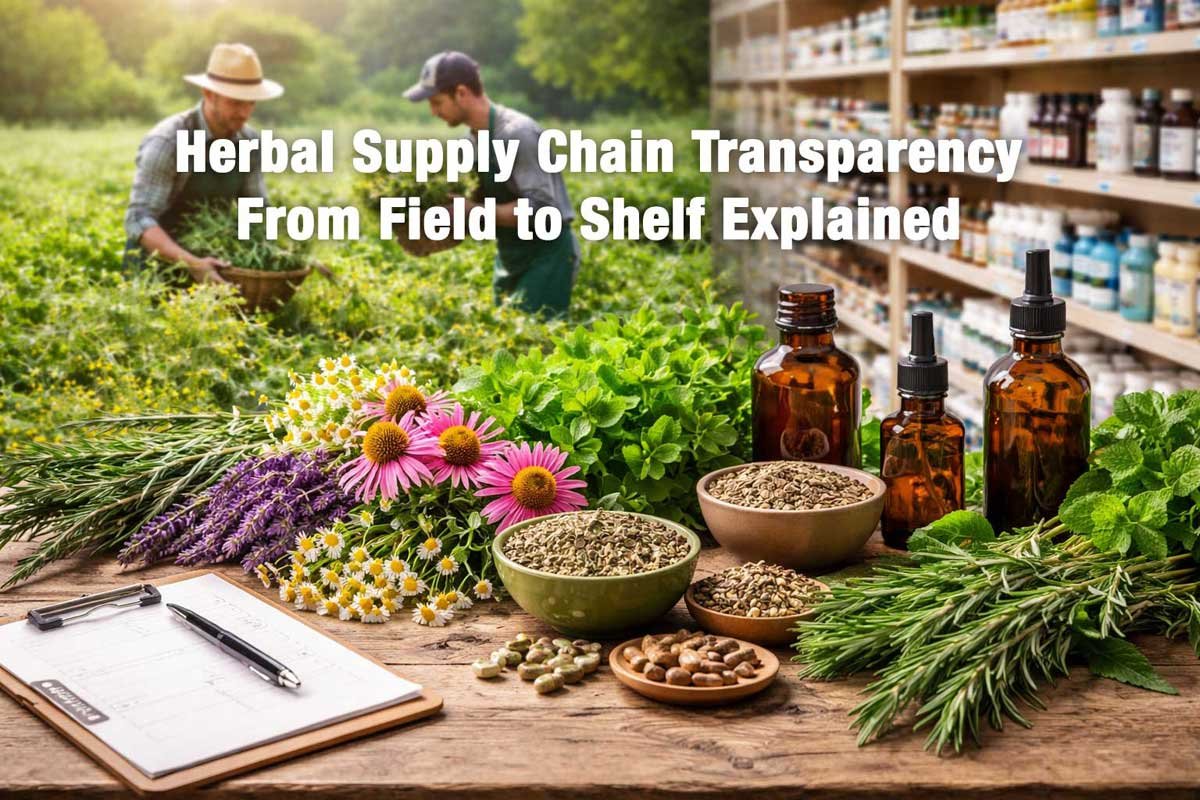
From Soil to Supplement Trust Begins at the Source
People love to talk about transparency once a product is already on a shelf. Labels, seals, QR codes, glossy claims. But the truth is quieter and a bit less glamorous. Trust in herbal products does not begin with paperwork or packaging. It begins in the dirt. Literally. The herbal supply chain starts long before a harvest crew steps into a field or a processor fires up a dryer. It starts with soil that has a history, water that carries a memory, and land that either supports integrity or quietly undermines it.
Spend enough time around growers and you learn quickly that soil is not just a growing medium. It is a record keeper. Years of agricultural inputs, nearby industry, traffic, and even wind patterns leave traces behind. Heavy metals do not announce themselves. Persistent pesticides do not fade politely when a new farmer switches to organic methods. They linger. This is why the herbal supply chain cannot be understood in snapshots. It is cumulative. Every decision made years earlier echoes forward into finished products.
Table of Contents

Organic farming often gets framed as a binary. Certified or not. That framing misses the reality on the ground. A field may meet organic standards today and still carry residues from conventional practices decades ago. Another plot may lack certification but sit in a remote, uncontaminated region managed carefully by growers who understand their land intimately. The herbal supply chain does not reward simplistic thinking. It demands context.

Location matters more than most people realize. Medicinal plants grown near highways, mining regions, or industrial zones face risks that no post harvest testing can fully undo. Plants are not passive. They absorb what surrounds them. Some species are especially good at pulling minerals from soil. That trait can be useful or problematic, depending on what those minerals are. In the herbal supply chain, plant biology intersects with geography in ways that marketing rarely explains.
Then there is water. Irrigation sources vary wildly across regions. Surface water can carry agricultural runoff. Groundwater can concentrate arsenic or other naturally occurring elements. Rainwater itself reflects airborne pollution. When growers talk about terroir, they are not being poetic. They are describing a set of environmental inputs that shape chemical profiles and safety long before harvest. The herbal supply chain records all of this, whether anyone documents it or not.
Timing adds another layer. Harvesting too early or too late affects more than potency. It influences moisture content, microbial risk, and stability during drying. A rushed harvest ahead of a storm can trap excess moisture in plant material. That moisture becomes a liability later. Mold does not need much encouragement. In the herbal supply chain, small shortcuts compound fast.
Handling at harvest is where experience shows. Clean tools. Clean containers. Separation of plant parts. Avoiding contact with bare ground. These practices sound obvious, yet they vary widely across regions and operations. In some parts of the world, medicinal plants are still gathered wild by families who have done it for generations. In others, harvest crews rotate between crops with little specialization. Both models can work. Both can fail. The herbal supply chain reflects the weakest moment, not the strongest intention.
Organic standards try to impose order on this complexity. They define prohibited inputs and outline best practices. They create a baseline. But standards cannot see everything. They rarely account for neighboring land use. They do not follow wind or water upstream. They cannot measure the judgment of a harvest crew or the attentiveness of a field manager. In the herbal supply chain, certification is a starting point, not a guarantee.
This is where transparency becomes either meaningful or hollow. Real transparency at the source means knowing more than the name of a farm. It means understanding land history. It means soil testing that looks beyond minimum requirements. It means acknowledging risks rather than hiding behind labels. The herbal supply chain rewards those who ask uncomfortable questions early, not those who hope problems can be filtered out later.
There is also a human layer that rarely gets discussed. Farmers make decisions under pressure. Weather windows close. Labor runs short. Buyers push for volume. Prices fluctuate. In that environment, quality competes with survival. Long term partners behave differently than transactional buyers. When growers know where their plants will end up and who will stand behind them, practices improve. Trust travels upstream in the herbal supply chain, not just downstream.
One grower once described soil to me as something you borrow, not own. That mindset changes behavior. You rotate crops. You rest fields. You avoid shortcuts that bring short term gains and long term damage. In the herbal supply chain, this philosophy shows up quietly in test results years later. Cleaner inputs. Fewer surprises. More consistency.
The opposite is also true. Fields pushed hard to meet demand show it eventually. Nutrient imbalances creep in. Pest pressure rises. Allowed organic treatments get overused. None of this violates standards on paper. All of it shapes outcomes. The herbal supply chain does not punish instantly. It accumulates consequences.
Transparency at the source also means admitting uncertainty. Soil changes. Climate patterns shift. What was safe five years ago may not be safe now. Responsible actors revisit assumptions. They retest. They adapt. They do not rely on a single snapshot frozen in time. In the herbal supply chain, static data creates false confidence.
Consumers often imagine a straight line from field to shelf. In reality, the herbal supply chain branches immediately. Plant material moves through dryers, storage facilities, and transport routes that add risk at every step. But the foundation remains the same. Weak inputs cannot be fixed downstream. Strong inputs forgive minor mistakes later. This is why experienced buyers obsess over origins. Not out of romance, but out of pragmatism.
Trust built at the source feels different. It is quieter. Less performative. There may be fewer logos and more conversations. Fewer promises and more records. The herbal supply chain becomes less about storytelling and more about continuity. Who grew this. Where. Under what conditions. For how long. With what checks along the way.
When those questions are answered honestly, everything else becomes easier. Processing decisions improve. Testing results make sense. Labels align with reality. Transparency stops being a selling point and becomes a habit. In the herbal supply chain, habits matter more than headlines.
At its core, soil teaches patience. You cannot rush regeneration. You cannot fake balance for long. The same is true for trust. It grows slowly, fed by consistency and attention. When people talk about transparency from field to shelf, this is what they are really pointing toward, whether they realize it or not. The herbal supply chain begins long before anyone thinks to look.
Growing It Right Where Quality Actually Starts
Soil, Location, and Environmental Load
If you want to understand why two batches of the same herb can behave completely differently, stop looking at the label and start looking at the ground it came from. Soil is not neutral. It is active, complex, and opinionated. In the herbal supply chain, soil sets the ceiling for quality long before anyone talks about extraction ratios or standardization.
Soil composition determines how plants access nutrients, but it also controls what else comes along for the ride. Heavy metals occur naturally in many regions. Cadmium, lead, and arsenic can sit quietly in soil for centuries. Add modern industry, traffic, or intensive agriculture, and those levels can climb without anyone noticing. Plants do not filter. They absorb. Some medicinal species are particularly efficient at pulling minerals from deep layers, which makes them valuable and risky at the same time. In the herbal supply chain, this biological efficiency becomes a liability when soil history is ignored.
Location amplifies these effects. A field downwind from a highway accumulates different residues than one surrounded by forest. Valleys trap airborne pollution. Flood plains collect runoff. Even altitude matters. Higher elevations often bring cleaner air but thinner soils and harsher weather. Each variable nudges plant chemistry in subtle ways. The herbal supply chain captures these differences whether documentation exists or not.
Environmental load is the sum of these pressures. Past land use. Current neighbors. Regional pollution. Climate stress. It is not a single factor you can test once and forget. It shifts over time. A drought concentrates contaminants. Heavy rain redistributes them. In the herbal supply chain, assuming stability is one of the easiest ways to get blindsided later.
Experienced growers pay attention to patterns, not just numbers. They notice when plants struggle in familiar fields. They watch changes in pest pressure. They observe shifts in aroma or color. These signals often appear before lab results change. That kind of awareness does not come from manuals. It comes from working the same land year after year. In the herbal supply chain, intuition built on observation often catches problems before paperwork does.
Organic Farming Practices Versus Paper Compliance
Organic certification is useful. It creates a baseline. It removes the most obvious synthetic inputs. But it does not equal quality by default, and it definitely does not equal transparency. In the herbal supply chain, organic status tells you what was avoided, not necessarily what was done well.
Paper compliance focuses on inputs and records. What fertilizers were used. Which treatments were applied. How often inspections occurred. These things matter, but they leave gaps. Organic rules allow certain substances that can still stress soil when overused. Copper based fungicides are a classic example. Allowed, effective, and damaging if relied on too heavily. On paper, everything looks clean. In the field, soil biology slowly degrades.
Real organic farming is more demanding than certification suggests. It requires crop rotation that fits the land, not the market. It requires resting fields even when demand spikes. It requires accepting lower yields some years. These choices do not show up on certificates. They show up later in consistency and safety. In the herbal supply chain, long term soil health often matters more than any single season’s output.
There is also a timing mismatch that rarely gets discussed. Land can be certified organic after a transition period, but ecological recovery does not follow a fixed schedule. Microbial communities rebuild slowly. Residues dissipate unevenly. A field may be legally organic and biologically fragile at the same time. The herbal supply chain tends to ignore this nuance, because nuance is inconvenient.
Some of the cleanest raw materials come from growers who treat organic standards as a floor, not a target. They test soil beyond minimum requirements. They track neighboring land use. They invest in buffer zones. They ask uncomfortable questions about water sources. These practices cost money and time. They rarely earn labels. In the herbal supply chain, this is where real quality quietly forms.
Paper compliance also struggles with scale. As demand grows, farms expand or consolidate. New fields get added quickly. Practices that worked on ten hectares strain at fifty. Oversight thins. Shortcuts appear. None of this requires bad intentions. It is structural. In the herbal supply chain, rapid growth is one of the most reliable predictors of future problems.
Transparency means acknowledging these pressures rather than pretending certification solves them. When organic becomes a marketing endpoint instead of a process, quality stalls. The herbal supply chain rewards those who keep asking whether their practices still match their principles, even as conditions change.
Harvest Timing and Handling Decisions
Harvest is where theory meets reality. Months of careful growing can be compromised in a few careless hours. In the herbal supply chain, harvest timing and handling decisions often separate dependable suppliers from chronic headaches.
Plants change daily as they mature. Active compounds rise and fall. Moisture content shifts. Structural fibers toughen. Harvest too early and you lose depth. Too late and you invite degradation. Weather complicates everything. A dry spell concentrates compounds but stresses plants. Rain plumps biomass but raises microbial risk. There is no perfect moment, only informed tradeoffs.
Skilled harvesters read plants, not calendars. They look at color, scent, texture. They know how a plant should feel when cut. This knowledge is difficult to standardize and easy to lose when labor turns over. In the herbal supply chain, this is one of the least visible and most critical skills.
Handling matters just as much. Clean cuts reduce tissue damage. Gentle collection limits bruising. Separation of plant parts prevents cross contamination. These steps sound basic, yet they are often rushed when volume pressures hit. Plant material piled too deep heats internally. Heat drives moisture migration. Moisture feeds microbes. The cascade is fast. By the time material reaches drying, the damage is already done.
Drying itself is not neutral. Temperature, airflow, and time interact. Too hot and volatile compounds vanish. Too slow and spoilage sets in. Sun drying works beautifully in some climates and fails spectacularly in others. Mechanical dryers add control and risk. In the herbal supply chain, drying is where regional tradition and modern engineering collide.
Transport immediately after harvest adds another layer. Delays matter. Compression matters. Exposure matters. A truck stuck overnight with fresh material can undo careful work. This is why proximity between field and first processing step is so important. Shorter distances mean fewer unknowns. In the herbal supply chain, logistics often decide outcomes more than intentions.
What stands out, after watching this process repeatedly, is how cumulative it is. No single decision ruins quality. It is the accumulation of small compromises. Slightly late harvest. Slightly wetter material. Slightly crowded containers. Each choice feels manageable. Together, they create variability that downstream testing struggles to interpret.
This is also where trust either forms or fractures. Suppliers who control their harvest and early handling tend to speak confidently about their material. They know its quirks. They expect certain results. Those who outsource or rush tend to lean heavily on certificates and assurances. In the herbal supply chain, certainty usually comes from proximity, not paperwork.
Growing it right is not romantic. It is repetitive, demanding, and occasionally frustrating. It requires patience when markets want speed. It requires humility when nature refuses to cooperate. But when done well, it creates a foundation that carries through every later step. In the herbal supply chain, quality does not start in a lab or a factory. It starts with decisions made quietly, in fields most people will never see.
What Happens After Harvest Is Where Things Get Murky
Drying, Storage, and Early Contamination Risks
The moment an herb leaves the field, the herbal supply chain enters its most fragile phase. Fresh plant material is biologically active, moisture-rich, and unstable. Everything that happens next either preserves that vitality or quietly erodes it. This is where good intentions meet logistical reality, and where quality often starts to slip without anyone noticing.
Drying is usually the first hurdle. It sounds simple. Remove moisture. Prevent spoilage. In practice, it is a balancing act that varies by species, climate, and scale. Too much heat drives off volatile compounds and alters chemical profiles. Too little airflow traps moisture deep inside plant tissue. On the surface, the material may feel dry. Inside, it remains a perfect environment for microbial growth. In the herbal supply chain, this hidden moisture is a common source of later surprises.
Traditional drying methods evolved for a reason. Sun drying works in arid regions with consistent airflow. Shade drying protects delicate leaves and flowers. Mechanical dryers offer speed and control but introduce new risks. Uneven loading, fluctuating temperatures, and rushed timelines can create hot spots and cold zones in the same batch. These inconsistencies rarely show up immediately. They reveal themselves later, during storage or testing, when degradation or contamination becomes harder to trace back to its origin.
Storage compounds these risks. Dried herbs are still hygroscopic. They absorb moisture from the air. Poorly sealed bags, humid warehouses, and temperature swings slowly undo careful drying. Insects find their way in. Rodents follow. Fumigation may solve one problem and introduce another. In the herbal supply chain, storage conditions often receive less scrutiny than cultivation, even though they can undo months of careful work.
Early contamination does not always mean something dramatic. It can be subtle. A gradual rise in microbial counts. A slow oxidation of sensitive compounds. A faint musty note that only experienced noses catch. These changes rarely trigger alarms until much later. By then, the trail has gone cold. The herbal supply chain remembers everything, but it does not label its memories clearly.
Brokers, Aggregators, and Lost Traceability
Once dried and bagged, herbs often enter a world most consumers never imagine. They move through brokers, aggregators, and trading hubs where efficiency matters more than intimacy with the source. This is where the herbal supply chain becomes opaque, not because anyone is hiding something, but because complexity dilutes clarity.
Brokers serve a function. They connect small producers to global markets. They balance supply and demand. They smooth seasonal fluctuations. But every handoff introduces distance. Information gets summarized. Context gets stripped away. A field becomes a region. A harvest becomes a lot number. In the herbal supply chain, this abstraction is where traceability starts to thin.
Aggregators take this a step further. They combine material from multiple farms, sometimes multiple regions, into larger commercial lots. This makes sense economically. It stabilizes pricing and availability. It also blurs origin. When material is mixed early, it becomes impossible to trace later issues back to a specific field or practice. The herbal supply chain trades precision for volume at this point, often without acknowledging the cost.
Documentation tries to keep up. Bills of lading. Certificates. Batch records. Each document captures a slice of reality, but rarely the whole picture. A broker may know the country of origin but not the exact field. An aggregator may know the species and grade but not the harvest conditions. By the time material reaches a manufacturer, traceability may exist on paper while practical insight has evaporated. The herbal supply chain still moves forward, but its memory has faded.
This is also where substitution and adulteration become easier, not always maliciously. When supply tightens, similar species get blended. Lower grades get upgraded on paper. Old stock gets refreshed by mixing with new. These practices thrive in environments where material is anonymous. In the herbal supply chain, anonymity is a risk factor.
Some companies try to counter this by shortening their supply chains. Fewer intermediaries. Direct relationships. Smaller lots. These approaches cost more and scale poorly. They also preserve context. When problems arise, they can be traced and corrected. In the herbal supply chain, accountability shrinks as distance grows.
Processing, Milling, and Batch Blending
Processing is where raw herbs begin to look uniform. Cutting, milling, sifting, and extracting transform diverse plant material into standardized inputs. This is necessary. It is also where individuality disappears. In the herbal supply chain, processing creates the illusion of consistency while hiding variability underneath.
Milling generates heat. Heat drives chemical change. Fine powders expose more surface area to oxygen. Oxygen accelerates oxidation. Each step seems minor. Together, they reshape the material. Well-run facilities manage these variables carefully. Poorly run ones prioritize throughput. The difference shows up later in stability and shelf life, not always in immediate test results.
Cross-contamination is another quiet risk. Shared equipment processes multiple species. Cleaning protocols vary. Residues linger. Allergens migrate. These issues rarely make headlines, but they matter. In the herbal supply chain, shared infrastructure ties unrelated products in invisible ways.
Batch blending deserves special attention. It is often used to achieve consistency. Strong batches get diluted. Weak ones get bolstered. From a manufacturing perspective, this makes sense. From a transparency perspective, it muddies the water. When multiple harvests, regions, or even years get blended, traceability collapses. A single batch number now represents a mosaic of origins. The herbal supply chain becomes a composite rather than a line.
Testing at this stage provides reassurance, but it has limits. A clean result tells you the blend meets specifications. It does not tell you why. It cannot reveal which component contributed what. When issues appear later, blends make root cause analysis nearly impossible. In the herbal supply chain, blending is both a solution and a blindfold.
What makes this phase particularly murky is that nothing here is inherently wrong. Drying, storage, brokering, processing, and blending are necessary. The problem arises when they are treated as neutral. They are not. Each step alters the material and erodes information unless deliberately managed.
The most transparent operations acknowledge this erosion. They design systems to slow it down. Smaller batches. Tighter controls. Better records. More frequent testing tied to specific lots rather than blended averages. These choices rarely make products cheaper. They make them more predictable. In the herbal supply chain, predictability is often the quiet marker of integrity.
By the time herbs leave this phase, they look stable and interchangeable. They are anything but. Their history is embedded in them, even if no one can fully read it anymore. This is why downstream transparency efforts struggle. Once context is lost, it cannot be reconstructed. The herbal supply chain does not forgive amnesia.
Labels, Paper Trails, and the Illusion of Transparency
Documentation That Matters Versus Noise
By the time herbs reach finished products, paperwork tends to multiply. Certificates, declarations, audits, summaries. On the surface, this looks like transparency. In reality, much of it is noise. In the herbal supply chain, documentation can either illuminate reality or bury it under layers of reassurance.
Some documents genuinely matter. A clear chain of custody that tracks material from the field through processing. Batch-specific records that show when and where material moved. Storage and handling logs tied to actual facilities. These create continuity. They allow questions to be answered without guesswork. When something goes wrong, they point backward with enough precision to be useful. In the herbal supply chain, continuity is everything.
Other documents exist mainly to satisfy expectations. Generic organic certificates that cover multiple crops and seasons. Supplier declarations that repeat what standards already require. Summaries that smooth over variability by averaging results. None of these are fraudulent. They are incomplete. They create confidence without clarity. In the herbal supply chain, confidence unsupported by detail is fragile.
One common mistake is treating documents as proof rather than prompts. A certificate should invite further questions. Where exactly was this grown? How many fields were involved? Were they contiguous or scattered? What was grown there previously? Who handled drying? Documentation that cannot answer these questions directly is not transparent, even if it is technically correct. The herbal supply chain rewards curiosity, not compliance alone.
Another issue is scale. As operations grow, documentation often becomes standardized. Templates replace narratives. Exceptions disappear. This makes systems efficient and removes texture. The herbal supply chain loses the small notes that once explained why a batch looked different or behaved oddly. Those notes rarely survive audits, yet they are often the most valuable information available.
True transparency does not mean sharing everything. It means sharing the right things. A smaller set of meaningful records beats a mountain of generic paperwork. In the herbal supply chain, signal matters more than volume.
Third-Party Testing and Its Blind Spots
Third-party testing has become the cornerstone of trust for many buyers. Independent labs. Objective numbers. Pass or fail results. This feels reassuring, and to a degree it is. Testing plays an essential role in the herbal supply chain. It also has limits that are rarely acknowledged.
Lab tests are snapshots. They measure what is present in a specific sample at a specific moment. They do not reveal how the material got there or what happened before. A clean result does not guarantee clean practices. A failed result does not explain the cause. In the herbal supply chain, tests answer narrow questions very well and broader questions not at all.
Sampling is the first blind spot. A test is only as representative as the sample taken. When batches are large or blended, a small sample can miss localized issues. Hot spots of contamination or degradation do not distribute evenly. In the herbal supply chain, sampling strategy matters as much as the test itself.
Test panels introduce another layer of limitation. Labs test for what they are asked to test for. If a compound is not on the panel, it remains invisible. Emerging contaminants, regional residues, and degradation products often fall outside standard screens. This is not negligence. It is practicality. No lab can test for everything. In the herbal supply chain, assuming completeness is a common and costly mistake.
Timing matters too. Testing finished material tells you what survived the journey, not what happened along the way. A contaminant present early may degrade or dilute below detection limits later. The absence of evidence becomes evidence of absence. In the herbal supply chain, this logic fails quietly.
There is also an interpretive gap. Results need context. A marginal microbial count might be acceptable in one format and risky in another. A heavy metal result may fall below regulatory limits but still indicate a trend worth investigating. Numbers without interpretation create false clarity. In the herbal supply chain, expertise sits between data points.
None of this makes testing unimportant. It makes it insufficient on its own. Testing works best when it confirms what is already understood about sourcing and handling. When it becomes the sole basis for trust, it is asked to do a job it was never designed to do. The herbal supply chain cannot be audited for integrity.
Building Real Transparency From Field to Shelf
Real transparency feels different from performative transparency. It is quieter and more demanding. It does not rely on a single proof. It builds layers of understanding that reinforce each other. In the herbal supply chain, this kind of transparency is built deliberately, not advertised loudly.
It starts with shorter distances. Fewer intermediaries. Smaller, well-defined lots. Direct communication between growers, processors, and manufacturers. These relationships preserve context. When a batch behaves unexpectedly, someone remembers why. That memory rarely exists in long, fragmented supply chains. The herbal supply chain benefits from proximity, even when it costs more.
Lot-level traceability is another cornerstone. Not regional level. Not annual averages. Actual lots are tied to specific harvests and handling conditions. This requires discipline. It complicates inventory. It reduces flexibility. It also creates accountability. In the herbal supply chain, accountability is the foundation of trust.
Transparency also depends on asking better questions. Not just whether material meets specifications, but how stable those specifications are over time. Not just whether a supplier passed an audit, but what changed since the last one. Not just whether testing was done, but why those tests were chosen. The herbal supply chain improves when questions evolve alongside conditions.
Technology helps, but it does not solve everything. Digital tracking systems can preserve records. They cannot create insight. Insight still comes from people who understand what the records mean. In the herbal supply chain, human judgment remains central, no matter how advanced systems become.
Perhaps the most overlooked aspect of transparency is honesty about limits. No supply chain is perfectly visible. Weather disrupts plans. Crops fail. Data gaps appear. Transparent operations admit this. They explain uncertainties instead of hiding them. In the herbal supply chain, admitting uncertainty often builds more trust than claiming perfection.
There is also a cultural element. When teams are encouraged to surface problems early, transparency improves. When they are punished for deviations, information gets buried. This dynamic shapes how data flows long before it reaches consumers. In the herbal supply chain, culture determines what gets recorded and what gets ignored.
Over time, real transparency creates a different relationship with quality. It shifts focus from catching failures to understanding systems. From reacting to test results to anticipating risks. From marketing claims to operational habits. The herbal supply chain becomes less about proving innocence and more about maintaining coherence.
Labels still matter. Tests still matter. Documents still matter. But they work best as parts of a larger picture. When treated as substitutes for understanding, they create an illusion of transparency that collapses under scrutiny. When treated as tools within a living system, they support decisions grounded in reality.
Those who work closely with the herbal supply chain eventually recognize a pattern. The most reliable products often come from the least flashy systems. Fewer claims. Fewer badges. More conversations. More notes. More continuity. Transparency, in its most useful form, is not something you point to. It is something you experience repeatedly, across seasons, without surprises.
Seeing the Herbal Supply Chain Clearly Changes Everything
Something shifts once you really see the herbal supply chain for what it is. Not a straight line. Not a checklist. Not a promise printed on a label. It becomes a living system made of land, people, habits, compromises, and memory. Once that picture clicks, it is hard to unsee, and almost impossible to go back to judging quality by surface signals alone.
Clarity changes expectations first. You stop expecting perfection and start looking for coherence. Does this material make sense given where it came from. Do the records align with the realities of climate, geography, and scale. Are the results consistent with the story being told. The herbal supply chain begins to feel less like a mystery to solve and more like a process to understand. That shift alone eliminates a surprising amount of confusion.
It also changes how risk is perceived. Instead of treating contamination or inconsistency as random events, they start to look like outcomes of accumulated decisions. A rushed harvest here. An overloaded dryer is there. A blended lot that erased its own history. In the herbal supply chain, most problems are not sudden failures. They are slow drifts. Seeing that drift early is one of the biggest advantages transparency offers.
There is a quiet confidence that comes from this perspective. Not the loud certainty of marketing claims, but a grounded sense of probability. When you understand how material was grown, handled, stored, and processed, test results stop being surprises. They become confirmations or warnings. The herbal supply chain starts speaking a language you can interpret instead of react to.
This clarity also exposes how misleading shortcuts can be. A clean certificate without context feels thinner. A single lab report without a history feels incomplete. Even organic claims take on a different weight. They are no longer endpoints. They are indicators that still need interpretation. The herbal supply chain rewards those who read between the lines without dismissing the lines themselves.
One of the most practical changes this brings is better decision-making under uncertainty. Not every question has a clean answer. Weather disrupts plans. Crops vary. Markets push. When you see the herbal supply chain clearly, uncertainty stops being paralyzing. You know which unknowns matter and which are noise. You know where flexibility is safe and where it is risky. That discernment is hard-won and incredibly valuable.
Transparency also reshapes relationships. Conversations become more specific. Instead of asking whether something is certified or tested, the questions deepen. How was this handled when the humidity spiked? What changed after last season? Which fields fed into this lot? These are not interrogations. They are signs of engagement. In the herbal supply chain, better questions tend to produce better behavior over time.
There is an emotional component too, though it rarely gets acknowledged. When people understand the full arc of the herbal supply chain, respect grows. Respect for growers working within ecological limits. Respect for processors managing tradeoffs. Respect for the fact that quality is maintained through attention, not declarations. That respect changes tone. It reduces cynicism without inviting naivety.
Seeing clearly also reveals why some systems feel perpetually stressed. Long chains with many handoffs accumulate fragility. Information thins. Accountability diffuses. When something goes wrong, everyone has partial answers and no ownership. In contrast, a tighter herbal supply chain structures feel calmer, even when problems arise. Issues surface earlier. Corrections happen faster. Stress dissipates instead of compounding.
This perspective has a way of simplifying things. Not by removing complexity, but by organizing it. Instead of tracking dozens of disconnected signals, you start watching a few critical ones. Origin stability. Handling discipline. Lot integrity. Feedback loops between testing and sourcing. The herbal supply chain becomes legible, even when it remains complex.
It also reframes what improvement looks like. Progress is not always adding more checks. Sometimes it is removing steps that dilute accountability. Sometimes it is slowing down. Sometimes it is choosing smaller batches over higher margins. In the herbal supply chain, improvement often looks boring from the outside. Internally, it feels like relief.
Perhaps the most important change is psychological. Once transparency becomes real rather than performative, fear recedes. Fear drives overtesting, overclaiming, and defensive documentation. Clarity replaces fear with responsibility. You still care deeply about safety and quality, but the energy shifts from proving innocence to maintaining integrity. The herbal supply chain responds well to that shift.
There is a tendency to think that more information automatically creates better outcomes. In practice, better framing matters more. Seeing the herbal supply chain clearly means understanding which information connects decisions across time. It means valuing continuity over snapshots. It means accepting that trust is built through repetition, not revelation.
Over time, this way of seeing becomes instinctive. You notice inconsistencies faster. You sense when a story does not quite fit. You also recognize when things are simply working as they should. Quietly. Reliably. Without drama. In the herbal supply chain, that quiet reliability is the real signal of success.
This clarity does not eliminate problems. It makes them manageable. It does not guarantee quality. It makes quality reproducible. And perhaps most importantly, it restores a sense of proportion. Not every deviation is a failure. Not every clean result is a victory. The herbal supply chain exists in the real world, shaped by nature and human behavior. Seeing it clearly allows you to work with that reality instead of arguing against it.
Once that perspective settles in, transparency stops being a buzzword. It becomes a habit of attention. A way of noticing patterns. A commitment to continuity. And from that place, decisions tend to improve naturally. Not because rules demand it, but because understanding makes anything else feel unnecessary.
Best-selling Organic Products




Article Sources
At AncientHerbsWisdom, our content relies on reputable sources, including peer-reviewed studies, to substantiate the information presented in our articles. Our primary objective is to ensure our content is thoroughly fact-checked, maintaining a commitment to accuracy, reliability, and trustworthiness.
- World Health Organization. (2007). WHO guidelines on good agricultural and collection practices (GACP) for medicinal plants. https://apps.who.int/iris/handle/10665/43665
- World Health Organization. (2019). WHO global report on traditional and complementary medicine 2019. https://www.who.int/publications/i/item/9789241515436
- European Medicines Agency. (2018). Guideline on quality of herbal medicinal products. https://www.ema.europa.eu/en/documents/scientific-guideline/guideline-quality-herbal-medicinal-products_en.pdf
- Booker, A., Johnston, D., Heinrich, M. (2012). Value chains of herbal medicines—Research needs and key challenges in the context of ethnopharmacology. Journal of Ethnopharmacology, 140(3), 624–633. https://doi.org/10.1016/j.jep.2012.01.039
- Ichim, M. C. (2019). The DNA-based authentication of commercial herbal products reveals their globally widespread adulteration. Frontiers in Pharmacology, 10, 1227. https://doi.org/10.3389/fphar.2019.01227
- Sahoo, N., & Manchikanti, P. (2013). Herbal drug regulation and commercialization: An Indian industry perspective. Journal of Alternative and Complementary Medicine, 19(12), 957–963. https://doi.org/10.1089/acm.2012.0275
- de Boer, H. J., Ichim, M. C., & Newmaster, S. G. (2015). DNA barcoding and pharmacovigilance of herbal medicines. Drug Safety, 38(7), 611–620. https://doi.org/10.1007/s40264-015-0306-8
- van der Valk, J., et al. (2017). Risk assessment of contaminants and residues in herbal medicines. Regulatory Toxicology and Pharmacology, 85, 198–206. https://doi.org/10.1016/j.yrtph.2017.02.006
- Heinrich, M., Barnes, J., Gibbons, S., & Williamson, E. M. (2018). Fundamentals of pharmacognosy and phytotherapy (3rd ed.). Elsevier.
- Upton, R., Graff, A., Jolliffe, G., Länger, R., & Williamson, E. (2011). Botanical pharmacognosy—Microscopic characterization of botanical medicines. CRC Press.

- Phosphatidic Acid: Supporting Muscle Growth and Strength - July 31, 2026
- Ceramides: Supporting Healthy Skin From Within - July 31, 2026
- Synbiotics: Combining Prebiotics and Probiotics Together - July 31, 2026