
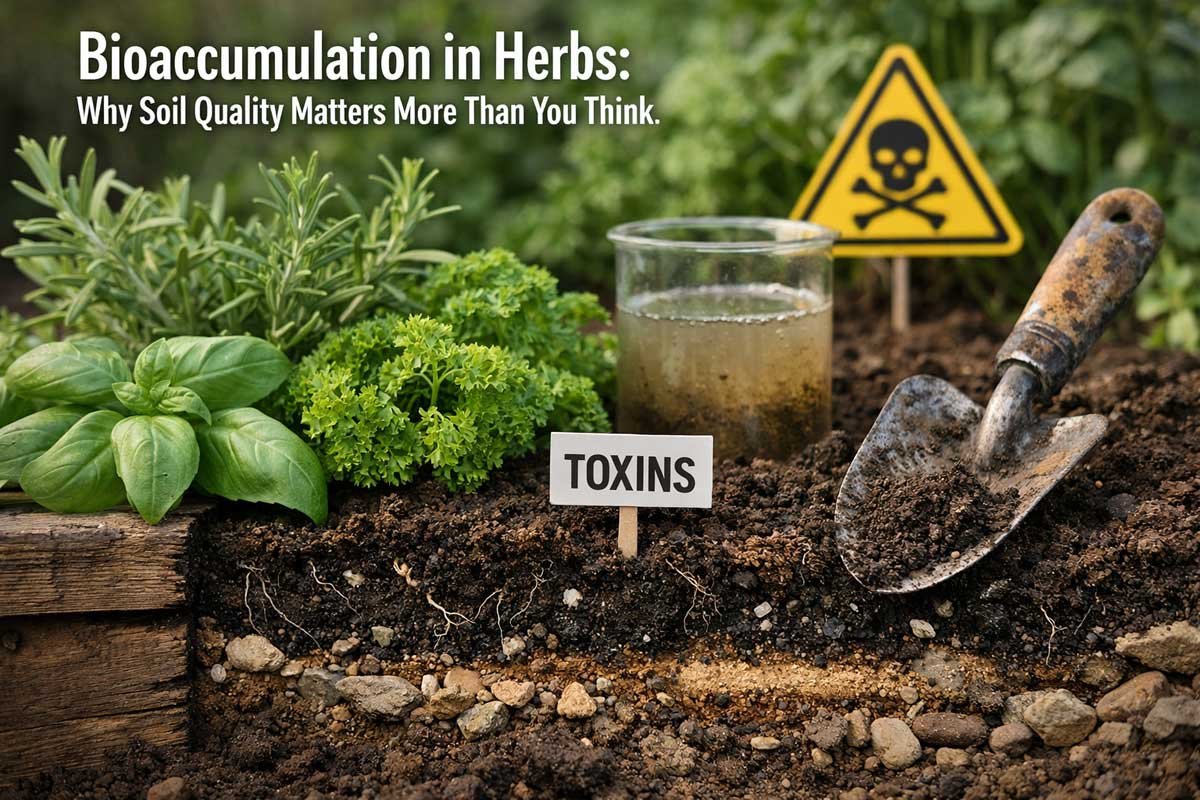
When the Ground Beneath Herbs Tells a Hidden Story
Most conversations about herbs start at the surface. Labels. Certifications. Farming practices. Organic versus conventional. It all feels logical. What goes into the plant determines what comes out of it. But after years of looking closely at how herbs actually grow, dry, store, and travel, it becomes obvious that the real story often starts much deeper. Literally beneath your feet.
Soil is not just a growing medium. It is a memory. It holds decades of chemical decisions, industrial shortcuts, atmospheric fallout, and agricultural habits. Herbs do not interact with soil passively. They read it. They respond to it. They pull from it, slowly and persistently. That is where bioaccumulation quietly enters the picture, usually long before anyone thinks to look for it.
Table of Contents

Bioaccumulation sounds technical, almost abstract. In practice, it is intimate. It is the reason two batches of the same herb can behave very differently. One smells alive and vibrant. The other looks fine but carries a dull heaviness that shows up later in lab reports. The difference is rarely visible. It is written in the soil chemistry, the mineral balance, and the contaminants that have nowhere else to go.
Herbs are particularly honest plants. Many are perennial. Many develop deep or wide root systems. Many grow slowly, taking their time to absorb what the soil offers. This makes them resilient. It also makes them vulnerable. Bioaccumulation does not require dramatic pollution. It thrives in subtlety. Trace amounts. Residues from decades ago. Heavy metals that do not break down and do not politely disappear when a farm switches to organic practices.
This is where expectations often collide with reality. Organic farming improves many things. It reduces exposure to certain synthetic chemicals. It protects soil life. It changes how plants are treated above ground. But organic does not mean the soil is clean. Soil quality is inherited, not reset. Bioaccumulation does not care about intent. It responds to availability.
Imagine a field that was once near a busy road. Decades of leaded gasoline emissions settled into the soil. Or land that previously supported intensive conventional farming, where phosphate fertilizers introduced cadmium as a contaminant. Or soil downwind from industrial activity, where airborne particles slowly accumulated year after year. None of this violates organic standards today. Yet herbs grown there will interact with that history through bioaccumulation.
What makes this uncomfortable is how invisible it all feels. You cannot taste cadmium. You cannot smell arsenic. A plant can look vibrant and still reflect poor soil quality at the molecular level. Bioaccumulation works patiently. It concentrates what is available, especially when plants are harvested repeatedly or left in the same soil year after year.
This is one reason herbs deserve more scrutiny than leafy vegetables. Lettuce grows fast and shallow. Herbs like burdock, dandelion, astragalus, or licorice stay longer. They dig deeper. They are often valued specifically for the parts most involved in uptake and storage. Roots, rhizomes, bark. These tissues do not just transport minerals. They hold onto them.
There is also a psychological gap that makes this topic harder to grasp. We like clean narratives. Organic equals safe. Soil equals nature. Nature equals benign. Bioaccumulation disrupts that comfort. It reminds us that natural systems absorb everything, not just what we approve of. Soil does not filter morality. It filters chemistry.
Even well meaning producers can miss this. Soil testing is expensive. It is rarely required. Many tests focus on nutrients, not contaminants. Some only measure what is immediately bioavailable, ignoring what may become available over time. Bioaccumulation operates on a longer timeline than most certifications are designed to observe.
Then there is geography. Soil quality varies wildly, even within short distances. Two neighboring farms can have entirely different contamination profiles based on water flow, historical land use, or subtle differences in soil composition. This is why broad statements about countries or regions fall apart under scrutiny. Bioaccumulation is local. It reflects specific ground, not general reputation.
What complicates matters further is that not all herbs accumulate in the same way. Some species are known accumulators. Others are more selective. Soil pH, microbial activity, and mineral competition all influence what a plant absorbs. Acidic soils can increase the uptake of certain metals. Low organic matter can make contaminants more available. Healthy microbial populations can sometimes immobilize them. Sometimes.
None of this is theoretical. It appears in testing data repeatedly. Herbs that meet every visual and aromatic expectation but fail quietly on heavy metal thresholds. Herbs grown organically yet reflecting soil contamination from long before organic standards existed. Herbs sourced from pristine looking landscapes that still carry the fingerprint of industrial history through bioaccumulation.
This is not a call to panic. It is a call to precision. Understanding bioaccumulation changes how you read labels. It shifts attention from surface level claims to deeper questions about soil quality, testing transparency, and sourcing decisions. It encourages curiosity instead of blind trust.
If there is one thing experience teaches, it is that a single factor rarely determines safety and quality. Bioaccumulation is slow. Soil quality is complex. Herbs sit at the intersection of both. Ignoring that intersection does not make it disappear. It just makes it easier to overlook.
Once you start paying attention to the ground beneath herbs, you cannot unsee it. The story stops being about whether something is organic and starts being about where it comes from, what the soil remembers, and how plants translate that memory into matter. That is where the real conversation begins.
Bioaccumulation Explained Without the Lab Coat
What Bioaccumulation Really Means in Plants
Bioaccumulation sounds like something that belongs in a white paper, not in a conversation about everyday herbs. Strip away the jargon and it becomes easier to grasp. Bioaccumulation is simply the process by which a plant absorbs substances from its environment and stores them faster than it can eliminate them. Over time, those substances build up inside plant tissues.
Plants do not have a detox system. They do not flush unwanted compounds the way animals do. If something enters through the roots and is not metabolized or locked away harmlessly, it stays. That is the core idea behind bioaccumulation.
In soil, substances exist in different forms. Some are tightly bound to minerals. Others float freely in soil water. Plants absorb what is available to them through normal nutrient uptake pathways. Calcium, magnesium, iron, and zinc move through the same channels as lead, cadmium, or arsenic when the chemistry allows it. Bioaccumulation happens when those unwanted elements hitch a ride.
This is not an abnormal failure of plant biology. It is how plants survive. Roots evolved to extract scarce resources from complex environments. They respond to gradients, not labels. If a metal ion fits the transport mechanism, it can move inward. Bioaccumulation is a side effect of efficiency.
What often gets missed is that bioaccumulation is not linear or predictable in a simple way. Two soils with the same total lead content can produce very different results. Soil pH, organic matter, microbial activity, and mineral competition all affect how much of a substance becomes bioavailable. Bioaccumulation reflects what the plant can access, not what exists on paper.
Once inside the plant, distribution matters. Some compounds stay in the roots. Others move upward into stems, leaves, flowers, or seeds. Herbs harvested for aerial parts show different bioaccumulation patterns than those harvested for roots or bark. This distinction matters more than most people realize.
Time is the quiet amplifier. Bioaccumulation increases with repeated growth cycles. A perennial herb grown in the same soil year after year has more opportunity to concentrate what the soil offers. Annual crops often escape this effect simply because they do not stay long enough.
Why Herbs Are Especially Vulnerable
Herbs are not just small vegetables with better marketing. They behave differently, and that difference makes them more susceptible to bioaccumulation.
Many medicinal and aromatic herbs grow slowly. Slow growth means longer exposure. A plant that takes three or four years to reach harvest size interacts with the soil far longer than a fast growing leafy green. That extended relationship allows bioaccumulation to compound quietly.
Root architecture plays a role. Herbs prized for resilience often develop deep or expansive root systems. Think of burdock, dandelion, licorice, or astragalus. These roots explore soil layers that shallow crops never touch. Deeper soil is not automatically cleaner. In some cases, it holds older contamination that has migrated downward over time.
Herbs are also chemically active plants. They produce secondary metabolites that help them survive stress. Alkaloids, flavonoids, terpenes. These compounds can bind metals or influence how substances move within the plant. Sometimes this increases accumulation rather than limiting it. The very complexity that makes herbs interesting can also make bioaccumulation more pronounced.
Harvest practices add another layer. Many herbs are cut multiple times from the same plant. Each regrowth cycle draws again from the same soil reservoir. Bioaccumulation does not reset between harvests. It continues as long as uptake continues.
Then there is the part no one likes to talk about. Medicinal herbs are often consumed in concentrated forms. Teas, tinctures, powders, extracts. Concentration magnifies whatever is present. A trace level in raw plant material can become more relevant once water or alcohol pulls compounds into solution. Bioaccumulation at the plant level becomes exposure at the human level, even without dramatic numbers.
Organic farming does not eliminate this vulnerability. Organic standards regulate inputs. They do not guarantee soil quality. An herb can be grown organically and still reflect bioaccumulation from legacy contamination. This is not a flaw in organic farming. It is a limitation of what certification can realistically control.
There is also selection bias in sourcing. Herbs are often grown in marginal lands where food crops struggle. Mountain regions. Dry soils. Areas with limited infrastructure. These environments can be pristine, but they can also hide geological sources of metals or historical contamination that never made headlines. Bioaccumulation does not care whether contamination comes from industry or bedrock.
The Difference Between Exposure and Accumulation
One of the most common misunderstandings is treating exposure and accumulation as the same thing. They are related, but they are not interchangeable.
Exposure is contact. A plant is exposed to a substance when it is present in soil, water, or air. Accumulation happens only when that substance enters the plant and stays there. Bioaccumulation is exposure that did not leave.
This distinction matters because exposure can be temporary. Rain can wash surface residues away. Soil chemistry can change. A contaminant can be present but unavailable. Accumulation reflects the end result of all those variables interacting over time.
Testing often captures exposure, not bioaccumulation. Soil tests measure total content or short term availability. They do not always predict what a plant will actually store. Plant testing provides a snapshot, but even that snapshot depends on harvest timing, plant age, and which part is tested.
This is why two batches from the same field can differ. One harvest may show acceptable levels. Another, taken later or from older plants, may reflect higher bioaccumulation. Nothing changed in the soil. Time did the work.
Bioaccumulation also differs from contamination events. A spill, drift, or improper handling introduces a clear source. Accumulation is quieter. It builds from low level, chronic presence. No single moment stands out. That makes it harder to notice and easier to dismiss.
Understanding this difference changes expectations. It explains why clean soil today does not guarantee clean herbs tomorrow. It also explains why long term relationships with land matter more than one season practices.
Bioaccumulation is not dramatic. It does not announce itself. It rewards patience, both in how it develops and in how it must be understood. When people look for simple answers, they miss it. When they look for patterns over time, it becomes obvious.
Once you grasp the difference between exposure and accumulation, many contradictions start to make sense. Why organic herbs sometimes test poorly. Why visual quality means little. Why soil quality is not a background detail but a central character.
Bioaccumulation is not a defect of herbs. It is a reflection of how deeply they are connected to their environment. The more you respect that connection, the more clearly you see both the value and the risk woven into every plant.
Soil Quality as the Silent Driver of Risk
Heavy Metals and Persistent Soil Contaminants
Soil has a long memory, and heavy metals are some of its most stubborn recollections. Unlike many synthetic chemicals, metals do not degrade. They do not evaporate. They do not politely exit when farming practices improve. Once they enter the soil, they tend to stay, sometimes for centuries, quietly participating in bioaccumulation whenever conditions allow.
Lead, cadmium, arsenic, and mercury are the usual names that surface, but the real issue is persistence, not notoriety. These elements enter soil through multiple pathways. Historical pesticide use. Phosphate fertilizers contaminated at the source. Industrial emissions carried by wind. Traffic pollution from decades of leaded fuel. Irrigation with contaminated water. Even natural geological deposits can contribute. Bioaccumulation does not discriminate between human made and naturally occurring sources. Availability is what matters.
What makes heavy metals particularly problematic is their ability to masquerade as nutrients. Cadmium can follow zinc pathways. Lead can mimic calcium under certain conditions. Roots do not recognize intent. They respond to chemical similarity. Once absorbed, these metals often bind tightly to plant tissues. They accumulate slowly, often without visible stress symptoms.
This creates a false sense of security. Plants can look healthy while quietly concentrating contaminants. In herbs, this is especially relevant because many are stress tolerant by nature. They evolved to survive poor soils, drought, and mineral imbalances. Resilience masks accumulation.
Persistent organic pollutants add another layer. While many modern organic standards restrict their use, residues from older chemicals can linger in soil long after application stopped. Some bind to organic matter and release slowly over time. Others become more available as soil conditions shift. Bioaccumulation reflects these dynamics, not the calendar date of the last application.
The uncomfortable truth is that soil contamination often has nothing to do with the current farmer’s choices. It is inherited. A field may meet every modern standard and still carry a chemical legacy that plants continue to access. Bioaccumulation is how that legacy expresses itself in living matter.
Organic Farming Does Not Reset the Soil
Organic farming changes how soil is treated going forward. It does not erase what happened before. This distinction is critical and often misunderstood.
Certification focuses on inputs and practices. What fertilizers are allowed. Which pest controls are prohibited. How crops are rotated. These rules matter. They improve soil structure. They protect microbial life. They reduce new contamination. But they do not guarantee soil quality in the sense most people assume.
There is no universal requirement for comprehensive contaminant screening before land becomes certified organic. Transition periods exist, but they are designed to allow prohibited substances to dissipate, not to remove persistent elements. Heavy metals do not dissipate. They redistribute.
Bioaccumulation exposes this gap. An herb grown organically can still accumulate cadmium if the soil contains it. The plant does not care that the compost is certified. It responds to chemistry, not certification language.
This creates tension between expectation and reality. Consumers expect organic to mean clean. Producers expect compliance to equal safety. Bioaccumulation quietly ignores both expectations. It operates on a different set of rules.
Land history matters more than current labels. Fields near former industrial sites. Orchards that once relied on arsenic based pesticides. Areas with long term fertilizer use. Even remote land can surprise, especially where geology contributes naturally high metal content. Organic practices can improve soil health while leaving contamination untouched.
There is also a timing issue. Improvements in soil biology can sometimes increase short term availability of contaminants. As organic matter breaks down and microbial activity increases, bound metals can become temporarily more mobile. This does not mean organic farming causes contamination. It means bioaccumulation responds dynamically to changing soil conditions.
The idea that organic farming resets soil creates complacency. It discourages testing. It shifts responsibility onto labels instead of evidence. Bioaccumulation thrives in that gap, unnoticed until someone bothers to look closely.
Recognizing this limitation does not undermine organic agriculture. It strengthens it. Honest assessment of soil quality allows organic practices to deliver on their promise without relying on assumptions that biology does not support.
Microbial Life, pH, and Mineral Availability
Soil is alive, and that life shapes bioaccumulation more than most people realize. Microbes influence what plants can access by altering chemical forms, binding contaminants, and changing the physical structure of the soil itself.
pH is one of the most powerful drivers. In acidic soils, many metals become more soluble. Cadmium, lead, and aluminum are more mobile at lower pH. As acidity increases, bioaccumulation risk often increases with it. Herbs grown in acidic soils may accumulate more even if total soil content is moderate.
Alkaline soils behave differently. Some metals precipitate and become less available. Others, like arsenic under certain conditions, can remain mobile. pH does not eliminate risk. It redistributes it.
Microbial life adds complexity. Bacteria and fungi can immobilize metals by binding them into stable compounds. Mycorrhizal fungi can sometimes protect plants by regulating uptake. In other cases, microbial processes increase availability by converting elements into more soluble forms. Bioaccumulation reflects the net result of these competing processes.
Organic matter acts as both a buffer and a reservoir. It can bind contaminants and reduce immediate uptake. Over time, as organic matter decomposes, those same contaminants can be released. This slow cycling is one reason bioaccumulation unfolds gradually rather than dramatically.
Mineral balance also matters. When essential nutrients are deficient, plants may increase uptake activity, inadvertently pulling in unwanted elements. A zinc deficient soil can encourage cadmium uptake. A calcium imbalance can affect lead absorption. Bioaccumulation often increases in stressed systems, not because contamination increased, but because plant behavior changed.
Water dynamics tie everything together. Poor drainage can concentrate contaminants. Flooding can redistribute them. Irrigation water can introduce new inputs. Dry periods can increase concentration in soil solution. Bioaccumulation responds to these fluctuations quietly, season after season.
What emerges from all this is a simple but uncomfortable insight. Soil quality is not a static attribute. It is a moving system. Bioaccumulation is the plant’s record of how that system behaves over time.
When soil is treated as a background detail, risk is misunderstood. When soil is seen as an active participant, patterns start to make sense. Herbs reflect the ground they grow in with remarkable fidelity. Bioaccumulation is not an anomaly. It is the soil speaking through the plant.
Ignoring that voice does not silence it. It just ensures the message arrives later, often in ways no one was prepared to hear.
Organic Herbs, Perceived Safety, and the Real Tradeoffs
When Organic Helps and When It Does Not
Organic farming carries clear benefits. It restricts synthetic pesticides, limits certain chemical fertilizers, and encourages practices that nurture soil biology. For consumers, the appeal is obvious: fewer artificial inputs, a connection to traditional practices, and the perception of cleaner, safer herbs. In many cases, these benefits are real. Organic methods can reduce acute exposure to certain contaminants and improve general soil health, which in turn supports plant vitality and resilience.
However, the story is more nuanced when it comes to bioaccumulation. Organic certification primarily governs inputs—it does not guarantee the absence of historical or naturally occurring contaminants in the soil. A herb can be certified organic yet still reflect decades of metal deposition, prior industrial use, or even naturally high concentrations of elements like arsenic or lead in the local geology. Bioaccumulation does not recognize compliance; it responds to chemistry and availability.
This creates a subtle tradeoff. Organic practices can limit new sources of contamination and promote sustainable growth, but they cannot erase what is already in the soil. Herbs that accumulate metals or other persistent substances will do so regardless of whether synthetic pesticides were used in the last season. Consumers may assume that “organic” automatically equals “safe from heavy metals or environmental residues,” but reality is rarely that simple. Safety and potency are influenced by the legacy of the land as much as current practices.
Organic farming does provide indirect benefits, though. Improved soil structure, higher organic matter, and richer microbial communities can buffer plant uptake in some cases. Certain contaminants may bind more tightly to organic matter, reducing immediate bioavailability. Still, these effects are context-specific and cannot be generalized across all herb types, soil conditions, or geographic regions. Organic practices are a helpful tool, but not a foolproof shield.
Geographic Origin and Soil Variability
One of the biggest determinants of herb quality and safety is geographic origin. Soil composition varies dramatically from region to region, even within small distances. Two farms growing the same herb under identical organic practices can produce materially different outcomes simply because their soils differ in pH, mineral balance, contamination history, and microbial life. Bioaccumulation patterns reflect these local conditions more than national labels or organic certification.
Industrial history, agricultural legacy, and natural geology all intersect to define what a soil can contribute to a plant. Mountain regions may have naturally high levels of certain metals in bedrock. Former farmland may carry residues of decades-old pesticides or fertilizers. Rivers and irrigation sources can deposit additional minerals and trace contaminants. Even neighboring plots can show significant variability. Bioaccumulation translates these localized characteristics directly into the plant’s tissues.
This explains why herb sourcing cannot rely solely on certifications or marketing claims. “Certified organic” or “wildcrafted” does not automatically indicate low contamination risk. Understanding the local soil, water, and environmental history provides a more reliable indicator of potential bioaccumulation than labels alone. In some cases, organically grown herbs from one region may contain higher concentrations of certain metals than conventional herbs grown elsewhere, simply due to underlying soil conditions.
Seasonal variability also plays a role. Soil chemistry changes over time with rainfall, temperature shifts, and crop rotation practices. A region known for relatively clean soils may still produce herbs that accumulate contaminants if weather or water flow concentrates metals in certain plots. Geography, then, is not just about country or state—it is about the specific microenvironment in which the plant grows.
Practical Signals of Higher or Lower Risk
While it is impossible to determine bioaccumulation by sight or smell alone, there are practical steps that can help gauge relative risk. Transparency in sourcing is one of the most reliable indicators. Producers who share soil test results, detail their water sources, and provide third-party analyses allow consumers to make informed decisions. Herbs from farms that test both soil and plants regularly tend to offer lower uncertainty.
Crop selection also matters. Certain herbs are known accumulators of metals due to root architecture or metabolic tendencies. Roots and rhizomes often concentrate heavy metals more than leaves or flowers. Consumers using concentrated extracts should pay particular attention, as processing amplifies whatever is present. Awareness of which herbs are more prone to accumulation allows for better risk management.
Soil amendments and cultivation practices can signal quality as well. Farms that actively monitor pH, manage organic matter, and encourage healthy microbial populations are generally reducing bioavailability of unwanted elements, even if they cannot eliminate them. Practices such as crop rotation, cover cropping, and careful water management further support long-term soil health, which in turn can influence bioaccumulation outcomes.
Finally, regional familiarity helps. Knowing the history of the land—whether it has been industrial, heavily farmed conventionally, or naturally enriched with minerals—provides a context that labels alone cannot convey. While this information is rarely highlighted on packaging, it can be uncovered through research, certifications, and producer communications.
In short, the practical approach is multi-layered: combine knowledge of plant type, plant part, cultivation practices, and geographic history. Organic certification helps guide choices but does not provide a full picture. True awareness comes from seeing the soil, understanding its story, and interpreting how that story manifests in the plants we consume. Bioaccumulation is subtle, persistent, and location-dependent—it rewards curiosity and careful sourcing over assumptions or simplistic rules of thumb.
What Soil Awareness Changes in Real Life
Soil awareness transforms how we think about herbs in ways that go beyond labels, certifications, or marketing claims. When you start paying attention to the ground beneath plants, the entire approach to sourcing, evaluating, and using herbs shifts from assumption to informed decision-making.
First, it changes expectations. Organic no longer automatically equals “clean” or “potent.” Instead, organic becomes one piece of a larger puzzle. Knowing the history and composition of the soil puts bioaccumulation into perspective. A field might be certified organic, but legacy contamination could still influence the plants. Conversely, conventional land with minimal industrial exposure might yield herbs with lower heavy metal content. Awareness of soil quality encourages nuanced thinking rather than blanket assumptions.
Second, soil awareness guides sourcing decisions. Consumers and producers alike can prioritize farms with transparent soil management practices. Farms that perform regular soil testing, document water sources, and rotate crops thoughtfully are more likely to produce herbs with predictable bioaccumulation profiles. Geographic knowledge also matters—regions with naturally lower contamination, or farms with long-standing stewardship of the land, become more attractive options. In practice, this means asking questions, seeking data, and reading beyond the label.
Third, it affects consumption habits. Understanding which plant parts tend to accumulate more metals—roots versus leaves or flowers—can influence which herbs are used for teas, tinctures, or powders. Awareness of bioaccumulation patterns allows for more thoughtful use of concentrated products, where even small traces in raw plant material may be amplified. It also helps people make sense of variability between batches: one harvest may test cleaner than another simply due to soil and growth cycle differences.
Fourth, soil literacy promotes better storage and handling practices. Healthy soil produces healthier, more resilient plants, which in turn store longer and retain potency better. Herbs grown in rich, well-managed soils tend to be less stressed, contain more balanced nutrient profiles, and are less likely to harbor excess concentrations of harmful substances. This knowledge can shape expectations around shelf life, storage conditions, and even drying techniques, aligning everyday handling with the biology of the plant.
Finally, it encourages a long-term perspective. Bioaccumulation is a slow, subtle process, often invisible until testing reveals it. By recognizing the importance of soil quality, both producers and consumers can adopt habits that mitigate long-term risk: careful site selection, rotation of cultivated areas, avoiding over-harvesting, and monitoring environmental conditions. Awareness does not eliminate bioaccumulation entirely, but it equips people to make informed, evidence-based choices that reduce uncertainty and enhance confidence in the herbs they use.
In real life, soil awareness turns abstract science into actionable insight. It transforms herb selection from a guessing game into a process informed by geography, history, and biology. It shifts focus from labels to lived environmental conditions. Most importantly, it nurtures a more realistic and practical understanding of safety, potency, and the subtle ways that plants interact with their environment. Understanding the soil is not a one-time exercise—it is a mindset that shapes every decision about cultivation, sourcing, and consumption, quietly steering outcomes toward better quality and more predictable results.
Best-selling Organic Products





Article Sources
At AncientHerbsWisdom, our content relies on reputable sources, including peer-reviewed studies, to substantiate the information presented in our articles. Our primary objective is to ensure our content is thoroughly fact-checked, maintaining a commitment to accuracy, reliability, and trustworthiness.
- Alloway, B. J. (2013). Heavy metals in soils: Trace metals and metalloids in soils and their bioavailability. Springer Science and Business Media. https://doi.org/10.1007/978-94-007-4470-7
- European Food Safety Authority. (2012). Cadmium dietary exposure in the European population. EFSA Journal, 10(1), 2551. https://doi.org/10.2903/j.efsa.2012.2551
- World Health Organization. (2007). Evaluation of certain food additives and contaminants: Sixty seventh report of the Joint FAO WHO Expert Committee on Food Additives. https://apps.who.int/iris/handle/10665/43870
- Zhao, F. J., Ma, Y., Zhu, Y. G., Tang, Z., & McGrath, S. P. (2015). Soil contamination in China: Current status and mitigation strategies. Environmental Science and Technology, 49(2), 750–759. https://doi.org/10.1021/es5047099
- Kumar, V., Sharma, A., Kaur, P., Sidhu, G. P. S., Bali, A. S., Bhardwaj, R., & Thukral, A. K. (2019). Pollution assessment of heavy metals in soils of India and ecological risk assessment. Environmental Science and Pollution Research, 26, 24531–24553. https://doi.org/10.1007/s11356-019-05874-2
- Sanei, H., & Nickerson, M. (2019). Plant bioaccumulation of heavy metals: A review of mechanisms and remediation strategies. Environmental Reviews, 27(3), 257–274. https://doi.org/10.1139/er-2018-0041
- Luo, C., Yang, Q., Liu, Y., & Li, J. (2018). Heavy metal accumulation and health risk assessment of medicinal herbs from different regions in China. Journal of Hazardous Materials, 353, 203–212. https://doi.org/10.1016/j.jhazmat.2018.03.018
- FAO/WHO. (2020). Food safety and quality in medicinal plants: Contaminants and residues. Food and Agriculture Organization of the United Nations. http://www.fao.org/3/ca7124en/CA7124EN.pdf
- Schenker, U., & Blessing, J. (2021). Soil-to-plant transfer of trace elements in herbal cultivation: Implications for safety and quality. Journal of Agricultural and Food Chemistry, 69(14), 4125–4135. https://doi.org/10.1021/acs.jafc.1c00234
- Marschner, P. (2012). Marschner’s mineral nutrition of higher plants. Academic Press. https://doi.org/10.1016/C2010-0-66007-0

- Nectarine: Stone Fruit for Heart Health and Antioxidants - March 8, 2026
- Peach: Hydrating Fruit for Skin Health and Digestion - March 8, 2026
- Plum: Fiber-Rich Fruit for Digestion and Heart Health - March 8, 2026
