
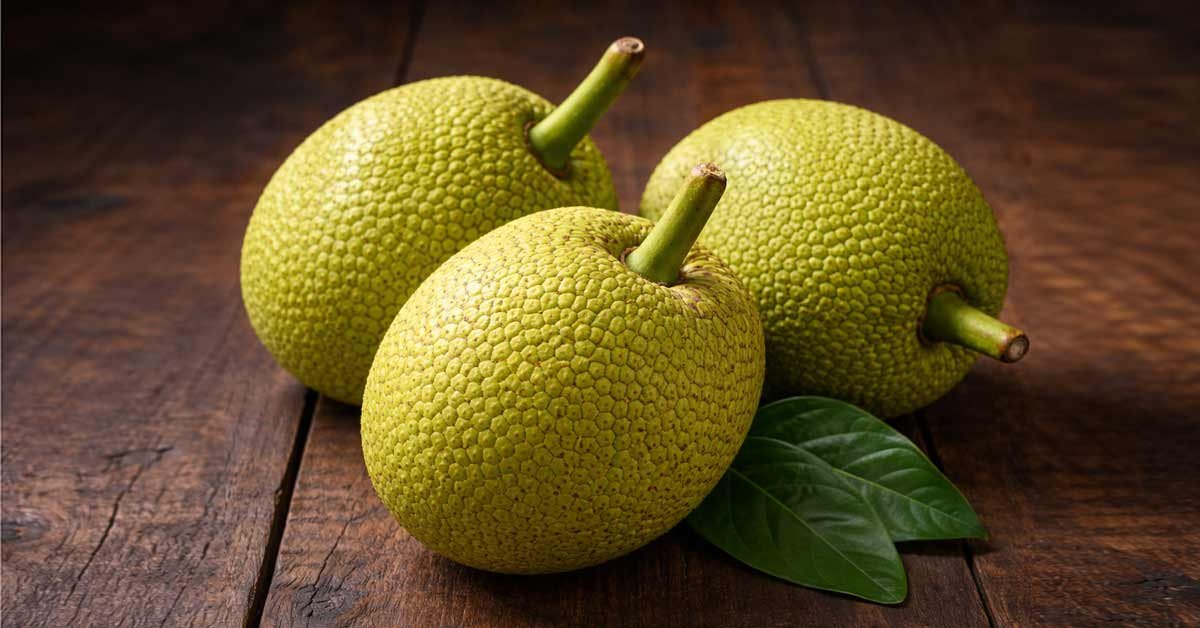
A Fruit That Eats Like a Staple, Not a Snack
There’s a moment when you first try breadfruit where your brain hesitates. You expect something sweet, something light, something you’d toss into a smoothie or eat absentmindedly between meals. Instead, breadfruit lands on your plate with the quiet confidence of something far more substantial. It doesn’t behave like fruit in the way most people think of fruit. It behaves like food. Real food. The kind that holds you over for hours.
In many parts of the world, breadfruit is not a novelty. It’s not a health trend. It’s a staple. It sits in the same category as rice, potatoes, or cassava. You roast it, boil it, mash it, bake it. You build meals around it. That alone says a lot about what breadfruit actually offers, especially when you start thinking in terms of energy and fiber rather than just taste.
Table of Contents


Pick up a ripe breadfruit and you’ll notice its weight. Dense. Slightly rough on the outside. Cut into it and the texture tells the rest of the story. This is not a juicy fruit. It’s starchy, almost creamy when cooked, with a structure that feels closer to freshly baked bread or a firm potato than anything sweet or watery. That texture is your first clue. Breadfruit is built differently, and because of that, it fuels the body differently.
The reason breadfruit works so well as a staple comes down to its composition. It’s rich in complex carbohydrates, the kind your body breaks down slowly. That slow breakdown matters more than most people realize. Instead of quick spikes and crashes, you get a steadier release of energy. You eat breadfruit, and you feel it in a grounded way. No rush. No drop. Just a gradual, reliable sense of being fueled.
And then there’s the fiber. Breadfruit carries a meaningful amount of it, and not in a way that feels forced or added. It’s naturally part of the structure of the fruit itself. That fiber changes how your body processes everything else in the meal. Digestion slows down just enough. Absorption becomes more controlled. You stay full longer, not because you ate a large volume, but because what you ate was structured to last.
Think about a simple meal. Roasted breadfruit, a bit of olive oil, maybe some legumes or fish on the side. It doesn’t look complicated. It doesn’t rely on anything extreme. But nutritionally, it holds up. You get:
- Sustained energy from complex carbohydrates
- Digestive support from natural fiber
- A sense of fullness that actually lasts
- A stable base that pairs well with proteins and fats
This is where breadfruit starts to separate itself from the typical idea of fruit. Most fruits are supportive. They add vitamins, hydration, quick sugars. Breadfruit does something else. It carries weight in a meal. It can replace grains. It can anchor your plate. That’s not a small shift. It changes how you think about what belongs where in your diet.
There’s also something practical about breadfruit that often gets overlooked. It’s versatile in a way that fits real life. You can prepare it ahead of time. You can reheat it without losing much of its texture. You can use it in both simple and more involved meals. That matters when you’re trying to eat in a way that’s consistent, not just ideal on paper.
People who grow up eating breadfruit don’t talk about it like a superfood. They talk about it like something dependable. Something that shows up, does its job, and doesn’t demand much attention. And honestly, that’s part of its strength. Foods that quietly support energy and fiber intake, without needing constant reinvention, tend to stick around in a person’s routine.
There’s also a sensory side to it that’s worth mentioning. The smell of breadfruit roasting is subtle but comforting. Slightly nutty, a little earthy. The texture, when done right, sits somewhere between soft and firm, with just enough resistance to feel satisfying. It’s the kind of food you chew slowly without thinking about it. That alone can change how a meal feels.
Of course, breadfruit isn’t trying to replace every other carbohydrate source. It doesn’t need to. But it does offer an alternative that feels less processed, less engineered. You’re eating something that hasn’t been stripped down and rebuilt. It’s intact. And that matters more than it might seem at first glance.
When people start focusing on energy and fiber, they often jump to complicated solutions. Powders, fortified foods, carefully calculated plans. Breadfruit sits on the opposite end of that spectrum. It’s simple. Whole. Predictable in the best way. You don’t need to overthink it. You just cook it, eat it, and let it do what it naturally does.
And maybe that’s the quiet appeal here. Breadfruit doesn’t try to impress you right away. It doesn’t hit you with sweetness or intensity. It builds its case slowly, through how it makes you feel after you eat it. Steady. Satisfied. Not looking for a snack an hour later.
Once you notice that pattern, it’s hard to ignore.
Breadfruit as a Reliable Source of Everyday Energy
There’s a lot of confusion around the word energy. It gets thrown around on labels, attached to snacks, turned into a selling point. But when you strip it back to what actually matters in daily life, energy is simple. It’s how steady you feel between meals. It’s whether your focus holds or drifts. It’s whether you’re reaching for something sugary at 11 a.m. or just getting on with your day.
Breadfruit fits into this conversation in a quiet but very real way. It doesn’t promise a surge. It doesn’t try to wake you up. It supports a kind of energy that feels stable, almost unnoticeable at first, until you realize you haven’t crashed in hours.
What “Energy” Means in Real Nutrition
In practical terms, energy comes from calories. That part is straightforward. But the way your body uses those calories is where things get interesting. Not all sources are handled the same way.
Simple carbohydrates, like refined sugar, are broken down quickly. Glucose enters the bloodstream fast, insulin responds, and you get that familiar spike. It can feel good for a short window. Then it fades, often leaving you more tired than before.
Complex carbohydrates behave differently. They take longer to digest. They release glucose gradually. That slower release creates a more stable internal environment. No sharp peaks. No sudden drops.
Breadfruit sits firmly in this second category. Its carbohydrate structure is built for gradual digestion. When you eat breadfruit, your body doesn’t rush. It works through it steadily, which changes how that energy shows up in your day.
There’s also the fiber content to consider. Fiber doesn’t provide energy directly, but it shapes how energy is delivered. It slows gastric emptying. It moderates how quickly carbohydrates are absorbed. In simple terms, it stretches the curve. Instead of a steep rise and fall, you get a longer, flatter line.
The Role of Complex Carbohydrates in Breadfruit
Breadfruit is rich in starch, particularly when it’s cooked. That starch is made up of long chains of glucose molecules. Your body has to break those chains down step by step before the glucose becomes available for use.
That process takes time. And that time is exactly what makes breadfruit valuable as a steady fuel source.
Some of the starch in breadfruit also behaves in a way that resists immediate digestion. Often referred to as resistant starch, it passes through part of the digestive system intact before being fermented in the gut. While it doesn’t contribute to rapid energy release, it still plays a role in metabolic balance and how your body manages fuel over time.
What this means in practice:
- Energy from breadfruit arrives gradually
- Blood sugar fluctuations are less abrupt
- Hunger signals tend to come later, not sooner
- Meals feel more complete, even without large portions
If you’ve ever eaten a meal based on refined grains and noticed how quickly hunger returns, the contrast is noticeable. Breadfruit doesn’t eliminate hunger. It just delays it in a way that feels more natural.
How Breadfruit Supports Steady Energy Levels
The experience of eating breadfruit is less about immediate impact and more about what doesn’t happen afterward.
You don’t feel that sharp lift. But you also don’t feel the drop. There’s no moment where your energy dips and your brain starts negotiating for something sweet. Instead, there’s a kind of baseline that holds.
This comes down to a few overlapping factors:
- The structure of its carbohydrates
- Its natural fiber content
- The absence of rapid-digesting sugars
- Its density, which slows down how quickly you eat
That last point is easy to overlook. Breadfruit takes a bit more chewing. It’s more substantial. You don’t rush through it the way you might with lighter foods. That alone changes how your body processes the meal.
There’s also the context of how breadfruit is usually eaten. Rarely on its own, it tends to be part of a plate. Paired with fats, proteins, or legumes, the overall effect becomes even more stable. Each component reinforces the others, creating a meal that sustains rather than stimulates.
People who rely on breadfruit regularly often describe it in simple terms. It keeps them going. That’s it. No drama. No spikes. Just a consistent sense of fuel that supports daily activity without demanding attention.
When and How to Eat Breadfruit for Sustained Fuel
Timing matters more than most people think, especially when it comes to carbohydrate-rich foods. Breadfruit works best when it’s used intentionally, not randomly added to an already heavy or unbalanced meal.
Some of the most effective ways to use breadfruit for steady energy are surprisingly simple.
Morning or early day meals
Starting your day with breadfruit can create a strong baseline. Instead of chasing energy later, you’re building it early. A portion of roasted breadfruit with a source of protein can carry you through the morning without much effort.
Midday meals
This is where breadfruit really shines. Lunches that rely on breadfruit tend to feel satisfying without being overly heavy. You get enough fuel to stay focused, but not so much that you feel slowed down.
Pre-activity meals
If you have a physically demanding task ahead, breadfruit can act as a reliable fuel source. Because the energy release is gradual, it supports longer periods of activity rather than short bursts.
How you prepare it also matters.
- Roasting brings out a slightly nutty flavor and keeps the texture firm
- Boiling softens it, making it easier to digest and pair with other foods
- Baking can give it a more bread-like consistency, which works well in structured meals
Pairing is where you can fine-tune the effect:
- Add healthy fats like olive oil for longer satiety
- Include protein sources to stabilize the overall meal
- Combine with vegetables to increase volume and nutrient diversity
One thing worth avoiding is treating breadfruit like a side dish that doesn’t matter. It’s not background food. It’s a core component. When you build your meal around it, rather than placing it on the edge of the plate, the benefits become more noticeable.
There’s also no need to overcomplicate portions. A moderate serving is usually enough. Because of its density and fiber content, breadfruit naturally limits how much you want to eat. You don’t need strict rules. You just need to pay attention to how it feels.
Over time, the pattern becomes clear. Meals that include breadfruit tend to carry you further. You’re less reactive to hunger. You’re less dependent on quick fixes. And that, more than anything, is what real, usable energy looks like in everyday life.
Fiber in Breadfruit: What It Actually Does for Your Body
Fiber gets talked about a lot, usually in vague, checkbox kind of ways. “High in fiber” sounds good, but it rarely tells you what that actually means for your body once the food is on your plate. Breadfruit makes this easier to understand because its fiber is not added, isolated, or engineered. It’s part of the structure of the food itself. You feel it in the texture. You notice it in how the meal sits and how long it stays with you.
When you eat breadfruit, you’re not just getting a number on a nutrition label. You’re getting a form of fiber that interacts with digestion in a steady, predictable way. It doesn’t push extremes. It supports a rhythm that your body already knows how to work with.
Understanding Dietary Fiber Beyond Labels
At a basic level, fiber is the part of plant food your body doesn’t fully break down. But that doesn’t mean it’s inactive. It plays a role all the way through the digestive process.
There are two broad types:
- Soluble fiber, which absorbs water and forms a gel-like consistency
- Insoluble fiber, which adds bulk and helps move things along
Breadfruit contains a mix of both, and that balance matters more than the total number alone. Foods that lean too heavily in one direction can feel either too slow or too harsh. Breadfruit tends to land in a middle ground that feels functional rather than noticeable.
This balance influences how food moves through your system. It also affects how nutrients are released and absorbed. Instead of everything being processed quickly, fiber creates a kind of pacing mechanism. The meal unfolds over time rather than all at once.
That pacing shows up in small, practical ways:
- You feel full longer after eating breadfruit
- Digestion feels more gradual, less rushed
- Hunger returns in a more predictable pattern
None of this feels dramatic. That’s the point. When fiber is working well, it tends to stay in the background.
How Breadfruit Supports Digestive Function
Digestion is not just about breaking food down. It’s about how smoothly that process happens from start to finish. Breadfruit supports that process in a few key ways, mostly by creating consistency.
The fiber in breadfruit adds structure to the digestive process. It helps regulate movement through the intestines, which can make things feel more balanced over time. Not faster. Not slower. Just more regular.
There’s also the role of fermentable fibers. Some of the fiber in breadfruit reaches the large intestine intact, where it becomes a food source for gut bacteria. This fermentation process produces short chain fatty acids, compounds that are associated with maintaining the integrity of the gut lining and supporting overall digestive stability.
You don’t feel this happening directly. What you notice instead is the outcome:
- Meals feel easier to process
- There’s less heaviness after eating
- Digestive patterns become more consistent
It’s worth noting that this kind of effect tends to build over time. Eating breadfruit once won’t change much. Including it regularly is where the difference shows up.
Texture plays a role here too. Because breadfruit is dense and requires more chewing, digestion starts earlier. The mechanical breakdown in your mouth signals the rest of the system to prepare. That small detail often gets ignored, but it contributes to how smoothly the rest of the process unfolds.
The Link Between Fiber and Metabolic Balance
Fiber doesn’t just affect digestion. It also influences how your body handles nutrients after a meal, especially carbohydrates.
When you eat breadfruit, the fiber slows down how quickly glucose enters your bloodstream. This doesn’t eliminate the rise in blood sugar, but it changes the pace. The increase is more gradual, which gives your body more time to respond.
This slower response can support a more stable internal environment. Instead of sharp fluctuations, you get a smoother curve. Over time, that kind of stability can make a noticeable difference in how you feel between meals.
There’s also a connection between fiber and satiety signals. Meals that include enough fiber tend to trigger a stronger sense of fullness. Not the kind that comes from eating a large volume, but the kind that comes from sustained digestion.
In practical terms:
- You’re less likely to overeat without realizing it
- Snacking becomes less frequent or more intentional
- Energy levels feel more consistent across the day
This is where breadfruit fits naturally into a balanced approach to eating. It doesn’t force control. It supports it quietly, by shaping how your body responds to food.
Simple Ways to Add Breadfruit Without Overdoing It
One of the easiest mistakes with fiber-rich foods is going too far, too fast. Breadfruit is filling. It’s dense. Adding large amounts all at once, especially if your diet has been low in fiber, can feel like too much.
A better approach is to treat breadfruit as a base, not an overload.
Start with moderate portions
You don’t need a large serving to feel the effects. A portion that comfortably fits into a meal is enough. Pay attention to how your body responds and adjust from there.
Use it in place of refined starches
Instead of adding breadfruit on top of everything else, swap it in. Replace part of your usual rice, pasta, or bread with breadfruit. This keeps the meal balanced without increasing the overall load.
Pair it with other whole foods
Breadfruit works best alongside:
- Vegetables for added volume and diversity
- Protein sources for a more complete meal
- Healthy fats to extend satiety
Keep preparation simple
The more you process a food, the easier it is to overconsume it. Roasted or boiled breadfruit keeps its structure and makes portion awareness easier.
Give your system time to adjust
If your fiber intake has been low, your digestive system may need a bit of time to adapt. Gradual inclusion tends to work better than sudden changes.
There’s also a practical side to this. Breadfruit is satisfying enough that you don’t feel the need to build complicated meals around it. A simple plate often does the job.
Over time, it becomes less about thinking in terms of fiber and more about recognizing which meals leave you feeling steady. Breadfruit tends to show up in those meals more often than not.
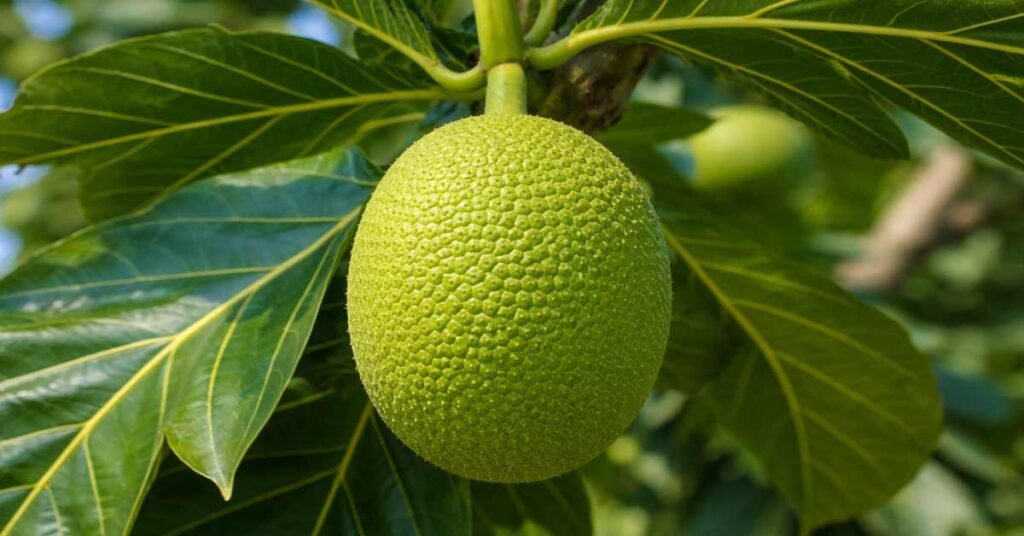
Why Breadfruit Works in Simple, Consistent Eating Habits
There’s a difference between foods that look good on paper and foods that actually fit into your life. Breadfruit falls into the second category. It doesn’t require precision, it doesn’t rely on trends, and it doesn’t ask you to rethink everything you eat. It just slips into place and does its job.
That’s a big reason why breadfruit has lasted as long as it has in traditional diets. Not because it’s flashy or nutritionally perfect, but because it’s reliable. You can eat it often, prepare it in different ways, and build meals around it without getting tired of it or needing to overthink it.
Consistency is where most people struggle. Not knowledge. Not access. Just the ability to repeat simple, effective habits without burning out. Breadfruit supports that kind of rhythm almost by default.
Traditional Diets and the Role of Breadfruit
In regions where breadfruit is grown, it has never been treated like a side ingredient. It’s a foundation. Entire meals are built around it, often in ways that haven’t changed much over time.
That consistency matters. Traditional eating patterns tend to favor foods that:
- Provide steady energy
- Support digestion without effort
- Are easy to prepare in large quantities
- Can be eaten regularly without fatigue
Breadfruit checks all of those boxes. It stores well when cooked. It reheats without losing its structure. It pairs with a wide range of local foods, from legumes to fish to vegetables.
There’s also an efficiency to it. A single breadfruit can feed multiple people. It’s filling without being complicated. That practicality is part of why it became a staple in the first place.
What’s interesting is that these traditional patterns often align with what people are now trying to recreate through more complex approaches. Stable energy, enough fiber, balanced meals. Breadfruit was already doing that, long before it became something people outside those regions started paying attention to.
Pairing Breadfruit for Better Nutrient Balance
Breadfruit on its own is solid. But like most carbohydrate-rich foods, it works best when it’s part of a balanced plate.
The goal isn’t to complicate things. It’s to make small adjustments that improve how the meal functions as a whole.
Start with protein
Adding a protein source helps round out the meal and supports satiety. This can be as simple as:
- Beans or lentils
- Fish or eggs
- Yogurt on the side, depending on preparation
Include healthy fats
Fats slow digestion further and add depth to the meal. You don’t need much:
- A drizzle of olive oil
- A handful of nuts or seeds
- Coconut-based preparations, common in traditional dishes
Add vegetables for volume and variety
Vegetables bring in additional fiber, micronutrients, and texture contrast. They also make the meal feel more complete without increasing heaviness.
When these elements come together, breadfruit becomes the anchor rather than the entire focus. It holds the meal steady while everything else builds around it.
This kind of structure doesn’t require measuring or strict planning. You can see it on the plate. A portion of breadfruit, something for protein, something fresh or cooked on the side. That’s usually enough.
Common Mistakes When Adding Breadfruit to Your Diet
Breadfruit is simple, but it’s still possible to use it in ways that don’t quite work. Most of these mistakes come from treating it like something it’s not.
Using it as an extra instead of a replacement
One of the most common issues is adding breadfruit on top of an already starch-heavy meal. That tends to make the meal feel too dense. Breadfruit works better when it replaces part of another carbohydrate source, not when it stacks on top of it.
Ignoring portion awareness
Because it’s a whole food, it’s easy to assume more is always better. But breadfruit is filling for a reason. Large portions can feel heavy, especially if the rest of the meal is also dense.
Overprocessing it
Turning breadfruit into highly refined forms can make it easier to overeat and faster to digest. Keeping it closer to its original form usually gives better results in terms of both energy and satiety.
Not adjusting the rest of the meal
If breadfruit becomes the main carbohydrate, the rest of the plate should shift slightly. More vegetables, a clear protein source, and a bit of fat help balance things out.
Expecting immediate results
Like most whole foods, breadfruit works best over time. One meal won’t change much. Regular inclusion is where the benefits become noticeable.
These are small adjustments, but they make a difference in how breadfruit actually fits into your routine.
Keeping It Practical: Making Breadfruit a Routine Food
The biggest advantage breadfruit offers is how easy it is to repeat. Once you figure out a few basic preparations, it becomes something you can rely on without much effort.
Cook in batches
Preparing breadfruit in larger quantities saves time. You can roast or boil it once and use it across multiple meals. It holds up well in the fridge and reheats without much loss in texture.
Keep preparation methods simple
You don’t need complex recipes. Some of the most effective ways to eat breadfruit are also the simplest:
- Roasted with a bit of salt and oil
- Boiled and paired with savory dishes
- Baked until slightly crisp on the outside
Build familiar meals around it
Instead of creating entirely new dishes, swap breadfruit into meals you already eat. Replace part of your usual starch with it and adjust from there.
Pay attention to how it feels
This is where things become personal. Notice how long a meal with breadfruit keeps you full. Notice how your energy holds. Small observations like that help you fine-tune portions and timing without needing strict rules.
Keep it available
If breadfruit is accessible to you, having it ready makes a difference. Foods you have on hand are the ones you actually eat. That sounds obvious, but it’s often the missing piece in building consistent habits.
Over time, breadfruit stops being something you think about and starts being something you rely on. It becomes part of your baseline. A food that shows up regularly, supports energy and fiber intake, and doesn’t require constant adjustment.
That’s what makes it work. Not complexity. Not novelty. Just the ability to fit into real life and stay there.
Best Selling Breadfruit Related Products


When Simple Foods Do the Heavy Lifting
At some point, you start to notice a pattern. The meals that leave you feeling steady, clear-headed, and satisfied are rarely the complicated ones. They’re usually built from a few solid ingredients that do exactly what they’re supposed to do. Breadfruit fits into that pattern almost too easily.
It doesn’t try to compete with processed foods on convenience or intensity. It doesn’t need to. What it offers is something quieter but more durable. Energy that holds. Fiber that works in the background. A sense that your body is being supported rather than pushed.
There’s a tendency to over-engineer the way we eat. You see it in the endless combinations, the optimization mindset, the idea that every meal needs to hit a perfect balance on paper. But in practice, most people don’t stick to systems that feel complicated. They fall back on what’s easy to repeat. That’s where breadfruit has an advantage.
It simplifies decisions.
Instead of asking what you need for energy, what you need for fiber, what you need to stay full, you build a meal around breadfruit and a lot of those boxes are already checked. Not perfectly, not in a calculated way, but in a way that’s good enough to work consistently.
And consistency is where results tend to come from.
Think about how most eating habits break down. It’s not usually a lack of knowledge. It’s friction. Too many steps. Too many variables. Too much reliance on foods that don’t actually satisfy, so you end up compensating later.
Breadfruit reduces that friction.
A simple plate built around breadfruit often looks like this:
- A portion of breadfruit as the base
- A protein source that adds substance
- A vegetable or two for texture and variety
- A small amount of fat to bring everything together
That’s it. No complicated rules. No need to track every detail. And yet, it covers a lot of ground. You get steady energy from the carbohydrate structure. You get fiber that supports digestion and satiety. You get a meal that feels complete without needing extras.
There’s also something worth saying about how breadfruit changes your relationship with hunger. Meals built on refined, fast-digesting foods tend to create a loop. Eat, spike, drop, repeat. You end up chasing energy rather than maintaining it.
Breadfruit breaks that loop in a subtle way.
Because it digests more slowly and includes natural fiber, it extends the time between meals. Not in a restrictive sense, just in a practical one. You eat, and then you don’t think about food for a while. That gap is where a lot of unnecessary snacking disappears.
Over time, that shift adds up.
- Fewer impulsive food choices
- Less reliance on quick fixes
- More predictable hunger patterns
- A steadier baseline of energy throughout the day
It’s not dramatic. You won’t feel a sudden transformation. What you’ll notice is the absence of extremes. And that absence is often what people are actually looking for, even if they don’t phrase it that way.
There’s also a mental side to this. Simple foods reduce decision fatigue. When you know what works, you stop second-guessing every meal. Breadfruit becomes one of those default options you can return to without thinking too much about it.
You roast it. You pair it with something you already have. You eat. It sounds almost too basic, but that’s the point.
A lot of modern eating patterns are built around novelty. New ingredients, new combinations, constant variation. There’s nothing wrong with that, but it can make consistency harder to maintain. Breadfruit leans in the opposite direction. It’s repetitive in a good way. Familiar. Predictable.
And that predictability is useful.
It allows you to focus less on the mechanics of eating and more on how food fits into the rest of your day. You’re not planning around meals as much. Meals just work.
There’s also the matter of trust. Over time, you start to trust certain foods based on how they make you feel. Breadfruit tends to earn that trust quickly. You know what you’re getting. You know how your body responds. There are no surprises.
That kind of reliability is underrated.
Especially when you’re trying to build habits that last, not just experiment for a few weeks.
Another thing that stands out is how breadfruit handles repetition without becoming boring. The texture shifts depending on how you prepare it. Roast it and it’s firm with a slightly crisp edge. Boil it and it softens, almost creamy. Bake it and it takes on a more structured, bread-like feel.
Those small variations are enough to keep it interesting without turning it into a project.
And because it pairs well with so many flavors, you can adjust the rest of the meal without changing the base. That flexibility makes it easier to keep using it regularly.
In the end, breadfruit doesn’t need to be positioned as anything special to be valuable. It just needs to be used consistently. It’s a food that supports energy and fiber intake without requiring attention, and that’s exactly why it works.
You don’t build a diet around occasional highlights. You build it around what shows up every day.
Breadfruit has a way of becoming one of those things.
Article Sources
At AncientHerbsWisdom, our content relies on reputable sources, including peer-reviewed studies, to substantiate the information presented in our articles. Our primary objective is to ensure our content is thoroughly fact-checked, maintaining a commitment to accuracy, reliability, and trustworthiness.
- FAO. (2018). Breadfruit: An underutilized staple with high potential. Food and Agriculture Organization of the United Nations. http://www.fao.org/3/i8946en/I8946EN.pdf
- Morton, J. F. (1991). Breadfruit. In Fruits of warm climates (pp. 111–126). Julia F. Morton. https://www.hort.purdue.edu/newcrop/morton/breadfruit.html
- Mishra, S., & Ghosh, T. (2019). Nutritional and health benefits of breadfruit (Artocarpus altilis) – A review. International Journal of Food Science and Nutrition, 4(2), 45–53. https://doi.org/10.11648/j.ijnfs.20190402.12
- Yamaguchi, M., & Tanimura, T. (2017). Starch characteristics of breadfruit (Artocarpus altilis) and its effects on postprandial glycemia. Journal of Food Science, 82(5), 1208–1215. https://doi.org/10.1111/1750-3841.13715
- FAO. (2020). The role of dietary fiber in staple foods: Insights from tropical fruits. Food and Nutrition Paper No. 120. http://www.fao.org/3/ca8633en/CA8633EN.pdf
- Singh, D., & Kapoor, R. (2018). Breadfruit as a source of dietary energy and fiber in tropical diets. Journal of Nutritional Health & Food Engineering, 8(3), 174–181. https://doi.org/10.15406/jnhfe.2018.08.00276
- WHO. (2021). Healthy diets and dietary guidelines. World Health Organization. https://www.who.int/news-room/fact-sheets/detail/healthy-diet

- Star Fruit: Hydrating Fruit for Vitamin C - March 30, 2026
- Sapodilla: Sweet Fruit for Digestion and Energy - March 30, 2026
- Pineapple: Enzyme Rich Fruit for Digestion and Immunity - March 29, 2026