
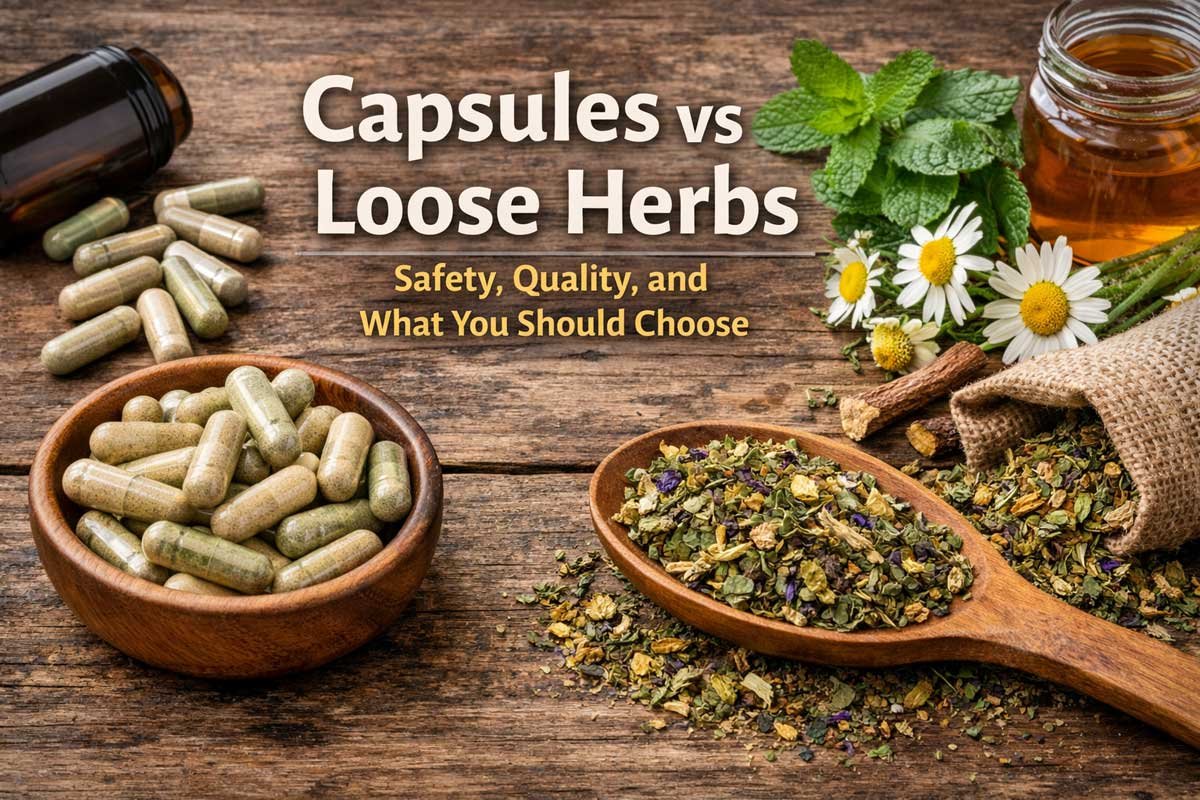
Picking Between Capsules and Loose Herbs: The Real Story
The choice between capsules and loose herbs looks simple on the surface. One fits neatly into a daily routine. The other feels closer to tradition, maybe even a bit romantic. But once you move past convenience and habit, the capsules vs loose herbs question turns into something deeper. It becomes about how quality is preserved, where safety can quietly break down, and how organic ideals hold up once herbs leave the field and enter real life.
Many people come to herbs with a clear expectation. Capsules feel cleaner. More controlled. Loose herbs feel raw, authentic, maybe even stronger. Both assumptions can be wrong, and sometimes they are wrong in opposite directions. The reality is that form does not guarantee quality. It only shapes risk in different ways.
Table of Contents

Think about how herbs actually move through the world. They are grown in soil that changes year to year. They are harvested by people, dried under conditions that are rarely perfect, and transported across borders. By the time an herb becomes either a capsule or a loose leaf, it has already passed through several points where quality can be protected or compromised. Capsules vs loose herbs is not a debate about nature versus technology. It is a debate about where control is gained and where it is lost.
Capsules often signal modern reliability. A label lists milligrams. The shell looks sealed and hygienic. For many people, this feels safer by default. But capsules hide as much as they reveal. You cannot see the herb. You cannot smell it. You cannot judge freshness by color or texture. You are trusting the grinder, the blender, the encapsulation line, and the storage conditions long before the bottle reached your hands. Safety depends almost entirely on the integrity of the producer.
Loose herbs do the opposite. They expose everything. Color fades if storage is poor. Mold smells are obvious. Stems, leaves, and powders tell a story the moment you open the container. This transparency feels empowering, especially for people who value organic sourcing and sensory connection. But exposure also brings vulnerability. Air, light, humidity, and handling all leave their mark. Loose herbs ask more of you as a consumer. They demand attention.
Organic status complicates this further. Organic farming standards focus on how plants are grown, not how they are processed after harvest. An organic herb can still lose quality through aggressive milling, prolonged storage, or poor packaging. Capsules vs loose herbs becomes less about the organic label and more about how that organic material is treated once it leaves the farm.
There is also a quiet psychological layer to this choice. Capsules fit into a supplement mindset. They are swallowed quickly, often alongside vitamins or minerals, barely noticed. Loose herbs slow things down. Measuring, steeping, tasting. This changes how people relate to herbs. Some find that slowness meaningful. Others find it impractical. Neither approach is inherently better, but they lead to different habits, and habits influence safety in subtle ways. Someone who rushes may skip proper storage. Someone who over handles may introduce moisture or contamination.
Quality is not static. It degrades over time. Capsules tend to mask this process. A capsule that is six months old and one that is two years old can look identical. Loose herbs show their age. Aroma weakens. Color dulls. Texture changes. This visibility can be uncomfortable, but it also serves as feedback. When people talk about capsules vs loose herbs, they often overlook how important feedback loops are for maintaining quality.
Safety concerns often surface only when something goes wrong. A strange smell. Digestive discomfort. A recall notice buried in a news feed. Capsules and loose herbs fail differently. Capsules may fail silently. Adulteration, fillers, or degraded material can go unnoticed until patterns emerge. Loose herbs tend to fail loudly. Mold, insects, or off odors force a decision. Discard or investigate.
None of this means capsules are unsafe or loose herbs are risky by nature. It means the risks are distributed differently. Capsules concentrate responsibility upstream. Loose herbs push responsibility downstream. This matters because most consumers assume the opposite. They believe capsules reduce personal responsibility, and loose herbs increase safety through naturalness. The truth sits in between.
Consider a common scenario. Someone buys an organic loose herb from a bulk bin. It smells fine at first. A few weeks later, after opening and closing the container repeatedly, moisture builds. The herb clumps slightly. Nothing dramatic happens, but quality slips quietly. Now consider a capsule bought online. It arrives sealed and uniform. Months later, it still looks the same. But you have no idea how long the powdered herb sat before encapsulation or how much surface area oxidation occurred during grinding. In both cases, quality shifts. You just notice it differently.
The capsules vs loose herbs discussion also intersects with trust. Capsules ask you to trust systems, labs, and paperwork. Loose herbs ask you to trust your senses and your habits. People tend to trust what aligns with their worldview. Those who value data and precision lean toward capsules. Those who value experience and intuition lean toward loose herbs. Neither approach guarantees safety or quality on its own.
Another overlooked factor is scale. Capsules are often produced in large batches. This can improve consistency but also amplify mistakes. One contaminated batch affects thousands of units. Loose herbs are sometimes handled in smaller lots, especially in local or specialty markets. This limits scale but increases variability. Consistency and resilience are traded back and forth.
The organic conversation often adds emotional weight. Organic implies purity, care, and responsibility. But organic does not equal gentle processing. Organic herbs can be finely milled, overheated, or stored too long just like non organic ones. Capsules vs loose herbs becomes misleading if organic status is treated as a shield rather than a baseline.
People who have worked with herbs for years often shift their preferences over time. Many start with capsules for simplicity. Later, they explore loose herbs for depth and flexibility. Others move in the opposite direction as routines get busier. These shifts are not failures of judgment. They reflect changing priorities. What matters is understanding what each form asks of you and what it gives back.
The real story is not about choosing sides. It is about recognizing tradeoffs. Capsules trade sensory transparency for convenience and standardization. Loose herbs trade ease for visibility and control. Safety and quality depend less on form and more on alignment. Alignment between your habits, your storage conditions, your sourcing standards, and your willingness to pay attention.
When you strip away marketing language, capsules vs loose herbs is a question of responsibility. Who carries it. Where it sits. And how consciously it is managed. Once that becomes clear, the choice stops being confusing. It becomes practical.
How Capsules and Loose Herbs Differ in Quality and Safety
The capsules vs loose herbs discussion becomes much clearer once you stop thinking in terms of preference and start thinking in terms of process. Quality and safety are shaped long before an herb reaches your shelf. They are shaped by how the plant is handled, altered, concentrated, and protected, or not protected, at each step. Capsules and loose herbs follow different paths, and those paths create very different strengths and vulnerabilities.
Processing and Its Impact on Organic Integrity
Processing is where many assumptions quietly fall apart. Capsules are rarely made from whole herbs in their original form. Most begin as dried plant material that is milled into a fine powder or extracted using water, alcohol, or other solvents. Even when everything starts organic, processing changes the material in fundamental ways.
Grinding increases surface area. This speeds oxidation. Heat generated during milling can degrade volatile compounds. Repeated handling exposes the herb to air and moisture. None of this automatically ruins quality, but each step creates opportunity for loss. Organic integrity is not just about what chemicals are absent. It is about how much of the original plant character survives the journey.
Capsules offer uniformity. That uniformity comes at a cost. When herbs are powdered, structural clues disappear. Leaf veins, root fibers, resinous textures are gone. Once powdered, visual verification becomes impossible. This is one reason adulteration is more common in powdered materials. It is easier to blend, substitute, or dilute without detection.
Loose herbs experience less transformation. Drying is the main intervention, and drying can be gentle or harsh depending on conditions. A well dried leaf retains color, aroma, and structure. A poorly dried one turns brittle, brown, or dull. Organic quality remains visible. You can see whether the herb was treated with care.
That visibility matters. It keeps producers accountable and gives consumers feedback. But it also means loose herbs are more sensitive to mistakes. Over drying drives off essential oils. Under drying invites microbial growth. Capsules hide these errors behind uniform shells.
Organic certification does not regulate how fine a powder can be, how hot a mill runs, or how long material sits between steps. An organic capsule can still contain material that has been stressed far beyond what most people imagine when they hear the word organic. Capsules vs loose herbs forces an uncomfortable realization. Organic status does not guarantee gentle handling.
Contamination Risks: Microbes, Chemicals, and Adulteration
Contamination is where safety concerns usually surface, and where form matters more than many people expect. Both capsules and loose herbs can carry microbial contaminants such as bacteria, yeasts, and molds. The difference lies in when contamination is most likely and how easily it is detected.
Loose herbs are exposed. They are handled, weighed, scooped, and stored in environments that may vary widely. Humidity is a constant threat. Even small increases can allow mold spores to grow. The advantage is immediacy. Off odors, visible growth, or clumping signal a problem quickly. You are alerted before prolonged use.
Capsules feel protected, but that protection is conditional. Powdered herbs inside capsules can carry microbial loads from earlier stages. Encapsulation does not sterilize material. It only seals it. If contamination occurred during drying, grinding, or storage, the capsule preserves it rather than revealing it.
Chemical contamination follows a similar pattern. Heavy metals can accumulate in herbs due to soil conditions. Pesticide residues are lower in organic crops, but environmental contamination still exists. Testing helps, but not all batches are tested equally. Capsules often rely on batch testing at scale. Loose herbs, especially in smaller operations, may rely more on supplier assurances.
Adulteration is where capsules vs loose herbs diverges most sharply. Powdered herbs are far easier to adulterate. Visual identification becomes impossible once plant structures are destroyed. Fillers, starches, or even entirely different plant species can be blended in without detection unless advanced testing is performed.
Loose herbs resist this to a degree. Whole roots and leaves are harder to fake. Experienced handlers can identify inconsistencies by sight and smell. This does not eliminate adulteration risk, but it raises the barrier.
There is also economic pressure. Capsules command higher prices per unit weight. This creates incentive for substitution or dilution. Loose herbs, especially when sold visibly and locally, rely more on reputation and repeat buyers.
None of this means capsules are inherently unsafe. It means safety depends heavily on transparency and testing. When those are strong, capsules can be reliable. When they are weak, problems stay hidden longer.
Stability and Shelf Life
Shelf life is often presented as a clear win for capsules. Sealed shells protect against air and light. Desiccants reduce moisture. Bottles are easy to store. On paper, this looks like superior stability.
In practice, stability is more nuanced. Powdered herbs degrade faster than intact plant material. Increased surface area accelerates chemical reactions. Active compounds slowly oxidize. Capsules can look unchanged long after potency has declined. There is no sensory warning system.
Loose herbs age visibly. Aroma fades. Color shifts. Texture changes. These cues are not perfect indicators of chemical stability, but they are better than nothing. They encourage rotation and replacement.
Storage conditions matter more than format. A capsule stored in a hot, humid environment degrades faster than a loose herb stored properly in a cool, dark, dry place. Yet people often assume capsules are immune to storage mistakes. This false confidence can undermine safety.
Another overlooked factor is time before purchase. Capsules may sit in warehouses for months or years. Loose herbs in high turnover markets may move faster. The date on a bottle rarely tells the full story. Stability claims often ignore pre retail aging.
Capsules vs loose herbs is not a simple contest of longevity. It is a question of how degradation is managed and detected. Capsules delay awareness. Loose herbs demand awareness.
When people talk about quality, they often mean consistency. Capsules excel here. Each dose looks the same. Loose herbs vary. One harvest differs from the next. For some, this variability feels risky. For others, it feels honest.
Safety lives in the details. It lives in drying rooms, milling temperatures, storage humidity, and human habits. Form influences how these details play out, but it does not override them.
Once you see this clearly, the debate shifts. Capsules vs loose herbs stops being about which is better and starts being about which risks you are prepared to manage.
Practical Considerations for Choosing Your Herbal Form
Once the theory is stripped away, capsules vs loose herbs becomes a daily decision. What fits into your life. What you will actually use. What you can manage consistently without cutting corners. Quality and safety are shaped as much by behavior as by chemistry, and this is where practical considerations start to matter more than abstract ideals.
Many people choose a form not because it is better, but because it is workable. That is not a weakness. It is reality. An herb that sits untouched in a cupboard, no matter how organic or carefully sourced, offers no value at all.
Dosage Consistency
Dosage is one of the strongest arguments in favor of capsules. Each capsule contains a defined amount of material. This removes guesswork. It also creates a sense of control, which is important for people who prefer structure and repeatability.
With capsules, intake becomes routine. One capsule in the morning. Another in the evening. No measuring spoons. No scales. This consistency reduces variability and helps people maintain stable habits. In the capsules vs loose herbs comparison, capsules clearly win on predictability.
Loose herbs require more attention. A teaspoon today may not weigh the same as a teaspoon tomorrow. Grind size, moisture content, and packing all change volume. People who work with loose herbs for years develop a feel for this, but beginners often underestimate variability.
That variability is not always a disadvantage. Some herbs are traditionally used flexibly, adjusted by observation rather than strict measurement. Loose herbs allow for this nuance. But flexibility demands awareness. If you want consistency, you must create it through weighing, careful measuring, and record keeping.
Organic quality does not depend on perfect dosage, but safety can. Overuse or underuse may not cause immediate problems, yet it can lead to confusion about what is actually working. Capsules reduce this confusion. Loose herbs require discipline to avoid it.
Preparation and Absorption
Preparation changes how herbs behave. Loose herbs invite preparation. Teas, decoctions, powders mixed into food. Heat, time, and water extract different compounds. This can be an advantage or a complication depending on the herb.
Some compounds dissolve better in hot water. Others are sensitive to heat and degrade quickly. Loose herbs allow you to adjust method based on experience. This hands on approach is part of their appeal. You are not just consuming an herb. You are working with it.
Capsules bypass this entirely. The digestive system becomes the extraction environment. This simplifies things, but it also removes control. You cannot adjust temperature or steep time. Absorption depends on stomach conditions, gut transit, and individual physiology.
There is also the question of timing. A tea consumed slowly creates a different experience than a capsule swallowed quickly. Sensation, taste, and ritual influence how people perceive effects. This does not mean one form is stronger. It means the experience differs.
Capsules vs loose herbs also differ in how quickly people notice changes. Teas and decoctions are felt in the moment. Capsules feel abstract. This can influence how people adjust use. Loose herbs encourage feedback. Capsules encourage consistency.
Organic safety intersects here as well. Preparing loose herbs with clean water and clean equipment matters. Capsules remove this variable but introduce others, such as capsule shell materials and excipients. Neither approach is free from considerations. They are simply different.
Sensory Experience and Customization
This is where loose herbs quietly dominate. Smell, taste, texture. These sensory cues provide information. A bright aroma suggests freshness. A dull taste suggests age. Your senses become tools for quality assessment.
Loose herbs also allow blending and adjustment. You can change ratios. Combine herbs based on intuition or observation. This flexibility is impossible with capsules unless you purchase multiple products and manage combinations manually.
Capsules remove the sensory layer entirely. For some people, this is a relief. Not everyone enjoys bitter tastes or strong aromas. Capsules make herbs accessible to those who would otherwise avoid them.
But something is lost. Sensory engagement builds familiarity. Familiarity builds awareness. Awareness supports safety. When herbs become anonymous powders in shells, people are more likely to ignore subtle signals.
Customization also extends to sourcing. Loose herbs make it easier to compare suppliers. Color, cut, aroma, and texture vary. You learn quickly who handles material with care. Capsules flatten these differences. Two bottles may look identical while containing very different quality.
In the capsules vs loose herbs decision, sensory engagement is not about romance. It is about feedback loops. Loose herbs talk back. Capsules stay silent.
That silence can be useful in busy lives. It can also create distance. Distance is not inherently bad, but it shifts responsibility entirely to the producer.
The practical choice comes down to honesty. Be honest about how much time you have. How much attention you are willing to give. How comfortable you are with variability. Capsules reward consistency without involvement. Loose herbs reward involvement without convenience.
Neither choice is a shortcut to quality or safety. Both can work well when matched to real habits rather than ideal ones.
Organic Certification and Its Limits
Organic certification carries weight. It signals care for soil, plants, and ecosystems. It reassures buyers who want fewer synthetic inputs and more transparency. But when the conversation turns to capsules vs loose herbs, organic labels often do more emotional work than technical work. They calm concern without answering every question that actually matters for quality and safety.
Organic certification is a starting point, not a finish line. Understanding where it stops is just as important as understanding what it covers.
What Organic Labels Guarantee
At its core, organic certification governs how plants are grown. It restricts the use of synthetic pesticides, herbicides, fertilizers, and genetically modified organisms. It also sets rules for soil management and crop rotation. These standards matter. They reduce certain chemical risks and support long term agricultural health.
What organic certification does not guarantee is often misunderstood. It does not guarantee potency. It does not guarantee freshness. It does not guarantee absence of microbial contamination. It does not guarantee gentle drying, careful storage, or minimal processing.
This matters more in the capsules vs loose herbs debate than most people realize. An organic herb that is poorly dried or aggressively milled can lose more quality than a non organic herb that is handled carefully. Organic status does not protect against heat damage, oxidation, or time.
Organic labels also do not regulate how long material can sit between harvest and final packaging. A capsule labeled organic may contain powdered herb that was harvested years earlier. The label remains valid even if aromatic compounds have faded or sensitive constituents have degraded.
There is also the issue of form. Organic certification does not differentiate between whole herbs and powders. It does not account for increased surface area or exposure created by grinding. Once again, capsules vs loose herbs reveals a gap between expectation and reality. The same organic rules apply to very different physical materials.
Organic certification reduces certain risks. It does not eliminate them. Treating the label as a seal of total safety creates blind spots.
Beyond the Label: Independent Testing
This is where safety and quality begin to move from assumption to evidence. Independent testing looks for things organic certification does not fully address. Heavy metals. Microbial load. Pesticide residues from environmental exposure. Species identity.
Capsules often advertise testing because their risks are hidden. Since you cannot see or smell the herb, lab results become the only window into quality. Reputable manufacturers test each batch and document results. Less reputable ones test selectively or rely on supplier data alone.
Loose herbs are tested less consistently, especially when sold in bulk. Smaller suppliers may lack resources for routine testing. Larger ones may test but not disclose results openly. In these cases, the burden shifts back to sensory inspection and trust.
Independent testing is not perfect. Tests are snapshots in time. They reflect a sample, not an entire harvest. Still, they add a layer of accountability. In the capsules vs loose herbs discussion, testing matters more for capsules because sensory cues are absent. For loose herbs, testing complements sensory feedback rather than replacing it.
One important limitation is scope. A test panel only covers what it is designed to measure. Passing microbial and heavy metal tests does not mean the herb is fresh or potent. It means it met thresholds at the time of testing.
Understanding this prevents false confidence. Testing supports safety. It does not define quality in full.
Supplier Reputation and Traceability
Reputation fills the gaps that labels and tests leave behind. Long term consistency matters more than isolated certifications. Suppliers who work directly with growers, document harvest dates, and control storage conditions tend to deliver better quality regardless of form.
Traceability is especially important when comparing capsules vs loose herbs. Capsules often involve complex supply chains. Raw material may pass through brokers, processors, and manufacturers across multiple countries. Each handoff increases distance from the original plant.
Loose herbs sometimes travel shorter paths, especially when sourced regionally. This does not guarantee quality, but it improves transparency. Being able to trace an herb back to a specific region or harvest season adds context that labels cannot provide.
Trust is built over time. People who use herbs regularly learn which suppliers deliver consistent aroma, color, and texture. Capsules require trust in paperwork and processes. Loose herbs allow trust to be reinforced by the senses.
Neither system is immune to failure. Reputable capsule brands exist. Careless bulk sellers exist. The difference lies in how easy it is to notice when standards slip.
Organic certification can support good practices. It cannot replace them. In the end, capsules vs loose herbs exposes the same truth again and again. Quality and safety depend less on format and more on how much visibility, accountability, and care exist throughout the chain.
Making the Choice That Fits Your Needs
By the time people reach this point in the capsules vs loose herbs conversation, most are hoping for a verdict. A clear winner. A rule they can follow and stop thinking about it. That verdict does not exist, and pretending it does usually leads to frustration or misplaced confidence. The more honest approach is quieter and less dramatic. It asks you to look at how you actually live, not how you wish you lived.
The right choice is the one that holds up under real conditions. Busy mornings. Inconsistent storage. Limited attention. Occasional shortcuts. Herbs do not exist in ideal environments. They exist in kitchens, backpacks, cupboards, and routines that shift over time. Capsules vs loose herbs is ultimately about matching form to behavior.
Start with consistency. Not theoretical consistency, but lived consistency. If capsules make it possible to use herbs regularly without skipping days, that matters. Regular use reduces the temptation to overcompensate later. It stabilizes habits. Loose herbs often fall out of rotation when life gets crowded. That does not mean they are inferior. It means they require space, both physical and mental.
Then consider attention. Loose herbs reward attention. They ask you to notice smell, color, texture. They encourage you to slow down. Some people thrive on that. Others resent it after a few weeks. There is no virtue in choosing a form that quietly irritates you. Irritation leads to neglect, and neglect undermines quality and safety faster than most external factors.
Storage is another reality check. Capsules tolerate imperfect conditions better, though not infinitely. Loose herbs demand more discipline. Airtight containers. Stable temperatures. Low humidity. If you know these conditions are hard to maintain, that knowledge should inform your choice. Capsules vs loose herbs is not about ideals. It is about tolerance for error.
Budget also plays a role, even when people prefer not to admit it. Capsules often cost more per unit of raw material. You pay for processing, encapsulation, testing, and packaging. Loose herbs stretch further, especially when bought in bulk. But bulk only makes sense if turnover is fast. Old herbs, no matter how organic, lose value quietly.
Trust deserves honest reflection. Do you trust systems or senses more? Capsules ask you to trust documents, labs, and manufacturers. Loose herbs ask you to trust your ability to evaluate freshness and handle materials properly. Neither trust model is wrong. Problems arise when people choose one while operating like the other.
There is also room for combination. Many experienced herbal users do not stay on one side. They use capsules when travel, schedules, or discretion matter. They use loose herbs when time allows and engagement feels worthwhile. Capsules vs loose herbs does not have to be a permanent identity. It can be situational.
Another factor rarely discussed openly is emotional response. Some people feel calmer knowing their intake is measured and sealed. Others feel calmer seeing the herb itself. Calm influences judgment. When people feel at ease, they make better storage choices, pay more attention, and notice changes sooner. Anxiety does the opposite.
It is also worth acknowledging change over time. What fits now may not fit later. Routines evolve. Priorities shift. A choice made today does not lock you in forever. The mistake is treating Capsules vs loose herbs as a loyalty test rather than a tool selection.
Quality and safety improve when form and habit align. Misalignment creates friction. Friction leads to shortcuts. Shortcuts create risk. This pattern repeats regardless of whether the herb is organic, encapsulated, or loose.
If you value ritual, sensory feedback, and flexibility, loose herbs make sense. They keep you close to the material. They invite adjustment. They expose problems early. If you value predictability, portability, and minimal effort, capsules make sense. They remove variables you may not want to manage.
Neither form compensates for poor sourcing. Neither form rescues careless storage. Neither form substitutes for attention where attention is needed. Capsules vs Loose Herbs is not a proxy for responsibility. It is a distribution of it.
Perhaps the most practical question is this: when something goes wrong, how would you prefer to find out? Slowly and quietly, or quickly and obviously. Capsules tend to fail quietly. Loose herbs announce their decline. Some people prefer silence. Others prefer warning signs.
Organic quality supports good choices, but it does not make them for you. Safety emerges from alignment, not labels. When your habits support the form you choose, the system holds. When they do not, even the best product deteriorates.
Making the choice that fits your needs does not require certainty. It requires self awareness. Once that is in place, capsules vs loose herbs stops feeling like a dilemma and starts feeling like a practical decision you can revisit as life changes.
Best-selling Organic Products




Article Sources
At AncientHerbsWisdom, our content relies on reputable sources, including peer-reviewed studies, to substantiate the information presented in our articles. Our primary objective is to ensure our content is thoroughly fact-checked, maintaining a commitment to accuracy, reliability, and trustworthiness.
- World Health Organization. (2020). WHO global report on traditional and complementary medicine 2019. World Health Organization. https://www.who.int/publications/i/item/9789241515436
- World Health Organization. (2007). WHO guidelines on good agricultural and collection practices (GACP) for medicinal plants. World Health Organization. https://apps.who.int/iris/handle/10665/43665
- European Medicines Agency. (2018). Guideline on quality of herbal medicinal products traditional herbal medicinal products. European Medicines Agency. https://www.ema.europa.eu/en/documents/scientific-guideline/guideline-quality-herbal-medicinal-products-traditional-herbal-medicinal-products_en.pdf
- Li, S., Han, Q., Qiao, C., Song, J., Cheng, C. L., & Xu, H. (2008). Chemical markers for the quality control of herbal medicines an overview. Chinese Medicine, 3, 7. https://doi.org/10.1186/1749-8546-3-7
- Booker, A., Johnston, D., Heinrich, M. (2012). Value chains of herbal medicines research needs and key challenges in the context of ethnopharmacology. Journal of Ethnopharmacology, 140(3), 624–633. https://doi.org/10.1016/j.jep.2012.01.039
- Tistaert, C., Dejaegher, B., & Vander Heyden, Y. (2011). Chromatographic separation techniques and data handling methods for herbal fingerprints a review. Analytica Chimica Acta, 690(2), 148–161. https://doi.org/10.1016/j.aca.2011.02.023
- Ichim, M. C., Häser, A., & Nick, P. (2020). Microscopic authentication of commercial herbal products in the globalized market potential and limitations. Frontiers in Pharmacology, 11, 876. https://doi.org/10.3389/fphar.2020.00876
- de Oliveira, L. M., Dasgupta, P. K., & Martin, S. (2018). Analytical approaches for the determination of heavy metals in medicinal plants and herbal products. Journal of Pharmaceutical and Biomedical Analysis, 155, 1–11. https://doi.org/10.1016/j.jpba.2018.03.028
- Newmaster, S. G., Grguric, M., Shanmughanandhan, D., Ramalingam, S., & Ragupathy, S. (2013). DNA barcoding detects contamination and substitution in North American herbal products. BMC Medicine, 11, 222. https://doi.org/10.1186/1741-7015-11-222
- Sarker, S. D., & Nahar, L. (2012). An introduction to quality control of herbal medicines. In S. D. Sarker & L. Nahar (Eds.), Natural Products Isolation (3rd ed., pp. 1–30). Humana Press. https://doi.org/10.1007/978-1-61779-624-1_1

- Nectarine: Stone Fruit for Heart Health and Antioxidants - March 8, 2026
- Peach: Hydrating Fruit for Skin Health and Digestion - March 8, 2026
- Plum: Fiber-Rich Fruit for Digestion and Heart Health - March 8, 2026
