
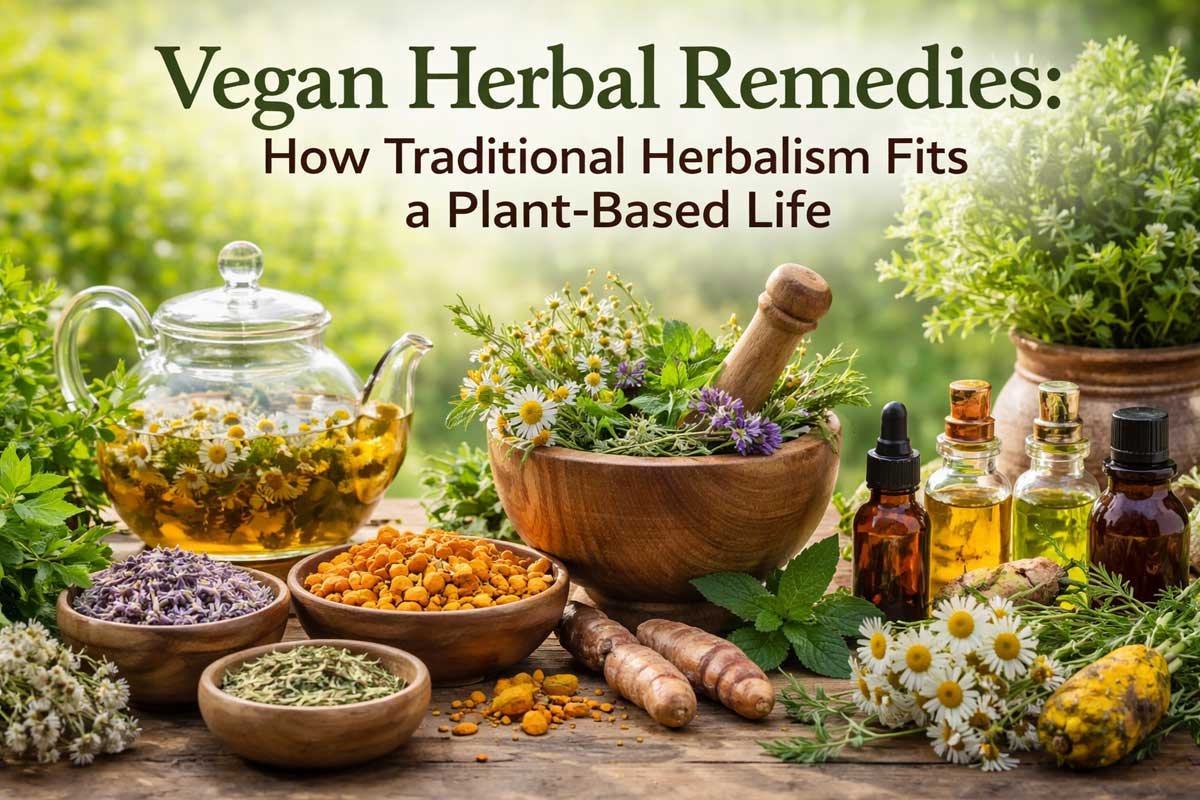
When Herbalism Meets a Plant-Based Way of Living
A plant-based life often begins with food. You clean out the fridge. You rethink protein. You start reading ingredient lists like a detective. Somewhere along the way, the question pops up quietly but persistently. What about herbal remedies? Are they really vegan? Do they fit the values that pushed you toward a plant-based life in the first place?
Vegan herbal remedies sit at an interesting crossroads. Herbalism is ancient. Veganism, at least as a defined ethical framework, is relatively young. Yet the overlap is deeper than most people expect. Long before supplements were encapsulated in gelatin or tinctures sweetened with honey, people worked almost exclusively with plants. Roots were decocted. Leaves were infused. Seeds were ground. Resins were chewed. No one was trying to optimize shelf life or flavor profiles. They were responding to the land around them.
Table of Contents

Modern herbalism complicates things. Shelves are full of capsules, extracts, syrups, and blended formulas. Some align beautifully with vegan principles. Others quietly do not. This is where vegan herbal remedies become less about ideology and more about attention. You start noticing what most people miss. The capsule shell. The solvent. The carrier oil. The sweetener. None of these are herbs, yet they decide whether a remedy fits into a plant-based life.
Vegan herbal remedies are not a niche invention. They are closer to the original form of herbal practice than many commercial products on the market today. The idea that herbalism requires animal products is largely a modern assumption driven by manufacturing convenience rather than tradition. In folk medicine, especially among rural communities with limited resources, plant-based solutions were the default. Animal products were valuable, scarce, and often reserved for food or survival tools, not daily remedies.
There is also a philosophical alignment that feels hard to ignore once you see it. Herbalism encourages relationship. With plants. With seasons. With place. A plant-based life often grows from the same soil. It values interdependence, restraint, and awareness of impact. Vegan herbal remedies sit comfortably inside that worldview. They do not ask you to compromise ethics for convenience. They ask you to slow down and choose deliberately.
That said, choosing vegan herbal remedies today is not automatic. You cannot assume that plant-based equals vegan. You have to look closer. You have to understand how remedies are made, not just what herbs are listed on the front label. This learning curve can feel frustrating at first. But it also reconnects you to herbalism as a practice, not a product category.
Many people come to vegan herbal remedies after a moment of discomfort. Maybe it is realizing that a daily tincture is preserved in honey. Maybe it is discovering gelatin capsules in a supplement taken for years. These moments are not failures. They are part of developing literacy. Herbalism, like food, rewards curiosity.
What makes vegan herbal remedies compelling is not purity or perfection. It is coherence. The feeling that your choices line up across different parts of your life. Food, health, ethics, and environment stop being separate silos. They start talking to each other. Herbalism becomes less about fixing something and more about participating in a system you respect.
This perspective also tempers expectations. Vegan herbal remedies are not about quick fixes or miracle claims. Traditional herbalism never worked that way. It worked slowly, contextually, and with humility toward the body. That mindset resonates strongly with plant-based living, where long-term patterns matter more than short-term results.
For people new to this space, there is often relief in realizing that vegan herbal remedies do not require abandoning tradition. You are not reinventing herbalism. You are peeling back layers that were added for industrial convenience. What remains is surprisingly simple. Plants. Water. Alcohol. Time. Attention.
And maybe that is the quiet appeal. In a world where wellness is loud and branded, vegan herbal remedies feel grounded. They ask fewer questions about trends and more about values. They invite you to participate, not just consume. They fit into a plant-based life not because they try to, but because they always belonged there.
Are Herbal Remedies Truly Vegan
The plant origin question
At first glance, the question feels almost silly. Herbs are plants. Veganism centers on plants. Case closed, right? That assumption is common, and it makes sense. When people talk about vegan herbal remedies, they usually imagine dried leaves, roots, flowers, or bark. That image is not wrong. It is just incomplete.
Herbal remedies are not only defined by what plant is used. They are shaped by how that plant is processed, preserved, delivered, and combined with other ingredients. This is where the idea of “plant-based” starts to drift away from “vegan,” even though the words often get used interchangeably.
Take a simple example. A chamomile tea made from dried flowers steeped in hot water fits comfortably within vegan herbal remedies. The same chamomile, extracted into alcohol, bottled with glycerin, and sweetened with honey, no longer does. The herb did not change. The surrounding choices did.
The plant origin question matters because it reveals a deeper truth about herbalism. Herbs do not exist in isolation. They move through human systems. Agriculture, harvesting, processing, formulation, and distribution all leave fingerprints on the final product. Vegan herbal remedies require paying attention to that entire chain, not just the Latin name on the label.
There is also a tendency to romanticize herbs as inherently ethical because they come from nature. Nature, however, does not make moral choices. People do. A plant can be harvested sustainably or destructively. It can be extracted gently or aggressively. It can be combined with plant-based carriers or animal-derived ones. None of this is visible unless you ask.
This is where many people feel a bit betrayed. They assumed that choosing herbal remedies automatically aligned with their plant-based values. Discovering otherwise can feel like finding gelatin in a food labeled vegetarian. It is annoying, but it is also clarifying. It pushes you to move from passive trust to active understanding.
Vegan herbal remedies are less about purity and more about intention. They require you to ask better questions. What is this made with? Why was that choice made? Was it necessary, or just convenient? Over time, these questions become second nature, the same way reading food labels once felt tedious and now feels automatic.
Where animal-derived ingredients quietly appear
Animal-derived ingredients rarely announce themselves loudly in herbal products. They tend to slip in quietly, wrapped in tradition, marketing language, or technical necessity. Honey is the most obvious example, and also the most debated. Many traditional syrups, lozenges, and electuaries rely on honey as a preservative and flavor enhancer. From a vegan perspective, this is a clear line. From an herbal tradition perspective, it is simply how things were done.
Then there is gelatin. Capsules are one of the most common delivery systems for modern herbal remedies, and gelatin capsules remain widespread. They are cheap, familiar, and easy to work with. Unless a product explicitly states that it uses plant-based capsules, it is often safe to assume gelatin is involved. This single detail quietly disqualifies many otherwise plant-centered formulations from being vegan herbal remedies.
Glycerin introduces another layer of complexity. Vegetable glycerin exists, and it works well in herbal extracts. But glycerin can also be derived from animal fats. Labels do not always clarify the source. If a tincture is labeled “glycerite” without further detail, its vegan status remains ambiguous. Ambiguity is not the same as non-vegan, but it does require extra diligence.
Less obvious examples include lactose used as a filler, beeswax used in salves, shellac used as a coating, and even dairy-derived processing aids that never appear on the final ingredient list. These are not hypothetical edge cases. They are documented practices within supplement manufacturing. They persist because most consumers do not ask, and manufacturers are not required to volunteer the information.
This is where vegan herbal remedies diverge from mainstream herbal products. They demand transparency. They reward companies that are willing to explain their choices rather than hide behind vague terms. They also challenge the idea that tradition alone justifies continued use of animal ingredients when viable plant based alternatives exist.
Alcohol extraction is often assumed to be safe territory, and in many cases it is. Ethanol derived from grains or sugarcane fits comfortably within vegan principles. The issue is not the solvent itself, but what is added after extraction. Sweeteners, stabilizers, and flavoring agents can shift the ethical profile of a remedy without changing its advertised purpose.
For people committed to a plant based life, this realization can feel exhausting at first. It seems like everything requires investigation. Over time, though, patterns emerge. You learn which forms are usually safe. Teas, powders, and plain tinctures are often easier to assess than complex blends. You learn which questions matter most. Capsule material. Sweetener source. Topical base ingredients.
Vegan herbal remedies do not eliminate complexity. They teach you how to navigate it with clarity instead of frustration.
Traditional herbalism and ethical consistency
One of the most persistent myths is that vegan herbal remedies are a modern reinterpretation that breaks from tradition. The reality is more nuanced. Traditional herbalism was pragmatic. People used what they had. In many cultures, that meant plants first, not because of ethics, but because of access.
In European folk traditions, remedies were often water based infusions and decoctions. Alcohol extraction existed, but it was not universal. Honey appeared where beekeeping was common, but it was not a requirement for herbal efficacy. In many cases, herbs were taken plainly, bitter and unadorned. Effectiveness was not tied to sweetness.
Ayurveda and traditional Chinese herbalism present a more complex picture. Both systems historically incorporated animal substances alongside plants. That fact cannot be ignored. At the same time, the vast majority of daily formulas relied heavily on herbs. Modern practitioners working within these traditions have increasingly adapted formulas to align with contemporary ethical frameworks, including veganism, without abandoning the core principles of the systems.
Ethical consistency does not mean pretending history was different than it was. It means recognizing that tradition is not static. Herbalism has always evolved in response to culture, environment, and available knowledge. Using plant based carriers instead of animal derived ones is not a betrayal of herbalism. It is a continuation of its adaptive nature.
There is also an argument that vegan herbal remedies better reflect the spirit of traditional practice than many industrialized products do. Traditional herbalism emphasized relationship, locality, and restraint. Modern mass production often prioritizes scale, shelf life, and uniformity. Choosing simpler, plant-based preparations can actually bring practice closer to its roots.
Ethical consistency shows up in small decisions. Choosing alcohol or vegetable glycerin instead of honey when possible. Selecting plant waxes instead of beeswax for topical preparations. Supporting growers and makers who treat plants as living allies rather than raw materials. None of these choices require abandoning tradition. They require engaging with it thoughtfully.
For many people, vegan herbal remedies become a way of resolving an internal tension. They no longer have to choose between honoring herbal wisdom and honoring their values. The two reinforce each other. Herbalism stops feeling like a collection of products and starts feeling like a practice again.
This consistency also builds trust. When your remedies align with your ethics, there is less mental friction. You are not constantly justifying exceptions or looking the other way. That calm matters. It creates space to actually listen to your body, notice subtle effects, and develop a more intuitive relationship with plants.
In the end, the question is not whether herbal remedies can be vegan. They clearly can be. The real question is whether you are willing to be attentive enough to choose them that way. Vegan herbal remedies do not ask for perfection. They ask for coherence. And once you experience that coherence, it is hard to go back.
Herbal Traditions That Naturally Align With Vegan Values
European folk herbalism
European folk herbalism has a quiet simplicity that often gets overlooked in modern discussions. It did not grow out of formal schools or rigid doctrines. It grew out of kitchens, fields, monasteries, and forests. Remedies were shaped by what people could gather locally and prepare with minimal tools. That context alone explains why so many practices align naturally with vegan values.
For much of European history, animal products were precious. Meat, fats, and dairy were food, not ingredients to be casually diverted into medicine. Everyday herbal remedies relied on water, time, and patience. Infusions made from leaves and flowers. Decoctions simmered from roots and bark. Poultices crushed fresh plant material directly onto the skin. These methods required no animal input and no complex processing.
Vegan herbal remedies fit seamlessly into this tradition because they mirror its original constraints. A nettle infusion does not need sweetening to be effective. A valerian decoction does not need a carrier beyond water. Bitterness was not something to be masked. It was often seen as part of the medicine itself. That attitude alone removes the need for honey or syrups, which are common sticking points for plant-based practitioners today.
Alcohol entered European herbalism primarily through monastic medicine and later through distillation advances. Ethanol became a way to preserve herbs year round, especially in colder climates. From a vegan perspective, alcohol extracted from grains or fruits presents little ethical tension. It remains one of the cleanest ways to prepare shelf stable vegan herbal remedies without introducing animal derived substances.
Folk herbalism also emphasized single herbs rather than elaborate formulas. This simplicity reduces the risk of hidden non-vegan ingredients. When a remedy is just dried elderflower or a simple tincture of dandelion root, there are fewer places for ethical misalignment to hide. That transparency is deeply appealing to anyone committed to a plant-based life.
There is another layer here that resonates strongly with vegan values. European folk herbalism was relational. Plants were gathered with respect, often accompanied by seasonal rituals or quiet acknowledgments. While not framed in modern ethical language, this attitude reflects a worldview that sees humans as participants rather than dominators. Vegan herbal remedies feel like a natural extension of that perspective.
Ayurveda through a vegan lens
Ayurveda is often assumed to be incompatible with veganism because of its historical use of dairy, ghee, and honey. That assumption deserves a closer look. Ayurveda is not a fixed list of ingredients. It is a framework for understanding balance, digestion, and individual constitution. Ingredients have always been adapted to geography, culture, and availability.
In its classical texts, Ayurveda describes a wide range of plant-based preparations. Decoctions, powders, infusions, and fermented herbal waters form the backbone of many protocols. Dairy and honey appear frequently, but they are vehicles, not the medicine itself. Their use reflects the agricultural reality of ancient India, not a philosophical dependence on animal products.
When viewed through a vegan lens, Ayurveda becomes surprisingly flexible. Many herbal actions do not depend on ghee or milk for effectiveness. Ashwagandha powder can be taken with warm water instead of milk. Triphala does not require honey to function. Turmeric works just as well infused in plant oils or consumed in food. Vegan herbal remedies can honor Ayurvedic principles without replicating every historical detail.
What matters in Ayurveda is not the ingredient itself, but how it interacts with digestion, absorption, and individual constitution. Modern plant-based alternatives can fulfill these roles. Coconut oil, sesame oil, and almond oil can replace ghee in many topical and internal applications. Plant-based milks provide a suitable medium for herbs traditionally taken in dairy, especially when digestion is considered carefully.
There is also growing recognition within contemporary Ayurvedic practice that ethical considerations matter. Practitioners working with vegan people have adapted formulas thoughtfully rather than dismissing their values. This adaptation is not a compromise. It reflects the living nature of Ayurveda as a system that responds to context.
Vegan herbal remedies grounded in Ayurveda tend to emphasize daily routines rather than heroic interventions. Herbal teas, digestive spices, gentle tonics, and seasonal cleanses align well with plant based living. They support long term balance without relying on animal products or intensive extraction methods.
This approach also challenges the idea that veganism weakens traditional systems. In practice, it often sharpens them. When you remove habitual ingredients like ghee or honey, you pay closer attention to the herbs themselves. You notice dosage, timing, and preparation more carefully. The practice becomes more intentional, not less authentic.
Traditional Chinese herbalism and modern adaptations
Traditional Chinese herbalism is often seen as the hardest tradition to reconcile with vegan values. Historically, it included a range of animal substances alongside plant materials. That history is real and should not be glossed over. At the same time, it does not define the entirety of the system.
The vast majority of Chinese herbal formulas rely primarily on plants. Roots, barks, seeds, mushrooms, and minerals form the foundation. Animal substances were typically reserved for specific, often severe conditions, not everyday use. For most people engaging with traditional Chinese herbalism today, especially outside clinical settings, plant based formulas are already the norm.
Modern adaptations have accelerated this shift. Ethical concerns, conservation issues, and regulatory changes have led many practitioners to replace animal derived ingredients with botanical alternatives. These substitutions are not random. They are guided by traditional theory, focusing on energetic qualities and functional actions rather than literal replication.
Medicinal mushrooms play a significant role here. Reishi, shiitake, and other fungi occupy an interesting space within Chinese herbalism. They are neither plant nor animal, yet they fit comfortably within vegan frameworks. Their long history of use and modern research interest have made them central to contemporary vegan herbal remedies inspired by Chinese traditions.
Another key adaptation involves delivery methods. Traditional decoctions prepared at home from raw herbs are inherently vegan when plant based ingredients are used. Issues arise mainly in patent medicines, pills, and syrups, where excipients and coatings can include animal derivatives. Returning to bulk herbs and custom decoctions often resolves these concerns.
There is also a philosophical resonance worth noting. Traditional Chinese herbalism emphasizes harmony, moderation, and responsiveness to change. These principles align closely with plant based ethics. Choosing vegan herbal remedies within this system becomes an expression of harmony applied to modern ethical awareness.
Practitioners who work in this space often speak about substitution as an act of skill, not loss. It requires deeper understanding of the materia medica and the logic behind formulas. In that sense, vegan adaptations can elevate the practice rather than dilute it.
For individuals navigating this tradition on their own, the key is discernment. Not every product labeled “Chinese herbal” aligns with vegan values, but many can. Asking about ingredients, choosing whole herb preparations, and favoring transparent sourcing makes a significant difference.
Across these traditions, a common thread emerges. Herbalism was never static. It has always responded to human values and environmental realities. Vegan herbal remedies are not an outlier. They are one of the current expressions of that ongoing evolution, rooted in old knowledge and shaped by modern conscience.
Practical Use of Vegan Herbal Remedies in Daily Life
Teas, tinctures, and powders without animal inputs
The easiest way to bring vegan herbal remedies into daily life is to start with the simplest forms. Not because they are weaker or less sophisticated, but because they leave very little room for ethical confusion. Teas, tinctures, and powders have been the backbone of herbal practice for centuries, and when prepared thoughtfully, they fit cleanly into a plant-based life.
Herbal teas are the most straightforward. Dried leaves, flowers, seeds, or roots combined with hot water. Nothing hidden. Nothing implied. When you prepare a tea at home, you control the process from start to finish. This alone makes teas a cornerstone of vegan herbal remedies. They are honest. They taste like what they are. They invite you to slow down and notice.
Powders are similarly transparent. Whole herbs dried and finely ground retain the full plant material. There is no carrier, no solvent, no capsule required unless you choose one. Powders can be mixed into water, sprinkled into food, or taken directly. Their simplicity is often mistaken for crudeness, but in traditional herbalism, powders were valued for their completeness. Nothing removed. Nothing added.
Tinctures require a bit more attention, but they are far from incompatible with vegan values. Alcohol based tinctures made with ethanol derived from grains or sugarcane are fundamentally plant-based. The key is what comes after extraction. Many tinctures are sold as plain alcohol extracts, which fit comfortably within vegan herbal remedies. Problems arise when sweeteners or stabilizers are added without clear disclosure.
Vegetable glycerin offers a plant-based alternative for those who avoid alcohol. Glycerites can be effective when properly prepared, but sourcing matters. “Vegetable” should be explicit, not implied. When it is, glycerites become a useful tool within a vegan framework, especially for daily or long-term use.
Capsules introduce complexity. The herb inside may be perfectly plant-based, while the capsule itself is not. Choosing powders in bulk and using plant-based capsules, or skipping capsules entirely, keeps things simple. Convenience is appealing, but it often comes at the cost of clarity. Vegan herbal remedies tend to favor forms that prioritize understanding over speed.
There is a quiet confidence that comes from knowing exactly what you are consuming. When your daily remedies are built from teas, tinctures, and powders you recognize and trust, herbalism stops feeling like a product category and starts feeling like a practice again.
Reading labels and asking better questions
Label literacy is not optional when it comes to vegan herbal remedies. It is a skill, and like any skill, it improves with use. At first, labels seem either overwhelming or suspiciously vague. Over time, patterns emerge, and red flags become obvious.
The first thing to look for is not the herb. It is everything else. Capsule material. Sweeteners. Fillers. Carriers. If these are not clearly stated, that absence is information. It does not automatically mean a product is non-vegan, but it does mean you cannot assume it is.
Words like “natural flavors,” “proprietary blend,” or “other ingredients” deserve scrutiny. They are not inherently bad, but they often hide details that matter for ethical consistency. Vegan herbal remedies thrive on transparency. The more clearly something is labeled, the easier it is to trust.
Asking questions is part of the process. Reputable producers expect them. Where is the glycerin sourced from? What is the capsule made of? Is the alcohol grain-based? These are not confrontational questions. They are practical ones. Companies that cannot or will not answer them reveal something important about their priorities.
There is also value in understanding common defaults. Gelatin capsules remain widespread. Honey is still the default sweetener in many syrups. Beeswax is common in salves. Knowing this helps you ask targeted questions instead of vague ones. Precision saves time and frustration.
Over time, you develop a mental shortcut system. Certain forms and brands earn trust. Others require verification every time. This is not cynicism. It is discernment. Vegan herbal remedies reward this kind of engagement because they are built on intentional choice rather than blind consumption.
It is also worth acknowledging the emotional side of this process. Discovering that a long used remedy does not align with your values can feel irritating or even disappointing. That reaction is normal. The goal is not to eliminate these moments, but to learn from them without judgment.
Building a simple vegan herbal routine
A daily herbal routine does not need to be elaborate to be effective. In fact, simplicity often leads to consistency, and consistency is where herbal practice shows its value. Vegan herbal remedies work best when they are woven into daily rhythms rather than treated as occasional interventions.
Start with one or two herbs you genuinely enjoy. Taste matters. If you dread drinking a tea, you will not stick with it. Many traditional tonics were consumed daily precisely because they were palatable, even pleasant. A morning infusion or an evening cup becomes part of the day, not a chore.
Choose forms that fit your lifestyle. If you enjoy the ritual of preparation, loose herbs and teas are ideal. If your schedule is unpredictable, a well-sourced tincture may be more realistic. Vegan herbal remedies are not about proving commitment through inconvenience. They are about creating alignment you can sustain.
Pay attention to timing. Some herbs feel better earlier in the day. Others naturally belong in the evening. This observation-based approach mirrors traditional practice and keeps you engaged with how your body responds. It also discourages the habit of stacking too many remedies at once.
Resist the urge to overcomplicate. A cupboard full of half-used herbs does not create wisdom. A small, well-understood selection does. Many experienced herbalists rely on a surprisingly limited materia medica for daily use. Depth matters more than breadth.
Finally, allow your routine to evolve. Seasons change. Needs shift. Vegan herbal remedies are not static prescriptions. They are tools you adapt over time. This flexibility is part of what makes them compatible with a plant-based life rooted in awareness rather than rigid rules.
When daily practice feels coherent, something subtle happens. Herbalism stops being about fixing what is wrong and starts being about maintaining relationships. With your body. With plants. With your values. That is where vegan herbal remedies quietly do their best work.
Living the Plant-Based Herbal Path Without Compromise
Living fully within a plant-based herbal path is less about rigid rules and more about aligning choices with values consistently and consciously. It requires a shift in perspective: seeing herbalism not as a collection of products to consume, but as a practice that intersects ethics, ecology, and daily life. This approach lets you use vegan herbal remedies without compromise, honoring both the tradition of herbs and the principles of a plant-based lifestyle.
At its core, this path begins with awareness. Every herb you choose carries a story: where it grew, how it was harvested, and how it was processed. Engaging with these details is not meant to be exhausting. It is meant to reconnect you to the rhythm of herbalism itself. Once you notice patterns—how teas differ from powders, how tinctures vary based on glycerin sources, how salves are prepared—you stop relying on labels alone and start relying on your own discernment. That discernment is the foundation of uncompromising plant-based practice.
Ethics extends beyond the obvious. Avoiding animal-derived ingredients is critical, but it is only the starting point. Consider sustainability, fair sourcing, and ecological impact. Supporting growers who prioritize organic, regenerative practices ensures that your herbal routine contributes positively to the broader system. Vegan herbal remedies flourish when ethics are holistic: they honor the plant, the planet, and the people involved.
Ritual and routine play a surprisingly large role in maintaining this coherence. Brewing a simple nettle infusion in the morning, stirring a powdered adaptogen into a smoothie, or applying a calendula salve at night becomes more than habit; it becomes a mindfulness practice. Each step reminds you that the herbs are not just ingredients—they are partners in daily life. This conscious engagement is what separates a routine built from boxes of products from a genuine practice of herbalism.
Flexibility is also essential. Plant-based herbalism does not demand perfection or rigidity. Some days your routine will be interrupted, and some products will be harder to source. The difference between compromise and adaptation is intention. Choosing a plant-based alternative for convenience or seasonal availability is not abandoning ethics; it is honoring them while navigating real life. Vegan herbal remedies are adaptable by design, because plants themselves are adaptive.
Education compounds the ability to practice without compromise. Learning about different traditions—European folk medicine, Ayurveda, Traditional Chinese Medicine—reveals that plant-based herbal remedies are historically grounded. You begin to see that ethical adaptation is not a modern invention, but a continuation of herbalism’s evolutionary story. Each choice becomes informed, deliberate, and confident rather than reactive or accidental.
Community matters too. Engaging with fellow practitioners, reading transparent sources, or joining ethical herbal groups reinforces patterns of clarity. Seeing what others prioritize—how they assess ingredient sourcing, how they verify vegan compliance, how they integrate herbs into life—helps normalize careful attention. This shared knowledge becomes a safety net for those seeking to live a plant-based herbal path without compromise.
Living this path also teaches patience. Herbal remedies are rarely dramatic. They work through subtle, cumulative influence. Plant-based herbalism encourages the same mindset as sustainable living: long-term attention, observation, and incremental adjustment. You do not need dozens of products to feel aligned. You need thoughtful, consistent choices that reflect your values in everyday actions.
Ultimately, living the plant-based herbal path without compromise is about coherence, trust, and integration. It is about ensuring that what you consume, apply, and prepare aligns with your ethics, your health philosophy, and your engagement with the natural world. It transforms herbalism from a transactional interaction into an ongoing dialogue—with plants, with your body, and with the principles guiding your life. When these threads align, vegan herbal remedies are no longer just a niche choice; they become a seamless extension of living ethically, intentionally, and holistically every day.
Best-selling Vegan Products


Article Sources
At AncientHerbsWisdom, our content relies on reputable sources, including peer-reviewed studies, to substantiate the information presented in our articles. Our primary objective is to ensure our content is thoroughly fact-checked, maintaining a commitment to accuracy, reliability, and trustworthiness.
- Sangiovanni, E., Brivio, P., Dell’Agli, M., & Calabrese, F. (2017). Botanicals as Modulators of Neuroplasticity: Focus on BDNF. Neural Plasticity, 2017, 5965371. https://doi.org/10.1155/2017/5965371
- Bone, K., & Mills, S. (2013). Principles and Practice of Phytotherapy: Modern Herbal Medicine (2nd ed.). Churchill Livingstone.
- Blumenthal, M., Goldberg, A., & Brinckmann, J. (2000). Herbal Medicine: Expanded Commission E Monographs. Integrative Medicine Communications.
- WHO. (2004). WHO Guidelines for Assessing Quality of Herbal Medicines with Reference to Contaminants and Residues. World Health Organization. https://www.who.int/publications/i/item/9241591618
- Mukherjee, P. K., Nema, N. K., Maity, N., & Sarkar, B. K. (2012). Quality control of herbal drugs: Challenges and approaches. Journal of Herbal Medicine, 2(2), 12–19. https://doi.org/10.1016/j.hermed.2012.03.001
- Tyagi, S., & Aggarwal, B. B. (2015). Herbal supplements and their ethical considerations in modern herbal practice. Journal of Ethnopharmacology, 172, 31–42. https://doi.org/10.1016/j.jep.2015.06.015
- Chopra, A., Doiphode, V. V. (2002). Ayurvedic medicine: Core concept, therapeutic principles, and current relevance. Medical Clinics of North America, 86(1), 75–89. https://doi.org/10.1016/S0025-7125(03)00053-2
- Kemper, K. J., & Shannon, S. (2003). Ethical considerations in herbal medicine. Complementary Therapies in Medicine, 11(3), 171–177. https://doi.org/10.1016/S0965-2299(03)00026-1
- Bensky, D., Clavey, S., & Stoger, E. (2004). Chinese Herbal Medicine: Materia Medica (3rd ed.). Eastland Press.
- Hobbs, C. (2010). Medicinal Mushrooms: An Exploration of Tradition, Healing, & Culture. Botanica Press.

- Nectarine: Stone Fruit for Heart Health and Antioxidants - March 8, 2026
- Peach: Hydrating Fruit for Skin Health and Digestion - March 8, 2026
- Plum: Fiber-Rich Fruit for Digestion and Heart Health - March 8, 2026
