
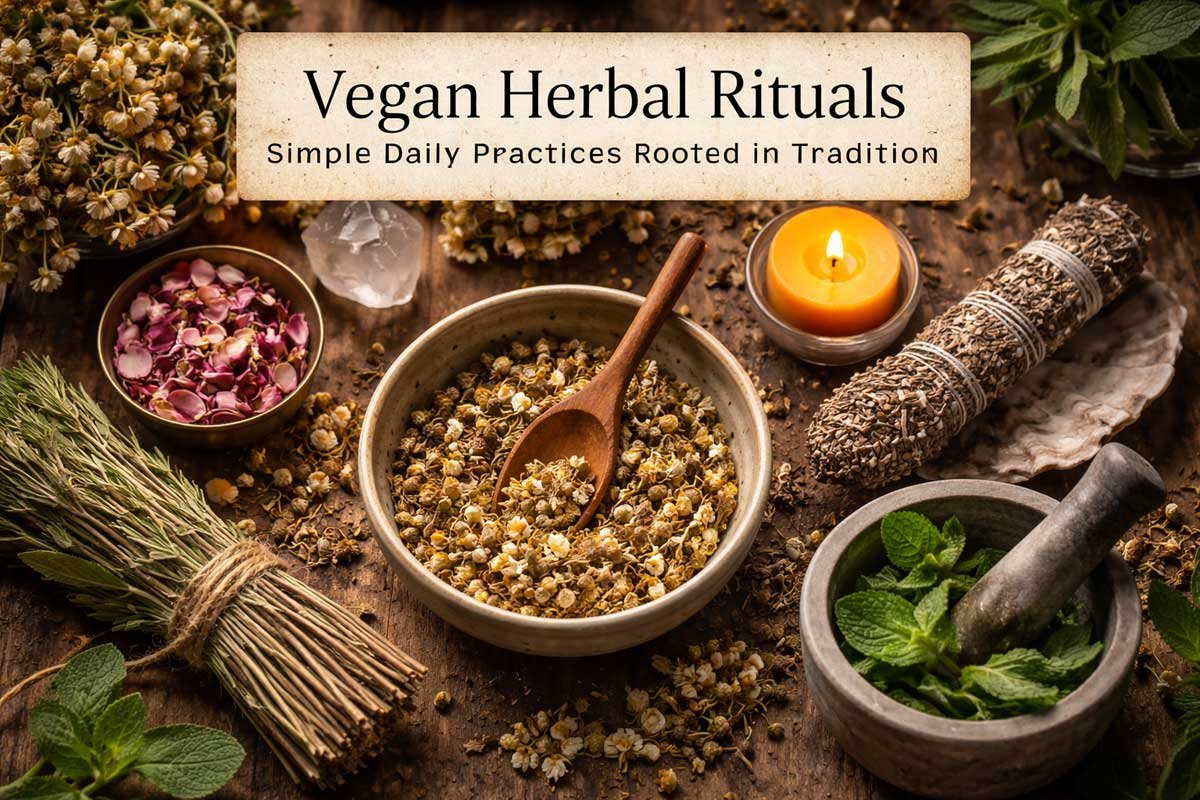
Where Daily Life Meets Plant Wisdom
Herbal rituals did not begin as wellness routines, productivity tools, or aesthetic habits shared online. They emerged quietly, shaped by repetition and need. Someone boiled leaves every morning because it helped them feel awake enough to work the fields. Someone else steeped roots at night because sleep came easier afterward. Over time, those small acts became familiar, almost invisible. That is how ritual is born. Not from ceremony, but from usefulness repeated until meaning settles in.
In a modern vegan context, herbal rituals often arrive stripped of their original setting. We inherit fragments. A chamomile tea before bed. A bitter tincture before meals. A handful of herbs added to soup because it feels grounding. These gestures may seem simple, even casual, yet they carry echoes of older systems of thought where plants were not supplements or trends but companions in daily life. Plant wisdom lived in kitchens, gardens, and hands that touched the same materials every day.
Table of Contents

What makes herbal rituals distinct from casual herb use is intention anchored in routine. Intention does not need grand language or spiritual framing. It can be as plain as noticing how your body responds, or choosing to slow down for five minutes while the water heats. A ritual gains weight through consistency. The act becomes familiar enough that it starts shaping how the day unfolds. Morning tea signals the start of movement. Evening infusions mark the shift toward rest. These cues matter more than the specific herb chosen.
Vegan living often sharpens awareness of daily choices. Food, sourcing, preparation, and waste are no longer background noise. They require attention. Herbal rituals naturally fit into this mindset because they rely on plants in their whole or gently processed forms. Leaves, roots, seeds, bark. Nothing abstract. Nothing hidden. You see what you are working with, smell it, taste it, and adjust over time. That sensory feedback creates a relationship rather than a rule.
Historically, herbal Extraction or standardization mattered far less than timing and repetition. People worked with what grew nearby and adapted practices to climate, season, and labor demands. A warming decoction in winter. Cooling infusions in summer. Bitter greens in early spring. These choices aligned with availability, not optimization. Modern herbal rituals can still honor this logic by focusing less on perfection and more on rhythm.
Ritual also acts as a pause. In a day shaped by screens and speed, preparing herbs interrupts momentum. Water must heat. Leaves must steep. Nothing happens instantly. This enforced waiting creates space to notice breath, hunger, fatigue, or mood without labeling or fixing them. That moment of attention is part of the ritual itself, not a side effect. Many people find that this pause is the most valuable aspect of herbal rituals, even more than the plants involved.
Within vegan culture, there is often pressure to do things correctly. Correct nutrients. Correct substitutions. Correct ethical choices. Herbal rituals offer relief from that rigidity. There is no perfect cup of tea or ideal time to drink it. Tradition provides guidance, not commands. A ritual survives because it adapts. Miss a day, return the next. Change the herb when seasons shift. Let preference evolve. This flexibility keeps the practice alive rather than brittle.
Plant wisdom is not stored only in texts or studies. It lives in observation. Does a certain infusion make you feel heavy or light? Does the smell of a particular herb signal comfort or alertness? Over time, these impressions form a personal map. That map may differ from someone else’s, and that difference is not a flaw. Herbal rituals respect individual experience because they are built from repetition, not prescription.
There is also an ethical dimension that often goes unspoken. Working with herbs daily encourages respect for limits. Plants grow slowly. Harvesting requires restraint. Even store-bought herbs represent land, labor, and time. When rituals are frequent, waste becomes obvious and uncomfortable. You learn to prepare only what you need. You notice quality. You start asking where things come from. This quiet awareness aligns naturally with vegan values centered on harm reduction and care.
Modern discussions of herbs often separate tradition from evidence, as if one must cancel the other. Daily herbal rituals sit somewhere else entirely. They are not arguments. They are lived habits. A person does not need to justify why they drink the same infusion every evening if it supports a sense of closure to the day. The value lies in continuity. Tradition, in this sense, is simply memory carried forward through action.
Many people approach herbal rituals during periods of change. Shifting to a vegan diet. Moving cities. Adjusting to new schedules. Rituals provide anchors when other structures feel unstable. They do not demand belief. They ask only for participation. Boil water. Add herbs. Wait. Drink. Repeat tomorrow. That simplicity can feel surprisingly grounding when everything else feels negotiable.
It is worth noting that ritual does not require complexity. A single plant can support a lifelong practice. So can a blend that changes with availability. The pressure to collect, combine, and optimize often comes from outside the tradition itself. Historically, restraint was common. Fewer plants, deeper familiarity. Herbal rituals thrive under those conditions because familiarity breeds nuance. You start noticing small differences in flavor depending on harvest or storage. You learn how long to steep without checking instructions. The practice becomes embodied.
Vegan herbal rituals also blur the line between food and herb. Culinary herbs cross easily into ritual use because they are already part of daily meals. Parsley, fennel, rosemary, thyme. When used intentionally, cooking itself becomes ritualized. Chopping, simmering, tasting. These actions repeat daily, making them powerful carriers of meaning. The boundary between nourishment and ritual dissolves.
Another overlooked aspect is social transmission. Many herbal rituals survive because someone else modeled them. A family member who always drank the same tea. A friend who kept a jar of dried leaves by the stove. These influences rarely arrive as formal teaching. They appear as habits witnessed and quietly adopted. Even now, people pass rituals along without explanation. Try this. I drink it every night. That is often enough.
Daily life is not poetic most of the time. It is repetitive, rushed, and fragmented. Herbal rituals do not romanticize this reality. They fit inside it. They accept interruption. They tolerate inconsistency. Their strength lies in adaptability. A ritual that survives imperfect days is more valuable than one that collapses under pressure.
At its core, plant wisdom is relational. It grows through use, not theory. When herbs become part of daily life rather than occasional remedies, they stop feeling external. They blend into routines the same way meals or rest do. Over time, this integration changes how plants are perceived. Not as tools to fix problems, but as steady presences that accompany ordinary moments.
Herbal rituals remind you that support does not always arrive through dramatic change. Sometimes it shows up as a familiar taste at the same time every day. A small, repeatable act that signals continuity. In a world that rewards novelty and speed, choosing repetition becomes a quiet form of resistance. One rooted in tradition, simplicity, and lived experience rather than performance.
This is where daily life meets plant wisdom. Not in grand gestures, but in ordinary moments repeated often enough to matter.
Morning Herbal Rituals for Grounding and Clarity
Mornings carry a particular kind of weight. Before the day has fully revealed itself, the body is already negotiating sleep, hunger, anticipation, and habit. This is where herbal rituals earn their place. Not as motivation hacks or performance enhancers, but as quiet frameworks that help the system arrive gently into motion. A morning ritual does not push. It invites.
In traditional settings, mornings were shaped by necessity. Fires had to be lit. Water fetched. Food prepared. Herbs naturally entered this rhythm because they were part of what was already happening. Leaves were added to hot water because it was available. Bitter greens were chewed because they grew nearby. Steam rose because cooking required it. Over time, these actions became reliable signals. The day had begun.
Modern mornings look different, but the nervous system still responds to cues. Herbal rituals work here because they are slow enough to counter urgency and familiar enough to require little decision making. You do not need to invent anything each day. You repeat what you already know. That repetition creates stability before external demands arrive.
Herbal Infusions as Intentional Beginnings
A simple herbal infusion can define the opening tone of the day. Not because of its chemical profile alone, but because of the way it structures time. Water must heat. Herbs must steep. Hands must wait. That sequence matters.
Many people reach for caffeine immediately upon waking. There is nothing inherently wrong with that, but it often skips the transition phase between rest and activity. Herbal rituals built around infusions restore that missing step. Even when caffeine is part of the routine, placing an herbal infusion before or alongside it changes the pacing. The body is acknowledged before it is asked to perform.
Infusions have been morning staples across cultures for centuries. Leaves and flowers were commonly used because they extract easily and feel lighter in the system. The goal was not stimulation but orientation. A warm liquid moving through the body signals safety and readiness. It wakes digestion gently and anchors attention.
The choice of herb often reflects climate and season rather than abstract rules. In cooler environments, warming plants were favored. In warmer regions, lighter or aromatic herbs were common. What matters more than the specific plant is consistency. Drinking the same infusion each morning teaches the body what to expect. That predictability reduces friction at the start of the day.
There is also something quietly grounding about beginning the day with a non commercial substance. No branding. No packaging noise. Just plant material and water. In vegan living, this simplicity can feel especially aligned. It reinforces the idea that nourishment does not always need to be optimized or purchased in complex forms. Herbal rituals remind you that enough is often already available.
Intentional beginnings do not require silence or meditation. They require presence. Even preparing an infusion while distracted still carries value because the sequence remains intact. Over time, attention naturally returns to the act because repetition breeds familiarity, and familiarity invites noticing.
Bitter Herbs and Digestive Awakening
Bitterness has largely disappeared from modern breakfast routines. Sweet, salty, and bland dominate. Yet bitterness once played a central role in morning herbal rituals, especially in traditional food cultures. Bitter herbs were taken before meals not as interventions, but as signals. They told the body that nourishment was coming.
In a vegan context, digestive awareness often becomes more pronounced due to higher fiber intake and varied plant foods. Bitter herbs fit naturally into this landscape because they encourage attentiveness rather than force. The taste itself demands presence. You cannot ignore bitterness. It wakes the senses.
Historically, bitter plants were rarely isolated or dramatized. They were chewed fresh, infused briefly, or added to simple preparations. The amounts were small. The goal was not to overwhelm but to nudge. That restraint is an important lesson for modern herbal rituals, which sometimes drift toward excess.
Taking bitterness in the morning establishes a relationship with appetite and digestion that is based on signaling rather than control. It encourages you to notice hunger cues instead of suppressing them or rushing past them. This is especially valuable in a culture where mornings are often compressed and meals delayed.
Bitterness also carries symbolic weight. It represents complexity and maturity. Incorporating bitter herbs into morning herbal rituals can feel like reclaiming a lost sensory experience. At first, resistance is common. Over time, appreciation grows. That shift mirrors how rituals themselves deepen through repetition.
Practical application remains simple. A small amount of bitter herb taken before breakfast. A few sips of an infusion. A leaf added to a morning broth. The key is consistency rather than intensity. Bitter herbal rituals lose their grounding effect when they become performative or extreme.
Importantly, bitterness invites pacing. You sip slowly. You pause between tastes. This slows the entire morning sequence. Even when time is limited, that pause can recalibrate the day’s tempo.
Scent, Steam, and Sensory Focus
Not all herbal rituals involve ingestion. Some of the most grounding morning practices rely on scent and steam. These sensory rituals work quickly and require minimal preparation, which makes them accessible on busy days.
Steam rises naturally during cooking and infusion preparation. Leaning into that moment rather than rushing past it transforms a functional act into a ritualized one. Aromatic herbs release volatile compounds into the air, engaging the senses before the mind fully engages with tasks. This creates a soft landing into wakefulness.
Across traditions, aromatic plants were burned, steamed, or crushed in the morning to clear indoor spaces and mark the start of activity. These practices were not framed as self care. They were practical. Scent freshened the air. Steam warmed the body. Awareness followed naturally.
In modern homes, scent is often outsourced to synthetic products. Herbal rituals reclaim it through direct contact with plants. The difference is immediate. Natural aromas shift quickly and fade naturally. They do not linger aggressively. This impermanence is part of their grounding effect.
Morning sensory rituals can be as simple as inhaling steam from an infusion before drinking it. Or crushing a fresh herb between the fingers and noticing its aroma. Or adding aromatic plants to hot water while washing dishes. These actions integrate seamlessly into existing routines.
Sensory focus also acts as a bridge between sleep and cognition. The mind may still feel scattered or dull in the morning. Engaging smell and touch anchors attention without effort. Herbal rituals excel here because they rely on physical cues rather than mental discipline.
Over time, specific scents become associated with morning readiness. This associative learning strengthens the ritual. The body begins responding before conscious thought intervenes. That is the quiet power of repetition.
What matters most is restraint. One scent. One moment. Sensory overload defeats the purpose. Traditional herbal rituals favored simplicity because it allowed the nervous system to orient rather than react.
Morning herbal rituals do not aim to optimize productivity or sharpen focus aggressively. They aim to establish coherence. Body, senses, and environment align just enough to begin. That alignment carries forward into the rest of the day, often unnoticed but deeply felt.
When mornings are anchored in plant-based rituals that respect timing, taste, and sensation, clarity emerges as a side effect rather than a goal. Grounding happens the same way. Not through effort, but through familiarity.
Midday and Evening Rituals That Restore Balance
By the middle of the day, momentum has usually taken over. Decisions stack up. Sensory input accumulates. Meals are eaten quickly or delayed entirely. This is where herbal rituals shift their role. In the morning, they orient. Later in the day, they interrupt. They create punctuation in long stretches of effort and attention.
Traditional herbal practices rarely separated herbs into neat categories like energizing or calming based on the clock alone. Instead, they responded to what the day demanded. Midday often required steadiness rather than stimulation. Evening called for release rather than collapse. Herbal rituals that support these transitions are less about adding something new and more about helping the body shift gears without resistance.
In vegan daily life, where meals, work, and personal time often blur together, these rituals offer structure without rigidity. They do not demand withdrawal from responsibilities. They fit into what is already happening, reshaping it gently.
Herbal Teas as Transitional Moments
Tea occupies a unique place in herbal rituals because it is both ordinary and deliberate. Preparing tea requires just enough attention to interrupt autopilot, but not so much that it becomes burdensome. This makes it an ideal marker between phases of the day.
Midday tea rituals historically aligned with labor cycles. Workers paused not to rest indefinitely, but to recalibrate. Warm liquid soothed the digestive system, which was often taxed by earlier meals or physical exertion. The pause itself mattered as much as the plants used.
In modern settings, midday often arrives without a clear boundary. Screens remain active. Tasks overlap. A cup of herbal tea can reintroduce a sense of sequence. You stop. You prepare. You wait. You drink. That sequence signals a transition even if the external environment does not change.
Herbal rituals built around midday tea are especially useful for people who skip meals or eat quickly. Warm infusions support digestion indirectly by encouraging slower consumption and conscious breathing. This is not about correcting behavior, but about creating conditions where the body can regulate itself more easily.
The choice of herbs at midday often leans toward gentle aromatics or mild bitters. These plants do not dominate attention. They accompany it. Their role is to support clarity without pushing the system into overdrive. This balance is crucial in vegan routines that already rely heavily on plant based foods and fibers.
Evening tea rituals carry a different quality. They are not about pausing before continuing, but about signaling completion. Historically, evening infusions marked the end of communal work and the beginning of rest. That symbolism still resonates, even when work extends into private spaces.
What gives tea its ritual power is not the vessel or tradition attached to it, but repetition. The same cup. The same preparation. The same time window. Over weeks, the body learns the cue. Tension begins to release earlier. Appetite adjusts. Attention softens. Herbal rituals work quietly this way, through association rather than instruction.
Culinary Herbs as Quiet Daily Medicine
Culinary herbs rarely receive the respect given to more exotic or medicinal plants, yet they form the backbone of many enduring herbal rituals. Their strength lies in frequency. A plant used once a month cannot shape daily rhythms the way a plant used at nearly every meal can.
Historically, the distinction between food and medicine was fluid. Herbs were added to meals because they tasted good, grew locally, and supported digestion. No one needed to label this as therapy. It was simply how food was prepared.
In vegan kitchens, culinary herbs often appear as flavor enhancers rather than ritual elements. Shifting perspective changes everything. When herbs are added intentionally, cooking itself becomes a ritual. Chopping, heating, stirring, and tasting form a sequence that mirrors traditional preparation practices.
These actions ground attention in the present moment. You smell herbs as they hit warm oil or water. You adjust seasoning gradually. You taste and pause. This sensory engagement counters the tendency to rush meals or eat distractedly, which is common in busy schedules.
Culinary herbal rituals also support balance by spreading plant intake across the day rather than concentrating it into supplements or isolated practices. This aligns with traditional patterns where small amounts of herbs were consumed consistently rather than in large, infrequent doses.
There is a humility to culinary herbs that fits well with vegan values. They are accessible. Often inexpensive. Easy to grow. Using them daily fosters familiarity and respect rather than novelty seeking. Over time, you begin to notice subtle effects. Certain herbs feel grounding. Others feel uplifting. These observations arise organically through use.
Evening cooking rituals carry particular weight. Preparing food with herbs at the end of the day signals care without effort. It transforms nourishment into a closing act rather than another task. This is especially important in households where dinner marks the only true pause of the day.
When culinary herbs are treated as part of herbal rituals, meals stop feeling transactional. They become markers of time and transition, anchoring the day without requiring additional structure.
Evening Nervines and Nervous System Unwinding
As evening approaches, the body seeks resolution. Not collapse, but release. Traditional herbal rituals recognized this need and often turned to plants now described as nervines. These herbs were valued for their ability to support rest through familiarity rather than force.
Evening rituals built around nervine herbs are among the most enduring across cultures. They survived because they worked within daily life rather than against it. A warm infusion after the final meal. A shared cup before sleep. These acts required no explanation.
In modern vegan life, evenings are often overstimulated. Artificial light, screens, and delayed meals disrupt natural wind down cues. Herbal rituals reintroduce sensory signals that the nervous system recognizes. Warmth. Mild bitterness or sweetness. Familiar aroma.
The effectiveness of these rituals depends less on potency and more on timing. Taking the same infusion at roughly the same time each evening conditions the body to anticipate rest. Over time, the ritual itself becomes calming, regardless of external stressors.
It is important to note that evening herbal rituals are not about sedation. They do not erase thoughts or emotions. They create space for them to settle. This distinction matters, especially for those who carry the day’s experiences into the night.
Rituals that unwind the nervous system often extend beyond drinking herbs. Dimmed lights during preparation. Slower movements. Reduced conversation. These contextual elements amplify the effect. The herb becomes part of a larger sensory environment rather than a standalone solution.
Historically, these rituals were communal. Families or households shared them. Even when practiced alone today, that sense of continuity remains. You are participating in a pattern that has outlived countless individual days.
Midday and evening herbal rituals restore balance not by correcting imbalances, but by acknowledging them. They respect the natural arc of effort and rest. In doing so, they make space for recovery without requiring justification.
When these rituals are woven gently into daily life, balance stops being something to achieve and becomes something that happens on its own, one repeated act at a time.
Seasonal and Cyclical herbal rituals in Vegan Practice
Daily rituals build stability, but seasonal and cyclical herbal rituals provide orientation. They remind you that life is not flat or linear. Energy rises and falls. Appetite changes. Attention sharpens and dulls. Traditional plant practices were never meant to remain static throughout the year. They shifted with weather, daylight, workload, and availability. When herbal rituals lose that flexibility, they start feeling forced or performative.
Vegan practice already carries an implicit awareness of cycles. Produce changes. Markets rotate. Cravings evolve. Aligning herbal rituals with these rhythms feels intuitive once the pressure to standardize is released. Instead of asking what should be taken year round, the question becomes simpler. What is present now, and how does it want to be used.
Seasonal rituals slow time. They stretch attention beyond the day or week and place it within a longer arc. This perspective reduces urgency. Not everything needs to be addressed immediately. Some things resolve through timing alone.
Working With Seasonal Plants
Seasonality was once unavoidable. Plants appeared when they appeared. Preservation mattered. Choice was limited. That constraint shaped herbal rituals that felt coherent because they matched the environment. Modern access has erased many of those boundaries, but the body still responds to seasonal cues.
Working with seasonal plants brings herbal rituals back into dialogue with place. Fresh spring greens signal renewal and movement. Aromatic summer herbs cool and disperse. Roots and seeds dominate colder months, offering density and warmth. These patterns repeat across cultures because they reflect shared human physiology rather than ideology.
In vegan living, seasonal herbal work integrates naturally with food choices. When meals shift with the seasons, herbs can follow the same logic. This avoids the mental load of deciding what to use and when. The environment makes the decision for you.
Seasonal herbal rituals also encourage restraint. When a plant is available only briefly, it is used thoughtfully. Attention sharpens. You notice flavor and texture more clearly. That heightened awareness deepens the ritual without adding complexity.
Preservation itself becomes ritualized. Drying herbs, storing roots, preparing infusions for later use. These acts extend the season without denying its limits. They teach patience and planning rather than accumulation. In vegan contexts that value sustainability, this approach feels aligned rather than imposed.
Importantly, seasonal practice does not require strict adherence. Climate varies. Personal schedules differ. The point is orientation, not obedience. Even small adjustments, such as rotating herbs every few months, can restore a sense of movement that static routines lack.
Seasonal herbal rituals work because they reduce friction. Instead of forcing the body into the same pattern year round, they adapt. That adaptability is not weakness. It is tradition functioning as intended.
Lunar and Weekly Herbal Rhythms
Beyond seasons, many cultures observed shorter cycles. Lunar phases, market days, rest days. Herbal rituals often mirrored these rhythms, not through elaborate ceremony, but through subtle shifts in activity and intake.
Lunar awareness does not require belief to be useful. The moon offers a visible marker of time passing. Waxing and waning create a sense of progression that modern calendars often flatten. Some people naturally feel more outward focused at certain times and more reflective at others. Herbal rituals can support these tendencies without defining them rigidly.
Weekly rhythms are even more accessible. Most lives still contain some variation across the week. Workdays differ from rest days. Social energy fluctuates. Aligning herbal rituals with these patterns adds structure without additional effort.
For example, a stronger tasting infusion prepared on days that demand focus. A gentler, familiar tea reserved for evenings before rest days. These choices are not prescriptions. They are responses to lived experience.
Historically, weekly herbal rituals often aligned with communal schedules. Market days dictated access to fresh plants. Rest days encouraged slower preparations. Even now, grocery patterns and social habits shape availability. Noticing these rhythms rather than resisting them simplifies decision making.
Cyclical practice also prevents ritual fatigue. Doing the same thing every day indefinitely can drain meaning from even the most well intentioned habit. Introducing gentle variation restores curiosity. Herbal rituals remain alive when they evolve.
It is worth noting that cycles are personal. One person’s week may not match another’s. Vegan practice often includes non traditional schedules. Herbal rituals adapt easily here because they are flexible by nature. The cycle belongs to you, not the calendar.
Simplifying Ritual Without Losing Meaning
One of the most common reasons people abandon herbal rituals is overload. Too many herbs. Too many rules. Too much pressure to do it correctly. Tradition does not support this complexity. Most enduring rituals are simple enough to survive exhaustion, distraction, and imperfect days.
Simplification does not strip meaning. It reveals it. When fewer elements are involved, attention deepens. A single plant used consistently teaches more than a rotating collection used sporadically.
In seasonal practice, simplification might mean choosing one primary herb per season. In cyclical practice, it might mean one tea reserved for specific days. These boundaries create contrast. Contrast is what makes ritual perceptible.
Vegan culture sometimes leans toward accumulation. New ingredients. New protocols. New information. Herbal rituals resist that impulse by rewarding familiarity. The more often you work with the same plant, the more nuanced your understanding becomes. That relationship carries meaning on its own.
Simplifying also supports sustainability. Fewer herbs mean less waste. Less storage. Less cognitive load. This aligns with the ethical core of vegan practice, where intentional choice matters more than abundance.
Ritual meaning emerges from repetition paired with attention. Not from scale. Not from novelty. When rituals feel heavy, they need pruning, not expansion.
Seasonal and cyclical herbal rituals thrive when they are light enough to move with life. Missed days do not break them. Changes in schedule do not invalidate them. They pause and resume naturally, just as seasons do.
There is quiet confidence in this approach. You stop asking whether you are doing enough. You trust that consistent, modest practices accumulate effect over time. That trust is earned through experience, not instruction.
Herbal rituals rooted in season and cycle restore balance by restoring context. They place daily actions within a larger frame that feels both ancient and immediate. In doing so, they offer a way to live attentively without striving, grounded without rigidity, and connected without excess.
Living the Ritual Without Overthinking It
There is a point where interest turns into interference. Herbal rituals tend to fall apart right there. Not because they stop working, but because they become heavy with expectation. Too many rules. Too much tracking. Too many quiet judgments about whether the ritual was done correctly. Tradition rarely survives under that kind of pressure.
Historically, herbal rituals lived because they were easy to return to. Miss a day, nothing breaks. Change a plant, the ritual adapts. What mattered was continuity over time, not precision in execution. Modern life complicates this with constant access to information. Every practice can be optimized, refined, or corrected. While knowledge has value, it can also crowd out experience.
Living a ritual means letting it be imperfect. Some mornings the infusion is forgotten. Some evenings the tea tastes wrong. Some weeks pass without ceremony. None of this cancels the ritual. In fact, rigidity is often the first sign that a practice has drifted away from its purpose. Herbal rituals are meant to support life, not compete with it.
One of the simplest ways to keep rituals alive is to attach them to actions that already happen. Boiling water for breakfast. Cooking dinner. Cleaning up at night. When herbs slip into these moments, they stop feeling like extra tasks. They become part of the landscape. This is how herbal rituals embed themselves quietly and stay for years.
Overthinking often shows up as accumulation. More herbs. More formulas. More plans. The assumption is that complexity equals commitment. In practice, the opposite is usually true. The most durable rituals tend to involve one or two familiar plants used repeatedly. Familiarity builds confidence. Confidence removes friction.
There is also a tendency to moralize consistency. Doing the ritual every day becomes a marker of discipline or identity. When that happens, missing it can trigger guilt or self criticism. Traditional practices did not operate this way. They responded to circumstance. Travel disrupted routines. Illness changed appetite. Seasons reshaped schedules. Flexibility was built in because it had to be.
Herbal rituals work best when they are forgiving. You return to them because they feel supportive, not because you are supposed to. If a ritual starts feeling like an obligation, it is worth simplifying. Reduce frequency. Reduce steps. Reduce expectations. Meaning often returns when pressure lifts.
Another source of overthinking is comparison. Seeing how others practice can be inspiring, but it can also distort perception. Someone else’s elaborate setup may look intentional, but intention does not require complexity. A chipped mug and a jar of dried leaves can hold just as much meaning as a carefully curated shelf. Herbal rituals are personal by nature. Their value cannot be measured externally.
Vegan practice sometimes amplifies this tendency toward comparison. Ethical choices already carry weight. It is easy to extend that seriousness into ritual life. Yet rituals thrive on ease. They are not proof of commitment. They are supports for living in alignment with values without constant effort.
Living the ritual means allowing it to change with you. What felt grounding one year may feel heavy the next. That does not mean the ritual failed. It means it did its job. Traditions evolve because people do. Herbal rituals that adapt remain relevant. Those that freeze become museum pieces.
One helpful orientation is to think in terms of signals rather than outcomes. A ritual signals the start of the day, the end of work, or the shift into rest. Whether it delivers a noticeable effect each time is less important than whether the signal remains clear. When you prepare herbs at the same time each day, the body learns the pattern even if the mind is distracted.
This is why simplicity matters. Clear signals require minimal noise. One action repeated consistently communicates more effectively than many actions performed occasionally. Herbal rituals lose clarity when they try to do too much at once.
It is also worth letting rituals remain small. Not everything needs to scale. A practice that fits into ten minutes of real life has a better chance of surviving than one that requires ideal conditions. Small rituals accumulate impact through repetition, not intensity.
There is a quiet confidence that develops when you stop seeking confirmation that a ritual is valid. You no longer ask whether it is traditional enough or effective enough. You know because you have lived with it. That confidence is not loud. It does not need defending. It simply continues.
Herbal rituals are not meant to replace intuition. They are meant to train it. Repeated contact with plants sharpens sensory awareness. Taste, smell, timing. Over time, you rely less on instruction and more on recognition. This is how tradition transmits itself without formal teaching.
Overthinking often pulls attention away from the body and into abstraction. Living the ritual brings it back. You notice when a certain herb no longer feels right. You adjust without drama. That adjustment is part of the practice, not a failure of it.
In a vegan daily life, where choices already carry ethical and practical considerations, herbal rituals offer relief from constant decision-making. When they are simple, they remove questions instead of adding them. What tea do I drink tonight? The same one as yesterday. That ease is not laziness. It is sustainability.
The most enduring rituals tend to disappear into the background. They stop feeling special. They feel normal. This is not a loss. It is a success. When a ritual becomes ordinary, it has fully integrated into life. It no longer requires motivation or justification.
Living the ritual without overthinking it means trusting repetition. Trusting familiarity. Trusting that small, consistent acts shape experience in ways that are subtle but real. You do not need to analyze every cup or interpret every sensation. You show up. You prepare the herbs. You continue tomorrow.
Herbal rituals are not about mastery. They are about companionship. Plants accompany daily life quietly, asking only for attention and respect. When you meet them there, without pressure or performance, the ritual lives on its own terms.
Best-selling Vegan Products


Article Sources
At AncientHerbsWisdom, our content relies on reputable sources, including peer-reviewed studies, to substantiate the information presented in our articles. Our primary objective is to ensure our content is thoroughly fact-checked, maintaining a commitment to accuracy, reliability, and trustworthiness.
- World Health Organization. (2013). WHO traditional medicine strategy 2014–2023. World Health Organization. https://apps.who.int/iris/handle/10665/92455
- European Medicines Agency. (2018). Guideline on the assessment of clinical safety and efficacy in herbal medicinal products. European Medicines Agency. https://www.ema.europa.eu/en/documents/scientific-guideline/guideline-assessment-clinical-safety-efficacy-herbal-medicinal-products_en.pdf
- Heinrich, M., Barnes, J., Gibbons, S., & Williamson, E. M. (2018). Fundamentals of pharmacognosy and phytotherapy (3rd ed.). Elsevier. https://www.sciencedirect.com/book/9780702070044/fundamentals-of-pharmacognosy-and-phytotherapy
- Tilburt, J. C., & Kaptchuk, T. J. (2008). Herbal medicine research and global health: An ethical analysis. Bulletin of the World Health Organization, 86(8), 594–599. https://www.who.int/bulletin/volumes/86/8/07-042820/en/
- Bent, S. (2008). Herbal medicine in the United States: Review of efficacy, safety, and regulation. Journal of General Internal Medicine, 23(6), 854–859. https://link.springer.com/article/10.1007/s11606-008-0632-y
- Fabricant, D. S., & Farnsworth, N. R. (2001). The value of plants used in traditional medicine for drug discovery. Environmental Health Perspectives, 109(Suppl 1), 69–75. https://ehp.niehs.nih.gov/doi/10.1289/ehp.01109s169
- Leonti, M., & Casu, L. (2013). Traditional medicines and globalization: Current and future perspectives in ethnopharmacology. Frontiers in Pharmacology, 4, 92. https://www.frontiersin.org/articles/10.3389/fphar.2013.00092/full
- Sarris, J., McIntyre, E., & Camfield, D. A. (2013). Plant based medicines for anxiety disorders, part 1: A review of preclinical studies. CNS Drugs, 27(3), 207–219. https://link.springer.com/article/10.1007/s40263-013-0044-5

- Nectarine: Stone Fruit for Heart Health and Antioxidants - March 8, 2026
- Peach: Hydrating Fruit for Skin Health and Digestion - March 8, 2026
- Plum: Fiber-Rich Fruit for Digestion and Heart Health - March 8, 2026
