
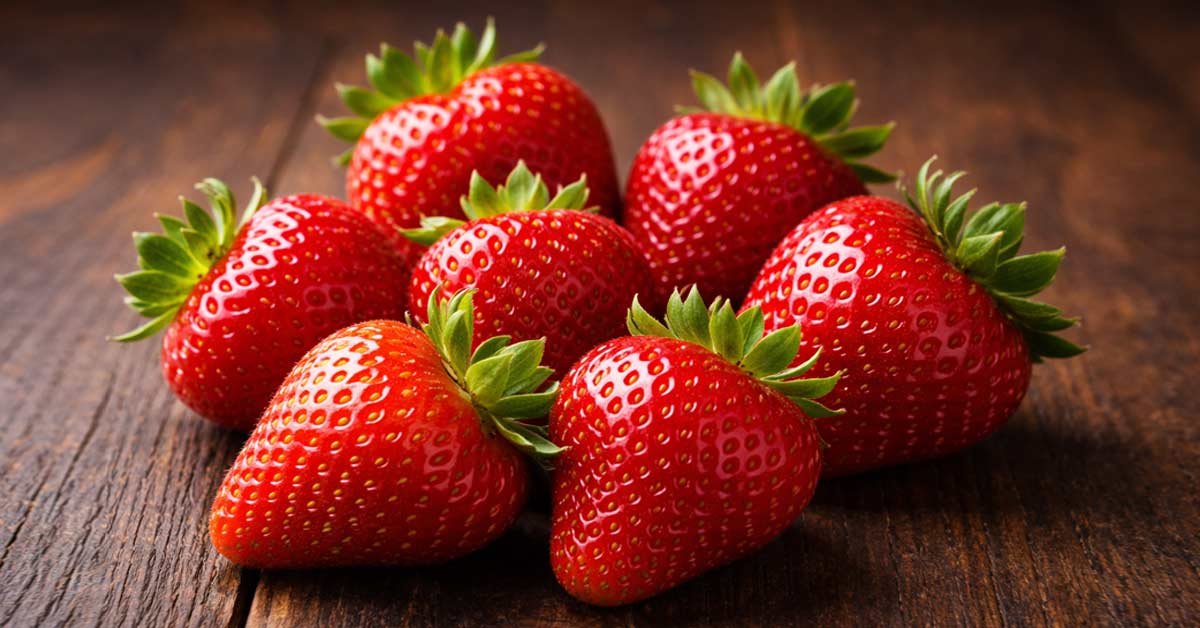
A Fruit That Quietly Does a Lot
There is something almost deceptive about a strawberry. It looks light. Casual. A handful disappears in seconds. It rarely gets the same attention as more “serious” foods like leafy greens or fatty fish. And yet, if you pause for a second and actually look at what a strawberry brings to the table, things start to shift.
A strawberry is not just a sweet fruit you toss into yogurt or eat on the go. It is one of the most concentrated everyday sources of vitamin C you can realistically eat without effort. That alone changes how it fits into your routine.
Table of Contents
Let’s ground that in numbers you can verify.

A standard serving of strawberries is about 150 grams. That portion provides roughly 85 to 90 milligrams of vitamin C. The recommended daily intake for adults sits around:
- 75 mg for women
- 90 mg for men
Do the math:
- 150 g strawberries ≈ 85–90 mg vitamin C
- That equals about 95% to 120% of daily needs
In practical terms, a simple bowl of strawberries can cover your daily vitamin C intake. No supplements. No complicated planning. Just food.
And this is where things get interesting. Vitamin C is not a niche nutrient. It is involved in processes your body relies on every day. It supports tissue structure. It participates in antioxidant defense. It plays a role in how your body handles oxidative stress from normal metabolism, not just extreme conditions.
That means when you eat strawberries regularly, you are not chasing a quick effect. You are quietly supporting systems that work in the background all the time.
Now layer in the fact that strawberries are not just about vitamin C.
They also contain:
- Polyphenols, especially anthocyanins, which give strawberries their color
- Fiber, around 2 to 3 grams per 150 grams serving
- Manganese, a mineral involved in metabolic processes
- A high water content, over 90%
This combination matters more than any single nutrient.
Take fiber as an example. Two to three grams does not sound like much. But most people fall short of daily fiber intake by a wide margin. Adding strawberries regularly is a low friction way to close part of that gap without changing your entire diet.
Or consider polyphenols. These compounds are studied for their role in how the body responds to oxidative stress and inflammation. You do not feel them working. There is no immediate feedback. But over time, they become part of the larger pattern that shapes long term health.
That is really the point here. A strawberry is not impressive because of one dramatic effect. It is valuable because of how easily it fits into repetition.
You do not need to prepare it in a specific way. You do not need to measure precisely. You can eat strawberries:
- Fresh, straight from the fridge
- Added to breakfast without thinking
- As a quick snack when you want something sweet
- Paired with other foods without planning
That ease is not trivial. It is what makes consistency possible.
There is also a subtle behavioral angle people overlook. When strawberries are part of your routine, they often replace something else. A processed snack. A sugary dessert. A mindless habit. That swap alone can shift overall intake patterns without forcing discipline.
And yet, strawberries do not feel like a restriction. That matters more than most nutrition advice acknowledges.
Taste plays a role here too. A good strawberry has a balance of sweetness and acidity that keeps you coming back. That sensory experience reinforces the habit. You are not forcing yourself to eat something “healthy.” You are choosing something you actually enjoy.
It is worth mentioning that not all strawberries are equal. Fresh, in season strawberries tend to have higher flavor intensity. Frozen strawberries, on the other hand, are often picked at peak ripeness and retain most of their vitamin C content. That makes them a reliable option year round.
Dried strawberries are a different story. They are more concentrated in sugar per gram due to water loss. Useful in small amounts, but not a direct replacement for fresh or frozen if your goal is balance.
So where does that leave you?
If you strip away the noise, strawberries sit in a very practical category of foods:
- Easy to eat
- Nutrient dense for their calorie level
- Versatile across meals
- Sustainable as a daily habit
That combination is rare.
You do not need to treat strawberries as a superfood. That label tends to distort expectations. Instead, it makes more sense to see strawberries as a reliable baseline. Something simple you return to often. Something that quietly supports your intake of vitamin C and other compounds without demanding attention.
And that is exactly why strawberries matter.
Not because they do something extreme.
Because they do something consistent.
Strawberry and Heart Health: What Actually Matters
When people connect strawberry intake with heart health, the conversation often drifts into vague territory. Antioxidants get mentioned. Circulation comes up. But what actually matters in practical terms is much simpler. It comes down to how a strawberry contributes small, repeatable inputs that influence vascular function, lipid balance, and overall cardiovascular strain over time.
A single serving will not change anything overnight. But a consistent pattern can shift how your body manages everyday stressors that affect the heart.
Polyphenols and Vascular Function
The color of a strawberry is not just visual. It signals the presence of polyphenols, especially anthocyanins. These compounds have been studied for how they interact with the inner lining of blood vessels, known as the endothelium.
The endothelium plays a key role in regulating blood flow. It helps vessels relax and contract as needed. When this system functions well, circulation adapts smoothly. When it does not, stiffness and reduced responsiveness can develop over time.
Strawberries provide a mix of polyphenols that appear to support this system indirectly. Research has looked at how diets rich in anthocyanin containing foods relate to vascular responsiveness. The consistent pattern is not a dramatic effect, but a subtle improvement in how blood vessels handle normal fluctuations in blood flow.
Here is the practical takeaway:
- Regular intake of strawberries contributes polyphenols
- Polyphenols interact with endothelial function
- Over time, this may support more flexible vascular response
This is not something you feel day to day. There is no immediate signal. But it is part of the long game of maintaining how efficiently blood moves through your system.
Fiber and Cholesterol Balance
Strawberries also bring fiber into the equation. It is not a large amount per serving, but it adds up with consistency.
A 150 gram portion provides about 2 to 3 grams of fiber. If your daily target is around 25 to 38 grams, that is roughly:
- 2.5 g ÷ 25 g = 10% of the lower target
- 2.5 g ÷ 38 g ≈ 6.5% of the higher target
That is a meaningful contribution from a single, easy food.
Why does this matter for heart health?
Soluble fiber, in particular, is associated with how the body handles cholesterol. It can bind bile acids in the digestive system. Since bile acids are made from cholesterol, this process encourages the body to use circulating cholesterol to produce more bile.
The result is a gradual shift in lipid balance when fiber intake is consistently adequate.
Strawberries are not a primary fiber source like legumes or whole grains. But they fit into a pattern:
- They increase total daily fiber intake without effort
- They help diversify fiber sources
- They support consistency, which is often the missing piece
Most people do not struggle with knowing fiber is important. They struggle with maintaining intake. Strawberries make that easier.
Potassium and Blood Pressure Support
Potassium is another piece that often gets overlooked in everyday eating patterns. It plays a role in fluid balance and how the body regulates sodium.
A typical serving of strawberries contains around 220 to 250 mg of potassium.
Compare that to general intake recommendations:
- Around 2600 mg per day for women
- Around 3400 mg per day for men
Do the math:
- 240 mg ÷ 2600 mg ≈ 9%
- 240 mg ÷ 3400 mg ≈ 7%
Again, not dominant. But not negligible either.
Potassium contributes to how the body manages blood pressure by helping counterbalance sodium levels. When potassium intake is adequate, it supports normal vascular tension and fluid distribution.
What makes strawberries useful here is not their potassium alone. It is the combination:
- Potassium
- Water content above 90%
- Low sodium
That trio supports hydration and electrolyte balance in a way that fits easily into daily meals.
You are not relying on strawberries to solve blood pressure. You are using them as part of a broader intake pattern that supports balance.
Oxidative Stress and Cardiovascular Aging
Everyday metabolism produces reactive molecules often referred to as free radicals. External factors like pollution, smoking, and even intense physical activity can increase their production.
This is normal. The body has systems to manage it. The issue arises when the balance shifts and oxidative stress accumulates over time.
This matters for cardiovascular health because oxidative stress is associated with how blood vessels age. It can influence stiffness, inflammation, and how efficiently the vascular system responds to demand.
Strawberries contribute to this discussion through their antioxidant content. This includes:
- Vitamin C
- Anthocyanins
- Other polyphenols
These compounds participate in the body’s broader antioxidant network. They do not act in isolation. They support existing systems that regulate oxidative balance.
Here is a grounded way to look at it:
- You produce oxidative stress daily
- Your body manages it continuously
- Diet influences how well that system holds up over time
Strawberries fit into that third point. They are not a fix. They are a steady input that supports the system doing its job.
There is also an indirect effect worth noting. Foods like strawberries tend to replace less nutrient dense options. That shift reduces exposure to excess added sugars and processed fats, which can influence oxidative load and metabolic strain.
So the benefit is not only what strawberries add. It is also what they displace.
When you zoom out, the role of strawberry in heart health becomes clearer. It is not about a single mechanism or a dramatic claim. It is about stacking small advantages:
- Polyphenols that support vascular function
- Fiber that contributes to cholesterol balance
- Potassium that helps regulate fluid and pressure
- Antioxidants that assist with oxidative stress management
Each piece is modest. Together, repeated over time, they form a pattern that aligns with how cardiovascular health is actually maintained.
And that is where strawberries quietly earn their place.
Vitamin C in Strawberry and Its Impact on Skin
If you look at why strawberry keeps showing up in conversations about skin, it almost always comes back to one thing: vitamin C. Not in a vague, trendy way. In a very practical, biological sense.
Your skin is not static. It is constantly renewing, repairing, and adapting to what you eat, how you sleep, and what you are exposed to every day. Nutrients that support these processes tend to show their effects slowly, through consistency rather than sudden change.
Strawberry fits into that pattern because it delivers a meaningful amount of vitamin C in a form people actually eat regularly.
A 150 gram serving provides roughly 85 to 90 mg of vitamin C. That is enough to meet or exceed daily needs for most adults. When intake is consistent, it supports several processes that directly relate to how skin looks and functions over time.
Collagen Formation and Skin Structure
Collagen is often reduced to a buzzword, but it has a very specific role. It is the structural protein that gives skin its firmness and resilience. Think of it as part of the internal framework that keeps skin from losing its shape.
Vitamin C is required for collagen synthesis. Without enough of it, the body cannot efficiently stabilize and cross link collagen fibers. This is not optional. It is a basic biochemical requirement.
Here is the chain in simple terms:
- You consume vitamin C from foods like strawberry
- The body uses it as a cofactor in collagen production
- Collagen contributes to skin structure and elasticity
If vitamin C intake is consistently low, collagen formation becomes less efficient. Over time, that can show up as reduced firmness or slower recovery from everyday stress.
This does not mean eating strawberries will suddenly change your skin. It means that regular intake supports the ongoing process of maintaining structure.
There is also a timing element people overlook. Collagen turnover is slow. You are not feeding today’s skin. You are supporting the condition of your skin weeks and months from now.
That is why consistency matters more than quantity in a single day.
Antioxidant Protection and Environmental Stress
Skin is constantly exposed to external stressors. Sunlight, air pollution, temperature changes. Even normal oxygen metabolism generates reactive molecules that can affect skin cells.
This is where vitamin C plays a second role. It acts as an antioxidant.
Antioxidants help neutralize reactive molecules before they interact with cellular components like lipids, proteins, and DNA. This is part of the body’s built in defense system.
Strawberries contribute to this through:
- Vitamin C
- Polyphenols such as anthocyanins
These compounds do not work in isolation. They interact with other antioxidants in the body, forming a network that maintains balance.
From a practical standpoint:
- Daily exposure to environmental stress is unavoidable
- The body manages it continuously
- Nutrient intake influences how effective that management is
Strawberry becomes relevant because it is an easy, repeatable source of these compounds. You are not relying on a single food to “protect” your skin. You are supporting the system that handles stress in the background.
There is also a subtle cumulative effect. Small, repeated exposures to antioxidants from foods like strawberries contribute to overall resilience, even if you never notice a direct, immediate result.
Skin Tone, Texture, and Everyday Nutrition
When people talk about skin tone and texture, they often expect fast results. In reality, these are reflections of long term patterns.
Consistent intake of nutrient rich foods, including strawberries, influences:
- How evenly skin renews itself
- How well it maintains surface smoothness
- How it responds to minor irritation or imbalance
Vitamin C contributes here by supporting both collagen formation and antioxidant defense. Together, these processes influence how skin maintains its structure and how it handles daily wear.
There is also a dietary context to consider. Strawberries tend to replace less nutrient dense foods. That shift affects overall intake:
- Lower intake of added sugars in some cases
- Higher intake of fiber and water
- More exposure to micronutrients
These changes can indirectly influence skin appearance. Not because strawberries are doing something dramatic, but because they are part of a better overall pattern.
In real life, this might look like:
- Adding strawberries to breakfast instead of processed toppings
- Reaching for strawberries as a snack instead of packaged sweets
- Including strawberries regularly without planning around them
Over time, these small decisions shape how your skin reflects your habits.
Hydration and Skin Barrier Function
Hydration is often reduced to how much water you drink. That is only part of the picture. Water rich foods also contribute to overall hydration status.
Strawberries are about 90% water. A 150 gram serving provides roughly 135 grams of water.
That contributes to daily fluid intake in a way that feels almost effortless.
Why does this matter for skin?
The outer layer of the skin, often referred to as the barrier, relies on adequate hydration to function properly. This barrier helps:
- Retain moisture
- Protect against external irritants
- Maintain overall skin comfort
When hydration is adequate, the barrier tends to function more effectively. When it is not, skin may feel dry, tight, or less resilient.
Strawberries support this indirectly:
- They add to total fluid intake
- They provide small amounts of electrolytes like potassium
- They combine hydration with nutrients, not just water
This combination is often overlooked. Drinking water is essential, but pairing hydration with nutrients creates a more supportive environment for skin function.
There is also a behavioral aspect again. Water rich foods like strawberries are easy to consume in larger volumes compared to dry snacks. That naturally increases fluid intake without conscious effort.
When you step back, the role of strawberry in skin health becomes clearer.
It is not about a single visible effect. It is about supporting multiple underlying processes:
- Collagen formation through vitamin C
- Antioxidant defense against daily stress
- Nutritional patterns that influence skin tone and texture
- Hydration that supports the skin barrier
Each of these operates quietly. None of them deliver instant results. But together, repeated over time, they shape how your skin holds up under everyday conditions.
And that is where strawberries fit best. Not as a quick fix. As a consistent input that supports how your skin functions from the inside out.
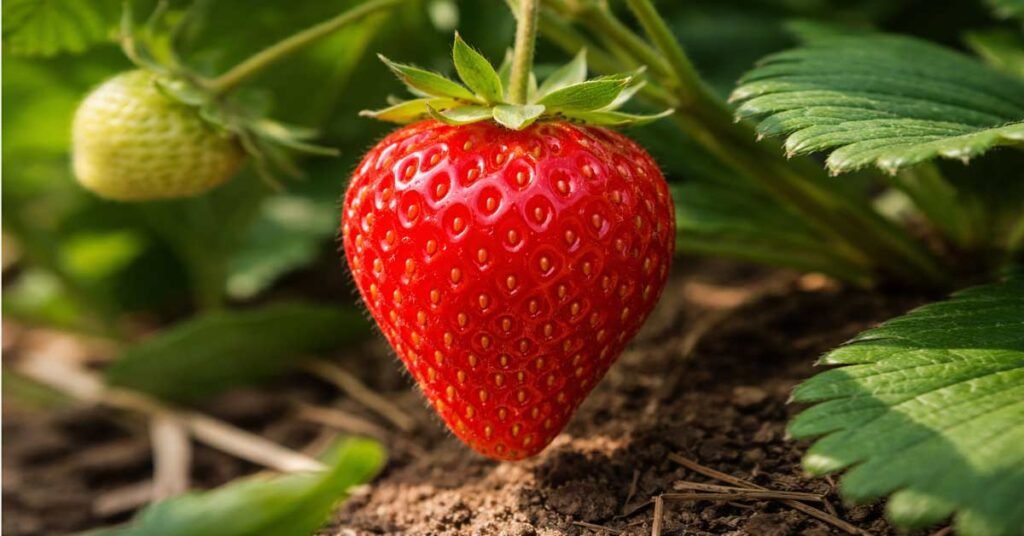
Nutritional Value of Strawberry and Smart Ways to Eat It
A strawberry earns its place in your routine because it delivers a solid nutritional return without asking for much effort. You are not dealing with a complicated food. No prep skills. No strict timing. You just eat it. That simplicity is exactly what makes it effective over time.
Still, it helps to understand what you are actually getting when you eat strawberries, and how to use them in a way that sticks.
Key Vitamins, Minerals, and Plant Compounds
Start with a realistic serving. Around 150 grams of strawberries, which is roughly one heaped cup.
Here is what that looks like in numbers you can verify:
- Calories: about 45 to 50 kcal
- Vitamin C: 85 to 90 mg
- Fiber: 2 to 3 g
- Potassium: 220 to 250 mg
- Manganese: about 0.4 mg
Now put that into context.
Vitamin C:
- 90 mg ÷ 75 mg = 120% of daily needs for women
- 90 mg ÷ 90 mg = 100% of daily needs for men
Fiber:
- 2.5 g ÷ 25 g = 10% of a 25 g target
- 2.5 g ÷ 38 g ≈ 6.5% of a 38 g target
Potassium:
- 240 mg ÷ 2600 mg ≈ 9%
- 240 mg ÷ 3400 mg ≈ 7%
These are not extreme numbers individually. The strength of strawberries comes from how these nutrients show up together in a low calorie, easy to eat form.
Then there are the plant compounds.
Strawberries contain:
- Anthocyanins, which give them their red color
- Ellagic acid, studied for its role in oxidative balance
- Flavonoids that interact with metabolic processes
You are not going to feel these working. But they contribute to the broader nutritional pattern that supports long term health.
One detail that matters more than it seems: strawberries have a high nutrient to calorie ratio. You get a meaningful amount of micronutrients without adding much energy intake. That makes them easy to include even if you are paying attention to calories.
Fresh vs Frozen vs Dried Strawberries
Not all strawberries are equal, but the differences are often misunderstood.
Fresh strawberries are what most people prefer. When they are in season, they have better flavor and texture. Nutritionally, they provide full vitamin C content if stored and consumed within a reasonable time.
But there is a catch. Vitamin C is sensitive to storage and air exposure. The longer fresh strawberries sit, the more vitamin C they can lose.
Frozen strawberries solve that problem in a practical way.
They are typically frozen shortly after harvest. That helps preserve:
- Vitamin C
- Polyphenols
- Overall nutrient profile
In many cases, frozen strawberries can match or even outperform fresh ones that have spent several days in transport and storage.
So if your goal is consistency, frozen strawberries are a reliable option. They work well in:
- Smoothies
- Yogurt bowls
- Oatmeal
Dried strawberries are a different category.
When water is removed, everything becomes more concentrated. That includes:
- Natural sugars
- Calories per gram
For example:
- 150 g fresh strawberries ≈ 50 kcal
- 150 g dried strawberries can exceed 400 kcal
That is not inherently bad. But it changes how you should use them.
Dried strawberries make sense in small portions:
- As a topping
- Mixed into trail mix
- Added to baked goods
They are not a direct substitute for fresh or frozen if you are aiming for volume and hydration.
Practical Ways to Add Strawberry to Daily Meals
The biggest mistake people make is overcomplicating how to eat strawberries. You do not need recipes. You need repeatable habits.
Here are simple ways that actually work in real life:
Breakfast:
- Add sliced strawberries to oatmeal or yogurt
- Pair strawberries with eggs and toast on the side
- Blend frozen strawberries into a smoothie with milk or yogurt
Snacks:
- Eat strawberries on their own, no preparation needed
- Combine strawberries with a handful of nuts
- Pair strawberries with plain yogurt for a quick option
Light desserts:
- Strawberries with a small amount of dark chocolate
- Strawberries with yogurt and a drizzle of honey
- Frozen strawberries blended into a thick, ice cream like texture
Savory pairings:
- Add strawberries to salads with leafy greens and cheese
- Combine strawberries with balsamic vinegar for a simple contrast
- Use strawberries alongside grilled protein for a fresh element
What matters here is not variety. It is repetition. Pick two or three ways you enjoy and stick with them.
There is also a timing advantage. Strawberries require almost no preparation. That makes them a good option when you would otherwise reach for something less balanced out of convenience.
Portion Size and Consistency
Portion size does not need to be exact, but having a reference helps.
A practical daily amount is:
- 100 to 200 grams of strawberries
That gives you:
- 60 to 120 mg of vitamin C
- 2 to 4 grams of fiber
- A meaningful contribution of water and potassium
You do not need to hit this every single day. But aiming for regular intake across the week creates consistency.
Think in patterns, not single days.
For example:
- A bowl of strawberries at breakfast a few times per week
- A handful as a snack on other days
- Frozen strawberries added to meals when fresh are not available
This kind of rotation is enough to maintain steady intake without effort.
There is also a practical upper limit. Eating very large amounts occasionally does not add extra benefit if it replaces balance in your diet. Strawberries work best as part of a varied intake, not as the only focus.
So the goal is simple:
- Keep strawberries visible and accessible
- Use them in ways that require no decision making
- Repeat often enough that it becomes automatic
That is how a food like strawberry moves from something you eat occasionally to something that quietly supports your nutrition every week.
Best Selling Strawberry Related Products


A Simple Habit That Shows Up Over Time
There is a tendency to look for turning points in nutrition. A single change that shifts everything. In practice, that is rarely how things work. What actually moves the needle is repetition. Small inputs, applied often enough, that start to shape outcomes you do not notice day to day.
Strawberry fits into that model almost perfectly.
It is easy to eat. It requires no preparation. It works in different meals without forcing you to change your routine. That combination is what allows a habit to stick. And once something sticks, it starts to matter.
You are not eating strawberries for a one time effect. You are building a pattern where vitamin C intake stays consistently adequate. Where fiber intake gets a steady boost. Where nutrient dense foods quietly replace less useful ones.
That is where the impact shows up.
Not in a visible shift after a week. But in how your baseline changes over months.
Think about what usually happens without intention. Snacks become automatic. Convenience drives choices. Nutrient gaps form without being obvious. It is not a dramatic failure. It is a gradual drift.
A consistent strawberry habit works in the opposite direction.
It anchors part of your day with something predictable:
- A bowl of strawberries in the morning
- A handful in the afternoon
- Frozen strawberries blended into a quick meal
These are small actions. But they reduce friction. You are not deciding what to eat from scratch every time. You are repeating something that already works.
There is also a substitution effect that matters more than people expect.
When strawberries are available, they often replace:
- Packaged snacks
- Sugar heavy desserts
- Low fiber options
This is not about restriction. It happens because strawberries satisfy a specific need. They are sweet. They have texture. They feel like a treat without requiring justification.
Over time, those swaps accumulate.
If you replace a 200 calorie processed snack with a 50 calorie portion of strawberries several times per week, the math is straightforward:
- Difference per instance: about 150 kcal
- If this happens 4 times per week: 150 × 4 = 600 kcal
- Over 4 weeks: 600 × 4 = 2400 kcal
You do not need to track this. But the effect exists whether you pay attention or not.
The same applies to nutrients.
Each time you eat strawberries, you are adding:
- Around 80 to 90 mg of vitamin C
- A few grams of fiber
- Water and potassium
If that happens regularly, your baseline intake improves without effort. You are not correcting deficiencies aggressively. You are preventing them quietly.
There is also a psychological side that is easy to miss.
Habits that feel light tend to last. Strawberries do not come with rules. You do not need to measure precisely. You do not need to prepare anything in advance. That makes the habit resilient.
Compare that to changes that require strict planning. Those often work for a short period, then fade when life gets busy.
Strawberries survive busy days.
You can eat them:
- Standing in the kitchen
- Between tasks
- As part of a meal or on their own
That flexibility is what turns a good idea into a long term behavior.
Another point worth considering is seasonality and adaptability.
Fresh strawberries are not always available or consistent in quality. But frozen strawberries solve that. They give you the same core nutrients with almost no compromise. That means the habit does not depend on perfect conditions.
Consistency stays intact.
And that is really the underlying theme here. Not perfection. Not optimization. Just consistency.
A strawberry does not need to be exceptional to be useful. It needs to be reliable.
If you zoom out far enough, most nutrition patterns follow the same rule:
- What you do occasionally has limited impact
- What you do repeatedly defines your baseline
Strawberries belong in that second category. They are not the center of your diet. They are part of the structure that holds it together.
So the question is not whether strawberries are “good” for you. That is already established.
The better question is whether they fit into your routine in a way that you can maintain without effort.
If the answer is yes, then you already have what you need.
A simple habit.
Repeated often enough.
Quietly showing up where it counts.
Article Sources
At AncientHerbsWisdom, our content relies on reputable sources, including peer-reviewed studies, to substantiate the information presented in our articles. Our primary objective is to ensure our content is thoroughly fact-checked, maintaining a commitment to accuracy, reliability, and trustworthiness.
- Aune, D., Giovannucci, E., Boffetta, P., Fadnes, L. T., Keum, N., Norat, T., Greenwood, D. C., Riboli, E., Vatten, L. J., & Tonstad, S. (2017). Fruit and vegetable intake and the risk of cardiovascular disease, total cancer and all cause mortality: A systematic review and dose response meta analysis of prospective studies. International Journal of Epidemiology, 46(3), 1029–1056. https://doi.org/10.1093/ije/dyw319
- Basu, A., Nguyen, A., Betts, N. M., & Lyons, T. J. (2014). Strawberry as a functional food: An evidence based review. Critical Reviews in Food Science and Nutrition, 54(6), 790–806. https://doi.org/10.1080/10408398.2011.608174
- Boeing, H., Bechthold, A., Bub, A., Ellinger, S., Haller, D., Kroke, A., Leschik Bonnet, E., Müller, M. J., Oberritter, H., Schulze, M., Stehle, P., & Watzl, B. (2012). Critical review: Vegetables and fruit in the prevention of chronic diseases. European Journal of Nutrition, 51(6), 637–663. https://doi.org/10.1007/s00394-012-0380-y
- Giampieri, F., Tulipani, S., Alvarez Suarez, J. M., Quiles, J. L., Mezzetti, B., & Battino, M. (2012). The strawberry: Composition, nutritional quality, and impact on human health. Nutrition, 28(1), 9–19. https://doi.org/10.1016/j.nut.2011.08.009
- Heber, D., & Bowerman, S. (2001). Applying science to changing dietary patterns. Journal of Nutrition, 131(11), 3078S–3081S. https://doi.org/10.1093/jn/131.11.3078S
- Institute of Medicine. (2000). Dietary reference intakes for vitamin C, vitamin E, selenium, and carotenoids. National Academies Press. https://doi.org/10.17226/9810
- Kalt, W., Cassidy, A., Howard, L. R., Krikorian, R., Stull, A. J., Tremblay, F., & Zamora Ros, R. (2020). Recent research on the health benefits of blueberries and their anthocyanins. Advances in Nutrition, 11(2), 224–236. https://doi.org/10.1093/advances/nmz065
- Liu, R. H. (2013). Health promoting components of fruits and vegetables in the diet. Advances in Nutrition, 4(3), 384S–392S. https://doi.org/10.3945/an.112.003517
- National Institutes of Health, Office of Dietary Supplements. (2021). Vitamin C fact sheet for health professionals. https://ods.od.nih.gov/factsheets/VitaminC-HealthProfessional
- Slavin, J. L., & Lloyd, B. (2012). Health benefits of fruits and vegetables. Advances in Nutrition, 3(4), 506–516. https://doi.org/10.3945/an.112.002154
- U.S. Department of Agriculture, Agricultural Research Service. (2019). FoodData Central: Strawberries, raw. https://fdc.nal.usda.gov/fdc-app.html#/food-details/1102659/nutrients
- World Health Organization. (2020). Healthy diet. https://www.who.int/news-room/fact-sheets/detail/healthy-diet

- Phosphatidic Acid: Supporting Muscle Growth and Strength - July 31, 2026
- Ceramides: Supporting Healthy Skin From Within - July 31, 2026
- Synbiotics: Combining Prebiotics and Probiotics Together - July 31, 2026