
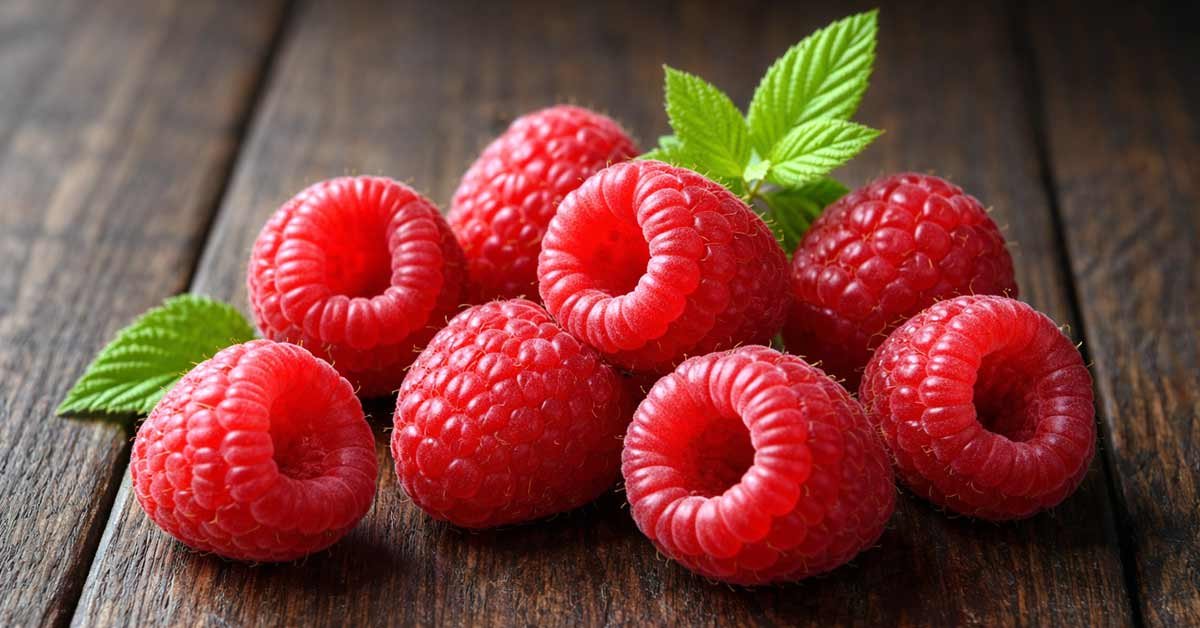
A Small Berry That Does More Than You Think
There is something easy to overlook about raspberries. They sit quietly next to flashier fruits. No aggressive marketing. No bold claims printed on packaging. Just a soft, slightly fragile berry that stains your fingers if you are not paying attention. And yet, when you actually look at what raspberries bring to the table, they start to feel less like a garnish and more like a daily tool.
You do not need a nutrition degree to notice the difference when raspberries show up regularly in your meals. A handful in the morning. Maybe another in the afternoon. It is subtle at first. Digestion feels a bit smoother. Meals feel a bit more complete. You are not chasing snacks as often. That kind of quiet shift tends to come from foods that do more than one job at the same time.
Raspberries are one of those foods.

Table of Contents
Start with the obvious. Fiber. Most people do not get enough of it. The general recommendation for adults sits around 25 to 38 grams per day depending on age and sex. Now look at raspberries. About 100 grams of raspberries provide roughly 6.5 grams of fiber. That is not a small contribution. If you eat a typical portion, say a cup which is around 120 to 130 grams, you are already covering close to a quarter of a daily target.
That matters more than people think.
Fiber is not just about digestion in the basic sense. It shapes how food moves, how nutrients are absorbed, and how full you feel after eating. It also feeds the bacteria in your gut. And that is where raspberries start to stand out even more.
A large part of the fiber in raspberries is insoluble. This type adds bulk and supports regular movement through the digestive tract. But there is also soluble fiber present, which forms a gel-like texture during digestion. That slows things down in a useful way. It helps moderate how quickly sugars enter your bloodstream and creates a steadier energy curve. No sharp spikes. No sudden crashes.
If you have ever felt that mid-afternoon drop after a quick snack, you know exactly what that feels like.
Raspberries work differently. They are naturally low in sugar compared to many other fruits, yet high in fiber. That combination is rare. It means you can eat something that tastes sweet but behaves in a more balanced way inside your body. You are not relying on willpower to avoid overeating later. The structure of the food itself helps you out.
Then there is the antioxidant side of things.
Raspberries get their deep red color from compounds like anthocyanins and ellagic acid. These are not just decorative pigments. They interact with oxidative processes in the body. Every day, your body deals with reactive molecules produced through metabolism, environmental exposure, even exercise. That is normal. The issue is when that balance tips too far.
This is where antioxidant-rich foods like raspberries come into play. Not as a quick fix. Not as a shield. But as part of a steady intake that helps maintain balance over time.
You will not feel antioxidants working. There is no immediate signal. But over weeks and months, diets rich in these compounds tend to support systems that rely on stability. Circulation. Cellular maintenance. Even how your body responds to everyday stressors.
And raspberries deliver this without asking much from you.
No prep. No cooking. No complicated pairing. You can eat raspberries straight from the container, toss them into yogurt, or mix them into oats without changing your routine much. That is a detail that often gets ignored. The best foods are the ones you will actually eat consistently.
There is also a texture element that makes raspberries interesting. The small seeds create a slight crunch, which slows down how quickly you eat them. That might sound minor, but it changes how your brain registers fullness. Foods that take longer to chew often lead to better portion control without any conscious effort.
It is one of those small behavioral nudges built directly into the food.
Another thing worth noticing is how raspberries fit into real life. They are available fresh, but also frozen with minimal nutritional loss. That removes the seasonality barrier. You do not have to rely on perfect timing or expensive fresh batches. A bag in the freezer works just as well for most purposes.
So the barrier to entry is low.
You do not need to redesign your diet. You do not need a strict plan. You just need to make space for raspberries in places where they naturally fit.
Think about simple situations:
- Adding raspberries to breakfast instead of reaching for processed toppings
- Keeping frozen raspberries on hand for quick meals
- Using raspberries as a snack that actually holds you over
These are not dramatic changes. But they stack.
There is a tendency to look for big, visible shifts when it comes to nutrition. New diets. Complex rules. Strict schedules. In reality, the foods that make the biggest difference are often the ones that quietly show up every day and do their job without friction.
Raspberries fall into that category.
They bring fiber in meaningful amounts. They contribute antioxidants that support long-term balance. They fit into routines without resistance. And they do all of this while still being enjoyable to eat.
That last part matters more than people admit.
Because if a food feels like a chore, it rarely becomes a habit. And without consistency, even the most impressive nutritional profile does not translate into real-world impact.
Raspberries do not have that problem.
Why Raspberries Stand Out for Gut Health
You can talk about gut health in abstract terms all day. Microbiome diversity. Fermentation. Short chain fatty acids. It sounds impressive, but it often feels disconnected from what you actually eat. Raspberries bring that conversation back to something practical.
They are one of the few foods where you can clearly see how composition translates into real digestive effects. Not instantly. Not dramatically. But consistently enough that you notice when they are part of your routine and when they are not.
Fiber Density That Changes Digestion
Raspberries are unusually dense in fiber for their size. That matters because most people underestimate how much fiber it takes to actually influence digestion.
Let’s put numbers on it.
- Around 6.5 grams of fiber per 100 grams of raspberries
- A typical cup gives you roughly 8 grams
- Daily recommendations sit around 25 to 38 grams
If you eat one cup of raspberries, you are covering about 21 to 32 percent of your daily fiber needs.
Calculation example:
8 grams from a cup divided by 25 grams minimum recommendation = 0.32 → 32%
8 grams divided by 38 grams upper range = 0.21 → 21%
That is a meaningful contribution from a single food that does not feel heavy or filling in an uncomfortable way.
But it is not just the amount. It is the structure.
Raspberries contain both insoluble and soluble fiber. Insoluble fiber adds bulk to stool and helps movement through the digestive tract. That is the mechanical side of digestion. It keeps things moving at a steady pace.
Soluble fiber behaves differently. It absorbs water and forms a gel-like substance. This slows gastric emptying and helps regulate how nutrients are absorbed. It is part of the reason why a meal with raspberries tends to feel more stable. You are not getting that rapid spike and drop in energy.
There is also a pacing effect. The seeds in raspberries require more chewing. That slows down eating, which gives your body more time to register fullness signals. It is a small detail, but it changes how meals feel overall.
You end up with a combination that is hard to replicate:
- Volume without heaviness
- Sweetness without rapid sugar absorption
- Texture that naturally moderates intake
That is what makes raspberries stand out at a very basic digestive level.
How Raspberries Support Microbial Balance
Now shift one layer deeper.
Your gut is not just a tube that processes food. It is an ecosystem. Trillions of microorganisms rely on what you eat. And fiber is one of their primary fuel sources.
Raspberries provide fermentable fibers that reach the colon intact. Once there, they are used by gut bacteria in a process that produces short chain fatty acids like butyrate, acetate, and propionate. These compounds are associated with maintaining the integrity of the gut lining and supporting local metabolic activity.
You do not need to track these compounds day by day. What matters is the pattern.
When you regularly include foods like raspberries, you are consistently feeding bacteria that thrive on fiber. Over time, this tends to favor a more balanced microbial environment.
There is also the polyphenol side of raspberries. Compounds like anthocyanins and ellagitannins do not get fully absorbed in the upper digestive tract. They travel further down, where they interact with gut bacteria.
Some of these compounds are transformed by microbes into smaller metabolites. Those metabolites can then be absorbed and used by the body. This creates a kind of two way relationship:
- You feed the microbes with fiber and polyphenols
- The microbes process these compounds into forms your body can use
It is not a one step process. It is a chain of interactions that depends on consistency.
This is why occasional intake does not do much. A single serving of raspberries is not going to shift your microbiome. But repeated exposure does.
Think in terms of patterns, not events.
Everyday Effects You Can Actually Notice
This is where things become more tangible.
You are not going to feel your microbiome changing. But you can notice indirect effects that come from improved digestive function.
When raspberries become a regular part of your diet, people often report small but consistent shifts:
- More regular bowel movements
- Less bloating after meals that include fiber
- A steadier sense of fullness between meals
- Reduced need for constant snacking
None of these are dramatic. That is the point. Gut health improvements rarely show up as sudden transformations. They show up as fewer disruptions.
You might notice that meals feel more predictable. That uncomfortable heaviness after eating becomes less frequent. There is less guesswork about how your body will respond to certain foods.
There is also a timing effect.
Fiber rich foods like raspberries tend to extend the digestive process in a controlled way. That means nutrients are released more gradually. Energy levels feel more stable. Hunger signals become easier to interpret.
Instead of sharp hunger spikes, you get a smoother curve.
This can change how you structure your day without forcing it. You might naturally eat at more consistent intervals. You might find that smaller meals feel more satisfying.
And all of this comes from something as simple as adding raspberries to what you are already eating.
There is also a practical advantage here. Raspberries are easy to combine with other gut friendly foods. Pair them with yogurt, oats, or nuts, and you create a more complete environment for digestion:
- Fiber from raspberries
- Protein and fats from other foods
- Additional fermentable compounds
This layering effect tends to amplify the overall impact.
It is not about turning raspberries into a centerpiece. It is about using them as a reliable component that improves the quality of what is already there.
And that is really the reason raspberries stand out.
They do not rely on extremes. They do not require strict planning. They fit into everyday meals and quietly improve how your digestive system functions over time.
You do not notice them working in a dramatic way. You notice when they are missing.
Antioxidants in Raspberries: What Matters in Real Life
Antioxidants get thrown around as a buzzword. It sounds good, but it rarely gets explained in a way that connects to how you actually eat. Raspberries make that conversation more concrete.
They are not the only fruit with antioxidants. Not even close. But the combination you get in raspberries, along with how those compounds behave in the body, makes them worth paying attention to. Especially if you are thinking long term, not just chasing quick wins.
Key Compounds Behind the Color
That deep red color in raspberries is not random. It comes from a group of compounds called anthocyanins. These are part of a larger family known as polyphenols, which are widely studied for their interaction with oxidative processes.
Raspberries also contain ellagic acid and ellagitannins. These are less talked about, but they play an important role once they reach the gut. Unlike some nutrients that get absorbed quickly, these compounds travel further into the digestive system, where they are transformed by gut bacteria into smaller metabolites.
That detail matters.
It means the benefits of raspberries are not just about what is immediately absorbed into your bloodstream. There is a second phase, happening deeper in the gut, where these compounds are processed and made more usable.
If you look at measured antioxidant capacity, raspberries consistently rank high among commonly consumed fruits. This is often evaluated using ORAC values, which estimate how well a food can neutralize certain reactive molecules in a controlled setting. While that does not translate perfectly to real life, it gives a useful comparison point.
Here is the practical takeaway:
- Raspberries provide multiple types of polyphenols, not just one
- These compounds act at different stages of digestion
- Their impact depends on regular intake, not occasional use
You are not getting a single, isolated effect. You are getting a layered interaction that builds over time.
Oxidative Stress and Daily Food Choices
Now zoom out for a second.
Oxidative stress is not something you feel directly. It is a background process. Your body naturally produces reactive molecules during metabolism. That is normal. You also get exposure from outside factors like pollution, smoking, and even intense exercise.
The issue is balance.
When the production of these reactive molecules exceeds your body’s ability to manage them, you get a shift toward oxidative stress. Over time, that can influence how cells function and how systems maintain stability.
This is where food choices come in.
You are not going to eliminate oxidative stress. That is not realistic. But you can influence how your body handles it by consistently including foods that contribute antioxidant compounds.
Raspberries fit into that pattern without adding complexity.
You do not need to think in terms of isolated nutrients or supplements. A serving of raspberries brings a mix of compounds that interact with oxidative processes in a more natural context. Fiber, polyphenols, vitamins, all working together.
And because raspberries are relatively low in sugar compared to many fruits, they do not come with the same trade-offs. You are not increasing sugar intake significantly just to get antioxidants.
That balance is often overlooked.
It is easy to assume that more fruit always means better outcomes. But when sugar intake climbs, especially in liquid or processed forms, the equation changes. Raspberries keep things in check. You get sweetness, but it is moderated by fiber and overall composition.
From a daily perspective, this leads to a simple strategy:
- Include raspberries as part of regular meals
- Combine them with other whole foods
- Focus on consistency instead of quantity spikes
That approach aligns better with how the body actually responds to nutrients.
What Makes Raspberries Different From Other Fruits
There are plenty of fruits with strong antioxidant profiles. Blueberries often get the spotlight. Strawberries are widely available. Grapes have their own set of polyphenols.
So where do raspberries fit?
The difference comes down to a combination of factors rather than a single standout feature.
First, fiber content. Raspberries provide significantly more fiber per serving than most berries. That changes how the antioxidants are delivered and processed. You are not just absorbing compounds quickly. You are extending their interaction through the digestive system.
Second, polyphenol diversity. Raspberries contain anthocyanins, ellagitannins, and flavonols in meaningful amounts. This mix creates overlapping effects rather than relying on one dominant compound.
Third, sugar to fiber ratio. Many fruits that are rich in antioxidants also come with higher natural sugar content. That is not inherently a problem, but it does influence how often and how much you might want to eat them. Raspberries offer a different balance:
- Lower sugar per serving
- Higher fiber per serving
- Strong antioxidant presence
This combination makes them easier to integrate daily without needing to think too much about portion control.
There is also a practical aspect.
Raspberries are rarely consumed as juice. They are usually eaten whole. That preserves their fiber structure and slows down intake. Compare that to fruit juices, where fiber is removed and sugars are concentrated. The metabolic response is not the same.
Even compared to smoothies, whole raspberries tend to have a different effect. Blending breaks down some of the physical structure, which can slightly speed up digestion. It is not a huge difference, but it adds up if most of your fruit intake comes in liquid form.
Whole raspberries keep things simple.
Then there is consistency again.
Because raspberries are available frozen with minimal nutrient loss, you can rely on them year round. That removes one of the biggest barriers to maintaining a steady intake of antioxidant rich foods.
No need to chase seasonal peaks. No need to switch foods constantly. Just a stable option you can return to.
And that might be the most important distinction.
Raspberries are not extreme in any single category. They are balanced. High fiber. Strong antioxidant profile. Moderate sweetness. Easy to use.
That balance is what makes them effective in real life.
You are not relying on them to fix anything. You are using them to support a system that works better when it gets the right inputs consistently.
And raspberries happen to be one of the easiest ways to provide those inputs without overthinking it.
Using Raspberries Without Overcomplicating Things
This is where most good intentions fall apart. Not because the food is hard to understand, but because people make it harder than it needs to be. Raspberries are simple. They work best when you treat them that way.
You do not need recipes saved in five different apps. You do not need perfect timing. You just need a few reliable ways to keep raspberries in your routine without thinking too much about it.
Fresh, Frozen, and Processed: What Changes
Let’s clear this up first, because it matters more than people expect.
Fresh raspberries are great. The texture is soft, slightly delicate, and the flavor is more nuanced. But nutritionally, they are not dramatically superior to frozen raspberries.
Frozen raspberries are typically picked at peak ripeness and frozen quickly. That helps preserve most of their fiber and antioxidant content. There can be small losses in certain vitamins over time, especially vitamin C, but the difference is not large enough to matter in a mixed diet.
So if your goal is consistency, frozen raspberries are often the better choice.
You remove a few common barriers:
- No rush to eat them before they spoil
- Lower cost in many cases
- Available year round
That alone makes it easier to actually eat raspberries regularly instead of occasionally.
Now, processed forms are a different story.
Raspberry jams, juices, and flavored products often come with added sugars and reduced fiber. The structure of the fruit changes, and that affects how your body handles it.
A quick comparison:
- Whole raspberries: high fiber, slower digestion, balanced response
- Raspberry juice: little to no fiber, faster sugar absorption
- Raspberry jam: concentrated sugars, lower fiber per serving
That does not mean you can never use processed forms. It just means they should not be your main source if you are aiming for gut health and antioxidant intake.
Whole or minimally processed raspberries keep things aligned with how the body responds best.
Simple Ways to Eat More Raspberries
This is where practicality wins.
If something requires effort every single time, it will not stick. The goal is to make raspberries part of things you already do.
Start with the obvious ones. They work for a reason:
- Add raspberries to yogurt
- Mix them into oatmeal or overnight oats
- Eat a handful as a standalone snack
That covers a large part of daily use without adding complexity.
Then you can layer them into slightly more structured meals:
- Toss raspberries into a salad with greens, nuts, and a simple dressing
- Add them on top of cottage cheese for a quick meal
- Mix them into a smoothie, ideally with a source of protein or fat
Even something as basic as pairing raspberries with a handful of nuts changes how satisfying the snack feels. You get fiber from the raspberries, fats and protein from the nuts, and a more stable energy curve overall.
There is also a timing aspect.
Raspberries work well earlier in the day, especially if you tend to rely on quick carbs in the morning. Replacing or balancing those with raspberries can change how your energy feels a few hours later.
But they are just as useful in the afternoon, when cravings usually show up. A portion of raspberries can take the edge off without leading to overeating later.
You do not need to schedule this perfectly. Just notice where they fit naturally.
Storage, Portions, and Consistency
This is the part that determines whether raspberries stay in your routine or disappear after a week.
Fresh raspberries are fragile. If you leave them in the fridge too long, they break down quickly. The simplest approach is to buy smaller quantities more often or wash them only right before eating. Moisture speeds up spoilage.
Frozen raspberries remove that problem completely. Keep a bag in the freezer and use what you need. No waste. No pressure.
Now, portions.
A typical serving of raspberries sits around one cup, which is roughly 120 to 130 grams. That gives you about 8 grams of fiber.
If your daily target is 25 grams:
8 ÷ 25 = 0.32 → 32% of your daily intake
If your target is 30 grams:
8 ÷ 30 = 0.27 → 27%
That is a strong contribution from one serving.
You do not have to hit a specific number every day. But having a rough sense of what a portion provides helps you build a pattern. One serving of raspberries plus other fiber sources throughout the day puts you in a much better position than relying on a single large meal.
Consistency beats intensity here.
Eating raspberries once in a large quantity does less than eating moderate amounts regularly. The body responds better to steady input, especially when it comes to fiber and compounds that interact with the gut.
So instead of thinking in terms of “how much can I eat today,” it makes more sense to think:
- Can I include raspberries most days this week
- Can I make them easy to access
- Can I pair them with foods I already eat
If the answer is yes, the rest tends to take care of itself.
And that is really the point.
Raspberries do not need a system. They just need a place in your routine.
Best Selling Raspberries Related Products


A Habit That Feels Small but Adds Up
Most people look for a turning point. A moment where things click and everything changes. Nutrition rarely works like that. It is quieter. More repetitive. The results show up in the background, almost unnoticed, until you compare where you are now to where you were a few months ago.
Raspberries fit perfectly into that kind of change.
They are not disruptive. You do not need to restructure your meals. You do not need to track anything obsessively. You just need to keep them around and actually eat them. That sounds almost too simple, but that is exactly why it works.
Think about what usually gets in the way. Time. Decision fatigue. Convenience. Most food choices are not made because of deep nutritional reasoning. They are made because something is easy, available, and familiar.
Raspberries check those boxes when you let them.
Keep a container in the fridge or a bag in the freezer, and suddenly they become the default option. Not because you forced it, but because they are there when you need something quick.
That is how habits form. Not through discipline, but through reduced friction.
There is also a compounding effect that people tend to underestimate. A single serving of raspberries does not feel like much. But repeat that across days and weeks, and you start stacking benefits without realizing it.
- A steady intake of fiber instead of occasional spikes
- Regular exposure to antioxidants instead of random bursts
- More predictable digestion instead of constant adjustments
None of these changes demand attention. They just make things feel smoother.
You might notice that meals feel more complete. That you are not reaching for extra snacks as often. That your energy does not dip as sharply in the middle of the day. These are not dramatic shifts, but they are the kind that make routines easier to maintain.
And once something becomes easier, it tends to stick.
There is also a psychological angle here that rarely gets mentioned. When you add something like raspberries to your routine, you are not taking things away. You are not restricting. You are building around something positive.
That changes how you relate to food.
Instead of thinking in terms of what to avoid, you start thinking in terms of what to include. It is a small shift, but it removes a lot of resistance. You are not fighting your habits. You are gently reshaping them.
Raspberries work well in that role because they are flexible. They fit into different parts of the day without feeling repetitive.
Some days it is breakfast. Other days it is a snack. Sometimes it is just something you add on the side without thinking too much about it.
That variability helps maintain consistency. You are not locked into a rigid pattern, which makes it easier to keep going long term.
There is also something to be said about enjoyment.
Raspberries are not a compromise. They are naturally sweet, slightly tart, and have a texture that makes them interesting to eat. That matters more than it seems. If a food is enjoyable, you do not have to convince yourself to eat it.
And that removes one more barrier.
From a practical standpoint, the goal is not to maximize anything. Not fiber. Not antioxidants. Just to make raspberries a regular presence.
If you want a simple way to think about it, it comes down to this:
- Keep raspberries visible and accessible
- Pair them with foods you already eat
- Use them often enough that it feels normal
That is it.
No strict rules. No complicated plans.
Over time, this kind of habit tends to influence other choices as well. When your meals start with or include foods like raspberries, the rest of your plate often shifts in the same direction. Not because you forced it, but because it makes sense in context.
You build momentum without trying to.
And that is where the real value shows up.
Not in a single serving. Not in a specific nutrient. But in the pattern that forms when something simple, like eating raspberries regularly, becomes part of your everyday life.
Article Sources
At AncientHerbsWisdom, our content relies on reputable sources, including peer-reviewed studies, to substantiate the information presented in our articles. Our primary objective is to ensure our content is thoroughly fact-checked, maintaining a commitment to accuracy, reliability, and trustworthiness.
- U.S. Department of Agriculture, Agricultural Research Service. (2019). FoodData Central: Raspberries, raw. https://fdc.nal.usda.gov/fdc-app.html#/food-details/167755/nutrients
- Slavin, J. L. (2013). Fiber and prebiotics: Mechanisms and health benefits. Nutrients, 5(4), 1417–1435. https://doi.org/10.3390/nu5041417
- Makki, K., Deehan, E. C., Walter, J., & Bäckhed, F. (2018). The impact of dietary fiber on gut microbiota in host health and disease. Cell Host & Microbe, 23(6), 705–715. https://doi.org/10.1016/j.chom.2018.05.012
- Aune, D., Giovannucci, E., Boffetta, P., Fadnes, L. T., Keum, N., Norat, T., Greenwood, D. C., Riboli, E., Vatten, L. J., & Tonstad, S. (2017). Fruit and vegetable intake and the risk of cardiovascular disease, total cancer and all-cause mortality. International Journal of Epidemiology, 46(3), 1029–1056. https://doi.org/10.1093/ije/dyw319
- Basu, A., Nguyen, A., Betts, N. M., & Lyons, T. J. (2014). Strawberry as a functional food: An evidence-based review. Critical Reviews in Food Science and Nutrition, 54(6), 790–806. https://doi.org/10.1080/10408398.2011.608174
- Giampieri, F., Tulipani, S., Alvarez-Suarez, J. M., Quiles, J. L., Mezzetti, B., & Battino, M. (2012). The strawberry: Composition, nutritional quality, and impact on human health. Nutrition, 28(1), 9–19. https://doi.org/10.1016/j.nut.2011.08.009
- Seeram, N. P. (2008). Berry fruits: Compositional elements, biochemical activities, and the impact of their intake on human health, performance, and disease. Journal of Agricultural and Food Chemistry, 56(3), 627–629. https://doi.org/10.1021/jf071988k
- Manach, C., Scalbert, A., Morand, C., Rémésy, C., & Jiménez, L. (2004). Polyphenols: Food sources and bioavailability. The American Journal of Clinical Nutrition, 79(5), 727–747. https://doi.org/10.1093/ajcn/79.5.727
- Williamson, G., & Clifford, M. N. (2017). Colonic metabolites of berry polyphenols: The missing link to biological activity? British Journal of Nutrition, 104(S3), S48–S66. https://doi.org/10.1017/S0007114510003946
- World Health Organization. (2020). Healthy diet. https://www.who.int/news-room/fact-sheets/detail/healthy-diet

- Phosphatidic Acid: Supporting Muscle Growth and Strength - July 31, 2026
- Ceramides: Supporting Healthy Skin From Within - July 31, 2026
- Synbiotics: Combining Prebiotics and Probiotics Together - July 31, 2026