
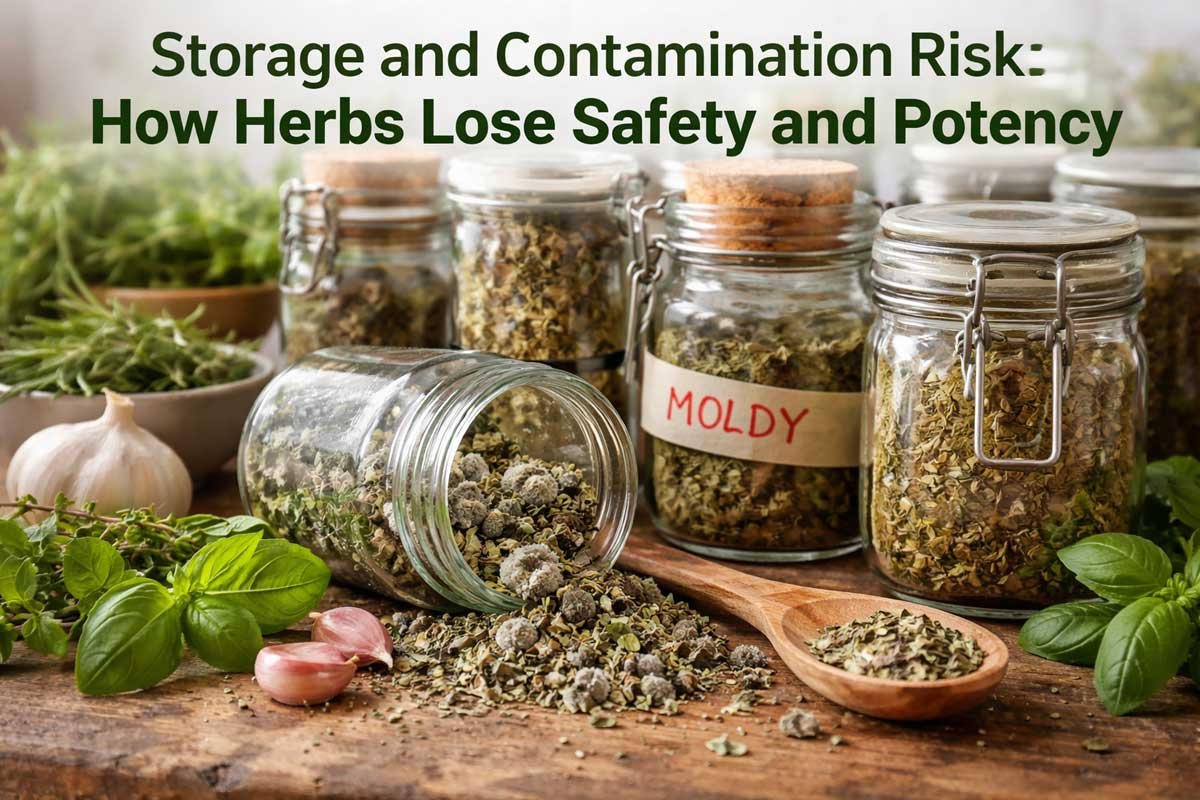
When Clean Herbs Slowly Turn Risky
Open a jar of dried herbs that once smelled sharp and alive. Now the aroma feels flat. Dusty. Almost tired. That moment tells a bigger story about contamination, one most people never think about. Herbs rarely become unsafe at the farm. They lose safety quietly after harvest, during storage, handling, and everyday use. This slow decline explains why organic labels alone do not guarantee safety or potency.
Contamination does not arrive dramatically. It creeps in through humidity, air, light, heat, and hands. A batch of herbs can leave the field clean and biologically rich, then degrade month by month in a warehouse, a shop, or a kitchen drawer. Microbial growth, oxidative reactions, and chemical migration all operate below the senses until potency drops and safety erodes.
Table of Contents

Organic herbs face the same physics and biology as conventional ones. The absence of synthetic pesticides does not stop mold spores, environmental bacteria, or airborne pollutants. In some cases, organic herbs may face higher contamination risk because they lack chemical preservatives and fumigation treatments used in conventional supply chains. That tradeoff is rarely discussed honestly.
Potency suffers first. Volatile oils evaporate. Polyphenols oxidize. Alkaloids break down. As potency drops, contamination becomes harder to detect because the herb no longer signals freshness through smell or taste. What remains looks harmless but may carry microbial or chemical risks.
Safety is not a single moment of failure. It is a gradual slide caused by storage decisions that feel small and routine. Plastic bags. Warm shelves. Open jars. Sunlit windows. Each choice pushes herbs closer to contamination without obvious warning signs.
Understanding how contamination develops after harvest changes how you judge quality. It shifts attention away from labels and toward storage reality. Clean herbs stay safe only when their environment respects their chemistry. Ignore that, and even the best-grown organic herbs slowly lose both safety and potency.
Where Contamination Begins After Harvest
Most people imagine contamination as something dramatic. A visible mold bloom. A strange smell. A recall notice. In reality, contamination usually starts in far quieter ways, right after harvest, when herbs look clean, dry, and perfectly safe. This is the phase where safety and potency are most fragile, yet most overlooked.
Once an herb is cut, its defenses are gone. No living immune response. No active metabolism to repair damage. From that point on, the plant material reacts passively to its environment. Moisture seeps in. Oxygen reacts with sensitive compounds. Light and heat accelerate chemical breakdown. None of this requires negligence. It happens through normal storage conditions that feel reasonable and familiar.
The uncomfortable truth is that many contamination problems begin in places that appear controlled: drying rooms, storage bins, transport containers, retail shelves. Herbs do not need extreme abuse to degrade. They only need time, mild humidity, and exposure to air. Understanding these mechanisms matters more than trusting certifications or origin stories.
Moisture, Mold, and Invisible Growth
Moisture is the single most reliable driver of contamination in dried herbs. Even small amounts are enough. A relative humidity above roughly 60 percent allows dormant fungal spores to wake up. Below that threshold, growth slows but does not necessarily stop. Herbs can feel dry to the touch while still holding enough internal moisture to support microbial activity.
Mold growth often starts invisibly. Microscopic hyphae spread through plant tissue long before fuzzy patches appear. By the time mold becomes visible, contamination is already well established. Some molds produce mycotoxins that remain even if the mold itself later dies. These compounds are chemically stable and not removed by drying or grinding.
Organic herbs are not immune. In fact, they may be more vulnerable because they are not treated with antifungal agents after harvest. Drying conditions matter immensely. Slow drying in humid air creates a perfect window for contamination. Uneven drying leaves pockets of moisture inside stems, roots, or thicker leaves.
What complicates matters further is that mold contamination does not always change smell or taste right away. A herb can look and smell acceptable while harboring microbial growth. Potency may already be declining as enzymes and microbes break down active compounds. By the time sensory cues appear, safety is already compromised.
Storage environments amplify this risk. Cardboard boxes absorb ambient moisture and transfer it to herbs. Cloth bags breathe too well in damp conditions. Even sealed containers trap moisture if herbs were not properly dried beforehand. One poorly dried batch can contaminate others through shared air space.
Contamination through moisture is rarely sudden. It unfolds slowly, which is why it escapes notice. People blame age or variety when potency drops, not realizing microbial activity has been quietly reshaping the chemistry all along.
Air Exposure and Oxidative Breakdown
Oxygen is essential for life, but for stored herbs, it is a relentless degrader. Air exposure triggers oxidative reactions that slowly dismantle the molecules responsible for aroma, color, and biological activity. This process does not require moisture or microbes. It happens even in clean, dry conditions.
Volatile oils are especially vulnerable. Terpenes oxidize quickly when exposed to air, changing both scent and effect. Polyphenols and flavonoids undergo structural changes that reduce their biological relevance. Alkaloids can degrade or rearrange into less active forms. None of this announces itself loudly. It feels like herbs are simply losing their strength.
Oxidation also interacts with contamination risk. As compounds degrade, they lose antimicrobial properties that help inhibit microbial growth. In other words, air exposure not only reduces potency but can indirectly increase contamination vulnerability. The herb becomes chemically weaker and biologically less stable.
Repeated opening of containers accelerates this process. Each time air rushes in, fresh oxygen replaces the depleted layer inside. Fine powders suffer more than whole herbs because increased surface area allows faster oxidation. Grinding too early is a common but underappreciated mistake.
Organic herbs face no special protection here. Oxidation does not discriminate. In fact, the absence of stabilizers means organic material may oxidize faster if storage conditions are poor. Airtight does not mean oxygen-free. Unless oxygen is displaced or absorbed, oxidative breakdown continues.
Over time, oxidized compounds can also react with environmental contaminants, forming secondary byproducts with unknown properties. While not always dangerous, this chemical drift undermines predictability and consistency, which are core elements of safety.
Contamination is not always biological. Chemical degradation driven by oxygen creates a quieter, less visible form of loss that still matters deeply.
Light and Heat as Silent Degraders
Light exposure, especially ultraviolet light, acts like a slow burn on stored herbs. Photodegradation alters molecular structures, breaking down sensitive compounds and generating reactive fragments. Clear jars on sunny shelves may look attractive, but they quietly accelerate contamination-related degradation.
Chlorophyll breaks down first, fading color and signaling chemical change. Volatile oils follow. Some compounds become photo-reactive, increasing oxidative stress within the plant material. Heat amplifies every one of these reactions. For every small temperature rise, reaction rates increase noticeably.
Storage near stoves, radiators, or sunlit windows introduces chronic low level heat stress. This does not cook herbs. It weakens them. Over months, heat drives off volatile components and destabilizes others. The result is reduced potency and increased susceptibility to contamination.
Temperature fluctuations are especially damaging. Warming causes expansion and contraction inside containers, pulling in moist air even when lids are closed. This cycling introduces both oxygen and humidity, a combination that accelerates microbial and chemical degradation simultaneously.
Organic herbs often travel long distances. During transport, they may experience heat spikes inside trucks or warehouses. These exposures are rarely documented or controlled tightly. By the time herbs reach shelves, they may already be compromised, despite looking intact.
Light and heat do not introduce contaminants directly. They prepare the ground. They weaken structural integrity. They strip protective compounds. Once that happens, even minor environmental exposure can lead to contamination.
This is why some herbs seem to spoil faster than others without obvious cause. The damage began long before the jar was opened. Storage decisions upstream shaped the outcome.
Contamination after harvest is not a failure of intention. It is a failure of understanding. Herbs are chemically alive long after they are cut. Treat them like inert objects, and they slowly transform into something less safe, less potent, and less reliable.
Storage Choices That Decide Safety and Potency
Once herbs leave the field and drying racks, their fate is no longer shaped by soil or farming methods. It is shaped by storage choices. These choices decide whether contamination stays a theoretical risk or becomes a practical reality. They also decide how long potency survives before quietly fading away.
Storage sounds boring. Jars, bags, shelves. Nothing dramatic. Yet this is where most herbs lose safety. Not because of one big mistake, but because of many small, reasonable decisions that slowly stack up. The wrong container. The wrong material. Too much trust in labels. Too much time.
What makes this tricky is that poor storage rarely produces obvious warning signs. Herbs do not rot like fresh food. They dry, fade, and weaken. Contamination often arrives alongside that weakening, hidden behind familiarity and habit.
Containers, Materials, and Chemical Migration
Containers do more than hold herbs. They interact with them. Every material creates a micro environment that either protects or undermines safety. The wrong container can introduce contamination even when herbs start out clean.
Plastic is the most common offender. Many plastics are slightly permeable to oxygen and moisture. Over time, this allows environmental exposure even when containers appear sealed. Heat worsens the problem by increasing permeability. Plasticizers and other additives can migrate into herbs, especially into lipid rich plant material. This is not dramatic poisoning. It is low level chemical contamination that accumulates quietly.
Thin plastic bags are particularly risky. They flex, breathe, and trap static dust. Fine powders cling to the surface, increasing surface contact and oxidation. When reused, they can carry residues from previous contents, creating cross contamination that is almost impossible to detect.
Glass is often treated as the gold standard, but it is not flawless. Clear glass allows light exposure, which accelerates degradation. Poor quality lids leak air. Repeated opening introduces oxygen and humidity. Glass protects against chemical migration but does nothing to stop oxidative contamination if the seal is weak.
Metal containers introduce their own risks. Unlined metal can react with acidic plant compounds. Even lined tins can degrade over time, especially if exposed to heat. Rust, micro scratches, and coating breakdown create points of contact that compromise safety.
Paper and cardboard seem natural and breathable, but they absorb moisture readily. In humid environments, they act like sponges, feeding mold growth indirectly. They also carry environmental contaminants from storage spaces, including dust, spores, and industrial residues.
The safest containers are those that limit air, light, moisture, and chemical interaction simultaneously. Few materials do all four well. Storage is always a compromise, which is why contamination risk never fully disappears. It can only be managed.
Organic Does Not Mean Protected
Organic certification speaks to how herbs are grown, not how they are stored. This distinction matters more than most people realize. Organic herbs are not treated with preservatives, fumigants, or stabilizing agents after harvest. That keeps them clean in one sense, but it also removes a layer of protection against contamination.
There is a persistent belief that organic herbs are inherently safer over time. In reality, they are often more sensitive to storage conditions. Without chemical buffers, they rely entirely on environmental control. When that control slips, contamination moves faster.
Organic herbs also tend to retain more complex phytochemical profiles. These compounds contribute to potency, but they are also reactive. They oxidize. They degrade under light. They interact with container materials. As potency declines, so does the herb’s natural resistance to microbial growth.
Another overlooked factor is scale. Organic herbs are often handled in smaller batches, moved through multiple intermediaries, and stored in mixed environments. Each transfer introduces variability. Temperature changes. Different containers. Different humidity levels. Each step increases contamination risk incrementally.
Labels do not reflect this reality. A sealed package with an organic stamp may have experienced months of suboptimal storage before reaching the shelf. The consumer sees a certification. The herb carries a history.
This is not an argument against organic herbs. It is an argument against assuming protection where none exists. Organic status does not pause chemistry. It does not slow oxidation. It does not prevent contamination caused by time and exposure.
The safest herbs are not defined by labels alone. They are defined by how carefully storage has been managed from drying room to final container.
Time, Aging, and Compound Instability
Time is the most underestimated storage variable. People think in expiration dates. Herbs think in reaction rates. Every compound inside dried plant material follows its own timeline of instability. Some degrade quickly. Others persist. Together, they shape both potency and contamination risk.
Volatile oils are usually the first to go. They evaporate or oxidize, flattening aroma and reducing functional relevance. Polyphenols follow, slowly rearranging into less active forms. Pigments fade. Structural components break down. None of this requires poor storage. Time alone is enough.
As herbs age, their internal balance shifts. Compounds that once inhibited microbial growth weaken. Structural integrity declines, making plant tissue more accessible to microbes if moisture appears. Aging does not cause contamination directly, but it lowers the threshold at which contamination becomes possible.
Grinding accelerates aging dramatically. Increased surface area exposes more compounds to oxygen and light. Powders can lose significant potency within months even under decent storage. They also absorb environmental moisture faster, raising contamination risk.
Expiration dates often reflect regulatory convenience, not chemical reality. Some herbs lose meaningful potency long before their date. Others remain stable longer if stored well. Safety does not flip like a switch. It erodes.
There is also a psychological component. Old herbs feel familiar. They sit quietly on shelves. Their gradual decline escapes attention. People blame dosage, not degradation. Meanwhile, contamination risk increases subtly as compounds that once kept microbes in check disappear.
The safest approach treats time as an active force, not a background detail. Storage decisions should slow aging, not ignore it. Smaller quantities. Whole herbs instead of powders. Minimal air exposure. Consistent temperatures. Darkness. These are not aesthetic preferences. They are contamination control strategies.
Storage decides whether herbs remain what they were meant to be or become something else entirely. Safety and potency are not fixed traits. They are conditions maintained, or lost, through daily choices that seem insignificant until they are not.
Handling, Transport, and Human Error
Even perfect storage cannot fully protect herbs from contamination if handling is careless. Human contact is one of the most underestimated risk factors in herbal safety. Hands, tools, surfaces, and movement introduce variables that no container can fully control. This is where theory meets reality, and where many well intentioned practices quietly undermine safety and potency.
Herbs pass through many hands before they are used. Harvesters, processors, packers, warehouse workers, shop staff, and finally consumers. Each interaction adds opportunity for contamination. Not because people are careless, but because systems are imperfect and habits feel harmless.
What makes handling especially tricky is that contamination introduced this way often appears unrelated to storage. A herb can be dried correctly, stored properly, and still lose safety because of repeated exposure to foreign materials, microbes, and environmental residues.
Cross Contamination in Homes and Shops
Cross contamination sounds like a problem reserved for industrial food processing. In reality, it is far more common in homes and small shops. Herbs are often handled alongside spices, foods, supplements, and household items without clear separation. This creates shared microbial and chemical environments.
In shops, open bins invite repeated contact. Scoops move from one container to another. Fine dust travels through the air. Customers touch herbs, smell them, and return them. Each interaction transfers skin microbes, environmental particles, and residues from other products. Over time, contamination accumulates even if no single interaction seems problematic.
Homes present similar risks. Herbs are often stored near cooking ingredients. Measuring spoons are reused without cleaning. Fingers dip into jars. Moisture from kitchens settles into containers. These small actions introduce bacteria, fungi, and moisture repeatedly.
Organic herbs are not shielded here. In fact, their lack of antimicrobial treatments means they rely entirely on cleanliness and discipline. Once contamination is introduced, it can persist quietly, especially in dried material where microbes enter dormant states and reactivate later when conditions allow.
Another overlooked factor is pets. Hair, dander, and environmental microbes travel easily through households. Open containers become collection points. Again, nothing dramatic happens. Potency fades. Safety erodes slowly.
Cross contamination rarely causes immediate illness. That is why it is ignored. Its real impact is cumulative. Each exposure nudges herbs closer to a threshold where contamination becomes active rather than dormant.
Grinding, Blending, and Surface Transfer
Grinding feels like a purely mechanical act. Reduce size. Increase convenience. In reality, it is one of the most aggressive interventions in terms of contamination risk and potency loss.
Grinding increases surface area dramatically. More surface means more contact with oxygen, light, and moisture. It also means more opportunity for contact with contaminated surfaces. Grinders, blenders, and mortars are rarely sterilized. They carry residues from previous uses, including oils, powders, and microbes.
Even when tools look clean, microscopic residues remain. Volatile oils from one herb can transfer to another. Allergens can persist. Environmental dust settles into crevices. When herbs are ground, these residues mix into the powder, creating cross contamination that cannot be reversed.
Heat generated during grinding adds another layer of risk. Friction raises temperature, accelerating oxidation and compound breakdown. Potency drops faster. Chemical stability declines. As protective compounds degrade, microbial resistance weakens.
Commercial grinding introduces additional variables. Shared equipment processes multiple products. Cleaning protocols vary. Trace contamination is common and often accepted as unavoidable. For people sensitive to purity and safety, this matters.
Blending compounds the issue. Mixing different herbs creates new chemical environments. Moisture content varies. Oils migrate. Reactive compounds interact. This does not mean blends are unsafe by default, but they are more complex systems where contamination can spread more easily.
Grinding early in the supply chain shortens shelf life significantly. Powdered herbs age faster. They absorb environmental moisture more readily. They lose potency at an accelerated pace. Safety becomes more dependent on perfect storage, which rarely exists.
Handling decisions around grinding often prioritize convenience over chemistry. The cost is paid quietly in contamination risk and reduced potency.
The Forgotten Role of Supply Chains
By the time herbs reach a shelf or a kitchen, they have already lived a long and largely invisible life. Supply chains shape safety more than most consumers realize. Contamination often begins not at the end, but in transit.
Herbs travel through drying facilities, warehouses, trucks, ports, and storage depots. Each location introduces new environmental conditions. Temperature spikes. Humidity changes. Dust exposure. Shared storage with non herbal goods. These variables are difficult to control consistently.
Transport containers may be reused for different materials. Agricultural products share space with industrial goods. Pallets absorb spills and odors. Even when herbs are packaged, permeable materials allow exchange with the surrounding environment.
Organic herbs often move through decentralized supply chains. Smaller operations. Multiple intermediaries. Less standardized handling. While this supports sustainability and diversity, it also increases variability. Contamination risk rises with every handoff.
Documentation rarely captures these nuances. A batch may pass inspection at origin and again at destination, yet experience multiple uncontrolled exposures in between. Safety assessments become snapshots, not continuous monitoring.
Another issue is time spent in limbo. Herbs sit in warehouses waiting for transport or sale. Storage conditions may be acceptable but not ideal. Over weeks or months, small degradations accumulate. Potency declines. Stability weakens. Contamination thresholds lower.
Human error plays a role here too. Mislabeling. Improper stacking. Containers left open briefly. Climate control failures. None of these events need to be severe to matter. Herbs respond to subtle stressors.
Supply chains are often optimized for efficiency, not chemical preservation. Speed matters. Cost matters. Safety becomes a minimum requirement rather than an active priority. This does not imply negligence. It reflects economic reality.
Understanding contamination requires acknowledging this complexity. Herbs do not travel in a vacuum. They move through systems designed for goods, not for delicate chemical matrices.
Handling and transport shape herbs as much as growing conditions. Safety and potency are outcomes of cumulative exposure, not single decisions. Human involvement is unavoidable. Awareness is the only real mitigation.
Treat herbs as chemically sensitive materials rather than inert commodities, and contamination becomes easier to anticipate and prevent. Ignore that reality, and safety slowly slips away without anyone noticing until the jar is empty or the effect is gone.
What Safe Storage Actually Looks Like
After years of watching herbs lose potency and safety in perfectly ordinary environments, one conclusion becomes hard to ignore. Safe storage is not about perfection. It is about respect for how herbs actually behave once they are no longer alive. When storage works, contamination pressure stays low and potency fades slowly instead of collapsing quietly.
Safe storage starts with a mindset shift. Herbs are not dry decorations or pantry fillers. They are chemically active materials that respond to air, moisture, light, heat, and handling every single day. Treat them as static objects and contamination becomes inevitable. Treat them as sensitive substances and safety becomes manageable.
The most reliable storage setups are boring. Dark. Consistent. Slightly inconvenient. They prioritize stability over aesthetics and discipline over habit.
The first pillar is dryness, but not the kind people assume. Herbs should be dry internally, not just to the touch. That means they were dried slowly enough to avoid trapping moisture, but thoroughly enough to prevent microbial reactivation. Once stored, humidity must stay low and stable. Opening containers in humid rooms undermines this instantly. Kitchens are often the worst place, despite convenience. Steam and temperature swings create constant contamination pressure.
The second pillar is oxygen control. Airtight means genuinely airtight. Lids that seal mechanically, not just by friction. Containers that do not flex or breathe. Oxygen exposure is cumulative. Each opening matters. Safe storage minimizes access rather than assuming occasional exposure is harmless. Smaller containers help. Opening a large jar repeatedly accelerates oxidation and contamination far faster than people realize.
Light protection is non negotiable. Herbs should live in darkness. Not shade. Not indirect light. Darkness. Clear glass is a compromise, not a solution. If clear containers are used, they must be stored inside cabinets or boxes that block light completely. Photodegradation is silent but relentless. Over time it weakens compounds that contribute both to potency and to natural microbial resistance.
Temperature stability matters more than coolness alone. Constant moderate temperatures protect herbs better than cycles of warmth and cooling. Avoid storage near appliances, windows, or exterior walls. Avoid garages and attics. Heat spikes accelerate chemical reactions and pull moisture into containers through pressure changes. These cycles quietly increase contamination risk even when average temperatures seem acceptable.
Material choice deserves more attention than it gets. Glass with tight seals remains the most neutral option for long term storage, provided light is blocked. High quality stainless steel containers can work if lined properly and kept cool. Plastics should be avoided for anything stored longer than short term. Chemical migration is subtle, but real, and it compounds over time.
Whole herbs outperform powders almost every time. Leaving plant material intact preserves internal structure, slows oxidation, and reduces surface exposure. Grinding should happen as late as possible, ideally just before use. This single choice dramatically improves both safety and potency. Powdered herbs are inherently more vulnerable to contamination because they interact with their environment more aggressively.
Clean handling is part of storage, not a separate issue. Hands introduce moisture and microbes. Scoops and spoons should be clean and dry. Containers should not remain open longer than necessary. These habits feel obsessive until you watch a batch degrade far earlier than expected. Then they feel obvious.
Organic herbs benefit the most from disciplined storage. Without chemical preservatives, they depend entirely on environmental control. When stored well, they age gracefully. When stored casually, they deteriorate faster than conventional counterparts. This is not a flaw. It is a reality of cleaner inputs and fewer artificial stabilizers.
Rotation matters. Herbs should not be hoarded indefinitely. Smaller quantities stored well outperform large quantities stored poorly every time. Aging increases contamination vulnerability even under good conditions. Potency declines whether people notice or not. Safe storage accepts this and works with it instead of pretending time does not matter.
Labeling helps more than people expect. Knowing when herbs were dried, ground, or opened provides context that sensory cues cannot always offer. Smell and appearance are unreliable indicators of contamination until problems are already advanced. Time tracking restores some objectivity.
Safe storage also means accepting limits. No setup eliminates contamination risk completely. The goal is reduction, not eradication. When storage respects chemistry, contamination becomes less likely and less severe. When storage ignores chemistry, contamination becomes routine.
There is also an emotional component. Many people keep herbs because they feel valuable, rare, or sentimental. Letting go feels wasteful. Yet using compromised herbs carries its own cost. Safety is not served by attachment. Potency is not preserved by nostalgia.
The most reliable indicator of good storage is consistency. Stable conditions. Predictable handling. Minimal exposure. When these elements align, herbs retain their character. Aroma stays vivid. Color remains true. Effects feel familiar rather than muted. Contamination pressure stays low enough that herbs age rather than spoil.
What safe storage actually looks like is not glamorous. It looks like dark cabinets, sealed jars, clean tools, and restraint. It looks like choosing chemistry over convenience. It looks like understanding that contamination is not an accident but a process, one that can be slowed significantly through informed daily choices.
When herbs are stored this way, organic quality finally has a chance to matter. Potency lasts longer. Safety becomes a maintained condition rather than a hopeful assumption. And contamination remains what it should be: a risk managed, not a fate accepted.
Best-selling Organic Products




Article Sources
At AncientHerbsWisdom, our content relies on reputable sources, including peer-reviewed studies, to substantiate the information presented in our articles. Our primary objective is to ensure our content is thoroughly fact-checked, maintaining a commitment to accuracy, reliability, and trustworthiness.
- World Health Organization. (2007). WHO guidelines on good agricultural and collection practices (GACP) for medicinal plants. World Health Organization. https://apps.who.int/iris/handle/10665/42783
- European Medicines Agency. (2018). Guideline on quality of herbal medicinal products traditional herbal medicinal products. EMA. https://www.ema.europa.eu/en/documents/scientific-guideline/guideline-quality-herbal-medicinal-products-traditional-herbal-medicinal-products_en.pdf
- Tournas, V. H., Katsoudas, E., & Miracco, E. J. (2001). Moulds yeasts and aerobic plate counts in herbal teas and medicinal plants. International Journal of Food Microbiology, 65(1–2), 155–160. https://doi.org/10.1016/S0168-1605(00)00524-6
- Kosalec, I., Cvek, J., & Tomić, S. (2009). Contaminants of medicinal herbs and herbal products. Archives of Industrial Hygiene and Toxicology, 60(4), 485–501. https://doi.org/10.2478/10004-1254-60-2009-1991
- Sengun, I. Y., Yaman, D. B., & Gonul, S. A. (2015). Mycotoxins and mould contamination in herbal teas. Journal of Food Composition and Analysis, 44, 72–80. https://doi.org/10.1016/j.jfca.2015.08.005
- Zhang, J., Wider, B., Shang, H., Li, X., & Ernst, E. (2012). Quality of herbal medicines issues and challenges. The Lancet, 380(9847), 1876–1884. https://doi.org/10.1016/S0140-6736(12)60983-9
- Balbino, E. E., & Dias, M. F. (2010). Pharmacovigilance of herbal medicines a review. Revista Brasileira de Farmacognosia, 20(5), 824–832. https://doi.org/10.1590/S0102-695X2010005000022
- Kumar, A., Shukla, R., Singh, P., & Dubey, N. K. (2009). Biodeterioration of some herbal raw materials by storage fungi and aflatoxin and fumonisin contamination. International Biodeterioration and Biodegradation, 63(5), 576–584. https://doi.org/10.1016/j.ibiod.2009.02.004
- U.S. Food and Drug Administration. (2022). Guidance for industry botanical drug development. FDA. https://www.fda.gov/media/93113/download

- Nectarine: Stone Fruit for Heart Health and Antioxidants - March 8, 2026
- Peach: Hydrating Fruit for Skin Health and Digestion - March 8, 2026
- Plum: Fiber-Rich Fruit for Digestion and Heart Health - March 8, 2026
