
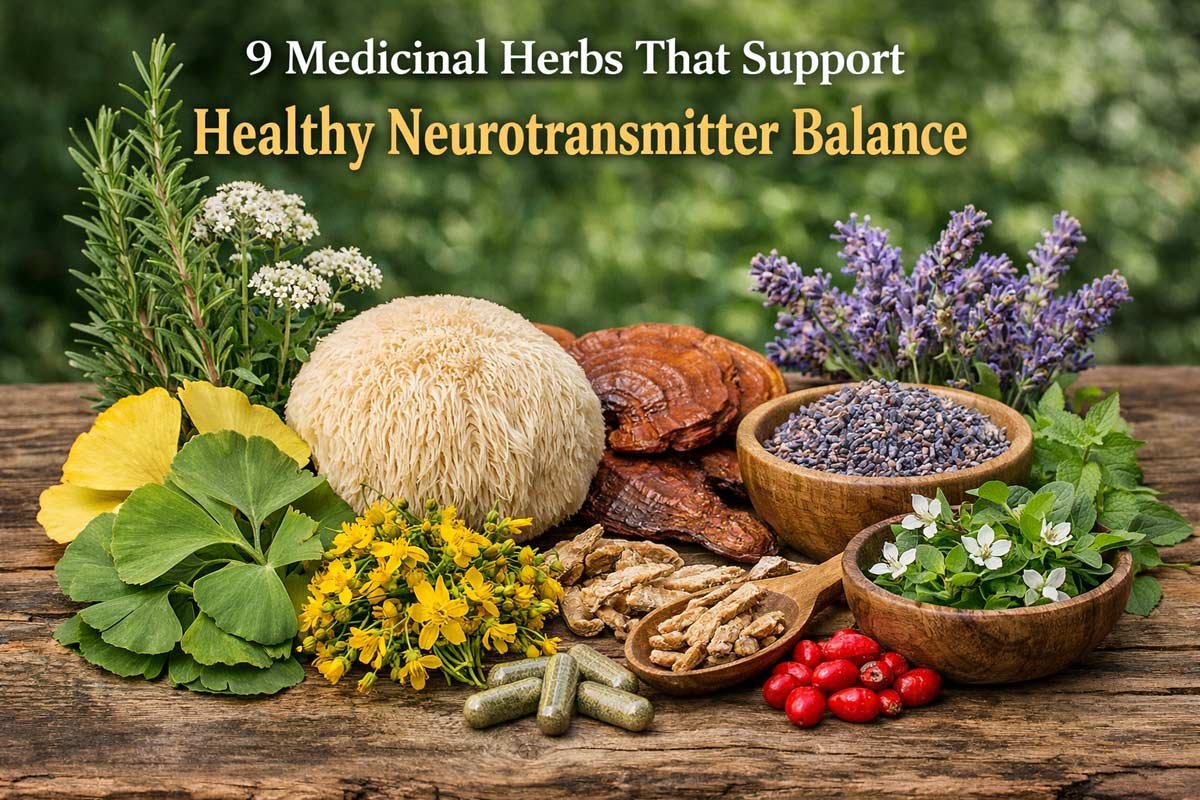
When the Mind Falls Out of Rhythm
There is a moment most people recognize, even if they cannot name it. Thoughts feel jumpy or heavy. Sleep stops refreshing. Motivation flickers, then fades. You are eating well enough, exercising sometimes, doing all the right things, yet your inner wiring feels slightly off. This is what I think of as the mind falling out of rhythm. Not broken. Not diseased. Just out of sync.
Neurotransmitters are often talked about like switches. Serotonin on, dopamine off. GABA low, glutamate high. The body does not work that way. Neurotransmitters behave more like a jazz band than a control panel. Timing matters. Volume matters. Who plays with whom matters. When one section gets too loud or drops out entirely, the music turns tense or flat. Herbs for neurotransmitter balance do not force the band back into line. They help everyone listen again.
Table of Contents

Modern life pulls hard on the nervous system. Artificial light late at night. Endless stimulation. Chronic low-grade stress that never quite resolves. Add blood sugar swings, gut imbalance, inflammation, and nutrient depletion, and you get distorted signaling in the brain. Dopamine stops responding to reward the way it once did. Serotonin loses its steadying influence. GABA cannot fully apply the brakes. Glutamate stays pressed on the gas. None of this happens overnight, and that is why it is so often missed.

What I see again and again is that people try to correct this imbalance by aiming at symptoms. Low mood gets chased with stimulation. Anxiety gets suppressed. Fatigue gets overridden. The nervous system rarely responds well to being bullied. It responds much better to being supported. That is where herbs for neurotransmitter balance earn their place.
Plants and mushrooms do not supply neurotransmitters directly in any meaningful way. They influence the terrain. They affect receptor sensitivity, enzyme activity, stress hormone signaling, inflammation, neurotrophic factors, and the gut brain axis. Some calm excess firing. Others gently encourage signaling where things have gone quiet. The intelligence of herbal medicine lies in this indirectness. It works with physiology instead of shouting over it.
One of the most misunderstood aspects of neurotransmitter health is that balance does not mean equal levels. Balance means appropriate response. Dopamine should rise with meaningful effort and reward, then fall back to baseline. Serotonin should provide emotional steadiness without flattening experience. GABA should calm without sedating. Glutamate should sharpen focus without tipping into agitation. When these patterns break down, people feel it long before lab tests ever show anything useful.
Another piece often overlooked is that neurotransmitters do not live only in the brain. A large portion of serotonin is produced in the gut. GABA is deeply tied to microbial activity. Dopamine signaling depends on amino acid availability, iron status, and mitochondrial health. This is why purely mental approaches so often fall short. The mind is embodied. Herbs for neurotransmitter balance tend to work broadly because they address multiple systems at once.
There is also the question of tempo. Fast acting interventions can be helpful in crisis, but long term balance usually requires slow recalibration. Plants excel here. Many traditional herbs were never used to chase immediate effects. They were used daily, sometimes for months, to retrain the nervous system’s expectations. Over time, stress responses soften. Sleep deepens. Emotional reactions become more proportional. People often say they feel more like themselves again, which is a useful phrase even if it never appears in clinical literature.
I have noticed that people often ask which neurotransmitter they are low in, as if there were a single missing piece. In reality, imbalance tends to cascade. Chronic stress elevates cortisol. Cortisol alters tryptophan metabolism. Serotonin synthesis shifts. Sleep degrades. Dopamine signaling dulls. Motivation drops. Anxiety increases. Herbs for neurotransmitter balance interrupt these loops at several points, which is why they can feel subtle at first and profound later.
Another misconception is that calming herbs are only for anxious people and stimulating herbs only for fatigued people. In practice, the nervous system is rarely that simple. Someone wired and tired may need calming input before energy returns. Someone low and flat may need improved stress tolerance before motivation can reemerge. Good herbal strategy pays attention to patterns rather than labels.
Sensory experience matters too. The bitterness of certain roots. The aroma of leaves rich in volatile oils. The earthy depth of mushrooms simmered slowly. These inputs signal safety and nourishment to the nervous system in ways capsules never fully replicate. Even before absorption, the body is already responding. This is not mystical thinking. It is neurobiology tied to taste receptors, vagal signaling, and conditioned response.
When herbs for neurotransmitter balance are chosen well, people often notice changes in small, telling ways. They laugh more easily. Music hits differently. Morning dread softens. Focus returns without strain. These are signs that signaling is becoming more responsive, not artificially elevated. The goal is not to feel up all the time. The goal is to feel appropriately alive to what is actually happening.
It is also worth saying that balance is contextual. What feels like imbalance during grief may be a healthy nervous system processing loss. What feels like flatness during burnout may be protective shutdown. Herbs should support adaptation, not erase meaning. The best results come when plants are used to create resilience rather than to numb discomfort.
Over the years, I have come to trust that the nervous system wants equilibrium. Given the right conditions, it will often find its way back. Herbs and mushrooms act as allies in this process. They do not replace sleep, nourishment, movement, or connection, but they make these inputs more effective. They widen the margin of tolerance so change becomes possible.
This article focuses on herbs for neurotransmitter balance not as quick fixes, but as long term companions for the nervous system. Each plant and mushroom discussed has its own personality, its own way of nudging chemistry and perception. Some are old friends in herbal traditions across continents. Others have only recently been studied in depth, even though people have worked with them for centuries.
When the mind falls out of rhythm, the solution is rarely force. It is usually listening, adjusting, and supporting the body’s own intelligence. Plants understand this language well.
Botanical Allies That Shape Neurochemical Signaling
Some plants do not just soothe or stimulate. They shape how signals move through the nervous system. They influence how long neurotransmitters linger in the synapse, how sensitive receptors become, and how the brain responds to stress over time. These are the herbs I reach for when the problem is not a single symptom, but a pattern. Flat mood paired with tension. Motivation tangled with anxiety. Energy that never quite settles into focus. Herbs for neurotransmitter balance shine here because they work upstream, where signaling is being distorted rather than simply dampened or pushed.
This group of plants tends to have strong personalities. They are not neutral. Used carelessly, they can overshoot. Used well, they help the nervous system remember its own internal logic. They do not force calm or happiness. They restore responsiveness. That distinction matters more than most people realize.
1. St. John’s Wort (Hypericum perforatum)
St. John’s Wort is one of the most misunderstood herbs in modern herbalism. It gets flattened into a single label, the depression herb, which does it a disservice. At its core, this plant influences how neurotransmitters communicate, especially serotonin, dopamine, and norepinephrine. It does not add these chemicals. It changes how quickly they are cleared and how receptors respond to their presence.
The compound hyperforin plays a central role. It inhibits the reuptake of several neurotransmitters, which means signals stay active a little longer. Not dramatically. Not in a blunt, pharmaceutical way. Just enough to restore tone when signaling has gone slack. This is why St. John’s Wort can lift mood without causing emotional flattening when it is well matched to the person.
What often gets missed is its effect on stress related neuroinflammation. Chronic stress alters neurotransmitter signaling partly through inflammatory pathways. Hypericum has been shown to modulate inflammatory markers that interfere with synaptic communication. When inflammation drops, signaling improves. Mood follows.
I have seen this herb work best in people who feel emotionally bruised. Not just sad, but tender. Easily overwhelmed by light, sound, or social interaction. Sleep may be restless. Rumination sticks. In these cases, herbs for neurotransmitter balance need to protect the nervous system while restoring signaling, and St. John’s Wort does exactly that.
There are real cautions. This plant induces liver enzymes involved in drug metabolism. That means it can reduce the effectiveness of many medications. This is not theoretical. It is well documented. Respect for this herb includes knowing when not to use it. Used appropriately, it remains one of the most effective botanical tools for reshaping neurotransmitter dynamics.
2. Rhodiola rosea
Rhodiola is often described as energizing, but that is only part of the story. What it really does is improve signal efficiency under stress. This plant comes from harsh environments, and it carries that resilience into the nervous system. It influences dopamine and serotonin pathways, but its most important action may be how it modulates the stress response that disrupts those pathways in the first place.
Under chronic stress, neurotransmitter signaling becomes sloppy. Dopamine stops responding proportionally to effort and reward. Serotonin synthesis shifts. Fatigue sets in even when stimulation is high. Rhodiola helps normalize this by acting on the hypothalamic pituitary adrenal axis. Cortisol patterns smooth out. When cortisol stabilizes, neurotransmitter production and receptor sensitivity often follow.
There is also evidence that Rhodiola mildly inhibits monoamine oxidase enzymes. These enzymes break down neurotransmitters. Gentle inhibition means signals last a bit longer without pushing levels unnaturally high. The effect is subtle but noticeable over time. Focus improves. Mental endurance increases. Emotional resilience grows.
What I appreciate most about Rhodiola is that it tends to correct direction rather than push in one way. People who are wired but exhausted often feel calmer and clearer. People who are flat and depleted often feel more engaged. That is the hallmark of good herbs for neurotransmitter balance. They respond to context.
Timing matters with this plant. Taken too late in the day, it can interfere with sleep for some people. Taken too high, it can feel edgy. Lower doses taken earlier often work best. The goal is not stimulation. It is adaptability. When that clicks, Rhodiola feels like the nervous system has more room to breathe under pressure.
3. Ashwagandha (Withania somnifera)
Ashwagandha works differently than the other two. Where St. John’s Wort shapes neurotransmitter availability and Rhodiola improves stress resilience, Ashwagandha quiets excessive signaling that prevents balance from emerging. It has a grounding quality that is hard to describe until you feel it.
One of its most consistent effects is reducing cortisol. Elevated cortisol interferes with serotonin and dopamine signaling and increases glutamate activity. Over time, this creates anxiety, poor sleep, and cognitive fog. By lowering baseline cortisol, Ashwagandha indirectly restores neurotransmitter balance without directly manipulating the chemicals themselves.
There is also evidence for GABAergic activity. GABA is the primary inhibitory neurotransmitter. It allows the nervous system to settle. When GABA signaling is weak, people feel restless even when tired. Thoughts race. Muscles hold tension. Ashwagandha appears to support GABA receptor function, which helps apply the brakes gently and effectively.
What I see most often is improved sleep quality and emotional steadiness after several weeks. Not sedation. Not numbness. Just a sense that reactions are more proportional. This makes Ashwagandha especially valuable in long term strategies using herbs for neurotransmitter balance. It lays the foundation that allows other interventions to work better.
This plant is not ideal for everyone. Some people with very low energy or sluggish digestion find it too heavy. Dose and preparation matter. Root powders behave differently than concentrated extracts. Again, balance is the goal, not intensity.
Together, these three plants illustrate the range of approaches within herbs for neurotransmitter balance. One extends signaling. One improves stress mediated efficiency. One calms excess excitation. None of them act in isolation. They interact with sleep, digestion, inflammation, and perception. When chosen thoughtfully, they do not just change how the brain feels. They change how it responds. That is where real balance begins.
Calming and Uplifting Herbs That Modulate Mood Messengers
There is a particular kind of imbalance that does not look dramatic from the outside but feels exhausting from the inside. Mood swings that never quite swing. Low level anxiety paired with mental fatigue. A nervous system that cannot fully relax, yet cannot fully engage either. This is where calming and uplifting herbs earn their keep. Not by forcing calm or pushing cheer, but by adjusting how mood messengers move, bind, and release.
These plants tend to work closer to daily experience. Sleep quality. Emotional reactivity. Mental clarity during ordinary tasks. They are often underestimated because their effects build quietly. With consistent use, they create a nervous system that can downshift and upshift without grinding gears. In the context of herbs for neurotransmitter balance, this category supports the moment to moment regulation that makes life feel livable again.
4. Lemon Balm (Melissa officinalis)
Lemon balm carries its medicine in its scent as much as in its chemistry. That bright, lemony aroma is not just pleasant. It signals safety to the nervous system. Even before ingestion, the body begins to respond. This is part of why lemon balm has such a reliable calming effect without sedation.
Chemically, lemon balm inhibits the breakdown of GABA by blocking GABA transaminase. GABA is the primary inhibitory neurotransmitter. When it lingers a little longer, the nervous system can settle. Thoughts slow. Muscles soften. This makes lemon balm especially useful for people whose anxiety shows up as restlessness rather than panic.
There is also evidence that lemon balm interacts with acetylcholine pathways. Acetylcholine is involved in attention and memory. This explains why lemon balm can calm the mind while improving mental clarity. It smooths the noise without dulling cognition, a rare and valuable combination in herbs for neurotransmitter balance.
I often think of lemon balm as a social herb. It helps people feel present without being on edge. It supports sleep when the mind will not turn off, yet it does not leave a hangover the next day. Taken regularly, it seems to teach the nervous system that it is safe to relax, which changes baseline tone over time.
Fresh plant preparations tend to be especially effective. The volatile oils matter. Teas, tinctures, and glycerites all work, but the quality of the plant makes a noticeable difference. When lemon balm is vibrant, the effect is unmistakable.
5. Passionflower (Passiflora incarnata)
Passionflower is often described as a sedative, but that misses its intelligence. It does not simply knock the nervous system down a notch. It reorganizes signaling so the mind can let go of unnecessary loops. This is a plant for circular thinking, for the kind of mental repetition that drains energy without producing insight.
Its primary action appears to involve GABA modulation as well, though through slightly different mechanisms than lemon balm. Passionflower increases GABA availability and may also influence GABA receptor binding. The result is a quieting of excess excitation, particularly in the limbic system where emotional reactivity lives.
What sets passionflower apart is how it affects sleep architecture. Many people fall asleep easily but wake feeling unrefreshed because the nervous system never fully disengaged. Passionflower supports deeper stages of rest without suppressing REM. Dreams may become more vivid. Sleep feels more complete. This has downstream effects on serotonin and dopamine signaling the next day.
In the realm of herbs for neurotransmitter balance, passionflower shines when anxiety and low mood coexist. It reduces the background hum of stress that interferes with pleasure and motivation. People often report that joy feels more accessible, not because something was added, but because something got out of the way.
This plant works well in the evening, but low doses during the day can help with situational anxiety without causing drowsiness. Again, dosage is everything. More is not always better. The goal is mental spaciousness, not heaviness.
6. Bacopa monnieri
Bacopa moves at a different pace. It is not a quick fix. It is a slow builder. Traditionally used to support memory and intellect, Bacopa also has a profound effect on mood regulation through its influence on neurotransmitters and neuroplasticity.
Research suggests that Bacopa modulates serotonin and dopamine levels while also enhancing antioxidant activity in the brain. Oxidative stress disrupts neurotransmitter synthesis and receptor function. By reducing this stress, Bacopa improves signaling fidelity. Messages get clearer. Noise drops.
One of Bacopa’s most interesting effects is on synaptic communication over time. It appears to support dendritic branching and synaptic density, which affects how efficiently neurons communicate. This structural support underlies its cognitive benefits and contributes to emotional resilience. When signaling pathways are healthier, mood stabilizes naturally.
People often notice that after several weeks, mental fatigue lifts. Focus becomes easier to sustain. Emotional reactions feel less extreme. This makes Bacopa a cornerstone herb for neurotransmitter balance when cognitive strain and mood imbalance overlap.
The taste is bitter and not particularly friendly. That bitterness is part of its medicine. It stimulates digestion and liver function, which indirectly supports neurotransmitter synthesis by improving nutrient assimilation. This is another example of how herbs work systemically rather than in isolation.
Consistency matters with Bacopa. Effects accumulate. It is best approached as a long term ally rather than a situational remedy. When used this way, it supports a calm, clear mental state that feels earned rather than imposed.
Together, lemon balm, passionflower, and Bacopa illustrate how calming and uplifting do not have to be opposites. They adjust the flow of mood messengers so the nervous system can respond appropriately to life as it unfolds. In the broader strategy of herbs for neurotransmitter balance, these plants bring grace to daily functioning, which is often where imbalance is felt most acutely.
Medicinal Mushrooms and Neuroplastic Support
Medicinal mushrooms work on a deeper timeline than most herbs. They do not rush. They rebuild. Where many plants modulate neurotransmitters by adjusting chemistry, mushrooms tend to influence structure and resilience. They affect how neurons grow, connect, and recover from stress. This is why their effects can feel quiet at first and surprisingly durable later. In conversations about herbs for neurotransmitter balance, mushrooms deserve a seat at the table because neurotransmitters depend on healthy neural architecture to function well.
Neuroplasticity is the nervous system’s ability to adapt. New connections form. Old ones weaken. Signaling pathways reorganize in response to experience. Chronic stress, inflammation, poor sleep, and metabolic strain all reduce this flexibility. When plasticity drops, neurotransmitter balance becomes harder to maintain. Signals misfire. Responses become rigid. Mood and cognition lose nuance. Medicinal mushrooms support the conditions that allow balance to reemerge naturally.
7. Lion’s Mane Mushroom (Hericium erinaceus)
Lion’s Mane is the mushroom most people associate with brain health, and for good reason. It directly supports nerve growth factor and brain derived neurotrophic factor signaling, both of which are essential for neuron growth, repair, and communication. Without these factors, neurotransmitter systems struggle because the physical pathways they rely on degrade.
What makes Lion’s Mane unique is that it does not stimulate in the usual sense. It does not push dopamine or serotonin aggressively. Instead, it improves the quality of the network those neurotransmitters move through. Think of it as repairing roads rather than increasing traffic. When pathways are clear, signaling becomes more efficient with less effort.
I have noticed that people often describe a sense of mental clarity that feels organic rather than forced. Words come more easily. Focus sustains without tension. Emotional processing feels smoother. These changes suggest improved integration between brain regions, which directly affects how neurotransmitters coordinate mood and cognition.
Lion’s Mane also appears to reduce neuroinflammation. Inflammation interferes with receptor sensitivity and neurotransmitter synthesis. By lowering inflammatory signaling in the brain, this mushroom indirectly supports neurotransmitter balance without targeting any single chemical. This broad effect is one reason it fits so well into long term strategies.
Taste and preparation matter. Slow cooked decoctions and dual extracted preparations tend to produce more noticeable effects than quick capsules. Consistency matters even more. Lion’s Mane works best when taken daily over months, allowing structural changes to accumulate. In the context of herbs for neurotransmitter balance, this mushroom builds the foundation that makes other interventions more effective.
8. Reishi Mushroom (Ganoderma lucidum)
Reishi does not announce itself loudly. Its influence shows up in the background. Sleep deepens. Stress reactions soften. Emotional swings lose some of their sharp edges. This mushroom has earned its reputation as a nervous system tonic because it supports regulation rather than stimulation.
One of Reishi’s most important actions is its effect on the stress response. Chronic stress disrupts neurotransmitter balance through cortisol, inflammation, and excitatory signaling. Reishi modulates these pathways by influencing the hypothalamic pituitary adrenal axis and calming excessive immune activation. When stress chemistry settles, neurotransmitter signaling often follows.
Reishi also interacts with GABA and serotonin pathways indirectly. People prone to anxiety often feel more grounded. People prone to irritability notice more patience. These shifts suggest improved inhibitory signaling and better emotional regulation. Reishi does not sedate. It stabilizes.
Another underappreciated aspect of Reishi is its effect on sleep architecture. Better sleep improves neurotransmitter synthesis, receptor sensitivity, and clearance of metabolic waste from the brain. Over time, this alone can dramatically improve neurotransmitter balance. Many people underestimate how much of their mood and focus issues stem from chronically shallow rest.
Reishi has a bitter, earthy taste that some people find challenging. That bitterness signals its depth. It supports liver function and detoxification, which affects neurotransmitter metabolism. The liver plays a major role in processing neurotransmitter byproducts and stress hormones. When this system is overloaded, balance suffers.
This mushroom shines in long term use. Its effects accumulate quietly. In strategies centered on herbs for neurotransmitter balance, Reishi often acts as the stabilizing anchor that prevents progress from unraveling under stress.
9. Cordyceps (Cordyceps sinensis)
Cordyceps brings a different energy to the picture. Where Reishi calms and Lion’s Mane rebuilds, Cordyceps supports vitality and drive. It influences neurotransmitter balance by improving energy metabolism and dopamine signaling, particularly under conditions of fatigue and burnout.
Dopamine depends heavily on mitochondrial function. When cellular energy production drops, motivation and reward signaling follow. Cordyceps enhances ATP production and oxygen utilization, which supports the metabolic side of neurotransmitter activity. This is why it often improves stamina, focus, and mental engagement without creating jitteriness.
Cordyceps also appears to modulate stress hormones in a way that supports resilience rather than suppression. It helps the nervous system meet demands without tipping into exhaustion. This balanced response protects neurotransmitter systems from the damaging effects of chronic overactivation.
People who benefit most from Cordyceps often describe feeling tired but wired, or flat and unmotivated despite adequate rest. In these cases, herbs for neurotransmitter balance must address energy availability as much as chemistry. Cordyceps does exactly that by supporting the physiological capacity to respond.
There is also emerging evidence that Cordyceps influences serotonin pathways and reduces inflammation. Again, the pattern is indirect support rather than direct manipulation. Mood improves because the system has more resources, not because a single switch was flipped.
Quality matters enormously with this mushroom. True Cordyceps sinensis is rare. Most preparations use cultivated alternatives with similar profiles. What matters is extraction and consistency. Used daily, Cordyceps often restores a sense of forward momentum that feels sustainable rather than forced.
Together, Lion’s Mane, Reishi, and Cordyceps illustrate why medicinal mushrooms are essential in discussions of herbs for neurotransmitter balance. They do not chase symptoms. They change capacity. They support growth, regulation, and energy at the level where neurotransmitters actually operate.
When neuroplasticity improves, balance becomes easier to maintain. Signals travel cleanly. Responses regain flexibility. Mood and cognition feel less brittle. Mushrooms excel at creating these conditions. They work quietly in the background, reinforcing the nervous system so that balance is not something you have to constantly manage, but something the body can hold on its own.
Letting the Nervous System Find Its Own Balance Again
At some point, the conversation has to move away from fixing and toward allowing. The nervous system is not a machine that needs constant adjustment. It is a living, adaptive network that evolved to regulate itself in response to real conditions. When neurotransmitter balance feels elusive, it is often because those conditions have been distorted for too long. Restoring balance is less about control and more about removing the obstacles that keep the system stuck.
One of the hardest ideas for people to accept is that effort can work against balance. Trying to force calm, happiness, motivation, or focus often amplifies the very signals that are already dysregulated. Herbs for neurotransmitter balance work best when they are part of a broader shift in how the nervous system is treated. Support replaces pressure. Consistency replaces urgency.
There is a pattern I see repeatedly. People start herbs and wait for a feeling. A lift. A drop. A clear signal that something is happening. Sometimes that comes. Often it does not, at least not in a dramatic way. What comes instead are subtler changes. Sleep deepens slightly. Reactivity softens. Energy steadies. These are not side effects. They are signs that the nervous system is reclaiming its ability to regulate itself.
Balance is not static. Neurotransmitter levels change throughout the day in response to light, movement, food, stress, and social interaction. Expecting a permanent state of calm or focus is unrealistic and, frankly, unhealthy. What herbs for neurotransmitter balance offer is flexibility. The ability to rise when needed and settle when appropriate. The ability to feel without being overwhelmed.
One of the most practical shifts is learning to work with time rather than against it. Plants and mushrooms respond to rhythm. Regular dosing. Predictable routines. Adequate rest. When inputs are steady, the nervous system stops bracing. This is when herbs show their real value. Not as acute interventions, but as quiet companions that reinforce safety signals over and over again.
Food matters here more than most people want to admit. Neurotransmitters are built from amino acids, vitamins, and minerals. If digestion is compromised or blood sugar swings wildly, no amount of herbal support will fully correct signaling. Bitter herbs, mineral rich plants, and mushrooms that support gut integrity all contribute indirectly to neurotransmitter balance. This is not separate work. It is the same work seen from another angle.
Movement plays a similar role. Gentle, regular movement improves dopamine sensitivity and serotonin turnover. It also clears stress hormones that interfere with signaling. Herbs often work better when the body is moving in ways that feel supportive rather than punishing. Walking, stretching, slow strength work. These inputs tell the nervous system that it is safe to recalibrate.
Sleep deserves special attention. Deep sleep is when neurotransmitter receptors reset and metabolic waste clears from the brain. If sleep is shallow or fragmented, balance remains fragile. Many herbs for neurotransmitter balance improve sleep indirectly by reducing evening cortisol or calming excess excitation. Respecting that effect means protecting sleep rather than overriding it with late nights and early alarms.
There is also an emotional dimension that cannot be ignored. Suppressed emotion alters neurotransmitter patterns just as surely as chronic stress does. Grief, anger, and fear all have biochemical signatures. Herbs can create enough internal safety for these emotions to move rather than stagnate. When that happens, balance often follows without being explicitly targeted.
I have come to trust that the nervous system remembers how to regulate itself. It does not need to be taught from scratch. It needs the conditions that allow old patterns to loosen and new ones to form. Herbs and mushrooms excel at creating those conditions because they speak the language of the body rather than the language of force.
Choosing herbs for neurotransmitter balance is ultimately an act of patience. It is a decision to support the system over time instead of demanding immediate performance. When that patience is present, the nervous system often responds with surprising generosity. Clarity returns. Mood steadies. Energy becomes more reliable. Not because something was fixed, but because something was allowed to heal.
Balance, in this sense, is not something you achieve. It is something you make room for.
Best-selling Supplements for Neurotransmitter Balance





Article Sources
At AncientHerbsWisdom, our content relies on reputable sources, including peer-reviewed studies, to substantiate the information presented in our articles. Our primary objective is to ensure our content is thoroughly fact-checked, maintaining a commitment to accuracy, reliability, and trustworthiness.
- Butterweck, V., & Schmidt, M. (2007). St. John’s wort: Role of active compounds for its mechanism of action and efficacy. Wiener Medizinische Wochenschrift, 157(13–14), 356–361. https://doi.org/10.1007/s10354-007-0436-4
- Sarris, J., Panossian, A., Schweitzer, I., Stough, C., & Scholey, A. (2011). Herbal medicine for depression, anxiety and insomnia: A review of psychopharmacology and clinical evidence. European Neuropsychopharmacology, 21(12), 841–860. https://doi.org/10.1016/j.euroneuro.2011.04.002
- Panossian, A., & Wikman, G. (2010). Effects of adaptogens on the central nervous system and the molecular mechanisms associated with their stress-protective activity. Pharmaceuticals, 3(1), 188–224. https://doi.org/10.3390/ph3010188
- Sangiovanni, E., Brivio, P., Dell’Agli, M., & Calabrese, F. (2017). Botanicals as modulators of neuroplasticity: Focus on BDNF. Neural Plasticity, 2017, 5965371. https://doi.org/10.1155/2017/5965371
- Kennedy, D. O., & Scholey, A. B. (2006). The psychopharmacology of European herbs with cognition-enhancing properties. Current Pharmaceutical Design, 12(35), 4613–4623. https://doi.org/10.2174/138161206778793635
- Mori, K., Inatomi, S., Ouchi, K., Azumi, Y., & Tuchida, T. (2009). Improving effects of the mushroom Hericium erinaceus on mild cognitive impairment. Phytotherapy Research, 23(3), 367–372. https://doi.org/10.1002/ptr.2634
- Baba, K., Nitta, Y., & Takano, T. (1998). Effects of Ganoderma lucidum on neurotransmitter levels in the brain. Phytotherapy Research, 12(2), 118–122. https://doi.org/10.1002/(SICI)1099-1573(199803)12:2<118::AID-PTR205>3.0.CO;2-5
- Zhu, J. S., Halpern, G. M., & Jones, K. (1998). The scientific rediscovery of an ancient Chinese herbal medicine: Cordyceps sinensis. Journal of Alternative and Complementary Medicine, 4(3), 289–303. https://doi.org/10.1089/acm.1998.4.289
- Pereira, R. P., Fachinetto, R., de Souza Prestes, A., Puntel, R. L., Santos da Silva, G. N., Heinzmann, B. M., Boschetti, T. K., Athayde, M. L., & Rocha, J. B. T. (2009). Antioxidant effects of different extracts from Melissa officinalis, Matricaria recutita and Cymbopogon citratus. Neurochemical Research, 34(5), 973–983. https://doi.org/10.1007/s11064-008-9861-z
- Dhawan, K., Dhawan, S., & Sharma, A. (2004). Passiflora: A review update. Journal of Ethnopharmacology, 94(1), 1–23. https://doi.org/10.1016/j.jep.2004.02.023
- Stough, C., Lloyd, J., Clarke, J., Downey, L. A., Hutchison, C. W., Rodgers, T., & Nathan, P. J. (2001). The chronic effects of an extract of Bacopa monniera on cognitive function in healthy human subjects. Psychopharmacology, 156(4), 481–484.https://doi.org/10.1007/s002130100815

- Phosphatidic Acid: Supporting Muscle Growth and Strength - July 31, 2026
- Ceramides: Supporting Healthy Skin From Within - July 31, 2026
- Synbiotics: Combining Prebiotics and Probiotics Together - July 31, 2026