
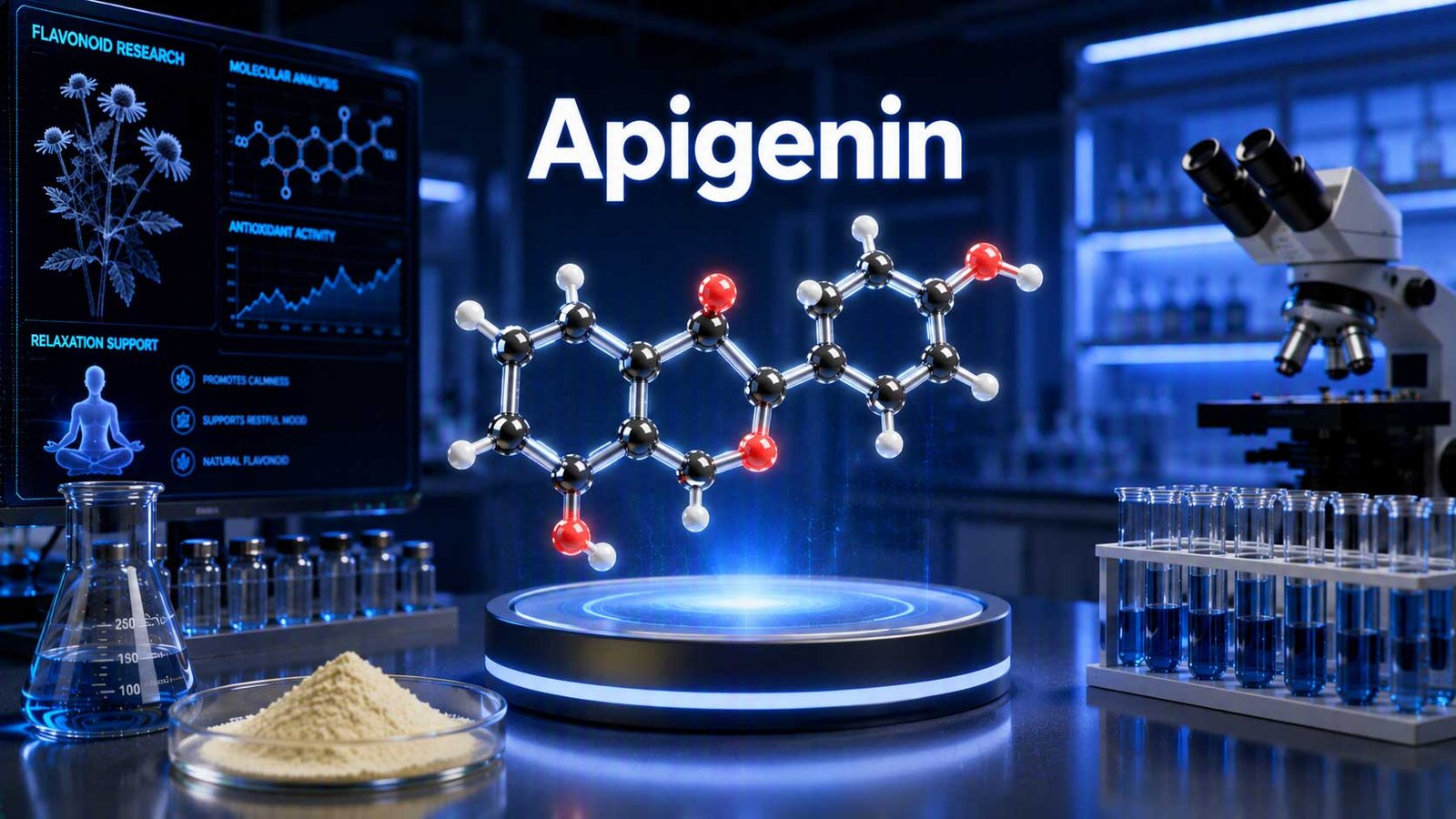
The Quiet Molecule Behind Your Chamomile Tea
There’s a particular kind of stillness that settles in after a warm cup of chamomile tea, and for years I chalked it up to ritual. Slow down, hold a warm mug, breathe. But the more time I’ve spent digging through the research on plant compounds, the more I’ve come to believe that ritual is only half the story. The other half is chemistry, and one molecule in particular deserves a lot more credit than it gets: Apigenin.
Apigenin is a flavonoid, specifically a flavone, and it belongs to a much larger family of plant compounds that give fruits, vegetables, and herbs their color, flavor, and a good chunk of their biological punch. Chemically speaking, it’s known as 4′,5,7-trihydroxyflavone, which is not a phrase you need to remember, but it’s worth knowing that this exact structure is what allows Apigenin to interact so cleanly with certain receptors in the human brain. That’s not marketing language. That’s decades of pharmacology research, some of it going back to the mid-1990s, when scientists first isolated Apigenin from chamomile flowers and found that it binds to the same receptor site targeted by benzodiazepine medications, just far more gently without producing sedation or muscle relaxation at typical doses.
Table of Contents


I’ve worked with a lot of botanicals over the years, and most of them earn their reputation through a combination of folklore and a handful of supportive studies. Apigenin is a little different. It shows up almost everywhere in the plant kingdom, it’s been part of traditional medicine for centuries through herbs like chamomile and parsley, and it has actually held up reasonably well under modern scientific scrutiny. That combination is rare, and it’s part of why I find this particular flavonoid so compelling.
What makes Apigenin worth a dedicated conversation, rather than a footnote in a broader flavonoid roundup, is its relationship with relaxation specifically. A lot of botanicals get labeled “calming” because they’re associated with herbal tea culture, full stop. Apigenin has something more concrete going on. Researchers have traced its interaction with GABA-A receptors, the same inhibitory neurotransmitter system that benzodiazepine drugs work through, and found that Apigenin competitively displaces certain binding markers at these receptor sites without affecting muscimol binding to GABA-A receptors. In plain terms, it seems to nudge the nervous system toward a calmer state through a mechanism that’s at least partially understood, not just assumed.
That said, I want to be upfront about something before we go any further: Apigenin is not a sedative in the pharmaceutical sense, and it’s not going to replace anyone’s prescribed medication. What it appears to offer, based on the current body of research, is a milder, food-based route toward the kind of nervous system down-regulation that supports better sleep, steadier mood, and an easier time unwinding after a stressful day. It also happens to carry a broader profile of antioxidant and anti-inflammatory activity that extends well beyond relaxation, which is part of what makes it such an interesting compound to study.
Flavonoids as a category have been getting more attention in nutrition science over the past two decades, largely because researchers keep finding that the “eat your vegetables” advice our grandparents gave us was doing a lot more biochemical heavy lifting than anyone realized. Apigenin is one of the more well-characterized members of that category. It’s abundant in parsley and celery, concentrated in chamomile flowers, and present in smaller amounts across a surprising range of everyday produce. You’ve probably consumed some today without thinking twice about it.
Over the course of this article, I want to walk through what the science actually says about Apigenin: how it supports the body, where you can find it in real food, how much of it people are actually taking in supplement form, and where the genuine risks and open questions sit. I’m not going to pretend every claim about this flavonoid is settled science, because it isn’t. Some of the most exciting findings come from cell studies and animal models rather than large human trials, and that distinction matters. But there’s enough here, both in mechanism and in early clinical evidence, to make Apigenin one of the more legitimately interesting natural compounds for anyone interested in relaxation, sleep support, or general antioxidant nutrition.
So let’s get into it. Not with hype, but with an honest look at what more than two decades of research on this particular flavonoid has actually shown.
Key Health Benefits of Apigenin
Supporting Relaxation and Sleep
This is the benefit most people come looking for, and it’s also the one with the clearest mechanistic story behind it. Apigenin’s calming reputation traces back to its interaction with benzodiazepine binding sites on GABA-A receptors in the brain. Early pharmacological work found that apigenin competitively displaced flunitrazepam binding with a Ki of roughly 4 micromolar in brain membrane studies, which is a fairly direct way of saying it occupies the same neurochemical neighborhood as classic anti-anxiety medications, just with a much softer touch.
In behavioral studies using the elevated plus-maze, a standard test researchers use to measure anxiety-like behavior in animals, apigenin produced clear anxiolytic activity without the sedation or muscle-relaxant effects typically seen with benzodiazepines. Interestingly, that same research found that a tenfold increase in dosage was needed before any noticeable sedative effect appeared, and even then it was modest. That dose-dependent pattern, mild calming at normal amounts and only slight sedation at much higher doses, is part of what makes Apigenin distinct from pharmaceutical sedatives.
Human evidence largely comes through chamomile, which is one of the richest dietary sources of Apigenin. In a randomized, placebo-controlled trial involving people with generalized anxiety disorder, participants taking chamomile extract for eight weeks showed a significantly greater reduction in anxiety symptoms compared to those on placebo. Secondary measures, including psychological well-being scores, moved in the same favorable direction. It’s worth noting this was chamomile extract rather than isolated Apigenin, so we can’t say with certainty how much of the effect came from Apigenin alone versus the broader mix of plant compounds in chamomile. Still, given what we know about Apigenin’s receptor activity, it’s reasonable to think it’s doing a meaningful share of the work.
Antioxidant and Anti-Inflammatory Activity
If relaxation is Apigenin’s headline act, antioxidant support is the steady undercurrent running through almost every study on this compound. Flavonoids in general are known for scavenging free radicals, and Apigenin performs well in this category, helping to blunt oxidative stress at the cellular level. This matters because unchecked oxidative damage is linked to everything from accelerated aging to chronic disease processes.
On the inflammation side, laboratory research using human and mouse immune cells found that Apigenin meaningfully dampened the inflammatory response triggered by bacterial endotoxin exposure. In that study, apigenin was shown to suppress lipopolysaccharide-induced inflammatory signaling in macrophages through multiple overlapping mechanisms, including effects on major inflammatory signaling pathways. Chronic low-grade inflammation is increasingly recognized as a contributor to a long list of health issues, so a compound that can meaningfully calm that response, even in a supportive rather than curative role, is worth paying attention to.
I’ll add a personal observation here: in my experience reading through this literature, anti-inflammatory flavonoids rarely work in isolation. Apigenin’s anti-inflammatory activity seems to be part of why it shows up in research spanning cardiovascular health, skin health, and even oral health. It’s not a wonder drug, but it’s a compound that keeps popping up across disciplines, which tends to happen when something has a genuinely broad mechanism of action rather than one narrow party trick.
Cognitive and Neuroprotective Potential
Beyond its calming effects, Apigenin has drawn interest for its potential role in supporting brain health more broadly. Its antioxidant and anti-inflammatory properties appear to extend into neurological tissue, and researchers have explored its effects in animal models related to memory and cognitive function. This is still an emerging area, and it would be overstating things to say Apigenin is a proven memory enhancer for humans. But the preclinical signals are consistent enough that neuroscience researchers keep returning to this molecule, particularly in the context of age-related cognitive decline and neuroinflammation.
Cardiovascular and Metabolic Support
Apigenin has also been studied for its relationship to cardiovascular markers, including blood pressure regulation and vascular inflammation. Animal research has pointed to cardioprotective effects, particularly around reducing tissue damage after cardiac stress. While this doesn’t mean a bowl of parsley is a substitute for cardiovascular care, it does add another layer to why Apigenin keeps earning attention as a broadly protective dietary compound rather than a single-purpose supplement.
Put all of this together, and you get a flavonoid whose benefits cluster around three connected themes: calming the nervous system, calming inflammation, and protecting cells from oxidative wear and tear. Those three things tend to reinforce each other, which is probably why Apigenin shows up so consistently across such different corners of the research.
Dietary Sources of Apigenin
The Herbs That Lead the Pack
If you’re trying to get more Apigenin into your diet without reaching for a supplement bottle, your kitchen herb rack is actually a great place to start. Parsley is, by a wide margin, one of the richest known sources. Dried parsley in particular concentrates Apigenin dramatically compared to the fresh leaf, since drying removes water weight while leaving the flavonoid content largely intact. Fresh parsley still carries a meaningful amount and is easy to work into everyday cooking, chopped over roasted vegetables, blended into a green sauce, or tossed generously into a salad the way tabbouleh does it.
Celery is the other major player here, both the stalks and, in more concentrated form, the seeds. Celery doesn’t get nearly as much credit in nutrition conversations as leafy greens do, but its Apigenin content, along with a reasonable amount in the seeds specifically, makes it worth keeping in regular rotation rather than treating it as a diet-food afterthought.
Then there’s chamomile, which deserves its own mention because of how directly it connects to Apigenin’s calming reputation. Dried chamomile flowers are traditionally used to prepare sedative and spasmolytic teas, and the Apigenin concentration in the flower heads is substantial enough that a cup of properly steeped chamomile tea genuinely delivers a meaningful dose. This is likely why chamomile tea has held onto its reputation as a bedtime ritual across so many cultures for so many centuries. It wasn’t just tradition. There was a real, identifiable compound doing real work.
Everyday Vegetables and Fruits
Beyond the headline sources, Apigenin shows up in smaller but still useful amounts across a surprisingly wide range of produce. Onions carry some, as do certain citrus fruits like oranges. Wheat sprouts and certain leafy vegetables, including vine spinach, contribute as well. None of these individually rival parsley or chamomile in concentration, but eating a varied, plant-forward diet naturally stacks these smaller contributions on top of each other.
Herbs and spices beyond parsley also deserve mention. Oregano and thyme, especially in dried form, retain notable Apigenin levels even after processing, which is a nice reminder that your spice cabinet isn’t just there for flavor. Every time you season a dish generously with dried herbs, you’re doing a small amount of nutritional work alongside the culinary work.
Getting Practical About Intake
Here’s where I’ll be honest about something that doesn’t always make it into glossy wellness content: dietary intake of Apigenin varies enormously depending on what a person actually eats, and most people are probably getting a fairly modest amount through food alone unless they’re deliberately eating a lot of parsley, celery, or drinking chamomile tea regularly. Some regional dietary surveys have put average daily Apigenin intake in the low single-digit milligram range, which is meaningfully lower than the doses used in most of the research showing measurable calming or antioxidant effects.
That gap between typical dietary intake and research-supported doses is exactly why isolated Apigenin supplements have become popular. But before jumping to supplementation, there’s real value in simply eating more of the foods that carry it. A parsley-heavy salad, a habit of steeping chamomile in the evening, celery as a regular snack rather than an occasional diet food. These are low-risk, low-cost ways to nudge intake upward, and they come with the side benefit of fiber, other phytonutrients, and the simple pleasure of eating actual food rather than swallowing another capsule.
I’d also gently push back on the idea that fat-soluble compounds like Apigenin need elaborate pairing strategies to be absorbed. Yes, some research suggests bioavailability improves modestly alongside dietary fat, but you don’t need to overthink this. A normal, balanced meal that includes some fat, olive oil on your salad, a bit of butter in your cooking, gets you most of the way there without turning dinner into a supplement optimization project.
Dosage & Deficiency
There Is No Recognized Deficiency
Let’s clear something up right away: Apigenin is not an essential nutrient in the way vitamin C or iron are essential. There’s no clinical deficiency syndrome associated with low Apigenin intake, and no medical body classifies it as something the body absolutely requires to function. It’s a beneficial dietary compound, not a vitamin, and treating it as though skipping it will cause a specific health problem would be misleading.
That said, the absence of a formal deficiency doesn’t mean intake is irrelevant. Given the antioxidant, anti-inflammatory, and calming activity we’ve walked through, a diet that’s consistently low in flavonoid-rich foods, not just Apigenin sources but the whole family of plant polyphenols, is associated with less favorable outcomes across a range of long-term health markers. So while you won’t develop an “Apigenin deficiency” in a clinical sense, chronically skipping the plants that carry it is probably not doing you any favors.
What the Research Doses Actually Look Like
This is where things get genuinely interesting, because the doses used in research vary quite a bit depending on what outcome is being studied. Animal studies exploring anxiolytic effects have used doses in the low single-digit milligrams per kilogram range for the calming effect, with sedation only appearing at substantially higher doses. Translating animal doses directly to humans is never a clean process, so I want to be careful not to hand you a false sense of precision here.
For chamomile-based human trials, the standardized extract doses used to show meaningful anxiety reduction have generally landed in the range of a few hundred milligrams of chamomile extract per day, taken consistently over roughly eight weeks before effects became clearly measurable. Keep in mind that chamomile extract contains Apigenin as one component among several active compounds, so the actual isolated Apigenin content within those doses is considerably smaller than the total extract weight.
Commercial isolated Apigenin supplements on the market today commonly range from around 25 to 200 milligrams per serving, generally taken in the evening for those using it as a sleep or relaxation aid. There isn’t yet a firmly established, universally agreed-upon optimal dose backed by large-scale human trials specifically isolating Apigenin rather than chamomile extract as a whole. That’s an honest gap in the research, and I think it’s worth saying plainly rather than papering over it with confident-sounding numbers that don’t have solid backing.
A Grounded Approach to Using It
If you’re considering an Apigenin supplement, starting conservatively makes sense, both because individual sensitivity varies and because the research base, while promising, isn’t dense enough to justify aggressive dosing. Many people find that consistency matters more than dose size. The chamomile trials that showed benefit weren’t measuring a single dramatic dose; they were tracking steady daily intake over weeks. That pattern, gradual, cumulative benefit rather than an immediate on-off switch, is consistent with how a lot of botanical compounds tend to work, and it’s a useful expectation to carry into any decision about supplementation.
And I’ll say this as someone who’s spent a long time looking at supplement trends: the fact that Apigenin doesn’t have a flashy, dramatic single-dose effect isn’t a weakness. Compounds that work gently and cumulatively tend to have gentler side-effect profiles too, which brings us naturally to the next section.
Toxicity & Risks of Apigenin
A Generally Favorable Safety Profile
The encouraging news is that Apigenin has consistently been characterized in the research literature as low in toxicity relative to many other bioactive plant compounds. Researchers studying its anti-inflammatory activity in macrophages specifically noted that apigenin is a non-toxic natural flavonoid abundantly present in common fruits and vegetables, and that framing holds up across a wide swath of the broader literature. This isn’t a compound that’s raised major red flags in the way some other botanicals have.
That said, “low toxicity” is not the same as “risk-free,” and it’s worth walking through the specific areas where caution is genuinely warranted rather than treating this section as a formality.
Enzyme Interactions and Medication Considerations
One of the more clinically relevant findings involves Apigenin’s interaction with liver enzymes responsible for metabolizing a wide range of medications. Research examining cytochrome P450 activity found that apigenin was among the more potent inhibitors of the CYP1A2 enzyme when tested alongside several other flavonoids. CYP1A2 is involved in metabolizing a range of common medications and even caffeine, so meaningful inhibition of this enzyme raises the theoretical possibility of altered drug metabolism when Apigenin is consumed in concentrated, supplement-level amounts alongside certain prescription medications.
This is exactly the kind of interaction that gets lost in casual wellness conversations but matters enormously in practice. If you’re taking prescription medications, particularly ones metabolized through the liver’s CYP enzyme system, it’s worth discussing concentrated Apigenin or chamomile supplementation with a healthcare provider or pharmacist before adding it to your routine. Occasional chamomile tea is a very different exposure level than a standardized high-dose Apigenin capsule, and that distinction matters when thinking through interaction risk.
Reproductive and Hormonal Considerations
Some animal research has raised questions worth flagging, even though the direct human relevance isn’t fully settled. Studies examining Apigenin’s effects on reproductive parameters in mice found that high-dose apigenin exposure was associated with measurable decreases in sperm motility and related semen quality parameters after a period of administration. This kind of finding doesn’t necessarily translate directly to typical human dietary or even supplemental exposure, since the doses used in these animal studies are often far higher, proportionally, than what a person would realistically consume. But it’s a legitimate area flagged in the scientific literature, and I think it deserves honest mention rather than being quietly left out because it complicates an otherwise favorable safety story.
Apigenin has also been studied in the context of phytoestrogenic activity in some research contexts, given its structural similarity to certain hormone-interacting flavonoids. This is an area where the research is still developing, and it’s part of why anyone who is pregnant, breastfeeding, or managing a hormone-sensitive health condition should treat concentrated Apigenin supplementation as something to discuss with a doctor rather than something to self-prescribe.
Common, Milder Side Effects
At the more everyday end of the risk spectrum, some people report mild stomach discomfort or skin sensitivity when taking concentrated Apigenin, particularly at the higher end of the commercial dosing range. These effects appear to be relatively uncommon and generally mild when they do occur, but they’re worth knowing about, especially if you’re trying a new supplement for the first time and want to know what to watch for.
Allergic sensitivity is also worth a brief mention, particularly for anyone with known sensitivities to plants in the daisy family, since chamomile belongs to that botanical group. Cross-reactivity isn’t common, but it’s not impossible either, and anyone with a history of ragweed or related plant allergies should introduce chamomile-based Apigenin sources cautiously.
The Honest Bottom Line on Risk
Taken together, Apigenin’s risk profile looks like what you’d expect from a compound that’s been part of the human diet for a very long time: generally well tolerated, with real but manageable considerations around drug interactions and reproductive research that hasn’t been fully translated to humans yet. This isn’t a compound I’d describe as dangerous. It’s one I’d describe as deserving the same basic respect you’d give any bioactive substance: know what you’re taking, know your own medication list, and don’t assume “natural” automatically means “no interactions to think about.”
Bringing Apigenin Into Your Daily Rhythm
After spending this much time with the research, what stands out to me most about Apigenin isn’t any single dramatic finding. It’s the consistency. A flavonoid that shows up in ordinary kitchen herbs, that’s been steeped into tea for centuries before anyone knew the word “GABA,” and that modern pharmacology keeps circling back to with genuine scientific curiosity rather than passing hype. That kind of staying power tends to mean something.
If you’re looking for a practical takeaway, I’d steer you toward the food-first path before the supplement aisle. Cook with more fresh parsley than you think you need. Keep celery as a real snack, not a diet-food punishment. Let chamomile tea become an actual evening habit rather than something you reach for only when you’re already too wound up to sleep. These small, repeatable choices build the kind of steady, cumulative exposure that seems to matter most in the research, far more than any single large dose ever could.
For those considering a concentrated Apigenin supplement, particularly for sleep or anxiety support, go in informed rather than hopeful. Start conservatively, pay attention to how your body responds, and loop in a healthcare provider if you’re managing medications or a health condition where enzyme interactions or hormonal sensitivity could realistically matter. None of that is meant to scare you off. It’s meant to help you use this compound the way the evidence actually supports using it, thoughtfully, consistently, and without expecting a single dose to work like a switch.
What I keep coming back to is this: Apigenin isn’t trying to be a miracle molecule, and the honest research doesn’t ask it to be. It’s a well-studied, reasonably well-understood flavonoid that nudges the body toward calm through a real, identifiable mechanism, while quietly doing antioxidant and anti-inflammatory work in the background. That’s not a flashy pitch. But after years of watching flashy pitches fall apart under scrutiny, I’ve come to appreciate compounds that simply hold up.
Article Sources
At AncientHerbsWisdom, our content relies on reputable sources, including peer-reviewed studies, to substantiate the information presented in our articles. Our primary objective is to ensure our content is thoroughly fact-checked, maintaining a commitment to accuracy, reliability, and trustworthiness.
- Allemailem, K. S., Almatroudi, A., Alharbi, H. O. A., AlSuhaymi, N., Alsugoor, M. H., Aldakheel, F. M., Khan, A. A., & Rahmani, A. H. (2024). Apigenin: A bioflavonoid with a promising role in disease prevention and treatment. Biomedicines, 12(6), 1353. https://doi.org/10.3390/biomedicines12061353
- Amsterdam, J. D., Li, Y., Soeller, I., Rockwell, K., Mao, J. J., & Shults, J. (2009). A randomized, double-blind, placebo-controlled trial of oral Matricaria recutita (chamomile) extract therapy for generalized anxiety disorder. Journal of Clinical Psychopharmacology, 29(4), 378-382. https://doi.org/10.1097/JCP.0b013e3181ac935c
- Avallone, R., Zanoli, P., Puia, G., Kleinschnitz, M., Schreier, P., & Baraldi, M. (2000). Pharmacological profile of apigenin, a flavonoid isolated from Matricaria chamomilla. Biochemical Pharmacology, 59(11), 1387-1394. https://doi.org/10.1016/S0006-2952(00)00264-1
- Salehi, B., Venditti, A., Sharifi-Rad, M., Kręgiel, D., Sharifi-Rad, J., Durazzo, A., Lucarini, M., Santini, A., Souto, E. B., Novellino, E., Antolak, H., Azzini, E., Setzer, W. N., & Martins, N. (2019). The therapeutic potential of apigenin. International Journal of Molecular Sciences, 20(6), 1305. https://doi.org/10.3390/ijms20061305
- Shimada, H., Eto, M., Ohtaguro, M., Ohtsubo, M., Mizukami, Y., Ide, T., & Imamura, Y. (2010). Differential mechanisms for the inhibition of human cytochrome P450 1A2 by apigenin and genistein. Journal of Biochemical and Molecular Toxicology, 24(4), 230-234. https://doi.org/10.1002/jbt.20328
- Viola, H., Wasowski, C., Levi de Stein, M., Wolfman, C., Silveira, R., Dajas, F., Medina, J. H., & Paladini, A. C. (1995). Apigenin, a component of Matricaria recutita flowers, is a central benzodiazepine receptors-ligand with anxiolytic effects. Planta Medica, 61(3), 213-216. https://doi.org/10.1055/s-2006-958058
- Zhang, X., Wang, G., Gurley, E. C., & Zhou, H. (2014). Flavonoid apigenin inhibits lipopolysaccharide-induced inflammatory response through multiple mechanisms in macrophages. PLOS ONE, 9(9), e107072. https://doi.org/10.1371/journal.pone.0107072

- Phosphatidic Acid: Supporting Muscle Growth and Strength - July 31, 2026
- Ceramides: Supporting Healthy Skin From Within - July 31, 2026
- Synbiotics: Combining Prebiotics and Probiotics Together - July 31, 2026