
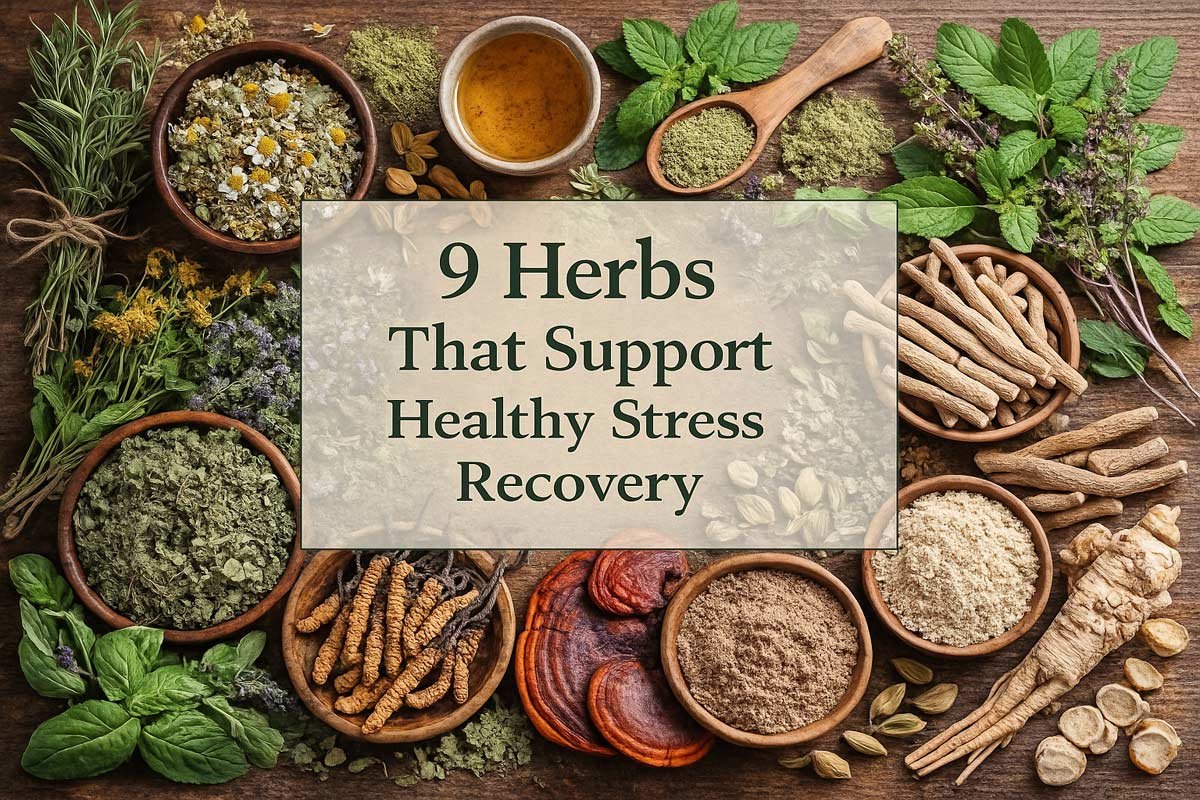
Understanding Stress Recovery and Herbal Support
Stress gets talked about like it’s the enemy. Something to crush, mute, shut down. I’ve never liked that framing. Stress itself isn’t the problem. It’s the recovery that’s missing.
Your body is built for stress. Sharp focus. Faster reflexes. A temporary surge of cortisol and adrenaline so you can handle what’s in front of you. That system works beautifully when stress comes in waves and then backs off. The trouble starts when the wave never really recedes. That’s when stress recovery matters more than stress relief.
Table of Contents

Cortisol sits at the center of this conversation. It’s not a villain hormone. It helps regulate blood sugar, inflammation, blood pressure, and your sleep-wake rhythm. But cortisol is meant to rise and fall with a clear daily rhythm. Chronic psychological pressure, poor sleep, constant stimulation, and emotional strain flatten that rhythm. You end up wired at night, sluggish in the morning, hungry at the wrong times, and oddly fragile under pressure. Sound familiar?
The nervous system takes the hit next. When the sympathetic branch stays switched on, digestion slows, immunity dips, and mental clarity thins out. People often describe it as feeling “tired but tense,” or calm on the surface but buzzing underneath. I’ve heard that exact phrase more times than I can count.
Stress recovery isn’t about forcing calm. It’s about restoring flexibility. The ability to ramp up when needed and settle back down without friction. That flexibility lives in the nervous system, the endocrine system, and the subtle conversation between them. Herbs and medicinal mushrooms shine here because they don’t override physiology. They support it.
This is where modern language like adaptogenic response overlaps neatly with older herbal traditions. Long before cortisol was isolated in a lab, herbalists noticed patterns. Certain plants helped people tolerate hardship better. They slept deeper. Their moods steadied. Their energy didn’t crash as hard after strain. These weren’t sedatives and they weren’t stimulants. They worked in the background, nudging systems back toward balance.
One thing I always stress, no pun intended, is that stress recovery feels different from relaxation. Relaxation can be passive. You lie down, you scroll, you distract yourself. Recovery is active at a cellular and neurological level. It involves replenishing neurotransmitters, calming excessive signaling, supporting mitochondrial output, and reestablishing circadian cues. You don’t always feel it immediately, but you notice it over time. Less reactivity. Fewer emotional spikes. A wider buffer between stimulus and response.
Herbs influence this process in several ways. Some modulate the hypothalamic-pituitary-adrenal axis, helping normalize cortisol output rather than suppress it. Others support GABAergic activity, gently easing nervous tension without dulling cognition. Some improve stress tolerance by enhancing oxygen use, glucose metabolism, or immune signaling. Medicinal mushrooms often work through immune and inflammatory pathways that indirectly affect mood and resilience. It’s not magic. It’s systems biology.
I remember someone, years ago, a small business owner, who swore nothing worked for stress. Meditation made him restless. Exercise just added more pressure. He didn’t chase calm. He focused on recovery. Supporting sleep depth. Stabilizing blood sugar. Adding one adaptogen and one nervine herb. Six weeks later he said something that stuck with me. “The problems didn’t change. I just don’t feel crushed by them anymore.” That’s stress recovery in real life.
Another important distinction is time scale. Pharmaceuticals often act fast and blunt. Herbs are slower and layered. That frustrates some people. I see it as a feature, not a flaw. You’re not flipping a switch. You’re retraining a system that’s been overloaded for months or years. Subtle daily support compounds. The nervous system remembers safety the same way it remembers threat, through repetition.
This also explains why dosage and consistency matter more than chasing strong sensations. If an herb makes you feel something dramatic right away, it’s often pushing rather than supporting. The plants traditionally used for stress recovery tend to feel almost boring at first. Then one day you realize you handled a stressful conversation better. Or you woke up without that tight chest feeling. Or you slept through the night without waking at 3 a.m. thinking about everything.
Another layer people overlook is that stress is not purely psychological. Inflammation, gut imbalance, micronutrient deficiencies, and poor metabolic health all feed into stress signaling. The body interprets internal imbalance as threat. Many herbs and mushrooms address these underlying stressors indirectly. When inflammation drops or digestion improves, the nervous system settles on its own. No pep talk required.
I’ll also say this plainly. Stress recovery is personal. Two people under the same pressure can respond completely differently. Genetics, past trauma, sleep history, and even childhood stress exposure shape how your nervous system reacts today. That’s why no single herb works for everyone, and why stacking random supplements often backfires. The goal is not maximum effect. It’s appropriate effect.
As we move through the herbs and mushrooms in this article, keep that frame in mind. These plants are not meant to numb stress or turn you into a monk on a mountain. They’re allies for resilience. They help you bend without breaking. They support recovery so that stress doesn’t linger in the tissues, the mind, or the hormones long after the moment has passed.
Stress will always be part of life. Stress recovery determines whether it sharpens you or slowly wears you down. That’s the difference herbal medicine aims to make.
Adaptogens for Hormonal and Nervous System Balance
If there’s one category of plants that actually earns its reputation in stress recovery, it’s adaptogens. Not because they’re trendy, but because they work quietly where stress does the most damage. Hormones. Nerves. Feedback loops that decide whether you feel steady or constantly on edge.
Adaptogens do not force calm. They do not sedate. They help the body respond more appropriately. That word matters. Appropriate response is the core of stress recovery. Too much cortisol for too long is just as problematic as too little. A nervous system stuck in high alert is not strong, it’s exhausted. Adaptogens aim for regulation, not suppression.
1. Ashwagandha (Withania somnifera)
Ashwagandha is often introduced as a calming herb, but that description barely scratches the surface. What it really does is restore tone to the stress response. Think of it less as a brake pedal and more as a mechanic tightening loose cables.
Physiologically, ashwagandha interacts with the hypothalamic-pituitary-adrenal axis. That’s the command center that decides how much cortisol you release and when. In people under chronic stress, this axis loses its rhythm. Cortisol spills into the evening, sleep becomes shallow, and mornings feel like dragging a body uphill. Ashwagandha helps normalize that rhythm over time.
I’ve seen it help people who feel constantly depleted yet wired. That odd state where fatigue and anxiety coexist. Ashwagandha does not give a jolt of energy. Instead, it tends to improve baseline resilience. You wake up feeling more rested. Stressful events don’t hit quite as hard. There’s a sense of internal buffering.
One thing worth saying plainly is that ashwagandha works best when stress is chronic, not acute. It’s not the herb you reach for before a big presentation. It’s the one you take daily when life has been grinding for months. Stress recovery is a long game here.
It also has a grounding quality that shows up physically. Tension in the jaw softens. That constant tight feeling in the chest eases. Digestion often improves, which tells you the nervous system is shifting toward parasympathetic activity. These changes are subtle, but they add up.
Not everyone loves ashwagandha. Some people feel too heavy on it, almost slowed down. That usually means the dose is too high or the person already trends toward low cortisol. Adaptogens are context dependent. Used well, ashwagandha can feel like finally getting a full exhale.
2. Rhodiola rosea
If ashwagandha is grounding, rhodiola is clarifying. This is the adaptogen I think of for mental fatigue and emotional burnout rather than pure exhaustion. Rhodiola supports stress recovery by improving how the brain uses energy under pressure.
It influences neurotransmitters like serotonin and dopamine, but not in a blunt way. The effect feels more like improved signal quality. Thoughts are less scattered. Focus comes easier. Emotional reactions soften, not because you care less, but because your nervous system is not overloaded.
Rhodiola is particularly useful when stress shows up as irritability, brain fog, or that brittle feeling where even small problems feel overwhelming. I’ve heard people describe it as feeling more “capable.” That word comes up a lot. Not euphoric. Capable.
From a hormonal perspective, rhodiola appears to reduce excessive cortisol output during stress without flattening it entirely. That distinction matters. You still get alert when you need to. You just recover faster afterward. That quicker return to baseline is a hallmark of good stress recovery.
One practical note. Rhodiola tends to work better earlier in the day. Taken too late, it can interfere with sleep for some people. That’s not stimulation in the classic sense, but improved alertness. Used correctly, it can actually reduce that late afternoon crash that sends people reaching for caffeine.
I once used rhodiola during a particularly demanding period that involved long hours, constant decision making, and very little margin for error. What I noticed wasn’t extra energy. It was fewer emotional spikes. Setbacks didn’t derail me for hours. That alone can dramatically change how stress accumulates.
3. Holy Basil (Ocimum sanctum)
Holy basil, or tulsi, sits at an interesting crossroads between emotional and physiological stress recovery. It’s an adaptogen, but it also has a distinctly heart centered quality. People often underestimate that aspect, yet it’s one of its strengths.
Tulsi supports cortisol balance, but its effects often show up first in mood and perception. Worry softens. Emotional noise quiets down. There’s a gentle uplift that doesn’t feel forced. It’s especially useful when stress expresses itself as rumination or low grade anxiety that hums all day.
What I appreciate most about holy basil is how it supports resilience without dulling sensitivity. You still feel things. You just don’t spiral as easily. That’s a big deal for stress recovery, especially in people who are emotionally perceptive and easily overstimulated.
Tulsi also supports metabolic and inflammatory pathways linked to chronic stress. When blood sugar swings less and inflammation drops, the nervous system relaxes naturally. This is one reason people often report better digestion and fewer stress related headaches with regular use.
There’s also something ritualistic about holy basil that shouldn’t be ignored. Drinking it as a tea creates a pause. A moment of intentional slowing. That behavioral cue reinforces the physiological effect. Stress recovery is not just chemistry. It’s pattern interruption.
I’ve found holy basil particularly helpful during periods of emotional strain rather than physical overwork. Relationship stress. Caregiving. That sense of carrying too much internally. It doesn’t push. It steadies.
Taken together, ashwagandha, rhodiola, and holy basil form a solid foundation for hormonal and nervous system balance. Each addresses stress recovery from a slightly different angle. One grounds. One sharpens. One soothes. Used thoughtfully, they remind the body how to respond to stress without losing itself in the process.
Calming Herbs for Emotional and Neurochemical Recovery
Not all stress lives in hormones. A lot of it gets trapped in chemistry. Neurotransmitters misfiring. Emotional tone skewed toward vigilance. Thoughts looping long after the actual stressor is gone. This is where calming herbs matter, not as tranquilizers, but as recalibrators. They help the brain remember how to settle without shutting down.
Emotional stress recovery is often overlooked because it’s quieter than burnout. People still function. They still show up. But internally, everything feels slightly off. Too reactive. Too sensitive. Or strangely numb. Calming herbs work in that middle space, helping the nervous system process stress rather than store it.
4. Lemon Balm (Melissa officinalis)
Lemon balm is one of those plants that feels almost too gentle to be effective. Until you actually work with it. Then you realize how precise it is.
Its primary strength lies in supporting GABA activity in the brain. GABA is the neurotransmitter that tells your nervous system it’s safe to slow down. When GABA signaling is weak, the mind races, muscles stay tense, and even rest feels effortful. Lemon balm doesn’t force sedation. It enhances the signal that says, you can let go now.
The effect often shows up as mental quiet rather than physical heaviness. Thoughts lose their sharp edges. Emotional reactivity softens. I’ve seen people describe it as feeling less “grabby” mentally. Stress still registers, but it doesn’t cling.
Lemon balm also has a curious relationship with mood and cognition. It can improve focus while calming anxiety, which sounds contradictory until you experience it. That combination makes it particularly useful for stress recovery when mental fatigue and worry coexist. The kind of stress where your brain is tired but refuses to shut up.
I tend to think of lemon balm as a social nervous system herb. It’s helpful when stress comes from interpersonal dynamics. Too many conversations. Too much emotional input. It helps create internal boundaries without emotional withdrawal.
One small but important note. Lemon balm can feel subtly uplifting. For people whose stress tilts toward low mood rather than agitation, that lift can be stabilizing. It’s not stimulation. It’s emotional clarity.
5. Passionflower (Passiflora incarnata)
Passionflower works deeper. Where lemon balm quiets the mind, passionflower unwinds the body-mind connection that keeps stress locked in place.
This herb has a long history of use for nervous tension, especially when stress shows up physically. Tight shoulders. Shallow breathing. That clenched feeling in the diaphragm that makes it hard to fully inhale. Passionflower helps release those patterns.
Neurochemically, it supports GABA as well, but with a more somatic expression. People often feel the effect in their muscles first. The jaw loosens. The belly softens. Breathing deepens without effort. That physical shift feeds back into emotional calm.
Passionflower shines in stress recovery when sleep is disrupted by a racing nervous system. Not the wide-awake buzzing of overstimulation, but the restless kind. Tossing. Half dreaming. Waking unrefreshed. It helps smooth the transition into deeper rest.
I’ve also found it useful for stress that carries an emotional charge. Grief. Frustration. That brittle edge where emotions feel close to the surface. Passionflower doesn’t suppress feeling. It makes feeling safer. That distinction matters.
Years ago, I started using passionflower during a period when stress sat squarely in my chest. Not panic, just constant pressure. Within a week, I noticed my breathing had changed. Deeper. Slower. I hadn’t consciously worked on it. The herb did the work quietly. That’s often how true stress recovery shows up.
Some people worry that calming herbs will dull them. Passionflower rarely does. If anything, it brings people back into their bodies, which makes emotional processing smoother rather than blunted.
6. Panax Ginseng (Panax ginseng)
Panax ginseng might seem like an odd inclusion here. It’s often associated with energy, not calm. But emotional and neurochemical stress recovery isn’t just about slowing down. It’s about restoring capacity.
Chronic stress depletes neurotransmitters and flattens emotional tone. People feel tired, unmotivated, and oddly disconnected. Panax ginseng helps rebuild that internal reserve. It supports dopamine signaling and mental stamina without the jittery edge of stimulants.
Emotionally, this can feel like renewed engagement with life. Stress doesn’t drain you as completely. You have more internal resources to respond rather than react. That’s a form of calm that doesn’t get enough credit.
Panax ginseng also supports cognitive resilience under stress. Decision making improves. Mental fatigue lifts. This reduces the secondary stress that comes from feeling mentally ineffective. Anyone who’s felt overwhelmed knows how much stress feeds on itself.
Used thoughtfully, ginseng can stabilize mood in people whose stress manifests as low drive and emotional flatness. It’s not for acute anxiety. It’s for recovery after prolonged demand. The phase where your system needs rebuilding rather than quieting.
One thing I’ve learned the hard way is that ginseng is about dosage and timing. Too much, or taken too late, can push instead of support. But in appropriate amounts, it brings a grounded sense of strength. You don’t feel hyped. You feel capable again.
This is an important point. Stress recovery is not always about calming down. Sometimes it’s about restoring the energy needed to meet life without strain. Panax ginseng fills that gap when emotional exhaustion is the real issue.
Together, lemon balm, passionflower, and Panax ginseng address emotional and neurochemical stress recovery from different angles. One quietens the mind. One releases the body. One restores internal capacity. Used with intention, they help the nervous system process stress rather than carry it forward. That’s the shift that changes everything.
Medicinal Mushrooms for Resilience and Stress Adaptation
Medicinal mushrooms work on stress from a different angle than most herbs. They don’t chase symptoms. They change terrain. When people tell me herbs feel subtle, mushrooms feel subterranean. You don’t always feel them right away, but the system starts behaving differently over time. More stable. Less reactive. Harder to knock off center.
From a stress recovery perspective, mushrooms are about resilience. Immune signaling, inflammation control, mitochondrial efficiency, and nervous system tone all intersect here. Chronic stress quietly disrupts all of them. That disruption feeds back into mood, sleep, and cognition. Mushrooms help close that loop.
They also ask for patience. These are not quick fixes. They’re daily allies. Taken consistently, they support the body’s ability to adapt rather than collapse under load. That’s a different kind of calm. Not relief, but capacity.
7. Reishi Mushroom (Ganoderma lucidum)
Reishi is often called the mushroom of calm, but that description is incomplete. It’s more accurate to say reishi teaches the nervous system how to rest again.
One of reishi’s strongest effects is on immune modulation and inflammation, both of which are tightly linked to stress physiology. Chronic stress pushes the immune system into a low-grade inflammatory state. That inflammation feeds back into the brain, amplifying anxiety, low mood, and sleep disruption. Reishi helps interrupt that cycle.
People often notice reishi first through sleep. Dreams become more vivid. Nighttime awakenings lessen. There’s a sense of sinking into rest rather than hovering on the surface of it. That deeper rest is foundational for stress recovery. Without it, no amount of daytime calm really sticks.
Reishi also has a distinctly heart-centered quality. Emotional stress often shows up as a tight chest or shallow breathing. Reishi tends to soften that. Not dramatically, but persistently. Over time, emotional reactions feel less sharp. You still care, but you don’t bristle as easily.
I’ve found reishi especially helpful for people who carry stress internally. They may look calm, even stoic, but inside they’re constantly processing. Reishi supports parasympathetic activity, allowing the body to exit threat mode more readily. That’s not sedation. It’s permission to stand down.
One thing worth mentioning is that reishi can feel almost nothing-like at first. No buzz. No obvious shift. Then, weeks later, you realize you’re sleeping better and reacting less. That delayed recognition is common. Reishi works slowly and deeply, which is exactly what chronic stress requires.
8. Cordyceps (Cordyceps sinensis, Cordyceps militaris)
Cordyceps is often marketed for energy, but in the context of stress recovery, its real gift is efficiency.
Chronic stress drains energy not because the body lacks fuel, but because it wastes it. Poor oxygen utilization. Inefficient glucose metabolism. Constant low-level muscle tension. Cordyceps helps the body use what it has more effectively. That changes how stress feels.
Rather than pushing energy upward like stimulants, cordyceps improves endurance and recovery. People describe feeling less winded by life. Tasks don’t feel as heavy. That reduction in perceived effort lowers stress reactivity automatically.
Cordyceps also supports adrenal resilience, which matters when stress has been physical as well as mental. Long work hours. Intense training. Chronic illness. The adrenals don’t just pump cortisol. They coordinate broader stress responses. Cordyceps helps restore their adaptive capacity.
Emotionally, cordyceps can feel stabilizing. Not calming in the traditional sense, but strengthening. Stress feels less depleting. There’s more left in the tank at the end of the day. That alone improves mood and sleep, two pillars of stress recovery.
I’ve seen cordyceps work well for people who crash after stress rather than during it. They get through the day, then collapse. Cordyceps helps smooth that drop. Energy becomes more even. That steadiness reduces anticipatory stress, which is often worse than the stressor itself.
One caution. Cordyceps is not for everyone at every stage. In very wired, anxious states, it can feel too activating. But when stress has led to exhaustion and poor recovery, it can be transformative. Used correctly, it rebuilds rather than stimulates.
9. Lion’s Mane (Hericium erinaceus)
Lion’s mane occupies a unique space in stress recovery because it works primarily through the brain. Not mood directly, but structure and signaling.
Chronic stress affects neuroplasticity. It impairs the brain’s ability to form new connections and repair existing ones. That shows up as brain fog, emotional rigidity, and a sense of being stuck. Lion’s mane supports nerve growth factor, which plays a role in neuronal repair and growth.
The subjective effect is often subtle but meaningful. Improved clarity. Better word recall. Less mental friction. Over time, emotional responses become more flexible. You don’t get locked into the same stress patterns as easily.
Lion’s mane is particularly useful when stress has dulled curiosity or creativity. That flattening of inner life is a common but under-discussed stress response. Restoring cognitive vitality is part of stress recovery, even if it doesn’t look like relaxation.
I’ve noticed lion’s mane helps people who say they feel disconnected from themselves after long periods of stress. Their thoughts are slower. Emotions feel distant. Lion’s mane gently brings sensation and awareness back online. That can feel surprisingly grounding.
It also supports gut-brain communication, another overlooked stress pathway. The gut houses a significant portion of the nervous system, and chronic stress disrupts that relationship. Lion’s mane appears to support intestinal nerve health, which indirectly improves mood and stress tolerance.
This mushroom works best when taken consistently and without expectation of immediate effect. It’s not dramatic. It’s restorative. Over time, people often report feeling more like themselves again. That’s not something you can force.
Together, reishi, cordyceps, and lion’s mane form a powerful foundation for Stress Recovery. One calms and restores rest. One rebuilds energy efficiency. One repairs and supports the brain. Medicinal mushrooms don’t chase calm. They cultivate resilience. And resilience is what allows stress to pass through without leaving scars.
Final Thoughts
Long-term stress recovery is less about what you take and more about what you stop fighting. That idea can be uncomfortable. Most people come to herbs and mushrooms wanting relief. Something to turn the volume down fast. But the body doesn’t really respond to force, especially after months or years of strain. It responds to signals of safety, consistency, and support.
Plants and fungi offer those signals in a way few other tools do. They don’t shout at the nervous system. They whisper. And over time, the system listens.
One of the biggest mistakes I see is treating stress like an isolated problem. As if it lives only in the mind. In reality, stress embeds itself everywhere. Hormones lose rhythm. Sleep loses depth. Digestion tightens. Immune signaling drifts toward inflammation. Emotional range narrows. Stress recovery means addressing the whole pattern, not just the most obvious symptom.
This is where herbs and medicinal mushrooms excel. They work across systems. An adaptogen that steadies cortisol also improves sleep. A calming nervine that quiets anxiety also improves digestion. A mushroom that modulates immunity also supports mood. These overlapping effects are not accidental. They reflect how the body actually functions.
Consistency matters more than intensity. A moderate dose taken daily for months will do more for stress recovery than a powerful formula used sporadically. The nervous system learns through repetition. Every calm response reinforces the next one. Herbs and fungi help create those repetitions, even on days when life doesn’t cooperate.
Another point worth sitting with is that recovery is not linear. There will be days when stress feels louder again. That doesn’t mean the plants stopped working. It often means the body is processing something deeper. As resilience improves, awareness increases. You notice tension sooner. Emotional signals become clearer. That awareness is part of healing, even when it’s inconvenient.
I also believe strongly that stress tolerance should never be the goal. Resilience is not about enduring more pressure indefinitely. It’s about recovering faster and more completely. If herbs and mushrooms are helping you survive a lifestyle that is slowly eroding you, something is off. True stress recovery creates space for better choices, not just more endurance.
There’s a quiet confidence that emerges when the nervous system stabilizes. You trust your reactions again. You stop second guessing every emotional response. Decisions feel cleaner. That internal steadiness changes how stress enters your life. Problems still show up, but they don’t automatically take over your physiology.
I’ve watched people come back to themselves through this process. Not dramatically. Gradually. They sleep deeper. They laugh more easily. They stop living in anticipation of the next demand. That shift is subtle, but it’s profound.
Plants and fungi are not shortcuts. They are companions. They walk alongside your biology while it relearns balance. When used with patience and respect, they don’t just support stress recovery. They restore relationship. Between mind and body. Between effort and rest. Between challenge and renewal.
That’s the kind of recovery that lasts.
Best Selling Supplements for Stress Recovery


Article Sources
At AncientHerbsWisdom, our content relies on reputable sources, including peer-reviewed studies, to substantiate the information presented in our articles. Our primary objective is to ensure our content is thoroughly fact-checked, maintaining a commitment to accuracy, reliability, and trustworthiness.
- National Center for Complementary and Integrative Health. (2023). Ashwagandha. U.S. Department of Health and Human Services. https://www.nccih.nih.gov/health/ashwagandha
- Panossian, A., & Wikman, G. (2010). Effects of adaptogens on the central nervous system and the molecular mechanisms associated with their stress-protective activity. Pharmaceuticals, 3(1), 188–224. https://www.ncbi.nlm.nih.gov/pmc/articles/PMC5452224/
- Cohen, M. M. (2014). Tulsi – Ocimum sanctum: A herb for all reasons. Journal of Ayurveda and Integrative Medicine, 5(4), 251–259. https://www.ncbi.nlm.nih.gov/pmc/articles/PMC4296439/
- Kennedy, D. O., Wake, G., Savelev, S., Tildesley, N. T. J., Perry, E. K., & Wesnes, K. A. (2004). Attenuation of laboratory-induced stress in humans after acute administration of Melissa officinalis. Psychosomatic Medicine, 66(4), 607–613. https://pubmed.ncbi.nlm.nih.gov/15272110/
- Akhondzadeh, S., Naghavi, H. R., Vazirian, M., Shayeganpour, A., Rashidi, H., & Khani, M. (2001). Passionflower in the treatment of generalized anxiety: A pilot double-blind randomized controlled trial. Journal of Clinical Pharmacy and Therapeutics, 26(5), 363–367. https://pubmed.ncbi.nlm.nih.gov/11679026/
- Reay, J. L., Kennedy, D. O., & Scholey, A. B. (2010). Panax ginseng improves aspects of working memory performance and subjective ratings of calmness in healthy young adults. Human Psychopharmacology, 25(6), 462–471. https://pubmed.ncbi.nlm.nih.gov/20641039/
- Boh, B., Berovic, M., Zhang, J., & Zhi-Bin, L. (2007). Ganoderma lucidum and its pharmaceutically active compounds. Biotechnology Annual Review, 13, 265–301. https://pubmed.ncbi.nlm.nih.gov/17875480/
- Zhu, J. S., Halpern, G. M., & Jones, K. (1998). The scientific rediscovery of an ancient Chinese herbal medicine: Cordyceps sinensis. Journal of Alternative and Complementary Medicine, 4(3), 289–303. https://pubmed.ncbi.nlm.nih.gov/9764768/
- Nagano, M., Shimizu, K., Kondo, R., Hayashi, C., Sato, D., Kitagawa, K., & Ohnuki, K. (2010). Reduction of depression and anxiety by Hericium erinaceus. Biomedical Research, 31(4), 231–237.https://pubmed.ncbi.nlm.nih.gov/20834180/

- Soursop: Tropical Fruit for Antioxidants and Digestion - March 28, 2026
- Sugar Apple: Tropical Fruit for Energy and Vitamin C - March 28, 2026
- Dragon Fruit: Tropical Fruit for Gut Health - March 28, 2026