
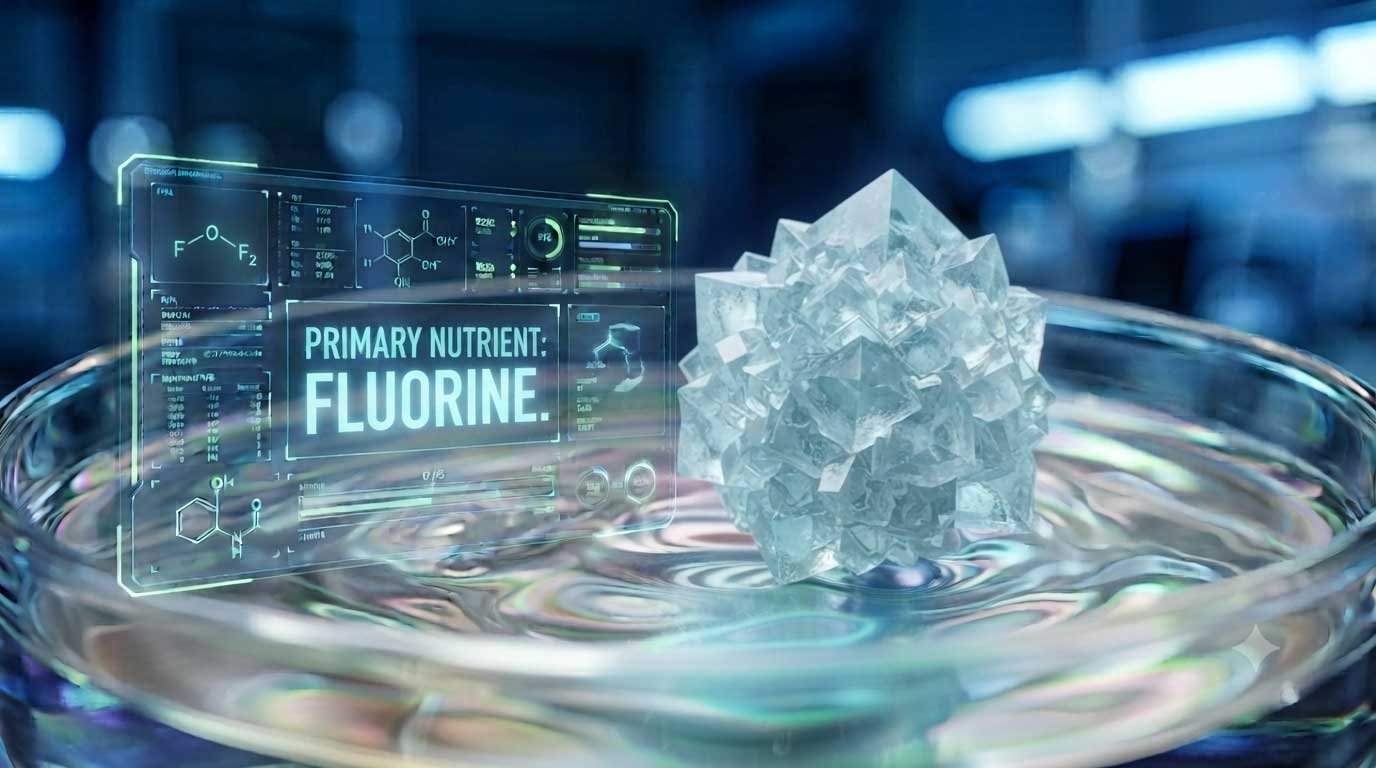
The Mineral in Every Smile You’ve Ever Noticed
Here’s a strange little fact that most people never stop to think about: one of the reasons your teeth haven’t crumbled into powder by now is a pale yellow, highly reactive gas that, in its raw form, would burn straight through your gums. That gas is fluorine. And no, you’re not drinking fluorine gas out of your tap water or swallowing it in your toothpaste. What you’re actually getting is fluoride, the stable, negatively charged ion that fluorine becomes once it settles down and bonds with something else. But fluorine is where the story starts, and it’s the name most people know, so we’ll use it the way it’s commonly used in everyday health conversation while keeping the chemistry honest along the way.
I’ve spent more years than I’d like to admit reading dental and nutrition research, and if there’s one mineral that gets both wildly overhyped and unfairly demonized in the same breath, it’s this one. Half the internet treats fluoride like it’s basically medicine sprinkled into the water supply. The other half treats it like a slow-acting poison someone snuck past the public without asking. The truth, as usual, sits in a much less dramatic middle ground. Fluorine, in its ionic form, is a trace mineral your body handles in small amounts, and those small amounts happen to do something genuinely useful for the hardest tissue you own: the enamel coating your teeth.
Table of Contents


Let’s back up for a second, because context matters here. Minerals are typically split into two categories in nutrition science — major minerals, like calcium and potassium, which your body needs in relatively large quantities, and trace minerals, needed in much smaller amounts but still essential for specific jobs. Fluoride falls into that second group. You don’t need much of it. But the amount you do need is doing something remarkably specific: helping to build and maintain the crystal structure of your enamel, the outermost, mineral-dense layer that takes the daily beating from acid, sugar, and bacteria every time you eat.

Enamel itself is a fascinating structure once you look closely at it. It’s made almost entirely of a mineral called hydroxyapatite, a crystalline form of calcium and phosphate. Under a microscope, it looks almost architectural, like tightly packed rods running in organized columns. That structure is what makes enamel the hardest substance in the human body, harder even than bone. But hydroxyapatite has a vulnerability. It dissolves in acid, and your mouth is an acidic environment more often than you’d think, especially after meals, sugary drinks, or that third cup of coffee you didn’t really need. This is where fluoride steps in. When fluoride ions are present in saliva and plaque, they can swap into the enamel’s crystal lattice and form fluorapatite, a version of the mineral that resists acid dissolution far better than the original. It’s not a dramatic transformation. It’s a quiet, ongoing chemical negotiation happening in your mouth every single day, whether you’re aware of it or not.
I want to be upfront about something before we go further: this article isn’t going to tell you fluoride cures cavities or that avoiding it guarantees decay. Biology rarely works in absolutes like that. What research consistently shows is an association — communities and individuals with adequate fluoride exposure tend to experience meaningfully less tooth decay than those without it, and the mechanism behind that pattern is well understood at the chemical level, even if no single mineral acts alone in a system as complex as the human mouth.
What makes fluorine worth an entire article, rather than a footnote in a dental hygiene pamphlet, is how unusual its story is compared to other minerals. Most nutrients we talk about — iron, zinc, magnesium — are things your body actively seeks out because cells need them for enzymatic processes, oxygen transport, or nerve function. Fluoride isn’t quite like that. Your body doesn’t have a known essential biochemical pathway that grinds to a halt without it, the way it would without iron or iodine. Instead, fluoride’s benefit is largely local and topical in nature, acting where it comes into direct contact with tooth surfaces, even though we now know it also gets absorbed systemically and incorporated into developing teeth and bone. This dual nature — part topical protector, part systemic trace mineral — is part of why fluoride research has such a long, occasionally contentious history stretching back nearly a century, to towns in the American Midwest where dentists first noticed that residents with naturally fluoride-rich water had oddly stained but remarkably decay-resistant teeth.
That observation, made almost by accident in the early twentieth century, eventually led to one of the more debated public health interventions of the modern era: adding controlled amounts of fluoride to municipal water supplies. We’ll get into the nuances of that later, along with dietary sources, how much you actually need, what happens if you don’t get enough, and what happens if you get too much. Because with fluoride, both ends of that spectrum carry real consequences, and understanding where the sweet spot sits is far more useful than picking a side in an argument that’s often louder than it needs to be.
For now, just sit with this: the strength of your enamel, the thing standing between you and a dental drill, is partly a story about a trace mineral so reactive in its pure form that chemists handle it with extreme caution, yet so mundane in its ionic form that it’s sitting quietly in your toothpaste tube right now. That contrast is worth understanding properly, not just accepting at face value.
Key Health Benefits
Strengthening Enamel from the Outside In
The most well-documented benefit of fluoride is also the simplest to explain: it helps enamel resist the acid attacks that lead to cavities. Every time you eat something containing sugar or refined carbohydrates, the bacteria living in dental plaque metabolize that sugar and produce acid as a byproduct. That acid lowers the pH around your teeth and begins pulling minerals out of the enamel surface in a process called demineralization. This happens constantly, dozens of times a day for most people, and it’s completely normal. What matters is what happens next.
Saliva naturally works to reverse this by supplying calcium and phosphate back to the tooth surface, a process called remineralization. Fluoride’s role here is to make that remineralized enamel tougher than what was there originally. When fluoride ions are present during the remineralization process, they get incorporated into the newly forming crystal structure, creating fluorapatite instead of plain hydroxyapatite. Research on enamel chemistry has shown that even very low concentrations of fluoride, in the range typically found in saliva after using fluoridated products, are enough to meaningfully influence this process, and pushing fluoride levels higher than that doesn’t necessarily produce proportionally greater benefit since research indicates only low levels of fluoride are needed to trigger remineralization, with additional fluoride beyond that point failing to increase the effect further.
This matters practically because it explains why dentists emphasize frequent, low-dose fluoride exposure — through toothpaste twice a day, for instance — rather than occasional high-dose treatments. It’s a maintenance mineral, not a one-time fix.
Reversing Early Decay Before It Starts
Here’s something that surprises a lot of people: fluoride doesn’t just prevent new decay, it can actually help reverse the very earliest stages of a cavity before it becomes an actual hole in the tooth. Dental caries doesn’t appear overnight. It starts as a microscopic weak spot, a white opacity on the enamel surface that dentists call an early carious lesion. At this stage, the damage is still reversible because the enamel’s outer surface layer is often intact even while minerals underneath have started dissolving.
Fluoride’s effectiveness is now understood to work mainly after the tooth has already erupted into the mouth, through topical contact that encourages remineralization and slows further mineral loss, and it also appears to reduce bacterial glycolysis and exert antibacterial effects against decay-causing bacteria such as Streptococcus mutans. That combination — chemical reinforcement plus a mild antibacterial effect — is part of why fluoride toothpaste is considered one of the most effective, low-cost tools in preventive dentistry.
This is also why dentists sometimes recommend fluoride varnish for patients showing early white-spot lesions rather than jumping straight to a filling. Give the tooth’s own remineralization process a chemical assist, and there’s a real chance the lesion never progresses into a cavity requiring restorative work.
A Quiet Role in Bone Density
Enamel gets most of the attention, but fluoride also interacts with bone tissue, since bone and teeth share a similar underlying mineral chemistry. Fluoride can be incorporated into the crystal structure of bone in much the same way it integrates into enamel. For decades, researchers explored whether this property could be harnessed to treat osteoporosis, since fluoride was known to stimulate new bone formation and increase bone mineral density in some studies.
The results of that line of research turned out to be more complicated than hoped. While fluoride did increase bone density in some trials, the new bone formed wasn’t always structurally sound, and some studies found increased fracture risk despite higher density readings, likely because density alone doesn’t capture bone quality or resistance to mechanical stress. This is a good example of why nutrition and mineral science resist tidy narratives. More of something isn’t automatically better, and a mineral that clearly benefits one tissue at typical dietary levels can behave unpredictably at pharmacological doses in another. Fluoride’s relationship with bone remains an area of ongoing research rather than a settled matter, which is part of why current dietary recommendations focus on the amounts naturally consumed through water, food, and dental products rather than anything approaching therapeutic dosing.
Supporting Broader Oral Health, Not Just Cavity Prevention
It’s worth mentioning that fluoride’s benefits extend a little beyond the headline cavity-prevention story. By interfering with the way cariogenic bacteria produce acid and by making enamel more acid-resistant, adequate fluoride exposure is associated with fewer dental fillings, less tooth extraction, and less pain-related time lost from work or school in populations with consistent access to fluoridated water or products. These aren’t dramatic, individually life-changing effects on any given day, but they compound over a lifetime of eating, drinking, and going about your normal routine, which is really the point of most preventive minerals in the first place.
Dietary Sources
Water: The Biggest Contributor by Far
If you’re trying to figure out where your fluoride intake actually comes from, water is almost always the biggest single source, and it isn’t particularly close. Nearly all natural water sources contain some trace fluoride, absorbed from rock and soil as water moves through the ground, but the concentration in untreated water is usually far too low to meaningfully affect dental health on its own. This is the reason many countries adjust fluoride levels in public water supplies to a specific target, rather than relying on whatever happens to occur naturally.
Community water fluoridation benefits members of a community by preventing cavities and reducing oral health disparities, and fluoride works by combining with the outer layers of tooth enamel, making teeth stronger and more resistant to decay. In the United States, the recommended optimal concentration sits at a level designed to maximize dental benefit while minimizing the risk of cosmetic side effects, and the current target is about 0.7 milligrams of fluoride per liter of water, an amount roughly equivalent to three drops in a fifty-five gallon barrel. That’s a genuinely tiny concentration, which is part of why the topic tends to generate more heated debate than the actual chemistry probably warrants.
An interesting side effect of water fluoridation is what public health researchers call the halo effect: beverages and foods processed in communities with fluoridated water extend those fluoride benefits to people living outside that community once those products are shipped and consumed elsewhere. So even if your local tap water isn’t fluoridated, you may still be getting some indirect exposure through packaged foods, sodas, and juices manufactured elsewhere.
Foods That Carry Fluoride Naturally
Solid food is a much smaller contributor to daily fluoride intake than water, but it isn’t negligible, especially for certain categories. Tea leaves, for instance, are known to accumulate fluoride from soil at unusually high concentrations, which means brewed tea, particularly when steeped for a long time or made from lower-grade leaves, can be a meaningfully significant source. Grape juice tends to show a similar pattern, likely tied to the fluoride content of the water and soil used in cultivation and processing.
Beyond that, canned fish that includes the bones, like sardines or canned salmon, contains some fluoride absorbed into the skeletal structure. Certain infant cereals and formulas prepared with fluoridated water also contribute meaningfully to a young child’s intake, which is part of why pediatric guidelines pay close attention to how infant formula is mixed. Beyond these specific categories, most whole foods, from vegetables to grains to meat, contain only trace amounts that don’t add up to much on their own.
A short list of relatively fluoride-rich foods and beverages worth knowing about:
- Brewed black and green tea
- Grape juice and grape-based products
- Canned fish with edible bones, like sardines
- Foods and infant cereals prepared with fluoridated water
- Certain mineral waters, depending on the source
Toothpaste, Supplements, and Other Everyday Sources
For most people in developed countries, dental products contribute a substantial share of overall fluoride exposure, arguably rivaling or even exceeding dietary intake in some cases. Standard fluoride toothpaste typically contains fluoride concentrations designed for topical use rather than swallowing, which is exactly why young children are taught to spit rather than swallow and why pea-sized amounts are recommended for toddlers.
Fluoride mouth rinses, professionally applied varnishes, and prescription supplement drops or tablets round out the remaining sources, generally reserved for people considered at higher risk of decay or living in areas without fluoridated water. These are typically used under professional guidance rather than as a general public recommendation, since layering multiple concentrated fluoride sources on top of an already adequate dietary intake is exactly the scenario that raises the risk of the cosmetic and structural issues we’ll cover later in this article.
Dosage & Deficiency
How Much Fluoride Do You Actually Need
Fluoride is a little unusual among trace minerals because its recommended intake is expressed as an Adequate Intake rather than a full Recommended Dietary Allowance, meaning researchers have determined an amount that appears sufficient for most healthy people, without having established a precise requirement backed by the same depth of metabolic data available for minerals like iron or zinc.
Typical daily fluoride intakes, including exposure from fluoridated drinking water, range from about 1.2 to 1.6 milligrams for infants and toddlers younger than four, 2.0 to 2.2 milligrams for children ages four to eleven, 2.4 milligrams for those eleven to fourteen, and 2.9 milligrams for adults. These figures reflect total exposure across water, food, and dental products combined, not a target you’re meant to hit through diet alone.
For most adults living in areas with fluoridated water and using standard fluoride toothpaste, meeting these amounts happens without any deliberate effort. The bigger practical question tends to involve people at either extreme: those living entirely on well water or unfluoridated municipal supplies who may fall short, and those combining multiple concentrated fluoride sources who may be edging toward the upper end of what’s considered appropriate, particularly during the years when a child’s adult teeth are still forming under the gums.
What Happens When Intake Falls Short
True fluoride deficiency, in the sense of a clearly defined clinical syndrome, isn’t really part of mainstream nutrition science the way deficiencies in iron or vitamin D are. Instead, inadequate fluoride exposure shows up statistically, as a higher rate of dental caries across populations with limited access to fluoridated water or fluoride-containing dental products, rather than as a specific set of individual symptoms you’d notice in yourself.
That said, the practical consequences are still worth taking seriously. Populations without adequate fluoride exposure consistently show higher rates of untreated cavities, more extractions, and greater lifetime dental treatment costs. This is one of the reasons oral health researchers frame water fluoridation not as an optional wellness add-on but as one of the more cost-effective public health measures available, particularly for people who might not otherwise have consistent access to dental care or fluoride-containing products.
Special Considerations for Children
Children deserve their own mention here because their developing teeth are more sensitive to fluoride levels than adult teeth, in both directions. Adequate fluoride during the years when enamel is forming under the gums, roughly up to around age eight, helps build enamel that’s structurally more resistant to future decay. But this same developmental window is also when excess fluoride can cause visible cosmetic changes, which is why pediatric dentists are fairly specific about toothpaste amounts, supervised brushing, and cautious use of supplemental fluoride drops or tablets, generally reserved for children in non-fluoridated areas who are considered at elevated risk for decay.
Parents navigating this often feel caught between conflicting messages online, but the underlying guidance is fairly consistent among major dental and pediatric organizations: use an appropriately sized amount of fluoride toothpaste for the child’s age, supervise brushing until a child can reliably spit rather than swallow, and only add supplemental fluoride sources under professional guidance rather than stacking multiple products independently.
Toxicity & Risks
Dental Fluorosis: The Cosmetic Warning Sign
The most common visible consequence of fluoride intake that runs too high, particularly during childhood tooth development, is dental fluorosis. This condition doesn’t affect adult teeth that have already fully formed and erupted; it only affects teeth still developing beneath the gums, generally before around age eight. In its mildest form, fluorosis shows up as faint white streaks or flecking on the enamel surface, often not even noticeable without close inspection. In more pronounced cases, it can appear as more visible white or brown mottling, and in severe cases, the enamel surface can become pitted.
The U.S. Environmental Protection Agency recommends that drinking water contain no more than 2.0 milligrams per liter of fluoride specifically to help children avoid dental fluorosis, a condition that only develops while teeth are still forming under the gums up to about age eight. It’s important to be clear that this is primarily a cosmetic issue rather than a functional or health-threatening one; fluorosed enamel isn’t weaker in a structurally meaningful way in most mild-to-moderate cases, but understandably, many parents still want to avoid it for aesthetic reasons, which is part of why toothpaste dosing guidance for young children exists in the first place.
Skeletal Fluorosis: When Excess Becomes Structural
Skeletal fluorosis is the more serious, though far rarer, consequence of chronic excessive fluoride exposure, and it involves changes to bone structure rather than just tooth enamel. This condition requires a level and duration of exposure well beyond what’s typically encountered through fluoridated water or standard dental products in countries with regulated water fluoridation.
Epidemiological research has indicated that a daily intake of at least ten milligrams sustained for ten or more years is generally needed to produce the milder clinical signs of skeletal fluorosis, such as arthritis-like joint symptoms, a level of exposure far beyond anything typical fluoridated water systems deliver even when combined with other everyday fluoride sources. Globally, skeletal fluorosis remains a genuine public health concern in specific regions where naturally occurring fluoride in groundwater reaches very high concentrations, unrelated to any deliberate water fluoridation program, and where it isn’t monitored or mitigated. Skeletal fluorosis with adverse changes in bone structure has been observed when drinking water contains three to six milligrams of fluoride per liter, and crippling skeletal fluorosis typically develops only where drinking water exceeds ten milligrams per liter, concentrations far above what regulated municipal systems allow.
Symptoms of more advanced skeletal fluorosis can include joint stiffness, bone pain, and in severe long-standing cases, changes to bone density and structure significant enough to affect mobility. Again, this level of exposure is not what’s happening through normal use of fluoridated water or standard dental products in countries with regulatory oversight of water fluoride levels; it’s almost exclusively associated with naturally contaminated groundwater in specific geographic regions, industrial exposure, or, in rare documented cases, chronic misuse of fluoride-containing products.
Where the Real-World Risk Actually Comes From
If you’re reading this wondering whether you personally need to worry about fluoride toxicity, the honest answer for most people living in countries with regulated water systems is: not really, as long as you’re not layering multiple concentrated sources on top of each other without guidance. The realistic risk factors worth paying attention to are things like a young child regularly swallowing large amounts of fluoride toothpaste rather than spitting it out, households relying on well water with unusually high natural fluoride content that hasn’t been tested, or combining fluoride supplements with already-fluoridated water without checking with a dentist or pediatrician first.
Less than one percent of the U.S. population draws water from private wells or systems with fluoride levels above the EPA’s non-enforceable guideline of 2.0 milligrams per liter, which puts the scale of this risk in perspective for most households. For anyone genuinely concerned, testing well water fluoride levels is a straightforward, worthwhile step, and water utilities are required to disclose fluoride content in their annual water quality reports, so the information is generally accessible without much effort.
A Small Ion With an Outsized Job
If you’ve made it this far, you’ve probably noticed that fluorine’s story doesn’t fit neatly into either the miracle-mineral camp or the dangerous-additive camp that so much of the online conversation seems stuck between. It’s neither. It’s a trace mineral doing a specific, well-documented job in a specific tissue, with a dosage window that matters more than most people realize, and consequences on both ends of that window that are real but, for the vast majority of people, entirely avoidable with basic awareness.
What stands out most to me after digging through the research is how local and mechanical fluoride’s main benefit actually is. This isn’t a mineral that’s quietly running some invisible enzymatic process deep in your cells. It’s sitting right at the surface of your teeth, swapping into a crystal lattice, making that lattice measurably more resistant to the acid your mouth produces every single day. That’s a fairly elegant, almost mechanical kind of protection, and it explains why frequent, low-dose exposure through toothpaste and fluoridated water tends to outperform occasional high-dose treatments. Consistency, not intensity, is what makes this mineral work the way it’s supposed to.
It also explains why the debate around fluoride so often talks past itself. People arguing about water fluoridation are frequently discussing two different things at once: the well-established topical benefit at low, regulated concentrations, and the genuinely serious risks that show up only at concentrations many multiples higher than anything found in a regulated public water system. Collapsing those two very different exposure levels into a single argument is where most of the confusion comes from, and it’s worth untangling the next time the topic comes up at a dinner table or in a comment section.
If there’s a practical takeaway here, it’s this: for most people, the sensible approach isn’t to chase more fluoride or to avoid it out of caution born from headlines rather than data. It’s simply to be aware of where your exposure is actually coming from — your local water supply, your toothpaste, whatever dietary sources you happen to consume regularly — and to make sure you’re not unknowingly stacking several concentrated sources at once, particularly for young children whose adult teeth are still under construction. Check your water utility’s annual report if you’re curious. Use an age-appropriate amount of fluoride toothpaste. Talk to a dentist before adding supplements. Beyond that, this is a mineral that, for the most part, quietly does its job in the background, one you’ll only really notice the absence of decades from now, in the form of teeth that held up better than they otherwise might have.
Article Sources
At AncientHerbsWisdom, our content relies on reputable sources, including peer-reviewed studies, to substantiate the information presented in our articles. Our primary objective is to ensure our content is thoroughly fact-checked, maintaining a commitment to accuracy, reliability, and trustworthiness.
- Mankar, N., Kumbhare, S., Nikhade, P., Mahapatra, J., & Agrawal, P. (2023). Role of fluoride in dentistry: A narrative review. Cureus, 15(12), e50884. https://doi.org/10.7759/cureus.50884
- National Institutes of Health, Office of Dietary Supplements. (2025). Fluoride: Fact sheet for health professionals. https://ods.od.nih.gov/factsheets/Fluoride-HealthProfessional/
- National Institutes of Health, Office of Dietary Supplements. (2024). Fluoride: Fact sheet for consumers. https://ods.od.nih.gov/factsheets/Fluoride-Consumer/
- Institute of Medicine, Food and Nutrition Board. (1997). Dietary reference intakes for calcium, phosphorus, magnesium, vitamin D, and fluoride. National Academies Press. https://www.ncbi.nlm.nih.gov/books/NBK109832/
- World Health Organization. (2004). Fluoride in drinking-water: Background document for development of WHO guidelines for drinking-water quality. https://www.who.int/docs/default-source/wash-documents/wash-chemicals/fluoride-background-document.pdf
- World Health Organization. (n.d.). Inadequate or excess fluoride: A major public health concern. https://www.who.int/teams/environment-climate-change-and-health/chemical-safety-and-health/health-impacts/chemicals/inadequate-or-excess-fluoride
- Centers for Disease Control and Prevention. (2024). About community water fluoridation. https://www.cdc.gov/fluoridation/about/index.html
- Centers for Disease Control and Prevention. (2024). Community water fluoridation frequently asked questions. https://www.cdc.gov/fluoridation/faq/index.html

- Phosphatidic Acid: Supporting Muscle Growth and Strength - July 31, 2026
- Ceramides: Supporting Healthy Skin From Within - July 31, 2026
- Synbiotics: Combining Prebiotics and Probiotics Together - July 31, 2026