
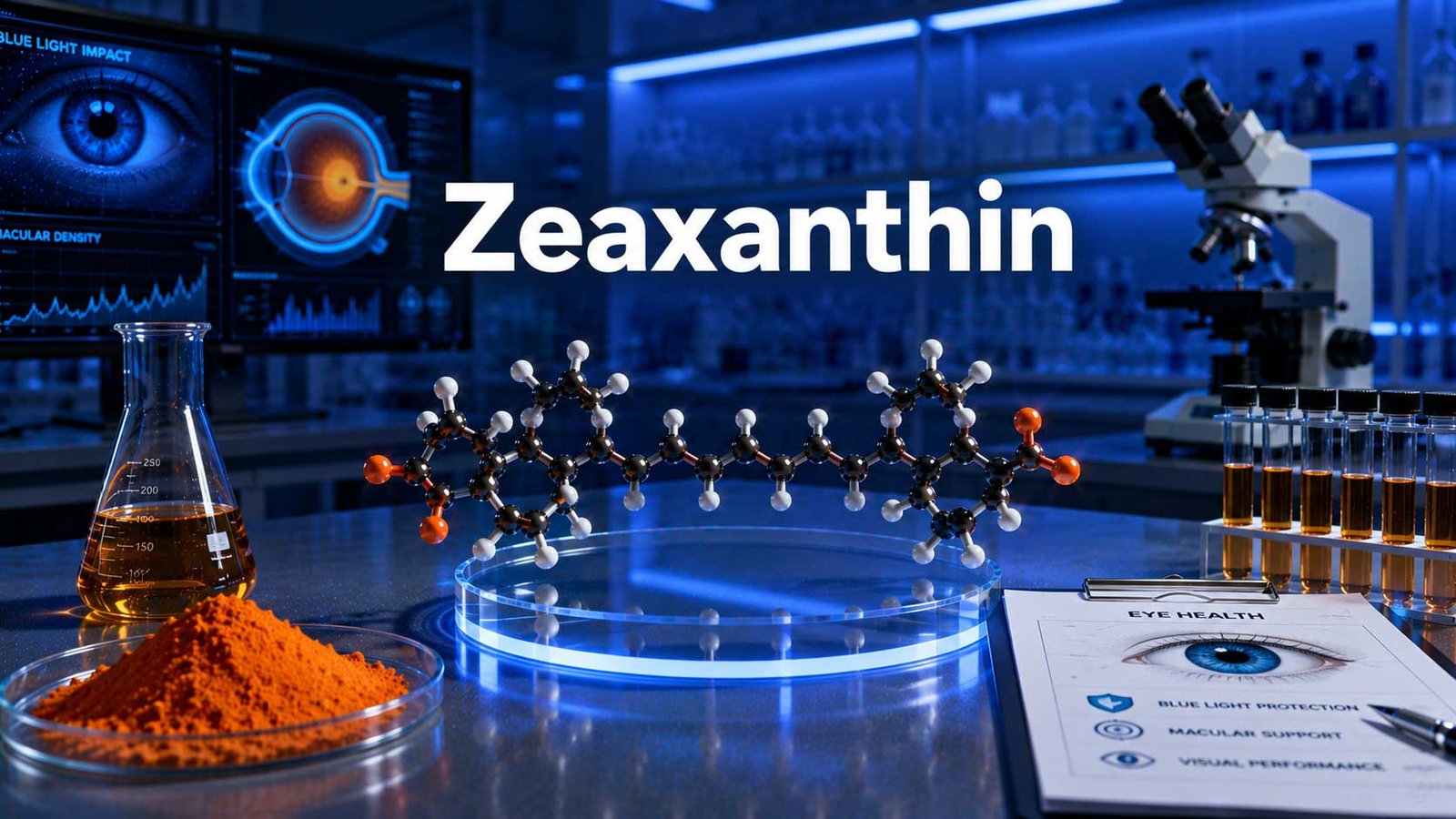
The Yellow Spot Nobody Talks About
Look closely at the back of your own eye and you’d find something most people never think about: a small yellow smudge sitting right at the center of your retina. It’s called the macula, and that yellowish tint isn’t an accident of biology. It’s put there on purpose, by two pigments your body can’t make on its own and has to pull directly from your plate. One of them is zeaxanthin. The other is its close cousin, lutein. Together they form what researchers call macular pigment, and after spending years digging into carotenoid research, I’ve come to think of that yellow spot as one of the more elegant pieces of engineering the human body has to offer.
Here’s the thing that surprises most people when they first hear about zeaxanthin: it’s not some obscure supplement-aisle ingredient invented by a marketing team. It’s a real, measurable component of your eye tissue, concentrated so densely in the central retina that scientists can literally see it under the right lighting conditions. Zeaxanthin belongs to a class of plant pigments called carotenoids, the same broad family that gives carrots their orange color and tomatoes their red. But unlike beta-carotene, which your body converts into vitamin A, zeaxanthin isn’t a vitamin A precursor. It has its own separate job, and that job happens almost entirely inside your eyes.
Table of Contents


Why does this matter right now, in 2026, more than it might have mattered a generation ago? Because our visual environment has changed dramatically. Screens are everywhere. Phones, laptops, tablets, LED lighting in offices and homes — all of it emits blue light in the 400 to 500 nanometer range, the same wavelength band that macular pigment is specifically built to filter. I’m not going to tell you that scrolling your phone at night is going to blind you; that’s an exaggeration you’ll see in a lot of lower-quality health content, and I’d rather be straight with you than scare you into buying something. But there is a real, biologically grounded reason why researchers have become increasingly interested in whether people are getting enough zeaxanthin in an era of unprecedented screen exposure.
Think about what blue light actually does when it hits your eye. It’s higher-energy, shorter-wavelength light, and when it reaches the photoreceptor cells and retinal pigment epithelium at the back of your eye, it can drive oxidative reactions. Your retina, by the way, is one of the most metabolically active tissues in your entire body — it consumes oxygen at a rate that rivals your brain, proportional to its size. High oxygen consumption plus high light exposure is a recipe for oxidative stress, and oxidative stress in the retina is a recurring theme in the research on age-related macular degeneration, or AMD, which remains a leading cause of vision loss in older adults across the world.
This is where zeaxanthin earns its keep. It does two things simultaneously, and it’s worth separating them because people often collapse them into one vague idea of “eye health.” First, it acts as an optical filter — a literal pair of built-in sunglasses sitting in front of your photoreceptors, absorbing a portion of that blue light before it can reach the more vulnerable structures behind it. Second, it acts as an antioxidant, mopping up reactive oxygen species that form as a byproduct of normal visual processing and light exposure. Zeaxanthin and lutein aren’t randomly distributed either. Zeaxanthin tends to dominate the very center of the macula, while lutein spreads out more toward the periphery, and a related compound called meso-zeaxanthin sits right at the epicenter, largely converted from lutein once it arrives in the retina.
I want to be upfront about something before we go further: zeaxanthin is not a cure, not a guaranteed shield, and not a substitute for basic eye care like regular exams, UV-protective sunglasses, or managing conditions like diabetes that affect eye health. What it is, based on a genuinely substantial body of research, is a nutrient that plays a structural and functional role in one of the most important tissues you have, and one that a lot of modern diets fall short on. Most people eating a typical Western diet take in somewhere around 1 to 4 milligrams combined of lutein and zeaxanthin per day, well below the range that researchers studying macular pigment density consider optimal.
There’s also a quieter, less flashy part of the zeaxanthin story that doesn’t get nearly as much attention as AMD prevention, and that’s visual comfort. People with higher macular pigment levels tend to report less discomfort from glare, faster recovery of vision after being exposed to a bright flash of light, and better contrast sensitivity — basically, an easier time distinguishing subtle differences in shading and detail. If you’ve ever driven at night and been bothered by oncoming headlights more than you feel like you should be, or found that your eyes take a beat too long to readjust after looking at a bright window, macular pigment density is one of the biological variables that researchers have connected to that experience.
So that’s the landscape we’re working with. A pigment your body can’t manufacture, concentrated in a tissue that does an enormous amount of metabolic work, doing double duty as both a light filter and a chemical bodyguard, in an environment that exposes us to more artificial blue light than any generation before us. Over the next several sections, I want to walk through what the research actually shows about zeaxanthin’s health benefits, where you can realistically get it from food, how much you’d want to be aiming for, what happens if you’re running low, and — because I think this part gets glossed over far too often in supplement marketing — what the real risks and limits are if you take too much. No hype, no fear-mongering, just what a decade-plus of following this research has taught me about a pigment that quietly does more work in your eyes than almost anyone realizes.
Key Health Benefits
Let’s get into what zeaxanthin actually does, because “supports eye health” is the kind of vague phrase that shows up on every supplement bottle and tells you almost nothing. I want to be more specific than that.
Filtering Blue Light at the Source
The most well-documented mechanism behind zeaxanthin’s benefits is its role as an optical filter. Macular pigment — the combined presence of zeaxanthin, lutein, and meso-zeaxanthin in the retina — has an absorption spectrum that peaks right around 460 nanometers, which sits squarely in the blue light range. Functionally, this means that before high-energy blue light photons ever reach the photoreceptor outer segments, a portion of that light energy gets absorbed by the pigment sitting in front of them. Researchers have described this as reducing chromatic aberration and scattering, which in plain terms means your eye processes a cleaner, more focused signal, with less visual “noise” from scattered blue wavelengths.
Antioxidant Defense in a High-Oxygen Environment
Beyond the physical filtering, zeaxanthin works chemically. The retina is exposed to a near-constant combination of light and oxygen, both of which can generate reactive oxygen species capable of damaging cell membranes, proteins, and DNA over time. Zeaxanthin and its fellow macular carotenoids are capable of quenching singlet oxygen and neutralizing free radicals before they can trigger a cascade of lipid peroxidation in the photoreceptor membranes. This antioxidant capacity isn’t unique to zeaxanthin among carotenoids, but its physical location — concentrated precisely where the damage is most likely to occur — is what makes it so relevant to eye health specifically.
Reducing Glare Sensitivity and Speeding Visual Recovery
This is the benefit I find most relatable to everyday life, because it’s not an abstract disease-prevention statistic — it’s something people can actually notice. Several controlled studies have found that people with higher macular pigment optical density recover faster from photostress, meaning the temporary vision blur you get after looking at something very bright, like a camera flash or oncoming headlights. One trial found that daily supplementation with lutein and zeaxanthin over a year led to meaningful improvements in photostress recovery time and glare disability in the study participants. Another body of research has linked higher macular pigment density to reduced discomfort glare, essentially meaning that bright light feels less unpleasant and disorienting.
Supporting Contrast Sensitivity and Visual Processing Speed
Contrast sensitivity — your ability to distinguish an object from its background when the difference in shading is subtle — has been another area of focus. Multiple studies in both younger and older populations have found associations between macular pigment levels and improved contrast sensitivity, as well as faster visual processing speed and critical flicker fusion thresholds, which is essentially a measure of how quickly your visual system can register rapid changes in light. This matters more than it might sound; contrast sensitivity tends to decline with age even before more obvious vision problems set in, and it plays a real role in things like night driving and reading in dim light.
A Possible Role in Reducing Age-Related Macular Degeneration Risk
I want to handle this section carefully, because it’s the area where I see the most overstatement in casual health writing, and I’d rather underclaim than overclaim. AMD is a complex, multifactorial disease, and no single nutrient is going to prevent it outright. That said, the research here is genuinely substantial. The Age-Related Eye Disease Study 2, commonly known as AREDS2, was a large, multicenter, randomized clinical trial involving over four thousand participants who were already at risk for progressing to advanced AMD. The trial tested whether adding lutein and zeaxanthin, along with omega-3 fatty acids, to the original AREDS antioxidant formula would further reduce the risk of disease progression.
The original AREDS2 analysis didn’t find a significant benefit from simply adding lutein and zeaxanthin on top of the existing formula. But a secondary analysis told a more interesting story: when researchers specifically compared participants who received lutein and zeaxanthin against those who didn’t, and separately compared lutein and zeaxanthin against beta-carotene, they found a meaningful reduction in progression to late AMD in the lutein and zeaxanthin group. This mattered enough that beta-carotene, which had been part of the original AREDS formula, was swapped out for lutein and zeaxanthin in updated formulations going forward — partly because of these findings, and partly because beta-carotene had been separately linked to increased lung cancer risk in smokers.
Emerging Interest Beyond the Retina
There’s also a smaller but growing body of research looking at whether macular pigment carotenoids play a role outside strict eye function, including associations between macular pigment density and cognitive processing speed in older adults. I’d file this under “interesting and worth watching” rather than “established fact,” since this research is younger and less consistent than the retinal studies, but it does reinforce the idea that zeaxanthin’s biological relevance may extend a bit further than just the visual system.
Put all of that together, and you get a nutrient with a genuinely multi-layered case behind it: physical light filtration, chemical antioxidant defense, measurable improvements in how comfortably and quickly your eyes handle bright and rapidly changing light, and a real, if not universal, connection to reducing progression risk in one of the most common causes of vision loss in older adults. That’s a lot more substance than you’ll find behind most ingredients riding the current wellness-industry wave, and it’s part of why I take zeaxanthin seriously as a nutrient worth understanding rather than dismissing as another trend.

Dietary Sources
Here’s where things get genuinely tricky, and I think most articles on this topic gloss over the difficulty. Zeaxanthin is not lutein. They travel together in a lot of nutrition writing as if they’re interchangeable, but from a dietary standpoint, they behave quite differently, and zeaxanthin is meaningfully harder to get in significant quantities from typical Western eating patterns.
The Lutein-Zeaxanthin Imbalance in Most Diets
Dark leafy greens — kale, spinach, collard greens — are the foods most commonly recommended for boosting macular carotenoid intake, and they absolutely do contain meaningful amounts of lutein. But when researchers actually analyzed the zeaxanthin content of these same vegetables, the numbers were underwhelming. One frequently cited analysis of fruits and vegetables found that most dark green leafy vegetables contain a reasonable percentage of lutein but only a very small fraction — often in the low single digits — of zeaxanthin by comparison. In other words, loading up on spinach salads is a great strategy for lutein, but it won’t move the needle much on zeaxanthin specifically.
The typical dietary ratio of lutein to zeaxanthin in most people’s diets sits somewhere around five to one, meaning for every five milligrams of lutein consumed, people are typically getting only about one milligram of zeaxanthin. This imbalance is worth understanding because if your only strategy for supporting macular health is “eat more greens,” you may be building up one half of the pigment pair while neglecting the other.
Where Zeaxanthin Actually Concentrates
So where does zeaxanthin show up in meaningful amounts? A few foods stand out clearly above the rest.
- Orange and yellow bell peppers are one of the more zeaxanthin-dense vegetables available, and they’re an easy addition to a lot of meals — raw in salads, roasted as a side, or blended into sauces.
- Corn contains a notably favorable ratio of zeaxanthin relative to lutein compared to most other common vegetables, making it one of the more accessible everyday sources.
- Egg yolks deserve special mention here, and not just because they contain zeaxanthin. The fat and cholesterol naturally present in egg yolks appear to enhance the bioavailability of the carotenoids they contain, meaning your body may absorb zeaxanthin from eggs more efficiently than from some plant sources, where the pigment is bound up in a more rigid cellular matrix.
- Goji berries are, by a wide margin, one of the richest known sources of zeaxanthin of any commonly available food. Some analyses have identified goji berries as containing dramatically more zeaxanthin per serving than typical vegetables, largely in the form of zeaxanthin dipalmitate, a naturally occurring ester form of the compound.
- Orange-fleshed fruits and vegetables more broadly, including certain squash varieties and persimmons, contribute smaller but still useful amounts.
- Pistachios are another food that shows up in some nutritional analyses as a reasonable zeaxanthin contributor, alongside their broader profile of healthy fats.
Why Preparation and Pairing Matter
Carotenoids as a category are fat-soluble, which means the way you prepare and pair your food genuinely changes how much zeaxanthin your body actually absorbs, not just how much is present on the plate. Eating a plain, dry salad with orange peppers and no added fat is going to result in meaningfully lower absorption than the same salad dressed with olive oil, or eaten alongside a source of healthy fat like avocado or nuts. This isn’t a minor technicality — it’s one of the more practical, actionable pieces of advice in this entire topic, and it’s the kind of detail that tends to get left out of surface-level nutrition content.
Cooking can also help in certain cases by breaking down plant cell walls and making carotenoids more accessible, though this has to be balanced against the fact that excessive heat and prolonged cooking time can also degrade carotenoid content. A light sauté or roast tends to strike a reasonable balance — enough heat to improve accessibility without destroying the pigment itself.
Practical Ways to Build a Zeaxanthin-Supportive Plate
If I were advising someone on how to realistically increase their zeaxanthin intake through food rather than supplements, I’d suggest a few habits rather than a rigid meal plan:
- Add sliced orange or yellow bell pepper to at least a few meals a week, ideally with some olive oil or avocado in the same dish.
- Don’t skip the yolk. If you eat eggs, whole eggs contribute more to macular carotenoid intake than egg whites alone.
- Keep a small stash of dried goji berries around as a snack or oatmeal topping. They’re one of the few foods where a small serving makes a genuinely meaningful contribution.
- Treat corn as more than a side dish filler; it’s doing more nutritional work than it typically gets credit for.
- Think in terms of color variety across the week rather than obsessing over any single “superfood.” Orange, yellow, and deep green produce together cover more of the lutein-zeaxanthin spectrum than any single food group alone.
I’ll be honest with you: getting a substantial, AREDS2-level intake of zeaxanthin from diet alone, without supplementation, takes real intention. It’s not something that happens by accident the way getting enough vitamin C often does. That’s not a reason to panic or assume you need a supplement immediately, but it is a reason to actually think about your plate rather than assuming a vague sense of “I eat pretty healthy” automatically covers this particular nutrient.
Dosage & Deficiency
This is probably the section people skip straight to, and I understand why — you want the number. But I think the number means very little without the context around it, so let’s build up to it properly.
What “Enough” Even Means Here
Unlike a nutrient with an established Recommended Dietary Allowance, zeaxanthin doesn’t currently have an official RDA in the United States or most other countries. What we have instead is a body of observational and interventional research suggesting ranges associated with measurable benefits, particularly around macular pigment optical density, or MPOD — essentially a measurement of how much of this protective pigment has actually accumulated in your retina.
This distinction matters because it explains why you’ll see different numbers thrown around in different places. Some sources talk about total combined lutein and zeaxanthin intake, since most research studies these two carotenoids together rather than isolating zeaxanthin on its own. The landmark AREDS2 trial, for instance, used a combination of 10 milligrams of lutein and 2 milligrams of zeaxanthin daily in its supplement formulation, and that combination showed a meaningful association with reduced progression to advanced AMD in the secondary analyses.
Typical Population Intake Versus Research-Backed Targets
Here’s the gap that I think deserves more attention than it usually gets. Dietary surveys have found that typical intake of combined lutein and zeaxanthin in many populations sits somewhere in the range of one to four milligrams per day. Meanwhile, the intake levels associated with measurable increases in macular pigment density in research settings tend to run higher, often in the range of six to ten milligrams combined per day, with some studies using considerably more.
That gap is worth sitting with for a second. It suggests that a meaningful portion of people, particularly those not specifically prioritizing carotenoid-rich foods, are likely consuming less zeaxanthin than the levels researchers associate with measurable benefit. This doesn’t mean everyone needs to start supplementing tomorrow, but it does explain why so much research attention has gone into finding practical ways to close that gap, whether through diet or supplementation.
Signs Associated With Low Zeaxanthin Status
Zeaxanthin doesn’t have a classic, dramatic deficiency syndrome the way vitamin C deficiency causes scurvy or vitamin D deficiency causes rickets. It’s not classified as an essential nutrient in that strict biochemical sense, since your body doesn’t have a specific, life-threatening failure mode tied directly to its absence. But low intake over time has been consistently associated with lower macular pigment optical density, and lower MPOD has, in turn, been associated in observational research with several patterns worth knowing about:
- Reduced contrast sensitivity, particularly noticeable in low-light or high-glare situations like night driving.
- Slower recovery from photostress, meaning your eyes take longer than they ideally would to readjust after exposure to bright light.
- Greater self-reported discomfort from glare sources.
- In longer-term population studies, an association between consistently low dietary lutein and zeaxanthin intake and higher rates of progression in people already at risk for advanced AMD.
I want to be careful with the wording here, because association isn’t the same as causation, and none of this means low zeaxanthin intake will definitely cause any of these outcomes for any specific individual. But the pattern shows up often enough across independent studies that it’s a reasonable thing to take seriously, particularly for people already in higher-risk categories for eye disease, such as older adults, smokers, or those with a family history of AMD.
Who Tends to Run Lower
A few groups show up repeatedly in the research as being more likely to have lower zeaxanthin and macular pigment levels. Smokers consistently show reduced macular pigment density compared to non-smokers, which lines up with the broader pattern of smoking depleting antioxidant status throughout the body. Older adults, somewhat counterintuitively, don’t automatically have lower MPOD purely due to age, but risk factors that cluster with aging — reduced dietary variety, other health conditions, lower overall antioxidant status — can contribute. People with diets low in colorful produce and eggs are, unsurprisingly, more likely to fall short, simply because the food sources are concentrated in a fairly specific list rather than being spread evenly across the food supply.
A Reasonable, Practical Target
If you’re looking for something closer to an actionable number rather than an abstract range, here’s how I’d frame it based on the weight of the current research: aiming for a combined lutein and zeaxanthin intake somewhere in the six to ten milligram range daily, through a combination of food and, if needed, supplementation, aligns reasonably well with the levels used in research associated with measurable macular pigment improvements. That’s not a rigid prescription — individual needs vary, and this isn’t medical advice tailored to your specific situation — but it’s a far more grounded target than the vague “eat more greens” advice that dominates most casual health content on this topic.
Toxicity & Risks
This is the section I think gets shortchanged the most in supplement marketing, because “more is better” sells more bottles than “here’s where the actual safety data plateaus.” I’d rather give you the real picture.
The General Safety Profile
Zeaxanthin has been studied fairly extensively from a toxicological standpoint, more so than many popular supplement ingredients. Regulatory toxicology studies conducted in mice, rats, and dogs found no adverse effects even at strikingly high doses, with no observed adverse effect levels reaching into the hundreds of milligrams per kilogram of body weight in short-term studies. Genotoxicity testing, including standard mutagenicity assays, consistently came back negative for properly formulated, stabilized zeaxanthin. Developmental toxicity studies in rats and rabbits found no evidence of harm to fetal development even at high doses.
Based largely on a comprehensive two-generation reproductive study in rats, the European Food Safety Authority applied a substantial safety margin and established an acceptable daily intake for synthetic zeaxanthin equivalent to 53 milligrams per day for a 70-kilogram adult. That’s an enormous margin above the 2 to 10 milligram range typically discussed for eye health benefits, which tells you something important: at the intake levels realistically relevant to most people pursuing zeaxanthin for eye support, whether through food or supplements, the safety margin is wide.
What Actually Happens at High Intakes
The most commonly reported effect of very high zeaxanthin or combined carotenoid intake isn’t dangerous — it’s cosmetic. Carotenodermia is a benign, fully reversible yellow-orange discoloration of the skin, most noticeable on the palms and soles, that can occur with sustained high intake over months, generally at levels exceeding fifteen to twenty milligrams daily over an extended period. It looks a bit alarming if you don’t know what it is, but it carries no known health risk and resolves once intake is reduced. I mention this mostly because I’ve seen people panic when they notice it, assuming something is seriously wrong, when in reality it’s just excess pigment sitting in fatty tissue near the skin’s surface.
Animal studies using very high doses did observe some findings worth noting honestly rather than glossing over. In a two-generation reproductive study in rats, the highest dose tested — 500 milligrams per kilogram of body weight per day, an extraordinarily high intake with no realistic human equivalent through diet or standard supplementation — was associated with some marginal effects on fertility indices and pup weight gain, which is why regulators used a lower dose from that same study as the basis for the acceptable daily intake calculation, applying a substantial 200-fold safety factor on top of it. This is standard, conservative regulatory practice, and it’s worth understanding that these effects occurred at doses so far beyond anything a person would encounter through normal supplementation that they function more as a safety buffer calculation than a real-world warning.
The Crystalline Retinopathy Question
One legitimate concern that sometimes gets raised, particularly around high-dose lutein supplementation, involves crystalline deposits forming in the retina. This concern originated primarily from observations with a different, structurally related carotenoid called canthaxanthin, which at very high doses has been associated with retinal crystal formation in some individuals. Because zeaxanthin and lutein are related compounds, researchers specifically investigated whether similar crystal formation could occur with them.
A dedicated year-long chronic study in monkeys, using a comprehensive battery of eye examinations including electroretinography and detailed retinal pathology, specifically looked for this effect with both zeaxanthin and lutein at meaningfully elevated doses. The result was reassuring: no evidence of crystalline deposit formation was found in the treated eyes, distinguishing zeaxanthin and lutein’s safety profile clearly from canthaxanthin’s. This doesn’t mean the theoretical concern was baseless as a starting hypothesis, but it does mean the specific worry doesn’t hold up against the dedicated research that was designed to test it directly.
Interactions and Special Populations Worth Mentioning
There’s limited but growing research on carotenoid supplementation in specific populations, including preterm infants being studied for potential effects on retinopathy of prematurity, a completely different context from typical adult eye health supplementation and not something I’d extrapolate general dosing advice from. If you’re pregnant, nursing, managing a chronic health condition, or considering supplementation for a child, that’s a conversation to have directly with a healthcare provider rather than something to figure out from a general nutrition article, mine included.
I’d also gently flag that anyone taking high-dose beta-carotene supplements, particularly current or former smokers, should be aware of the separate and well-documented lung cancer risk associated with high-dose beta-carotene specifically — not zeaxanthin — in that population. This is actually part of why zeaxanthin and lutein gained favor as AREDS formula ingredients in the first place; they don’t carry that same specific risk profile that beta-carotene does in smokers.
Where This Leaves Us
Taken as a whole, zeaxanthin has one of the more reassuring safety profiles among actively researched carotenoids. The realistic risks at typical supplemental or dietary intake levels are essentially cosmetic and fully reversible, the acceptable daily intake established by regulatory bodies sits far above what most people would ever reasonably consume, and the more serious theoretical concerns borrowed from related compounds haven’t held up under direct investigation. That’s not a blanket endorsement to take unlimited amounts without thought — sensible dosing within researched ranges is still the smarter approach than chasing an arbitrary “more is better” instinct — but it does mean the fear factor around this particular nutrient is lower than you might expect given how seriously eye health concerns tend to be taken.
Seeing Clearly Through the Noise
If there’s one thing I’d want you to walk away with, it’s this: zeaxanthin isn’t a miracle nutrient, and I’d be doing you a disservice if I framed it that way. It’s not going to reverse existing vision damage, and it’s not a substitute for wearing sunglasses, getting regular eye exams, or managing the health conditions that genuinely drive most vision loss as people age. What it is, though, is a nutrient with a legitimately strong biological rationale and a research base that’s more substantial than a lot of what circulates in wellness content right now — a compound your body deliberately concentrates in one of its most metabolically demanding tissues, doing real, measurable work as both a physical filter and a chemical defense system against the specific kind of light exposure that’s only become more common in daily life.
The practical takeaway, if you’re looking for one, is fairly straightforward. Most people are getting meaningfully less zeaxanthin than the levels associated with measurable benefit in research settings, largely because the foods that actually contain it — orange peppers, corn, egg yolks, goji berries — don’t get nearly as much airtime as the leafy greens that dominate general nutrition advice, and leafy greens, as it turns out, are a lutein source far more than a zeaxanthin one. Closing that gap doesn’t require a dramatic diet overhaul. It’s closer to a handful of specific, repeatable swaps: keeping the yolk instead of tossing it, reaching for orange or yellow peppers instead of green ones now and then, treating a small handful of goji berries as a legitimate snack rather than a novelty, and pairing carotenoid-rich foods with a bit of healthy fat so your body can actually absorb what you’re eating rather than letting it pass through unused.
For anyone weighing whether supplementation makes sense on top of dietary changes, the safety data gives you real room to work with, and the research-backed intake ranges are specific enough to actually plan around rather than guess at. But I’d encourage you to think of supplementation as filling a gap that diet doesn’t easily close, not as a replacement for actually paying attention to what’s on your plate. And if you’re dealing with an existing eye condition, are in a higher-risk category for AMD, or are simply noticing changes in your vision that concern you, none of what’s in this article is a substitute for sitting down with an eye care professional who can actually look at your retina and tell you what’s happening there.
Your eyes are doing an extraordinary amount of quiet, constant work, processing an environment that’s louder — visually speaking — than anything human vision evolved to handle. Giving that yellow spot at the back of your eye the raw materials it needs to do its job well seems like a small, reasonable thing to get right.
Article Sources
At AncientHerbsWisdom, our content relies on reputable sources, including peer-reviewed studies, to substantiate the information presented in our articles. Our primary objective is to ensure our content is thoroughly fact-checked, maintaining a commitment to accuracy, reliability, and trustworthiness.
- Abdel-Aal, E. M., Akhtar, H., Zaheer, K., & Ali, R. (2013). Dietary sources of lutein and zeaxanthin carotenoids and their role in eye health. Nutrients, 5(4), 1169–1185. https://doi.org/10.3390/nu5041169
- Age-Related Eye Disease Study 2 Research Group. (2013). Lutein + zeaxanthin and omega-3 fatty acids for age-related macular degeneration: the Age-Related Eye Disease Study 2 (AREDS2) randomized clinical trial. JAMA, 309(19), 2005–2015. https://doi.org/10.1001/jama.2013.4997
- Chew, E. Y., Clemons, T. E., SanGiovanni, J. P., Danis, R. P., Ferris, F. L., Elman, M. J., Randall Antoszyk, A., Ruby, A. J., Orth, D., Bressler, S. B., Fish, G. E., Hubbard, G. B., Klein, M. L., Chandra, S. R., Blodi, B. A., Domalpally, A., Friberg, T., Wong, W. T., Rosenfeld, P. J., Agrón, E., Toth, C. A., Bernstein, P. S., & Sperduto, R. D. (2014). Secondary analyses of the effects of lutein/zeaxanthin on age-related macular degeneration progression: AREDS2 report No. 3. JAMA Ophthalmology, 132(2), 142–149. https://doi.org/10.1001/jamaophthalmol.2013.7376
- Edwards, J. A. (2016). Zeaxanthin: Review of toxicological data and acceptable daily intake. Journal of Ophthalmology, 2016, 3690140. https://doi.org/10.1155/2016/3690140
- Li, X., Holt, R. R., Keen, C. L., Morse, L. S., Zivkovic, A. M., Yiu, G., & Hackman, R. M. (2023). Potential roles of dietary zeaxanthin and lutein in macular health and function. Nutrition Reviews, 81(6), 670–683. https://doi.org/10.1093/nutrit/nuac076
- Lima, V. C., Rosen, R. B., & Farah, M. (2016). Macular pigment in retinal health and disease. International Journal of Retina and Vitreous, 2, 19. https://doi.org/10.1186/s40942-016-0044-9
- Sommerburg, O., Keunen, J. E. E., Bird, A. C., & van Kuijk, F. J. G. M. (1998). Fruits and vegetables that are sources for lutein and zeaxanthin: the macular pigment in human eyes. British Journal of Ophthalmology, 82(8), 907–910. https://doi.org/10.1136/bjo.82.8.907

- Phosphatidic Acid: Supporting Muscle Growth and Strength - July 31, 2026
- Ceramides: Supporting Healthy Skin From Within - July 31, 2026
- Synbiotics: Combining Prebiotics and Probiotics Together - July 31, 2026