
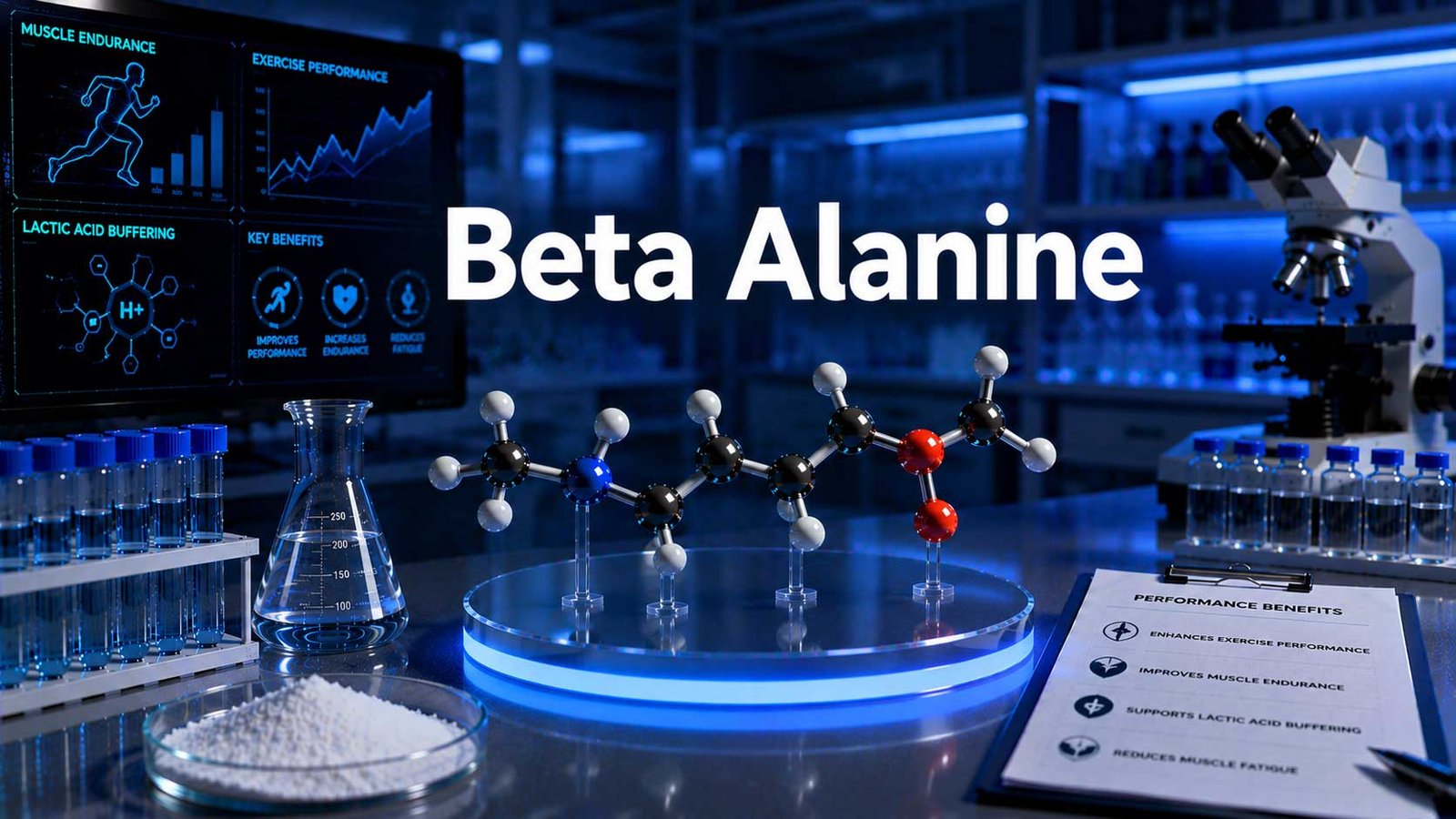
The Amino Acid That Makes Your Face Tingle (For a Good Reason)
I still remember the first time I felt it. A pre-workout drink, maybe fifteen minutes before a leg session, and suddenly my scalp and forearms started prickling like I’d rolled around in fiberglass insulation. My training partner laughed and said, “that’s the beta alanine kicking in.” I had no idea what he meant, but I was hooked on finding out.
That’s usually how people meet beta alanine — not through a textbook, but through a weird, harmless sensation that makes them ask questions. And once you start digging into what this amino acid actually does, it’s hard not to get a little fascinated by it. Beta alanine isn’t flashy. It doesn’t build muscle directly, it won’t spike your energy like caffeine, and it won’t do much of anything the first time you take it. But give it a few weeks, and it quietly changes how your muscles handle the burn of hard, repeated effort.
Table of Contents


Chemically speaking, beta alanine is a non-essential amino acid, meaning your body can make some of it on its own, mostly in the liver. It’s also unusual among amino acids because of where the amino group sits on the molecule — a structural quirk that means it isn’t used to build proteins the way most amino acids are. Instead, beta alanine has one dominant job in the body: it’s the rate-limiting building block for a dipeptide called carnosine, which lives inside your skeletal muscle fibers.

Carnosine, in turn, is where the real action happens. It functions as an intracellular buffer, meaning it helps neutralize the buildup of hydrogen ions that occurs when muscles work anaerobically at high intensity. Anyone who has sprinted the last 200 meters of a mile race, ground out a final set of heavy squats, or tried to hold on through the last 30 seconds of a Tabata circuit knows that burning sensation. That’s acidosis creeping into the muscle fibers, and it’s one of the main reasons performance craters in short, brutal efforts. Beta alanine, by raising carnosine levels, gives your muscles a bit more capacity to soak up that acid before things fall apart.
What’s interesting is that beta alanine itself isn’t the limiting factor for carnosine synthesis by accident — researchers identified it as the rate-limiting precursor in carnosine production, meaning your body simply doesn’t have enough beta alanine on hand, most of the time, to maximize carnosine stores on its own (Trexler et al., 2015). That’s the whole premise behind supplementing with it. You’re not adding some exotic compound to your body; you’re just topping up the raw material for a process that’s already happening, and happening in a way that matters most exactly when you need it — during those brutal one-to-four-minute efforts where your muscles are screaming.
I’ll admit, when I first came across beta alanine years ago, I was skeptical. Sports nutrition is full of ingredients riding on hype rather than evidence, and the wave of neon-colored pre-workout tubs promising world-changing pumps didn’t exactly inspire confidence. But beta alanine has held up surprisingly well under scrutiny. It’s one of the few ergogenic aids that keeps showing up in systematic reviews and meta-analyses with a consistent story: modest but real improvements in high-intensity, short-duration exercise performance (Trexler et al., 2015). Not a miracle. Not something that turns a couch potato into an athlete. But a legitimate tool with a plausible mechanism and real data behind it.
There’s also a slightly humbling angle to beta alanine that I appreciate. Unlike some supplements marketed toward raw power or explosive strength, beta alanine’s benefits show up mostly in that middle zone of exercise — efforts lasting somewhere between one and four minutes, sometimes stretching a bit longer. Think 400-meter repeats, wrestling rounds, a hard set of rowing intervals, or a punishing set of kettlebell swings. It’s not the amino acid you reach for if you’re training for a one-rep max deadlift. It’s the one you reach for when the goal is holding form and output as fatigue piles on.
So where does this leave the average person wondering whether beta alanine deserves a spot in their routine? Honestly, that depends on what you’re training for, how your diet already looks, and how much stock you put into shaving a few percentage points off fatigue during repeated high-intensity efforts. This article is going to walk through what the research actually says about beta alanine’s benefits, where you can find it in food, how much you’d realistically need to take, and what the downsides look like — including that tingling sensation everyone eventually asks about. No fluff, no exaggerated promises. Just what a decade of following this compound in the literature has taught me.
Key Health Benefits
Buffering Muscle Acid: The Core Mechanism
Everything beta alanine does for exercise performance traces back to one mechanism: raising muscle carnosine concentrations. Carnosine acts as an intracellular pH buffer, and when hydrogen ions accumulate during intense anaerobic work, carnosine helps mop some of them up, delaying the point at which muscle acidity interferes with contraction. The data on this is fairly striking. Supplementing with 4 to 6 grams of beta alanine daily for at least two to four weeks significantly increases muscle carnosine concentrations, with increases in the range of 20 to 30 percent after four weeks and up to roughly 80 percent after ten weeks of consistent use (Fernández-Lázaro et al., 2023; Trexler et al., 2015).
That’s not a small effect. Carnosine doesn’t just sit there passively, either — it’s been described as having a degree A level of evidence for its role as this intracellular buffer, which in research terms is about as confident a rating as you’re going to see (Fernández-Lázaro et al., 2023). For anyone who has ever wondered why their legs give out well before their lungs do during a hard 800-meter run, muscle acidosis is a big piece of that puzzle, and beta alanine directly targets it.
Extending Time to Exhaustion and Reducing Fatigue
Where this translates into real performance is in exercise lasting roughly one to four minutes — a duration window that happens to overlap with a huge amount of competitive and recreational training. Reviews focused on maximal-intensity exercise in trained individuals have found beta alanine supplementation associated with improvements across strength, power, and capacity measures during these efforts (International Journal of Sport Nutrition and Exercise Metabolism review, 2024). A systematic review of combat sports athletes similarly found that beta alanine significantly improved performance parameters tied to strength, power, and total exercise work capacity, along with combat-specific outcomes (Fernández-Lázaro et al., 2023).
Neuromuscular fatigue attenuation is another benefit worth calling out on its own. Beta alanine has shown a moderately elevated ergogenic effect specifically on reducing the rate at which neuromuscular fatigue sets in during repeated high-intensity work (Fernández-Lázaro et al., 2023). In practical terms, that might look like:
- Holding onto bar speed for longer during repeated heavy sets
- Maintaining sprint times across the later reps of an interval session
- Delaying the point where technique breaks down under fatigue in combat sports or rowing
I’ve noticed, anecdotally, that lifters and endurance athletes who commit to beta alanine for a full month tend to describe the same thing — not an obvious jolt of energy, but a subtle sense that the “wall” during hard intervals shows up a little later than it used to. That lines up well with what the buffering mechanism would predict.
Muscular Endurance and Repeated-Bout Performance
Beyond single bouts of maximal effort, beta alanine also appears to help with muscular endurance across repeated sets, which matters a lot for resistance training programs built around volume. One controlled trial in college-aged women found that eight weeks of beta alanine supplementation combined with resistance training increased lower-body muscular endurance, even though it didn’t move the needle on maximal strength or body composition markers (Rezaei et al., 2022, citing Outlaw et al.). That’s a useful distinction — beta alanine isn’t a strength supplement in the traditional sense, and it’s not going to inflate your one-rep max. What it seems to do is help you squeeze out a few more quality reps before form and output collapse, which over the course of a training block adds up.
Research pairing beta alanine with creatine has also shown that the combination can enhance high-intensity exercise performance, particularly anaerobic power and repeated-bout output, compared to either ingredient alone, although this combination doesn’t appear to add much for maximal strength beyond what creatine alone provides (PMC12251028 systematic review, 2024).
Benefits for Older Adults and Everyday Function
One benefit that doesn’t get nearly enough attention is beta alanine’s effect on neuromuscular fatigue in older populations. Fatigue resistance tends to decline with age, contributing to reduced capacity for daily tasks and increased fall risk. In one trial involving older adults with an average age around 70, a nutritional supplement fortified with beta alanine improved a measure of physical working capacity compared to placebo after 12 weeks (Trexler et al., 2015). That’s a meaningfully different population than the sprinters and combat athletes usually associated with this amino acid, and it hints that beta alanine’s buffering benefits aren’t confined to elite sport. Preliminary evidence also points toward potential benefits for tactical and occupational performance, where repeated bursts of high-intensity effort under fatigue are common (Trexler et al., 2015).
Taken together, the benefit profile of beta alanine is narrower than supplement marketing sometimes suggests, but it’s also more consistent than a lot of trendier ingredients. It’s not going to build size, and it’s not a stimulant. What it reliably does is buy your muscles a bit more time before acid buildup forces you to slow down, and that’s worth something whether you’re chasing a personal best or just trying to keep up with your kids at the park.
Dietary Sources
Meat, Poultry, and Fish: Nature’s Beta Alanine Reserve
Unlike some nutrients scattered generously across plant and animal foods alike, beta alanine has a pretty narrow home base: animal tissue. It’s concentrated almost exclusively in muscle and, to a lesser degree, in the nervous system, which means the foods richest in beta alanine are the usual suspects — beef, pork, poultry, and fish. Beef and pork tend to be the most concentrated sources of dietary carnosine, the compound your body breaks down to access beta alanine, delivering somewhere in the range of 1.7 to 2.4 milligrams of carnosine per gram of tissue, while poultry contributes a slightly wider range depending on the cut, and fish contributes a smaller but still meaningful amount (Examine.com food sources summary, citing peer-reviewed food composition data).
Chicken broth is an interesting outlier worth mentioning, since long-simmered bone and meat broths pull carnosine out of the muscle and connective tissue and into the liquid itself. If you’ve ever had a homemade stock that left your lips feeling slightly tacky, that’s partly the dipeptide content doing its thing.
Why Food Alone Rarely Gets You There
Here’s the catch, though, and it’s a big one: getting a performance-relevant dose of beta alanine from food alone is basically impractical. Because beta alanine makes up only about 40 percent of carnosine’s total molecular weight, you’d need to eat something like 7 to 10 pounds of beef, roughly 7 pounds of pork, or anywhere from 8 to over 25 pounds of poultry in a single sitting to match the 3.2 grams of beta alanine used in typical supplementation research (Examine.com food sources summary). Obviously nobody is doing that. The average daily carnosine intake from a normal omnivorous diet sits somewhere between 50 and 250 milligrams, depending heavily on how much protein a person eats — nowhere close to what’s needed to meaningfully shift muscle carnosine stores on its own.
This is really the crux of why beta alanine became a supplement in the first place. It’s one of those rare cases where food provides a trace amount of something biologically important, but concentrated supplementation is the only realistic path to the doses used in performance research.
The Vegetarian and Vegan Angle
Because beta alanine and carnosine are found almost exclusively in animal tissue, plant-based eaters start from a lower baseline. Cross-sectional research comparing long-term vegetarians to meat-eaters found significantly lower muscle carnosine content in the vegetarian group (Everaert et al., cited in Vegan Health summary, 2011). That’s a meaningful finding for anyone eating a vegetarian or vegan diet who also does a lot of high-intensity training — sprint work, combat sports, or interval-heavy programming.
Interestingly, though, the picture isn’t quite as simple as “vegetarians are deficient.” A controlled study out of Ghent University put twenty omnivorous participants through five weeks of sprint training while randomizing them to either a vegetarian or a mixed diet, and found no significant difference in muscle carnosine change between the two groups by the end of the intervention (Baguet et al., 2011). Separately, other trials have found that vegetarians can meaningfully raise muscle carnosine simply through high-intensity training itself, even without eating meat or taking beta alanine (cited in Vegan Health summary). So training stimulus clearly plays some role here too, not just diet.
Still, if you’re vegetarian or vegan and your training leans heavily on repeated short, hard efforts, it’s worth knowing that your baseline muscle carnosine is likely lower than an omnivore’s, and food sources aren’t going to close that gap in any meaningful way. A few plant sources, like dried spirulina, contain trace beta alanine, but nowhere near the concentration found in animal muscle tissue, and the practical contribution to your daily intake is minimal.
Bottom Line on Food vs. Supplementation
If you’re eating a reasonably varied omnivorous diet with regular servings of chicken, beef, pork, or fish, you’re getting some beta alanine — just not enough to meaningfully move the needle on athletic performance. That’s not a criticism of your diet; it’s simply how the math works out for this particular compound. For most people who are curious about beta alanine specifically for exercise performance, supplementation is really the only route that gets you into the dose range where research shows a benefit. Food remains valuable for a hundred other reasons, but for beta alanine specifically, think of dietary sources as background support rather than the main event.
A Quick Word on Cooking and Preparation
One detail that rarely comes up is how cooking method affects the beta alanine and carnosine content of meat. Slow, moist cooking methods — think braising, stewing, or simmering a broth for hours — tend to pull more of the water-soluble carnosine out of the muscle tissue and into the surrounding liquid, which is part of why a rich, homemade bone broth or stew base can carry a meaningful dose of carnosine even after the meat itself has been strained out. Quick, dry cooking methods like grilling or searing keep more of the carnosine locked inside the muscle fibers you’re actually eating. Neither approach is “better” nutritionally in any dramatic sense, but if you’re someone who leans on slow-cooked soups and stews as a staple, you’re likely getting a bit more usable carnosine per serving than someone eating the same cut grilled or pan-seared.
It’s also worth noting that supplement-grade beta alanine, the kind found in tubs of pre-workout powder or standalone capsules, is synthetically produced rather than extracted from meat. That’s actually a point in its favor from a practical standpoint — it means vegetarians and vegans can supplement with beta alanine without any conflict with their dietary choices, since the commercially available form isn’t derived from animal tissue at all, even though the compound itself is most abundant in animal muscle in its naturally occurring form.
Whether you get your beta alanine from a well-marbled steak, a bowl of chicken soup simmered all afternoon, or a scoop of powder stirred into water before a training session, the underlying biology doesn’t care about the source. What matters is total intake relative to what your muscles can actually use to build carnosine stores over time, and for most people chasing a performance benefit, that number is really only reachable through a dedicated supplement.
Dosage & Deficiency
What the Research-Backed Dosing Looks Like
The dosing range that keeps showing up across the beta alanine literature is fairly narrow and consistent: 4 to 6 grams per day, taken for at least two to four weeks, with more pronounced benefits typically emerging closer to the eight-to-twelve-week mark (Trexler et al., 2015; Fernández-Lázaro et al., 2023). This isn’t a supplement where you take one scoop and expect same-day results — the entire mechanism depends on muscle carnosine slowly accumulating over time, so patience really is part of the protocol.
Some studies have used doses as low as 3.2 grams daily, particularly in body composition and muscular endurance research, and still found meaningful benefits for muscular endurance in resistance-trained populations (Rezaei et al., 2022). Other work looking specifically at strength and power outcomes has explored daily doses between 4 and 6.4 grams, with certain fragmented dosing strategies — smaller doses like 0.8 grams spread across multiple servings per day — appearing to support muscle carnosine accumulation while reducing side effects (PMC12466178 dosing strategies review, 2025).
There’s also a time-course pattern worth understanding if you’re deciding whether beta alanine is worth committing to. Muscle carnosine concentrations rise by roughly 20 to 30 percent after about four weeks of consistent supplementation, and continue climbing to somewhere around 40 to 60 percent, eventually reaching approximately 80 percent after ten weeks of continuous use (Fernández-Lázaro et al., 2023). That climbing curve is a good reminder that beta alanine rewards consistency far more than it rewards a single big dose before a competition.
Splitting Doses to Manage the Tingle
One very practical piece of dosing advice that comes directly out of the research: splitting your daily total into smaller servings throughout the day helps reduce the tingling sensation (paresthesia) that beta alanine is famous for, without reducing its effectiveness. Studies have shown this side effect can be attenuated by using divided lower doses, such as around 1.6 grams per serving, or by using a sustained-release formulation that slows the rate of absorption (International Society of Sports Nutrition position stand, 2015).
In practice, that might look like:
- Taking 1.5 to 2 grams with breakfast, lunch, and dinner rather than one large 5-gram scoop pre-workout
- Choosing a sustained-release capsule if tingling is particularly bothersome
- Taking beta alanine with food, which can slightly slow absorption
I’ve had training partners who initially wrote off beta alanine because the tingling felt too intense on an empty stomach pre-workout, only to have a completely different experience once they switched to splitting the dose across meals. It’s a small adjustment that makes a real difference in tolerability.
Is There Such a Thing as a Beta Alanine “Deficiency”?
This is a slightly unusual section to write, because beta alanine doesn’t fit the classic deficiency model the way, say, vitamin D or iron does. Since it’s a non-essential amino acid your liver can produce on its own, and since your body doesn’t have an established minimum requirement for it the way it does for essential nutrients, there’s no formally recognized “beta alanine deficiency” in the clinical sense.
That said, there is a meaningful concept of relatively low muscle carnosine stores, which functions almost like a soft, performance-relevant version of insufficiency. Populations who tend to run lower on muscle carnosine include long-term vegetarians and vegans, women (who generally show lower baseline carnosine than men), and older adults, since carnosine content tends to decline with age (Baguet et al., 2011; Trexler et al., 2015). None of these groups are “deficient” in a medical sense, but if you fall into one of these categories and you’re training for repeated high-intensity efforts, it’s a reasonable signal that supplementation might offer more noticeable benefit than it would for, say, a 25-year-old omnivorous man who already eats a lot of meat.
The takeaway on dosage is refreshingly simple compared to a lot of sports nutrition guidance: pick a daily total somewhere in the 3.2 to 6.4 gram range, split it up if the tingling bothers you, stay consistent for at least a month, and don’t expect dramatic overnight change. Beta alanine is a slow burn, and that’s exactly how it’s supposed to work.
Timing Around Training
A question I hear constantly is whether beta alanine needs to be taken pre-workout to “work.” Given everything explained above about how gradually muscle carnosine builds, the honest answer is that timing around a single training session doesn’t matter nearly as much as people assume. Because beta alanine’s benefit comes from a slowly accumulated store of muscle carnosine rather than an acute spike in blood levels, what matters far more is your total daily intake and your consistency day after day, not whether you happen to take your dose thirty minutes before you walk into the gym. That said, plenty of people still prefer taking a portion of their daily dose pre-workout simply because the tingling sensation has become a psychological cue that primes them for a hard session — there’s nothing wrong with that habit, it’s just not doing anything mechanistically different than taking the same dose at breakfast.
Stacking With Other Supplements
Beta alanine is frequently paired with creatine, sodium bicarbonate, or caffeine in commercial pre-workout blends, and it’s worth understanding why. Creatine and beta alanine target different energy systems and buffering pathways, so combining them tends to produce complementary rather than overlapping benefits, particularly for repeated high-intensity efforts. Sodium bicarbonate works as an extracellular buffer, while beta alanine’s carnosine pathway works intracellularly, so on paper the two can theoretically stack well, although research specifically isolating that combination is still fairly limited. If you’re building your own supplement routine rather than relying on a pre-made blend, there’s no harm in taking beta alanine on its own — you don’t need a proprietary blend to get the benefit, and reading the label of any pre-workout product to confirm it actually contains a full 3.2 to 6.4 gram dose of beta alanine, rather than a token sprinkle, is a genuinely useful habit.
The takeaway on deficiency is really about relative status rather than a hard threshold. Nobody is going to get a blood test back that flags “beta alanine deficient.” But understanding where your baseline muscle carnosine likely sits — lower if you’re vegetarian, female, or older, higher if you’re a long-term meat-eating strength or sprint athlete — helps you set realistic expectations for how much benefit supplementation is likely to add on top of what your body and diet are already providing.
Toxicity & Risks
The Tingle: What Paresthesia Actually Is
Let’s address the elephant in the room, because it’s the first question almost everyone asks once they’ve felt it: what is that tingling sensation, and is it dangerous? The short answer is no — but the mechanism behind it is genuinely interesting. Paresthesia was identified as the only side effect consistently reported in human beta alanine supplementation trials, and it presents as a temporary tingling or pricking sensation on the skin, often around the face, neck, scalp, and hands (International Society of Sports Nutrition position stand, 2015).
For years, people assumed this was some kind of mild allergic or histamine-driven response, similar to hives. Research has since shown that’s not the case at all. The tingling occurs through a histamine-independent neural pathway, most likely triggered by beta alanine binding to a receptor called MrgprD on small-diameter sensory neurons in the skin (Liu et al., 2012). Interestingly, these same neurons don’t respond to histamine at all, which is part of why antihistamines don’t do anything to stop the sensation — it’s simply a different biological pathway entirely, one that researchers have suggested could even be relevant for understanding other forms of chronic itch unrelated to allergies (Liu et al., 2012).
Practically speaking, this means the tingling is a real physiological response, but it isn’t a sign that something is going wrong. It typically kicks in within 15 to 20 minutes of taking a dose and fades within an hour or so, with intensity and duration generally tracking with how large and how quickly-absorbed the dose was.
Safety Profile at Recommended Doses
Beyond the tingling, the safety data on beta alanine at studied doses is reassuring. Beta alanine supplementation currently appears to be safe in healthy populations when taken at recommended doses, and no serious adverse events have been consistently linked to it across the trials reviewed in major position statements (International Society of Sports Nutrition position stand, 2015). A dedicated risk assessment and meta-analysis on oral beta alanine supplementation similarly concluded that paresthesia was the primary and essentially only side effect observed across the available human trials, describing it as transient and generally not a cause for concern (systematic risk assessment, ScienceDirect, 2019).
That’s a fairly clean safety record compared to a lot of other performance supplements on the market, many of which come with a longer list of caveats around cardiovascular strain, blood pressure, or interactions with medications. Beta alanine’s downside, for the overwhelming majority of users, really does begin and end with an uncomfortable but harmless skin sensation.
Who Should Be More Cautious
None of this means beta alanine is appropriate for absolutely everyone without a second thought. A few groups warrant a bit more caution or a conversation with a healthcare provider before starting:
- People with pre-existing skin conditions or unusual sensory sensitivities, who may find paresthesia more distressing or harder to distinguish from a genuine reaction
- Individuals on medications that affect nerve signaling, since interactions haven’t been extensively studied
- Pregnant or breastfeeding individuals, simply because dedicated safety research in these populations is limited
- Anyone experiencing a sensation that doesn’t match typical paresthesia — meaning it comes with swelling, hives, difficulty breathing, or symptoms that persist well beyond an hour — since that pattern is inconsistent with typical beta alanine paresthesia and deserves prompt medical attention rather than being assumed to be a normal reaction
I want to be clear here: none of this is meant to alarm anyone. The vast majority of people who try beta alanine experience nothing worse than a passing tingle, and plenty of athletes come to genuinely enjoy the sensation as a kind of pre-workout cue that the supplement has kicked in. But it’s worth knowing the difference between an expected, benign response and something that warrants a second look.
Long-Term Use Considerations
One question I get asked often is whether beta alanine is safe to use continuously, or whether it needs cycling on and off. The honest answer is that most of the research supporting its safety comes from trials lasting anywhere from a few weeks up to around six months, with muscle carnosine washout studies showing that elevated carnosine levels gradually decline back toward baseline over a period of weeks once supplementation stops (Baguet et al., cited in dosing literature). There isn’t strong evidence that cycling on and off provides any particular benefit, nor is there strong evidence of harm from sustained daily use within the studied dose ranges. As with most supplements without decades of long-term data behind them, a sensible approach is to use it purposefully during training blocks where its benefits are most relevant, rather than treating it as something that needs to be taken indefinitely regardless of your training goals.
Small Molecule, Real Difference: Where Beta Alanine Actually Fits
After spending years following the research on beta alanine, what strikes me most is how unglamorous — and how honest — this compound is. It doesn’t promise transformation. It doesn’t come with wild claims about doubling your strength or torching fat while you sleep. What beta alanine offers is narrower and more believable: a modest, well-documented improvement in your muscles’ ability to buffer acid during hard, repeated efforts lasting somewhere between one and four minutes, built up patiently over weeks of consistent use.
If your training regularly pushes you into that zone — repeated sprints, wrestling rounds, high-rep resistance training, rowing intervals, combat sports — beta alanine has a legitimate, evidence-backed case for inclusion in your routine. The mechanism is well understood, the dosing guidance is consistent across independent research groups, and the side effect profile is about as clean as sports supplements get, with paresthesia being an odd but harmless quirk rather than a genuine safety concern.
If your training doesn’t spend much time in that high-intensity, short-duration window — say you’re mostly doing low-intensity steady-state cardio, or your lifting is built around low-rep max-strength work — beta alanine is far less likely to move the needle for you, and that’s worth being honest about rather than assuming every supplement belongs in every routine.
A few practical takeaways worth carrying forward:
- Give it time. Four weeks is a reasonable minimum before expecting to feel a difference, and the benefits keep building for months.
- Split your dose if the tingling bothers you — it doesn’t cost you anything in effectiveness.
- Don’t expect it to replace food, sleep, or actual training volume; it’s a supporting player, not a headliner.
- If you’re vegetarian, vegan, older, or simply curious whether your diet alone is getting you there, know that food sources realistically won’t get you into a performance-relevant range on their own.
Beta alanine earned its spot in my own training cabinet the old-fashioned way — not through marketing, but through a decade of research holding up reasonably well under scrutiny. It’s not for everyone, and it’s not magic. But for the right kind of training, it’s one of the more trustworthy tools in a fairly noisy industry, and that counts for something.
What I’d gently push back on is the tendency to treat beta alanine as a checkbox item, something you add to a stack simply because it’s cheap and well studied. It works because of a specific, well-mapped mechanism — raising muscle carnosine, which buffers acid during anaerobic effort. That mechanism has a use case, and outside of that use case, beta alanine is just an amino acid sitting in a tub, not doing much for you at all. Matching the supplement to the demand of your training is really the whole game here, and it’s a lesson that applies well beyond beta alanine.
There’s also something worth saying about expectations. Beta alanine isn’t going to feel like caffeine, where you notice a difference within the hour. It’s closer to how creatine works, in the sense that the benefit accumulates slowly, tied to a physiological adaptation happening in the background rather than an acute stimulant effect. People who quit after a week, disappointed that nothing happened, are quitting before the mechanism has had a chance to build. Four weeks is a floor, not a target, and the athletes who report the clearest benefits are usually the ones who stuck with a consistent dose through two or three full months of training.
I’d also encourage anyone considering beta alanine to think honestly about where their current diet and training already stand. If you’re eating meat regularly and mostly lifting heavy for low reps, you may already be close to your natural carnosine ceiling and might notice a smaller marginal benefit than a vegetarian endurance athlete would. That’s not a reason to avoid it, just a reason to calibrate expectations before you buy a tub expecting dramatic change.
At the end of the day, beta alanine is a small, unglamorous molecule doing a specific, well-documented job. Respect what it’s actually good for, dose it sensibly, give it time, and it can genuinely earn a place in a well-built training program — no hype required.
If you take away one thing from everything above, let it be this: beta alanine rewards patience and punishes impulsiveness. It’s not the amino acid for someone chasing a quick fix before a competition next week, and it’s not going to bail out a program with poor programming or inconsistent effort behind it. But stacked on top of solid training, sensible recovery, and a reasonable diet, beta alanine has earned its reputation as one of the more dependable, well-evidenced tools available for anyone whose sport or training regularly demands repeated bursts of hard, high-intensity effort.
Article Sources
At AncientHerbsWisdom, our content relies on reputable sources, including peer-reviewed studies, to substantiate the information presented in our articles. Our primary objective is to ensure our content is thoroughly fact-checked, maintaining a commitment to accuracy, reliability, and trustworthiness.
- Baguet, A., Everaert, I., De Naeyer, H., Reyngoudt, H., Stegen, S., Beeckman, S., Achten, E., Vanhee, L., Volkaert, A., Petrovic, M., Taes, Y., & Derave, W. (2011). Effects of sprint training combined with vegetarian or mixed diet on muscle carnosine content and buffering capacity. European Journal of Applied Physiology, 111(10), 2571–2580. https://doi.org/10.1007/s00421-011-1877-4
- Fernández-Lázaro, D., Fiandor, E. M., García, J. F., et al. (2023). β-Alanine supplementation in combat sports: Evaluation of sports performance, perception, and anthropometric parameters and biochemical markers—A systematic review of clinical trials. Nutrients. https://www.ncbi.nlm.nih.gov/pmc/articles/PMC10490143/
- Liu, Y., Costa, A. C., Bautista, D. M., et al. (2012). Mechanisms of itch evoked by β-alanine. Journal of Neuroscience, 32(42), 14532–14537. https://www.jneurosci.org/content/32/42/14532
- Rezaei, S., Akhavanfar, R., Kani, A. M., et al. (2022). Effects of beta-alanine supplementation on body composition: A GRADE-assessed systematic review and meta-analysis. Critical Reviews in Food Science and Nutrition. https://www.tandfonline.com/doi/full/10.1080/15502783.2022.2079384
- Trexler, E. T., Smith-Ryan, A. E., Stout, J. R., Hoffman, J. R., Wilborn, C. D., Sale, C., Kreider, R. B., Jäger, R., Earnest, C. P., Bannock, L., Campbell, B., Kalman, D., Ziegenfuss, T. N., & Antonio, J. (2015). International society of sports nutrition position stand: Beta-Alanine. Journal of the International Society of Sports Nutrition, 12(1), 30. https://doi.org/10.1186/s12970-015-0090-y
- Effects of Creatine and β-Alanine Co-Supplementation on Exercise Performance and Body Composition: A Systematic Review. (2024). https://www.ncbi.nlm.nih.gov/pmc/articles/PMC12251028/
- Effect of Beta-Alanine Supplementation on Maximal Intensity Exercise in Trained Young Male Individuals: A Systematic Review and Meta-Analysis. (2024). International Journal of Sport Nutrition and Exercise Metabolism, 34(6). https://journals.humankinetics.com/view/journals/ijsnem/34/6/article-p397.xml
- Dosing strategies for β-alanine supplementation in strength and power performance: A systematic review. (2025). Journal of the International Society of Sports Nutrition. https://pmc.ncbi.nlm.nih.gov/articles/PMC12466178/
- A Systematic Risk Assessment and Meta-Analysis on the Use of Oral β-Alanine Supplementation. (2019). ScienceDirect. https://www.sciencedirect.com/science/article/pii/S2161831322007050
- Examine.com. What are the main food sources of beta-alanine/carnosine? https://examine.com/supplements/beta-alanine/faq/what-are-the-main-food-sources-of-beta-alaninecarnosine/

- Phosphatidic Acid: Supporting Muscle Growth and Strength - July 31, 2026
- Ceramides: Supporting Healthy Skin From Within - July 31, 2026
- Synbiotics: Combining Prebiotics and Probiotics Together - July 31, 2026