
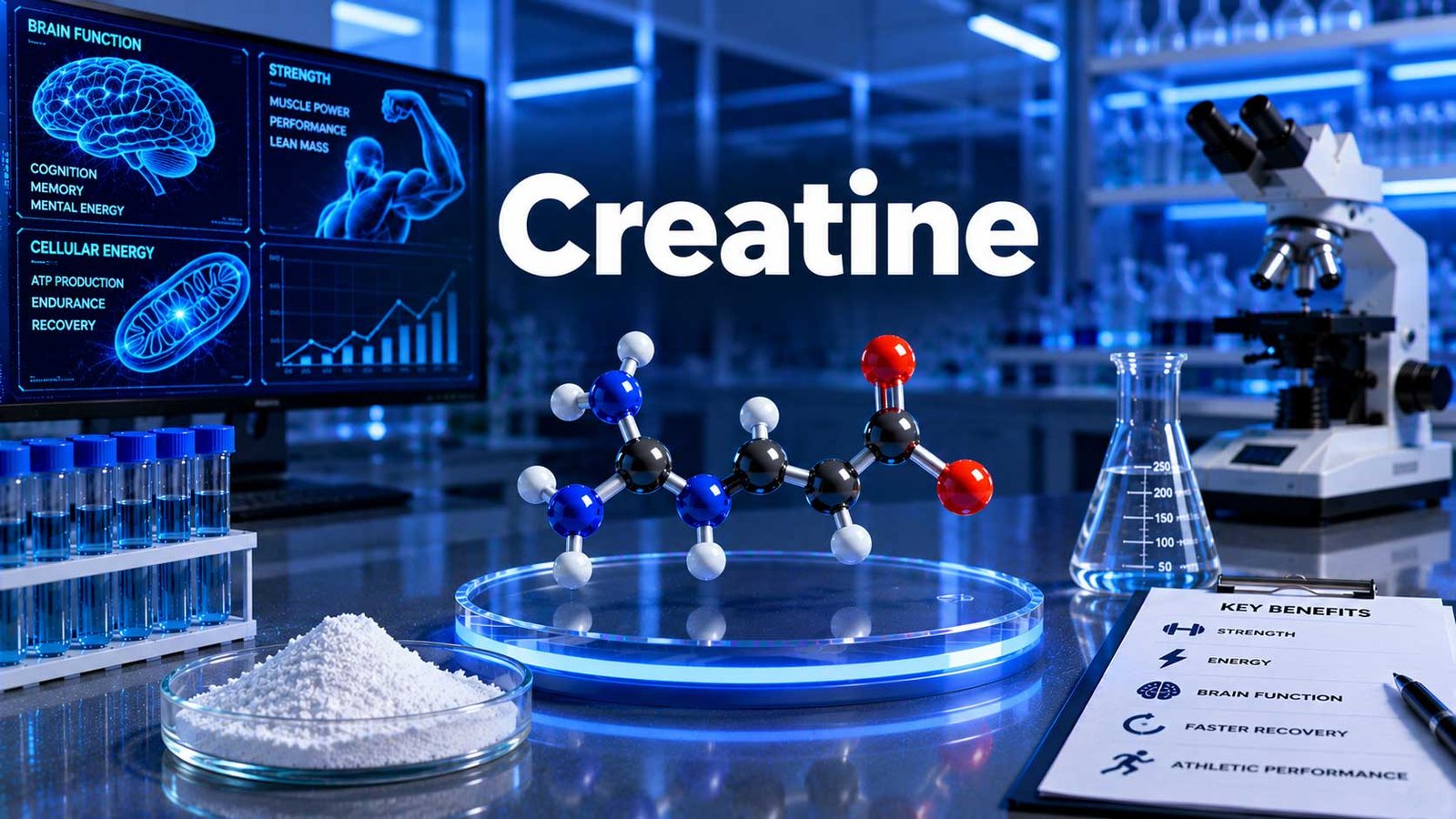
The Supplement That Refuses to Go Out of Style
Walk into any supplement shop and you’ll see shelves crammed with powders promising miracles, most of which quietly disappear from the market within a few years. Creatine isn’t one of them. It’s been studied for over three decades, and instead of fading out like most trends, it’s only picked up steam. That alone should tell you something.
Here’s the thing about creatine that surprises people who are new to it: it’s not some exotic, lab-cooked compound. Your body already makes it. Your liver, kidneys, and pancreas produce roughly a gram of creatine a day using three amino acids, and you top that up with whatever you eat, mostly from red meat and fish. It gets stored primarily in skeletal muscle, with a smaller reserve tucked away in the brain, where it plays a role most people never think about until they read the research themselves.
Table of Contents
I’ve followed the creatine literature for a long time now, and if there’s one thing that stands out, it’s how unusually solid the evidence base is compared to almost everything else sitting on supplement store shelves. We’re talking about a compound backed by hundreds of controlled trials, not just a handful of small studies with shaky methodology. That doesn’t mean every claim floating around the internet is accurate. It isn’t. But the core findings, that creatine can meaningfully support strength, power output, and possibly cognitive resilience, hold up under scrutiny in a way most trendy ingredients simply don’t.
So why does creatine work the way it does? The short answer involves energy metabolism. Your muscles run primarily on a molecule called adenosine triphosphate, or ATP, and during short, intense bursts of effort, like a heavy squat or a hundred-meter sprint, your cells burn through their immediate ATP supply in seconds. That’s where phosphocreatine comes in. It donates a phosphate group to regenerate ATP quickly, essentially acting as a rapid-recharge system for your muscles during high-intensity work. Supplementing with creatine increases the amount of phosphocreatine stored in muscle tissue, which extends how long you can sustain that explosive output before fatigue sets in.
What’s less commonly discussed, and what I find genuinely interesting after years of reading through this research, is that creatine’s role isn’t confined to the gym. Brain tissue is also energy-hungry, and it relies on the same phosphocreatine system to keep neurons firing efficiently, especially under conditions of stress, sleep deprivation, or mental fatigue. This has opened up a whole secondary conversation among researchers about whether creatine supplementation might support cognitive function, memory, and mental clarity, not just physical performance. The evidence here is more nuanced than the strength data, and honestly, some of the more dramatic headlines you’ll see about “creatine for brain power” oversell what the research actually shows. We’ll get into that with the appropriate level of caution later.
There’s also a persistent myth worth addressing right up front: the idea that creatine is some kind of anabolic steroid analog, or that it’s unsafe for long-term use. This misconception has stuck around for decades, largely thanks to a couple of isolated case reports from the 1990s that got blown out of proportion by media coverage. The accumulated research since then, including studies spanning years of continuous use in athletes, tells a very different story, one of a compound that’s remarkably well tolerated in healthy individuals.
What makes creatine worth a genuinely deep dive, rather than a quick supplement blurb, is the breadth of what it touches. We’re not just talking about a bump in bench press numbers, though that’s certainly part of it. We’re talking about energy metabolism at the cellular level, a role in maintaining lean mass as we age, a possible connection to mood and neurological health, and a safety profile that’s been stress-tested more thoroughly than almost any other supplement on the market. Whether you’re an athlete chasing another few reps, someone trying to hold onto muscle mass through your fifties and sixties, or simply curious about the biochemistry of energy and fatigue, there’s a lot of substance here.
One thing I’ll say plainly, because it matters for how you read everything that follows: creatine is not magic, and it’s not going to compensate for a poor training program or a chaotic diet. What it does is amplify the effort you’re already putting in. Think of it less as a shortcut and more as a tool that removes one small bottleneck in an otherwise demanding physiological system. For some people, especially those on plant-based diets who get very little dietary creatine, that bottleneck is bigger than they’d expect. For others who already eat plenty of red meat, the added benefit from supplementation, while still real, might be less dramatic simply because their baseline stores were already fuller to begin with.
Over the next several sections, we’ll walk through what the health benefits actually look like when you strip away the marketing, where you can find creatine naturally in food, how much you actually need and what happens if you fall short, and finally, an honest look at the risks and the populations who should be more cautious. No fluff, no exaggerated claims, just what over a decade of paying close attention to this research has taught me.
Key Health Benefits
Let’s get into what creatine actually does inside the body, because this is where the supplement earns its reputation, and also where a lot of exaggeration tends to creep in. I want to walk through the benefits the way the research actually supports them, not the way a supplement label might frame them.
Strength and Power Output
This is the area with the deepest and most consistent evidence. Creatine supplementation increases the phosphocreatine stores in skeletal muscle, and that translates into a measurable improvement in the ability to perform short bursts of high-intensity work, think heavy lifting, sprinting, jumping, anything that demands maximal effort over a few seconds. A comprehensive position stand from the International Society of Sports Nutrition, drawing on decades of accumulated research, identified creatine monohydrate as the single most effective performance-enhancing nutritional supplement currently available to athletes for boosting high-intensity exercise capacity and building lean body mass during training (Kreider et al., 2017).
What does that actually look like in practice? If you’re in the gym, it usually shows up as being able to squeeze out one or two extra reps at a given weight, or recovering slightly faster between sets so your fifth set doesn’t fall apart the way it might have before. It’s not a dramatic overnight transformation. It’s a gradual accumulation of small advantages that compound over weeks and months of training. And that compounding effect is exactly why creatine has stuck around in serious strength and conditioning circles for so long.
Muscle Mass and Body Composition
Creatine’s effect on lean mass isn’t purely about water retention, though that’s part of the initial weight change people notice. Over time, when paired with resistance training, creatine appears to support genuine increases in muscle protein synthesis and satellite cell activity, the processes underlying real hypertrophy. A systematic review looking at creatine combined with other performance supplements pointed out that beyond its well-known role in strength and power, creatine monohydrate has also been linked to improved aerobic and anaerobic performance, favorable shifts in body composition, and lower markers of exercise-induced muscle damage (Fernández-Landa et al., 2019). That last part, about reduced muscle damage markers, is worth sitting with for a second, because it suggests creatine might do more than just help you lift heavier. It might help you recover from the lifting itself.
Recovery and Reduced Muscle Damage
Speaking of recovery, this is an area that doesn’t get nearly as much attention as the strength gains, but it deserves more. Research examining muscle damage markers after intense exercise found that creatine supplementation was associated with meaningfully lower inflammation markers in the acute post-exercise window. One meta-analysis tracking recovery in the day or two following muscle-damaging exercise reported a notably large reduction in inflammatory markers among the creatine group compared to placebo, both in the first day and a half and again several days out (Doma et al., 2022). If you’ve ever been so sore after a heavy leg day that walking down stairs felt like a personal insult, you understand why this matters. Faster recovery means you can train more consistently, and consistency, more than any single supplement, is what actually drives long-term progress.
Cognitive Function and Brain Energy
Here’s where I want to slow down and be careful, because this is the area where enthusiasm has outpaced the evidence in a lot of online content. There’s a biologically plausible mechanism, brain tissue uses the same phosphocreatine energy system as muscle, so it’s reasonable to hypothesize that creatine could support cognitive performance, especially under conditions like sleep deprivation, stress, or aging.
Some research has pointed in that direction. A systematic review and meta-analysis published in 2024 concluded that creatine supplementation showed positive effects on certain aspects of cognitive performance in adults, particularly around memory (Xu et al., 2024). But here’s the honest caveat, and it’s an important one. When regulatory scientists at the European Food Safety Authority reviewed this same body of evidence for a formal health claim assessment, they flagged a statistical flaw: the analysis had combined results from several related cognitive tests taken by the same participants as though they were independent data points, which effectively counted the same people multiple times and made the sample size look bigger than it really was (EFSA Panel on Nutrition, Novel Foods and Food Allergens, 2024). Their conclusion was that no firm conclusions could be drawn from that particular analysis.
What does that mean for you? It means the cognitive benefits of creatine are plausible and worth watching, particularly in older adults or people dealing with sleep loss, but they’re not nearly as settled as the strength and muscle findings. I’d treat any bold claim about creatine “boosting your brainpower” with a healthy dose of skepticism until the research matures further.
Bone Health and Aging Populations
One benefit that doesn’t get talked about enough is creatine’s role in older adults. Combined with resistance training, low-dose creatine supplementation has been shown to support lean tissue mass, upper body strength, and even bone-related markers in aging populations. Research cited within the ISSN position stand described how low-dose creatine paired with protein supplementation increased lean tissue mass and strength while decreasing markers of bone resorption in older men, and separately, a year of creatine supplementation during resistance training preserved femoral neck bone mineral density in postmenopausal women. For anyone thinking about healthy aging and staying functionally strong into their seventies and eighties, that’s a genuinely compelling angle, and one that deserves more mainstream attention than it currently gets.
Dietary Sources
If you’re not interested in supplementing and you’d rather get creatine the old-fashioned way, through food, it’s absolutely possible, though it comes with some real limitations worth understanding upfront.
Where Creatine Actually Comes From in Food
Creatine is stored almost exclusively in animal muscle tissue, which means plant foods contain essentially none of it. This isn’t a case of “some foods have a little and some have a lot,” it’s closer to “animal products have it, and plants don’t.” That single fact has major implications for anyone following a vegetarian or vegan diet, which we’ll get into shortly.
Among animal foods, the concentration varies quite a bit by species and cut:
- Herring is generally considered the richest common source, delivering somewhere in the neighborhood of three-quarters of a gram to over a gram of creatine per typical serving.
- Beef and pork land in a similar range, with roughly half a gram per typical four-ounce serving, translating to somewhere around one gram per pound of cooked meat.
- Salmon, tuna, and cod offer moderate amounts, generally in the range of a third to half a gram per serving.
- Chicken and turkey contain creatine too, just at somewhat lower concentrations than red meat or fatty fish.
- Dairy and eggs contain only trace amounts, nowhere close to what you’d get from meat or fish.
Why Food Alone Rarely Gets You to Research-Backed Doses
Here’s where things get practical. Most of the research showing meaningful strength, power, and recovery benefits uses doses in the three to five gram per day range, sometimes higher during an initial loading phase. A typical diet that includes regular servings of meat and fish provides somewhere around one to two grams of creatine daily. That’s a meaningful contribution, don’t get me wrong, but it’s still well short of what’s used in the studies showing the benefits I described in the previous section.
To put it bluntly: you’d need to eat an unreasonable amount of herring or steak, day after day, to consistently hit five grams from food alone. It’s not impossible in theory, but in practice, almost nobody eats that way consistently, and cooking further complicates things. High-heat cooking methods can degrade a meaningful portion of the creatine naturally present in meat and fish, sometimes reducing content by twenty to thirty percent or more depending on the method and duration. So even someone eating creatine-rich foods regularly is likely losing some of that content in the pan or on the grill.
Vegetarians and Vegans Start From a Different Baseline
This is a point I think doesn’t get enough attention. People following vegetarian or vegan diets typically have noticeably lower baseline muscle creatine stores compared to omnivores, simply because they’re not getting any dietary creatine at all, only what their bodies synthesize internally. In practice, this often means vegetarians and vegans see a more pronounced response when they do start supplementing, because they’re filling a bigger gap. If you’ve gone plant-based and you’re serious about strength training, this is one of the more evidence-backed reasons to consider supplementation rather than relying on food sources you simply don’t have access to.
Practical Takeaways on Food Sources
If your goal is simply to include more dietary creatine as part of an overall nutrition strategy, prioritizing red meat and oily fish like salmon, tuna, and herring a few times a week is a reasonable approach, and it comes with the added benefit of protein, omega-3 fatty acids, and various B vitamins that support overall health anyway. But if your goal is to actually replicate what the research studies were doing, the ones showing strength gains, improved recovery, and lean mass increases, food alone is a tough road. That’s really the honest divide here: eating creatine-containing foods supports general health and provides a modest baseline, while reaching the doses associated with measurable performance benefits typically requires supplementation. Neither approach is wrong, they’re just solving different problems, and it’s worth being clear-eyed about which one you’re actually trying to achieve.
Cooking Methods and Storage Matter More Than People Realize
I mentioned that heat degrades creatine, but it’s worth expanding on because the details actually change how you might approach meal prep. Boiling and prolonged simmering tend to cause the greatest losses, partly because creatine is water-soluble and leaches out into the cooking liquid rather than just breaking down from heat alone. That’s actually useful information if you’re making a stew or a broth, since a good chunk of the creatine that left the meat is still sitting in the liquid, not gone entirely. Grilling and pan-searing at high heat for shorter durations tend to preserve somewhat more of the original content compared to extended boiling, though you’re still looking at some unavoidable loss no matter the method. Freezing and refrigeration, on the other hand, don’t appear to meaningfully degrade creatine content, so buying fresh fish or meat and freezing it for later doesn’t cost you anything on this front.
None of this should turn into an obsession. You’re not going to precisely calculate how many milligrams of creatine survived your pan-sear versus your slow-cooked version. But it’s a useful piece of context if you’re the type who likes understanding the “why” behind a recommendation, and it partly explains why even people who eat creatine-rich foods regularly still fall well short of supplement-level doses.
A Realistic Weekly Picture
To make this more concrete, picture someone eating a reasonably varied, meat-and-fish-inclusive diet across a typical week: a couple of beef-based meals, a serving or two of salmon or tuna, maybe chicken on a few other nights. Even in that fairly generous scenario, daily creatine intake from food is still landing somewhere around one to one and a half grams on average, nowhere near the three to five grams used in the research showing measurable strength or recovery benefits. This isn’t meant to discourage eating those foods, they’re genuinely nutritious for plenty of other reasons, but it does clarify why so many athletes and researchers alike treat food-based creatine as a nice supporting contribution rather than a primary strategy.
Where This Leaves You
Ultimately, the choice between relying on food alone versus supplementing comes down to what you’re actually trying to accomplish. Someone who simply wants to eat a well-rounded, nutrient-dense diet doesn’t need to think about creatine as a distinct target at all, it’ll show up naturally as a side effect of eating meat and fish regularly. But someone chasing the specific strength, recovery, or lean-mass outcomes documented in the research literature is going to need supplementation to close that gap in any realistic timeframe, and that’s true whether you’re an omnivore falling short of the mark or a vegetarian starting from close to zero. Understanding which category you fall into makes the rest of this decision a lot more straightforward.
Dosage & Deficiency
This is probably the section people skip ahead to, and I get it. Once you understand the benefits, the next logical question is simple: how much do I actually take, and is there such a thing as not getting enough?
The Standard Dosing Approach
There are really two common strategies, and both are well supported in the research.
The first is a loading phase followed by maintenance. This involves taking a higher dose, typically around twenty grams per day split into four smaller doses, for about five to seven days, followed by a maintenance dose of three to five grams daily after that. The idea behind loading is straightforward: it saturates your muscle creatine stores faster, so you notice performance benefits sooner rather than waiting several weeks for stores to build up gradually.
The second approach skips loading entirely and just uses a flat daily dose of three to five grams from day one. This method still gets you to fully saturated muscle stores, it just takes longer, generally somewhere in the range of three to four weeks rather than about a week. The dosing guidance summarized in the ISSN position stand lines up with this: the fastest route to fully saturated muscle stores is a loading dose of roughly 0.3 grams per kilogram of body weight per day for about five to seven days, followed by a maintenance dose of three to five grams daily, whereas simply starting at that lower maintenance dose from day one still gets you to saturated stores, just over a longer window of three to four weeks, with the tradeoff that early performance gains show up more slowly (Kreider et al., 2017).
Which one should you choose? Honestly, it comes down to patience. If you want to feel the difference in the gym as quickly as possible, loading makes sense. If you’d rather avoid the slightly higher water retention and occasional bloating that can come with a loading phase, and you’re not in a rush, the slow-and-steady approach gets you to the same place eventually.
Does Body Weight Change the Math?
To some extent, yes. Larger individuals with more muscle mass generally have a bigger total creatine storage capacity, so someone who weighs considerably more than average might benefit from dosing on the higher end of the standard range, or calculating their dose based on body weight rather than using a flat number. That said, for most people, the standard three to five gram maintenance dose works perfectly well regardless of exact body weight, which is part of why it’s become the default recommendation across so much of the research.
Timing: Does It Actually Matter?
There’s been a fair amount of debate about whether taking creatine before or after a workout makes a meaningful difference. The honest answer is that the research is mixed, and the effect, if it exists at all, is small. What matters far more than precise timing is consistency. Creatine works by gradually saturating your muscle stores over time, not by giving you an acute performance spike the moment you swallow it, the way caffeine might. So taking it at roughly the same time each day, whenever that fits naturally into your routine, is a perfectly reasonable strategy. Some people take it with a meal simply because it helps them remember, and there’s no downside to that.
What Happens If You Don’t Get Enough?
Unlike a true vitamin or essential mineral, creatine isn’t classified as strictly essential, since your body can synthesize its own supply. But there’s a growing perspective among some researchers that under certain conditions, creatine functions more like a conditionally essential nutrient, meaning demand can outpace your body’s own production capacity, particularly during periods of injury recovery, illness, aging, or for people on plant-based diets with no dietary intake at all.
In practical terms, insufficient creatine intake or synthesis doesn’t cause an obvious, dramatic deficiency syndrome the way a genuine vitamin deficiency might. Instead, what you tend to see is simply a lower ceiling on high-intensity performance capacity and potentially reduced resilience during recovery from intense training or physical stress. Rare genetic disorders affecting creatine synthesis or transport do exist and cause much more serious neurological and developmental issues, but those are uncommon inherited conditions, not something the average person needs to worry about from diet alone.
A Note on Realistic Expectations
I’ll be straightforward here: creatine isn’t a supplement where more is dramatically better beyond a certain point. Once your muscle stores are saturated, taking extra doesn’t continue producing proportional benefits, it just gets excreted. That’s actually good news from a safety and cost perspective. You don’t need to chase escalating doses. Find a consistent daily amount within the well-studied range, stick with it, and let the research-backed timeline do its work rather than expecting overnight transformation.
Toxicity & Risks
No honest conversation about any supplement is complete without an unflinching look at safety, and creatine has actually been put through the wringer on this front more than almost anything else sold in a tub. Let’s go through what the evidence actually shows, along with where genuine caution is still warranted.
The Kidney Question
This is, without question, the concern that comes up most often, and it deserves a clear answer. The worry stems from the fact that creatine supplementation increases blood creatinine levels, and creatinine happens to be a standard marker doctors use to estimate kidney function. On the surface, that sounds alarming. In reality, it’s largely a measurement artifact rather than a sign of actual kidney damage, because creatinine is simply the natural breakdown product of creatine, so having more creatine on board means producing more creatinine as a byproduct, independent of how well your kidneys are actually filtering.
Direct research examining actual kidney function, not just creatinine levels, backs this up. A controlled trial involving resistance-trained individuals consuming a high-protein diet alongside creatine supplementation used a gold-standard method to directly measure glomerular filtration rate, rather than relying on creatinine-based estimates, and found no meaningful difference in kidney filtration between the group taking creatine and the group taking a placebo over the twelve-week trial period. The researchers behind that study framed their findings as reinforcing the overall safety case for the supplement, even in people already consuming a high-protein diet that some had worried might compound any theoretical kidney strain (Lugaresi et al., 2013).
That said, I want to be fair to the nuance here. Most of the long-term safety data applies specifically to people with healthy kidneys to begin with. If you already have diagnosed kidney disease, or you’re taking medications that affect kidney function or fluid balance, this is a conversation to have with a doctor before adding creatine, not a decision to make solo based on a supplement article, however well-researched. The available evidence in that population is more limited, and caution is genuinely warranted rather than being an overreaction.
Dehydration, Cramping, and Heat Tolerance
For years, creatine had a reputation for causing muscle cramps and increasing the risk of heat-related illness, largely because it increases intracellular water retention. This concern got a lot of media traction in the late nineties and early two-thousands. Subsequent research examining creatine’s actual effect on injury rates and cramping in athletes training in real-world, high-heat conditions generally found the opposite of what was feared. Multiple studies involving athletes taking substantial daily doses over extended periods reported either no increase in side effects or, in some cases, fewer musculoskeletal injuries and less cramping compared to non-supplementing athletes. The theoretical mechanism for concern made intuitive sense, but it simply hasn’t held up when tested directly.
Digestive Discomfort
This one’s real, though generally minor and manageable. Some people, particularly during a loading phase with larger single doses, experience mild stomach upset, bloating, or looser stools. This tends to happen more with poor-quality creatine products or when taking a large dose all at once on an empty stomach. Splitting the loading dose into smaller portions throughout the day, and taking it with food rather than on an empty stomach, resolves this for most people without needing to abandon supplementation altogether.
Weight Gain
Creatine reliably causes a small increase in body weight, typically somewhere between one and three pounds in the first week or two, and this trips people up who are tracking the scale closely. It’s important to understand this is primarily water being pulled into muscle cells, not fat gain, and for most people pursuing strength or muscle goals, this is actually a desirable side effect rather than a problem. For athletes in weight-class sports, though, this is a legitimate practical consideration worth planning around ahead of competition.
Cancer and Other Theoretical Concerns
Occasionally you’ll see claims online linking creatine to cancer risk, generally based on the theoretical idea that creatine could contribute to the formation of certain harmful compounds during digestion. A recent review examining this specific concern directly addressed it, acknowledging that the theoretical pathway has been raised in scientific discussion but concluding that the actual body of research to date simply doesn’t support any real association between creatine supplementation and cancer risk in humans (Longobardi et al., 2025). This is a good example of why it’s worth distinguishing between a theoretical biochemical pathway and actual observed outcomes in real human studies. The former generates headlines, the latter is what should guide your decisions.
Who Should Be More Cautious
To bring this together plainly, the populations where more caution and medical consultation are genuinely warranted include people with pre-existing kidney disease, pregnant or breastfeeding individuals, since research in this group remains limited, and anyone taking medications that significantly affect fluid balance or kidney function. Outside of those specific situations, the accumulated evidence across decades of research in healthy adults, including studies stretching out to several years of continuous use, paints creatine as one of the more thoroughly safety-tested supplements available.
What a Decade of Reading This Research Has Taught Me
If you take one thing away from everything above, let it be this: creatine has earned its reputation the hard way, through repeated scrutiny rather than clever marketing. That’s rare in the supplement world, where most products rely on flashy branding to cover for thin evidence. Creatine doesn’t need the branding. The science speaks for itself, and it’s held up remarkably well against decades of researchers actively trying to poke holes in it.
What strikes me most, having followed this topic for so long, is how the story keeps expanding rather than shrinking. It started as a niche tool for power athletes chasing marginal gains in the weight room. Then it became relevant to bodybuilders and general fitness enthusiasts. Now it’s showing up in conversations about healthy aging, bone density in postmenopausal women, and cautiously, in early research on cognitive resilience. That kind of expanding relevance, backed by controlled trials rather than anecdote, is exactly what separates a genuinely useful compound from a passing fad.
But I also want to leave you with some grounded, practical takeaways rather than just enthusiasm.
- If your primary goal is strength, power, or lean mass, the evidence supporting three to five grams of creatine monohydrate daily is about as solid as supplement research gets. This isn’t a gamble.
- If you’re vegetarian or vegan, you’re starting from a lower baseline, and you may notice a more pronounced response to supplementation simply because you weren’t getting any from food beforehand.
- Don’t chase the cognitive benefits too aggressively yet. The mechanism is plausible and worth watching, but the current evidence is genuinely mixed, and some of the more optimistic headlines have gotten ahead of what regulatory reviewers consider well-established.
- Kidney safety concerns in healthy individuals are, at this point, more myth than substance, though that doesn’t apply if you have pre-existing kidney issues, where a conversation with a doctor is the responsible move.
- More isn’t better once your stores are saturated. Find your consistent daily dose and stop worrying about optimizing further.
I’ll also say this, because it’s easy to lose sight of amid all the biochemistry: creatine works best as part of a broader picture that includes actual resistance training, adequate protein, decent sleep, and general consistency. It’s a genuinely effective tool, not a replacement for the fundamentals. Anyone expecting a scoop of powder to substitute for showing up in the gym consistently is going to be disappointed, regardless of how strong the research is.
I also think it’s worth addressing why creatine tends to provoke such strong reactions in either direction. On one side, you get people who treat it almost like a cure-all, crediting it for every improvement in their training without acknowledging the actual mechanism behind it. On the other side, you get people who dismiss it entirely, still carrying around outdated fears from decades-old media coverage that never held up to scrutiny. Both reactions miss the point. Creatine is neither miraculous nor dangerous. It’s a well-characterized compound doing a specific, limited job extremely well, extending your capacity for short bursts of high-intensity effort and supporting recovery from the training you’re already doing. That’s a genuinely useful thing, but it’s also a modest thing, and holding both of those truths at once is really the mature way to think about it.
If you’re on the fence about whether to start, my honest advice, after years of watching this research accumulate, is that the downside risk for a healthy adult is about as low as supplements get, and the upside, particularly if you’re training seriously or you’re on a plant-based diet with minimal dietary intake, is genuinely worth the modest cost and minor inconvenience of remembering a daily scoop. Start with the maintenance dose if you’d rather skip the bloating that sometimes comes with loading, give it a full month before you judge whether it’s doing anything, and pay attention to your own training log rather than how you feel day to day, since the benefits tend to show up gradually in your numbers rather than as some dramatic subjective shift.
At the end of the day, creatine remains one of the few supplements where the hype and the evidence largely agree with each other. That’s worth appreciating, and it’s worth using thoughtfully rather than either dismissing it out of outdated fears or treating it as some kind of miracle. It’s neither. It’s a well-understood, well-tested tool that does a specific job effectively, and understanding exactly what that job is, and isn’t, is what lets you get real value out of it. Thirty years of accumulated research doesn’t guarantee certainty about everything, science rarely offers that, but it does earn a level of trust that very few things on a supplement shelf have actually earned.
Article Sources
At AncientHerbsWisdom, our content relies on reputable sources, including peer-reviewed studies, to substantiate the information presented in our articles. Our primary objective is to ensure our content is thoroughly fact-checked, maintaining a commitment to accuracy, reliability, and trustworthiness.
- Doma, K., Ramachandran, A. K., Boullosa, D., & Connor, J. (2022). The paradoxical effect of creatine monohydrate on muscle damage markers: A systematic review and meta-analysis. Sports Medicine, 52, 1959-1975. https://doi.org/10.1007/s40279-022-01640-z
- European Food Safety Authority (EFSA) Panel on Nutrition, Novel Foods and Food Allergens (NDA). (2024). Creatine and improvement in cognitive function: Evaluation of a health claim pursuant to Article 13(5) of Regulation (EC) No 1924/2006. EFSA Journal, 22(11), e9100. https://doi.org/10.2903/j.efsa.2024.9100
- Fernández-Landa, J., Calleja-González, J., León-Guereño, P., Caballero-García, A., Córdova, A., & Mielgo-Ayuso, J. (2019). Effect of the combination of creatine monohydrate plus HMB supplementation on sports performance, body composition, markers of muscle damage and hormone status: A systematic review. Nutrients, 11(10), 2528. https://doi.org/10.3390/nu11102528
- Kreider, R. B., Kalman, D. S., Antonio, J., Ziegenfuss, T. N., Wildman, R., Collins, R., Candow, D. G., Kleiner, S. M., Almada, A. L., & Lopez, H. L. (2017). International Society of Sports Nutrition position stand: Safety and efficacy of creatine supplementation in exercise, sport, and medicine. Journal of the International Society of Sports Nutrition, 14, 18. https://doi.org/10.1186/s12970-017-0173-z
- Longobardi, I., Solis, M. Y., Roschel, H., & Gualano, B. (2025). A short review of the most common safety concerns regarding creatine ingestion. Frontiers in Nutrition, 12, 1682746. https://doi.org/10.3389/fnut.2025.1682746
- Lugaresi, R., Leme, M., de Salles Painelli, V., Murai, I. H., Roschel, H., Sapienza, M. T., Lancha Junior, A. H., & Gualano, B. (2013). Does long-term creatine supplementation impair kidney function in resistance-trained individuals consuming a high-protein diet? Journal of the International Society of Sports Nutrition, 10(1), 26. https://doi.org/10.1186/1550-2783-10-26
- Ostojic, S. M., & Forbes, S. C. (2021). Perspective: Creatine, a conditionally essential nutrient: Building the case. Advances in Nutrition, 13(1), 34-37. https://doi.org/10.1093/advances/nmab111
- Xu, C., Bi, S., Zhang, W., & Luo, L. (2024). The effects of creatine supplementation on cognitive function in adults: A systematic review and meta-analysis. Frontiers in Nutrition, 11, 1424972. https://doi.org/10.3389/fnut.2024.1424972

- Creatine: Strength, Energy, and Brain Function - July 25, 2026
- Carnitine: Fat Metabolism and Energy Production - July 25, 2026
- Taurine: Heart, Brain, and Muscle Support - July 25, 2026