
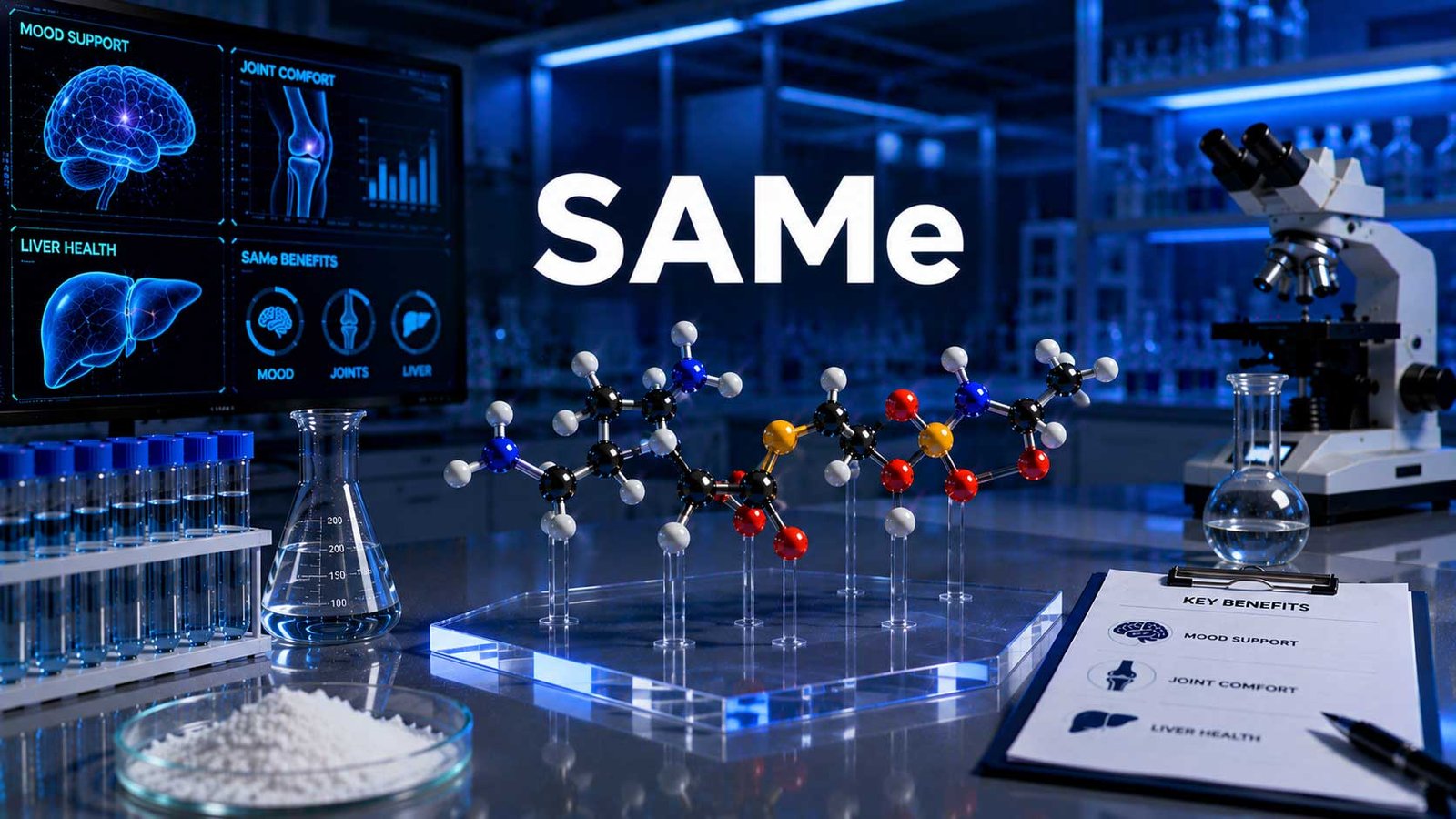
The Molecule Your Body Makes a Thousand Times a Second
I’ve spent years reading through methylation research, and if there’s one compound that keeps popping up in conversations about mood, joint comfort, and liver resilience, it’s SAMe. Not a herb, not a vitamin, not something you’ll find growing in a garden. SAMe — short for S-adenosylmethionine — is something your own cells manufacture, over and over, every single day, from the amino acid methionine and a molecule of ATP. It’s one of those compounds that quietly runs the show in the background of human biology without ever getting the spotlight that turmeric or ashwagandha get.
Here’s what makes SAMe interesting, and honestly a little strange when you first learn about it: it’s not a nutrient in the traditional sense. You don’t eat SAMe. Your body builds it internally, using methionine, which you do get from protein-rich foods, plus a functioning liver and a well-stocked supply of B vitamins to keep the whole machine humming. Once formed, SAMe becomes the primary methyl donor in the body, meaning it hands off small chemical tags (methyl groups) to hundreds of different targets — DNA, proteins, neurotransmitters, phospholipids, you name it. This process, called methylation, touches nearly every system you can think of, but three areas tend to dominate the conversation: mood regulation, joint health, and liver function.
Table of Contents


I remember the first time someone asked me about SAMe. She’d read that it was “Europe’s answer to antidepressants” and wanted to know if she should ditch her current supplement routine for it. That’s a decent enough entry point, because SAMe really has been used in parts of Europe, particularly Italy and Germany, as a prescription treatment for depression and joint conditions for decades — long before it hit U.S. shelves as a dietary supplement in the late 1990s. That regulatory split is actually a useful clue about how seriously researchers have taken this molecule. It’s not some fringe compound cooked up in a supplement lab; it’s been studied in hospital settings, compared head-to-head against tricyclic antidepressants and NSAIDs, and tracked in liver disease patients for years at a time.
But — and this is where I tend to slow down and get a little more careful with people — “well-studied” doesn’t automatically mean “settled science.” SAMe research has a complicated history. Some trials show genuinely encouraging results. Others, particularly larger and more rigorously controlled ones, come back with a shrug. A few systematic reviews have flagged that the strongest positive findings often come from smaller, older, or less tightly controlled studies, while newer, better-designed trials tend to show more modest or mixed effects. That’s not a reason to dismiss SAMe. It’s a reason to approach it with the same skepticism you’d apply to any compound that straddles the line between pharmaceutical and supplement.
What I find genuinely compelling about SAMe, separate from the depression conversation that tends to dominate headlines, is how it shows up across such different physiological territories. Depression, osteoarthritis, and liver disease don’t have much in common on the surface. But they share a thread: all three have been linked, in different ways, to disruptions in methylation and to measurably lower SAMe levels in affected tissue. Depressed patients often show altered one-carbon metabolism. Cirrhotic livers lose their ability to convert methionine into SAMe efficiently. Osteoarthritic cartilage shows reduced capacity for the kind of biosynthetic activity SAMe supports. Whether restoring SAMe levels actually reverses or meaningfully slows any of these processes is still being worked out, but the underlying biology gives researchers a reason to keep looking.
There’s also a practical angle that matters to a lot of people considering this supplement: SAMe tends to be reasonably well tolerated, at least at commonly used doses, and it doesn’t come with the same laundry list of gastrointestinal and cardiovascular concerns that chronic NSAID use does. That’s part of why it earned early enthusiasm as an alternative for joint discomfort in patients who couldn’t tolerate long-term anti-inflammatory drug use. It’s also part of why some clinicians have looked at it as an add-on option for depression that hasn’t fully responded to standard treatment, rather than a first-line replacement.
I want to be upfront about something before we go further: nothing here is meant to replace an actual conversation with your doctor, especially if you’re dealing with diagnosed depression, an autoimmune or inflammatory joint condition, or any form of liver disease. SAMe interacts with several medications, carries real considerations for certain populations, and isn’t automatically “safe because it’s natural.” We’ll get into all of that. But if you’re the kind of person who likes understanding the mechanism behind a supplement before deciding whether it earns a spot in your routine, SAMe rewards that curiosity. It sits at this interesting intersection of amino acid metabolism, neurotransmitter synthesis, cartilage biology, and hepatic function, and once you see how those pieces connect, the reason it keeps coming up in so many different corners of health research starts to make a lot more sense.
Let’s get into what the research actually shows, starting with the area SAMe is probably best known for: mood.
Key Health Benefits
SAMe’s reputation was built almost entirely on three pillars — mental health, joint comfort, and liver support — and each one has its own distinct body of clinical research behind it. I want to walk through these one at a time, because lumping them together tends to blur just how different the evidence quality is for each.
Mood and Depression Support
This is where SAMe first made its name, and it’s still the area with the deepest research base. The theory goes like this: depression has repeatedly been associated with disruptions in the “one-carbon cycle,” the metabolic pathway that produces SAMe. Some depressed patients show lower cerebrospinal fluid SAMe levels than non-depressed individuals, and SAMe itself plays a direct role in synthesizing neurotransmitters like serotonin, dopamine, and norepinephrine through methylation reactions. So the logic isn’t far-fetched: if depression sometimes involves a shortfall in methylation capacity, supplying more of the end-product might help.
A number of trials have tested this directly. An eight-week, double-blind, placebo-controlled trial out of Australia tested 800 mg per day of SAMe as a standalone treatment in adults with major depressive disorder who weren’t taking antidepressants, and found meaningful improvement compared to placebo. That’s a genuinely useful data point because it isolated SAMe on its own, rather than as an add-on to existing medication. On the other hand, a larger two-site trial comparing SAMe against both placebo and escitalopram (a standard SSRI) didn’t find a clear overall advantage for SAMe — though a later re-analysis of that same data found something worth noting: men in the trial responded significantly better to SAMe than women did, while women showed essentially no difference from placebo. Nobody has fully explained why that gender split showed up, but it’s the kind of detail that keeps researchers from writing SAMe off entirely and also keeps them from calling it a slam dunk.
Zooming out to the systematic review level paints a similarly mixed picture. A review examining eight controlled trials with over a thousand combined participants found that SAMe performed better than placebo in roughly half the direct comparisons, showed comparable results to older antidepressants like imipramine in several trials, and appeared to speed up response time when combined with SSRIs in at least one study. A more recent 2024 meta-analysis found that when SAMe is given orally or intramuscularly, it tends to outperform placebo, but when given intravenously, that advantage disappears — an interesting wrinkle suggesting delivery method matters more than people usually assume. Meanwhile, the Cochrane Collaboration, which tends to apply the strictest possible bar for evidence, concluded there wasn’t strong enough quality evidence to draw a firm conclusion either way, and called for larger, better-designed trials.
My honest read, after going through this literature more times than I can count: SAMe shows real, biologically plausible antidepressant activity in a meaningful chunk of the research, particularly for mild-to-moderate depression and particularly as an add-on rather than a total replacement for other approaches. It’s not a guaranteed fix, and results vary quite a bit between individuals — which, frankly, describes most mood interventions, pharmaceutical or otherwise.
Joint Health and Osteoarthritis
The second major pillar of SAMe’s reputation involves joints, specifically osteoarthritis. Here the mechanism shifts away from neurotransmitters and toward cartilage biology — SAMe is thought to support the production of proteoglycans, the molecules that give cartilage its cushioning, shock-absorbing quality.
The clinical picture here is actually a bit more consistent than the depression data, though still not without caveats. A meta-analysis pooling eleven randomized trials found that SAMe outperformed placebo for reducing functional limitation in osteoarthritis patients, though it didn’t show a statistically significant edge over placebo for pain reduction specifically. The same analysis found that SAMe’s effects on both pain and function were comparable to NSAIDs, with meaningfully fewer side effects — which is a genuinely attractive trade-off if you’re someone who’s tired of the stomach issues that come with long-term ibuprofen or naproxen use.
A Cochrane systematic review looking specifically at knee and hip osteoarthritis reached a similar conclusion: potentially clinically relevant, though modest, benefits on pain and function, with researchers explicitly calling for larger trials to nail down the effect size with more confidence. What I appreciate about this body of research is that it’s honest about its limitations — nobody’s claiming SAMe reverses joint degeneration or regrows cartilage. The claim is narrower and more grounded: it may ease some of the functional burden of osteoarthritis with a gentler side effect profile than standard anti-inflammatory drugs.
A few practical notes worth mentioning:
- Doses used in osteoarthritis trials have typically ranged from 600 to 1,200 mg daily, often split across two or three doses.
- Some studies used an initial loading period with higher doses before settling into a maintenance dose.
- Benefits, when present, tended to take several weeks to become noticeable — this isn’t a same-day pain reliever.
Liver Health and Detoxification
The third pillar, and arguably the most mechanistically direct, involves the liver itself. Remember, the liver is where the bulk of the body’s SAMe production actually happens, since it’s the primary site where dietary methionine gets metabolized. In chronic liver disease, particularly alcohol-related liver damage, the enzyme responsible for converting methionine into SAMe becomes measurably less active, which creates a kind of vicious cycle — a damaged liver produces less SAMe, and less SAMe further compromises the liver’s ability to manage oxidative stress and maintain healthy membrane function.
The most cited trial here is a Spanish multicenter study that followed over a hundred patients with alcoholic liver cirrhosis for two years, comparing oral SAMe against placebo. The results suggested that long-term SAMe treatment could improve survival or delay the need for liver transplantation, with the benefit appearing strongest in patients whose liver disease hadn’t yet progressed to its most severe stages. That’s a fairly striking finding for a nutritional compound, and it’s the study most often cited when SAMe’s liver benefits come up.
That said, a Cochrane review that pooled this trial alongside eight smaller ones found the overall evidence too thin and methodologically inconsistent to confirm a clear mortality benefit — while also noting that SAMe didn’t appear to increase serious adverse events across the pooled data. In plain terms: the safety signal looks solid, but the efficacy signal, while promising in that one well-run trial, hasn’t been replicated widely enough to call it settled.
Beyond alcohol-related liver disease, SAMe has also been studied for cholestatic conditions (where bile flow is impaired) and has a long history of use in parts of Europe for exactly that purpose. The proposed mechanism involves SAMe’s role in maintaining the fluidity and function of liver cell membranes, which affects how efficiently bile gets transported. Again, promising mechanism, mixed-to-modest clinical confirmation — a pattern you’ll notice repeats itself across all three of SAMe’s major benefit areas.

Dietary Sources
Here’s where SAMe gets genuinely unusual compared to almost every other supplement ingredient people ask me about: you cannot really “eat” SAMe in any meaningful dietary sense. It’s not sitting in a food waiting to be absorbed the way vitamin C or omega-3s are. Your body builds it internally, on demand, from raw materials — chiefly the amino acid methionine, plus a functioning supply chain of B vitamins that keep the underlying metabolic pathway running smoothly.
Foods That Feed the Methylation Cycle
Since methionine is the direct precursor to SAMe, getting enough of it through food is really the dietary side of this equation. Methionine is an essential amino acid, meaning your body can’t synthesize it from scratch — it has to come from what you eat. The richest sources are almost entirely animal-based:
- Eggs, particularly the yolk
- Fish and shellfish
- Poultry and lean meats
- Dairy products, including hard cheeses
- Brazil nuts, sesame seeds, and sunflower seeds among plant sources
Plant-based eaters aren’t left out entirely, but legumes tend to be comparatively low in methionine, so a varied plant diet that includes nuts, seeds, and whole grains alongside legumes does a better job of covering methionine needs than legumes alone.
But methionine is only half the story. Turning methionine into SAMe, and then recycling the byproduct of that reaction (homocysteine) back into usable methionine, depends heavily on a trio of B vitamins: folate, vitamin B12, and vitamin B6. This is where the conversation about SAMe overlaps almost completely with the broader conversation about “methylation support” that’s become popular in functional nutrition circles. A peer-reviewed appraisal of homocysteine metabolism lays this out clearly — dietary methionine gets converted to SAMe, SAMe donates its methyl group and becomes homocysteine, and homocysteine then gets either recycled back to methionine (a step that depends on folate and B12) or shuttled down a separate pathway that depends on B6. If any of those B vitamins run low, the whole cycle slows down, homocysteine can accumulate, and SAMe production can suffer even if you’re eating plenty of methionine-rich food.
Practically, that means foods rich in folate (leafy greens, legumes, asparagus), B12 (animal products almost exclusively, which is worth flagging for strict vegans), and B6 (poultry, fish, potatoes, chickpeas) all indirectly support your body’s own SAMe output. I’ve found this framing helps people understand why “just eat more protein” isn’t quite the full picture — you need the amino acid building block and the vitamin cofactors working together.
Why You Can’t Just “Eat” SAMe
So if SAMe isn’t really a dietary nutrient, why does it get called a “food supplement” at all? Because the supplement industry makes synthetic or fermentation-derived SAMe available in pill form, typically stabilized as a salt (like SAMe-tosylate or SAMe-butanedisulfonate) to protect the otherwise fragile molecule from breaking down before it reaches your bloodstream. That’s genuinely different from, say, taking a vitamin C tablet that mimics what’s already abundant in citrus fruit. You’re not supplementing something your diet is naturally full of — you’re supplementing an internally manufactured compound directly, essentially skipping the biosynthesis step altogether.
This distinction matters for a couple of reasons. First, it explains why SAMe supplements tend to be more expensive than most amino acid or vitamin products — the manufacturing and stabilization process is more involved. Second, it’s part of why absorption and bioavailability have been such a persistent topic in SAMe research; oral SAMe has to survive stomach acid and first-pass liver metabolism, which is a big part of why enteric-coated formulations became standard and why doses in clinical trials tend to look fairly high compared to typical vitamin dosing.
If your goal is simply supporting your body’s natural SAMe production through food, focus on getting adequate complete protein along with folate, B12, and B6-rich foods consistently, rather than searching for a “SAMe-rich” ingredient that doesn’t really exist in nature.
Dosage & Deficiency
Dosage conversations around SAMe get complicated fast because the “right” amount really depends on what you’re using it for, and the research hasn’t converged on one universal number the way it has for something like vitamin D.
Typical Dosages by Use Case
Pulling from the clinical trials that have actually tested SAMe against placebo or standard treatments, here’s roughly where the dosing has landed across different applications:
- Depression support: Trials have used anywhere from 400 mg to 1,600 mg daily, with 800 mg to 1,600 mg being fairly common in studies showing meaningful results. Clinical guidance in some reviews has cautiously endorsed even higher ranges (1,600–3,200 mg) specifically as an add-on to existing antidepressant treatment, rather than as a standalone approach.
- Osteoarthritis and joint comfort: Most trials clustered between 600 mg and 1,200 mg daily, often split into two or three smaller doses rather than one large one, sometimes with a higher “loading” dose for the first few weeks.
- Liver support: The landmark cirrhosis trial used 1,200 mg daily, split into two doses, over a two-year period — a notably long duration compared to most mood or joint studies.
A few things I always mention to people considering SAMe: doses in the research skew considerably higher than what you’d see for a typical vitamin or mineral, effects generally take two to four weeks to show up rather than days, and enteric-coated formulations (designed to survive stomach acid intact) tend to perform more consistently than uncoated tablets in the available research. Starting low and working upward gradually, ideally under the guidance of a healthcare provider familiar with your history, tends to minimize the digestive side effects some people experience when jumping straight to a full dose.
Signs of Low Methylation Capacity
Because SAMe isn’t an essential nutrient in the classic sense, there’s no formal “SAMe deficiency” diagnosis the way there is for iron or vitamin D. What exists instead is a broader concept: impaired methylation capacity, which can show up when the body’s ability to produce or use SAMe efficiently is compromised. This tends to happen in a handful of specific situations rather than as a general population-wide concern:
- Chronic liver disease, where the enzyme that converts methionine to SAMe becomes measurably less active, is probably the clearest and best-documented example.
- Genetic variations in enzymes involved in the folate and methylation cycle (MTHFR being the one that gets the most attention, fairly or not) can reduce how efficiently the body recycles homocysteine back into methionine.
- Nutritional deficiencies in folate, B12, or B6 can bottleneck the whole methylation cycle even when methionine intake from food is adequate.
- Chronic alcohol use directly suppresses hepatic SAMe synthesis, which is precisely why so much SAMe research has focused on alcohol-related liver disease specifically.
If you fall into one of these categories — particularly diagnosed liver disease or a known B-vitamin deficiency — that’s a much stronger rationale for discussing SAMe supplementation with a doctor than simply feeling low-energy or achy without any other clinical context. SAMe isn’t something I’d suggest reaching for on a hunch; it makes the most sense when there’s an identifiable reason to think your methylation capacity might actually be compromised.
Toxicity & Risks
SAMe has a genuinely favorable safety profile in most of the research I’ve reviewed, especially compared to long-term NSAID use or many prescription antidepressants. But “generally well tolerated” isn’t the same as “risk-free,” and there are a handful of considerations worth taking seriously.
Common Side Effects
Across depression, osteoarthritis, and liver disease trials, the side effects reported for SAMe have been consistently mild and largely digestive in nature:
- Nausea
- Gas and bloating
- Diarrhea or, less commonly, constipation
- Dry mouth
- Headache
These tend to be dose-dependent, meaning they show up more at higher doses and often improve with dose reduction or by taking SAMe with food (though some formulations recommend taking it on an empty stomach for better absorption — check your specific product’s instructions). Serious adverse events have been uncommon across the clinical trial data, and safety comparisons against both placebo and NSAIDs have generally favored SAMe’s tolerability.
Who Should Be Cautious
A few populations deserve a more careful, doctor-guided approach rather than casual self-supplementation:
People with bipolar disorder. This is probably the single most consistent warning that shows up across clinical resources. Because SAMe influences neurotransmitter synthesis in ways similar to some antidepressants, it carries a documented risk of triggering manic or hypomanic episodes in people with bipolar disorder. A published case report described a man who developed hypomania after about a week of combining SAMe with another serotonin-boosting supplement, reinforcing that this isn’t a purely theoretical concern. Anyone with a personal or strong family history of bipolar disorder should have an explicit conversation with a psychiatrist before starting SAMe.
People with compromised immune function. Some clinical guidance notes SAMe may support the growth of certain opportunistic organisms in immunocompromised individuals, which is a narrow but important consideration for anyone managing conditions like HIV or undergoing immunosuppressive treatment.
Pregnant or breastfeeding individuals. The research base simply isn’t robust enough here to make confident safety claims either way, so most clinical resources default to caution and recommend avoiding SAMe supplementation during pregnancy and lactation unless specifically directed otherwise by a physician.
Drug Interactions
This is the section I’d encourage anyone considering SAMe to read most carefully, because the interaction list is genuinely significant:
- Antidepressants, particularly SSRIs, SNRIs, and MAOIs — combining these with SAMe raises the risk of serotonin syndrome, a potentially serious condition involving symptoms like agitation, rapid heart rate, high fever, and confusion.
- Dextromethorphan (found in many cough medicines), tramadol, and meperidine carry the same serotonin syndrome concern when combined with SAMe.
- St. John’s Wort, another serotonin-influencing supplement, shouldn’t be combined with SAMe for the same reason.
- Levodopa, used for Parkinson’s disease, may have its effectiveness reduced by SAMe.
- Antipsychotics and amphetamines warrant caution due to overlapping effects on neurotransmitter activity.
None of this is meant to scare anyone away from a compound with a genuinely solid overall safety record — it’s meant to underline that SAMe isn’t a neutral, purely benign supplement just because it’s sold over the counter. Anyone currently taking an antidepressant, mood stabilizer, or Parkinson’s medication should treat SAMe as they would any other pharmacologically active substance and loop their prescribing doctor in before adding it to their routine.
Where This Leaves Us With SAMe
After spending real time in this research, my takeaway on SAMe isn’t a clean “yes, take it” or “no, skip it.” It’s more nuanced than that, and honestly, that nuance is what makes it interesting rather than disappointing. This is a molecule your body already relies on constantly, studied across three genuinely different areas of health, with a safety profile that holds up better than a lot of the alternatives people reach for instead — whether that’s chronic NSAID use for joints or jumping straight to prescription antidepressants for mild mood symptoms.
What stands out most to me is the consistency of the mechanism even when the clinical outcomes vary. Depression, osteoarthritis, and liver disease are three very different conditions, but all three have been linked to reduced SAMe activity in the tissues involved, and supplementing SAMe has shown at least some measurable benefit in rigorous trials for each one. That’s not nothing. At the same time, I’d be doing you a disservice if I glossed over how mixed some of the larger, more recent trials have been, particularly for depression, or how the liver disease evidence really rests heavily on one strong trial rather than a broad consensus.
If you’re weighing SAMe for yourself, a few practical takeaways worth carrying forward: dosing in the 400–1,600 mg range shows up repeatedly across the research depending on what you’re targeting, benefits generally take a few weeks to become noticeable rather than days, enteric-coated formulations tend to perform more reliably, and the interaction profile — especially with antidepressants and other serotonin-active substances — deserves real attention rather than a quick skim. If you have bipolar disorder, liver disease requiring active management, or you’re pregnant, that conversation with a healthcare provider isn’t optional; it’s the responsible starting point.
There’s something almost refreshing about a supplement that doesn’t promise to be everything to everyone. SAMe isn’t going to replace therapy, physical rehabilitation, or medical management of liver disease. But as a well-studied, endogenously produced compound with a defensible mechanism and a track record that spans decades of clinical use in parts of Europe, it earns a more serious look than most things sitting on a supplement shelf. Go in with realistic expectations, respect the interaction risks, and treat it the way you’d treat any other biologically active compound worth taking seriously — and SAMe becomes a genuinely reasonable option to discuss with your doctor rather than just another bottle gathering dust in the cabinet.
Article Sources
At AncientHerbsWisdom, our content relies on reputable sources, including peer-reviewed studies, to substantiate the information presented in our articles. Our primary objective is to ensure our content is thoroughly fact-checked, maintaining a commitment to accuracy, reliability, and trustworthiness.
- Sarris, J., Murphy, J., Stough, C., Mischoulon, D., Bousman, C., Ng, C. H., Byrne, G. J., et al. (2020). S-Adenosylmethionine (SAMe) monotherapy for depression: an 8-week double-blind, randomised, controlled trial. Psychopharmacology, 237(1), 209-218. https://link.springer.com/article/10.1007/s00213-019-05358-1
- Sarris, J., Price, L. H., Carpenter, L. L., Tyrka, A. R., Ng, C. H., Papakostas, G. I., Jaeger, A., Fava, M., & Mischoulon, D. (2015). Is S-Adenosyl Methionine (SAMe) for Depression Only Effective in Males? A Re-Analysis of Data from a Randomized Clinical Trial. Pharmacopsychiatry, 48(4-5), 141-144. https://pmc.ncbi.nlm.nih.gov/articles/PMC5380442
- Limveeraprajak, N., Nakhawatchana, S., Visukamol, A., Siripakkaphant, C., Suttajit, S., & Srisurapanont, M. (2024). Efficacy and acceptability of S-adenosyl-L-methionine (SAMe) for depressed patients: a systematic review and meta-analysis of randomized controlled trials. European Psychiatry. https://pmc.ncbi.nlm.nih.gov/articles/PMC11863058/
- Soeken, K. L., Lee, W. L., Bausell, R. B., Agelli, M., & Berman, B. M. (2002). Safety and efficacy of S-adenosylmethionine (SAMe) for osteoarthritis. Journal of Family Practice, 51(5), 425-430. https://pubmed.ncbi.nlm.nih.gov/12019049
- Mato, J. M., Camara, J., Fernandez de Paz, J., Caballeria, L., Coll, S., Caballero, A., Garcia-Buey, L., et al. (1999). S-Adenosylmethionine in alcoholic liver cirrhosis: a randomized, placebo-controlled, double-blind, multicenter clinical trial. Journal of Hepatology, 30(6), 1081-1089. https://www.journal-of-hepatology.eu/article/S0168-8278(99)80274-8/fulltext
- Rambaldi, A., & Gluud, C. (2006). S-adenosyl-L-methionine for alcoholic liver diseases. Cochrane Database of Systematic Reviews, (2), CD002235. https://pubmed.ncbi.nlm.nih.gov/16625556
- Olsufka, W., & Abraham, M. A. (2017). Treatment-emergent hypomania possibly associated with over-the-counter supplements. Mental Health Clinician, 7(4), 160-163. https://pmc.ncbi.nlm.nih.gov/articles/PMC6007531
- McCaddon, A., & Miller, J. W. (2023). Homocysteine – a retrospective and prospective appraisal. Frontiers in Nutrition, 10, 1179807. https://www.frontiersin.org/journals/nutrition/articles/10.3389/fnut.2023.1179807/full
- Mayo Clinic. (2023). SAMe. https://www.mayoclinic.org/drugs-supplements-same/art-20364924

- Phosphatidic Acid: Supporting Muscle Growth and Strength - July 31, 2026
- Ceramides: Supporting Healthy Skin From Within - July 31, 2026
- Synbiotics: Combining Prebiotics and Probiotics Together - July 31, 2026