
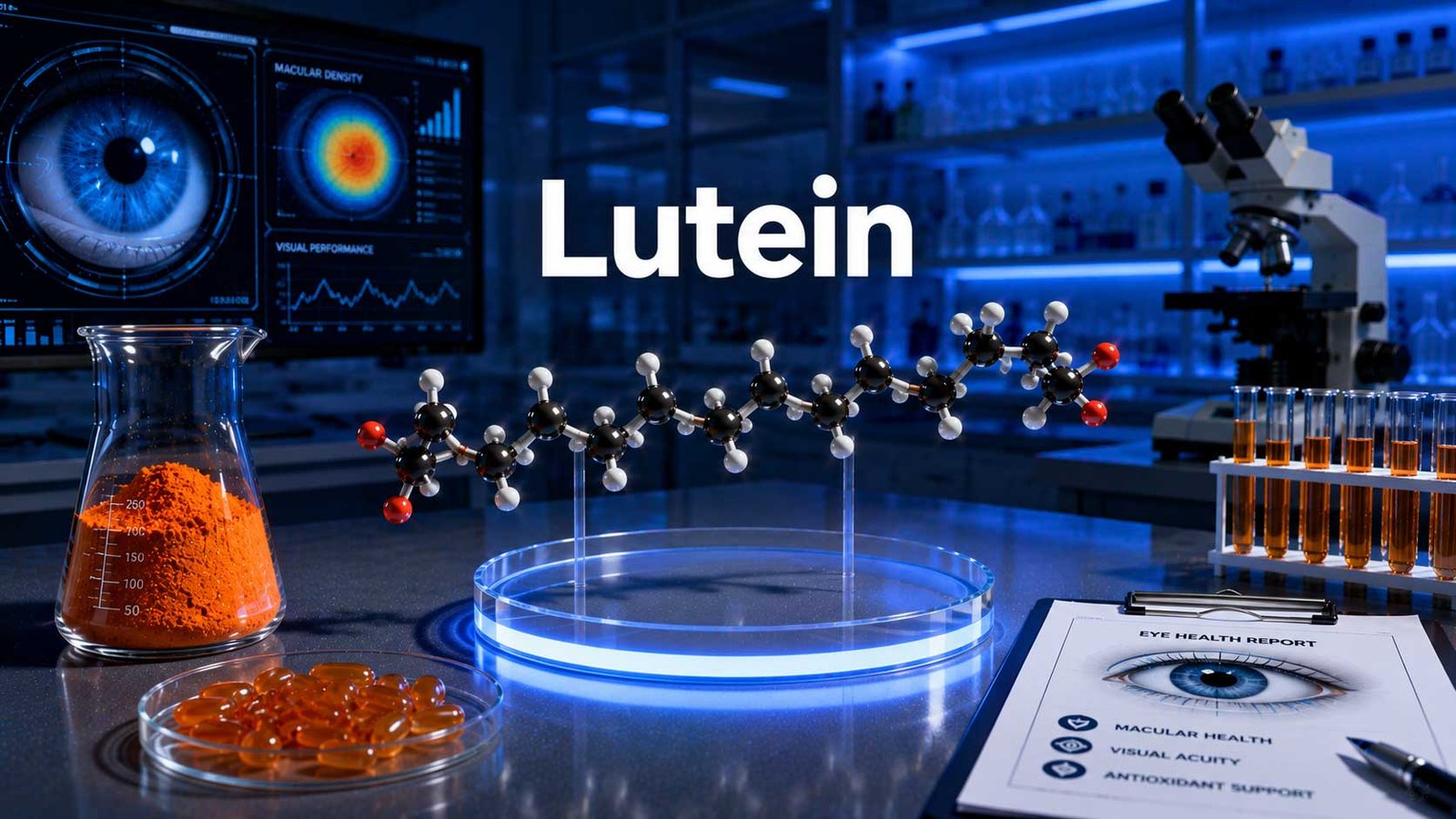
The Yellow Pigment Your Eyes Have Been Asking For
There’s a particular shade of yellow hiding in the back of your eye, right at the spot where your vision is sharpest. Most people never think about it. I didn’t either, for a long time, until I started digging into why some diets seem to protect eyesight as people age while others don’t do much at all. That yellow pigment is lutein, and once you understand what it’s doing back there, it’s hard to look at a plate of spinach the same way again.
Lutein belongs to a family of plant pigments called carotenoids, the same broad group that gives carrots their orange color and tomatoes their red. But lutein and its close cousin zeaxanthin do something the others don’t. They accumulate specifically in the macula, the small central region of the retina responsible for the fine detail vision you use to read, recognize faces, and drive. Scientists call this concentrated deposit the macular pigment, and it’s essentially a built-in pair of sunglasses that your body assembles from the food you eat.
Table of Contents


Here’s the thing that surprised me most when I first started paying attention to this topic: the human body cannot make lutein on its own. Zero synthesis. None. Every molecule of it sitting in your retina right now got there because you ate a plant that made it first. That single fact changes how I think about diet and eye health, because it means the macular pigment density in your eyes is, in a very real sense, a reflection of your dietary history over months and years, not just what you had for breakfast.

I want to be upfront that lutein isn’t some miracle nutrient that reverses vision problems overnight. Nothing in nutrition works that way, and anyone who tells you otherwise is selling something. But the research on lutein and long-term eye health, particularly around age-related macular degeneration and cataracts, has grown substantial enough that it’s genuinely one of the more evidence-backed nutrients in the eye health conversation, alongside omega-3 fatty acids and vitamin C.
What makes lutein interesting from a mechanistic standpoint is the dual role it plays. First, it acts as a filter, absorbing a portion of high-energy blue light before it reaches the more delicate photoreceptor cells underneath. Blue light is the shorter, higher-energy wavelength that’s been getting a lot of attention lately, partly because of screens, but the eye has been dealing with blue light from the sun for as long as eyes have existed. Second, lutein functions as an antioxidant, neutralizing reactive oxygen species that form as a natural byproduct of the retina’s extremely high metabolic activity. The retina, gram for gram, is one of the most metabolically demanding tissues in the human body, and that constant activity generates oxidative stress that needs to be managed.
I think what draws me to lutein as a topic, more than most nutrients, is how visible its effects can be with the right testing. There’s a noninvasive measurement called macular pigment optical density, and researchers have shown that dietary lutein intake correlates with it in a fairly consistent, dose-responsive way. You eat more lutein-rich foods, your macular pigment density tends to rise over a period of weeks to months. It’s one of the few nutrients where you can trace a relatively direct line from plate to physiological marker, which is part of why it’s been studied so extensively.
There’s also a cognitive angle that doesn’t get discussed nearly enough. Lutein, along with zeaxanthin, is found in brain tissue at levels that actually correlate with concentrations in the retina, since the retina is technically an extension of the central nervous system. Some researchers have proposed that this shared distribution explains observed associations between carotenoid status and certain measures of cognitive performance, though I’ll say clearly that this is an area still very much in development scientifically, and I wouldn’t want to overstate it.
Where does lutein actually come from? Dark leafy greens are the heavy hitters, and I’ll get into the specifics of that later. Egg yolks matter too, in a way that surprises people, because the fat content in yolk seems to help with absorption despite the relatively modest lutein concentration compared to greens. It’s not just about how much lutein is in a food; it’s about how bioavailable it is once it hits your digestive system, and that depends heavily on the food matrix and what else you’re eating alongside it.
I’ll be honest, there was a period where lutein got swept up into the broader “eat your carotenoids” advice without much nuance, lumped in with beta-carotene and lycopene as if they were interchangeable. They’re not. Beta-carotene, for instance, doesn’t accumulate in the macula the way lutein and zeaxanthin do. If eye health specifically is your goal, not general antioxidant support, lutein and zeaxanthin deserve their own conversation, separate from the rest of the carotenoid family.
So that’s the landscape we’re working with. A pigment your body can’t make, concentrated in a tiny but critical patch of retinal real estate, doing double duty as a light filter and an antioxidant, with a research base that’s grown steadily more convincing over the past two decades. The rest of this piece walks through what the science actually says about benefits, where to get it, how much makes sense, and where the limits and risks sit, because even a nutrient this well-regarded deserves an honest look at both sides.
Key Health Benefits
Let’s get into what lutein is actually doing for you, beyond the general “it’s good for your eyes” framing that tends to show up in casual health writing without much substance behind it.
Macular Health and Age-Related Decline
The most substantial body of research on lutein centers on age-related macular degeneration, often shortened to AMD, which is one of the leading causes of vision loss in older adults in developed countries. The macula, as I mentioned, is packed with lutein and zeaxanthin, and the working theory has been that higher macular pigment density offers a degree of protection against the oxidative damage and blue light exposure thought to contribute to AMD progression.
The Age-Related Eye Disease Study 2, commonly known as AREDS2, remains one of the most frequently cited pieces of evidence here. It was a large, randomized clinical trial examining whether adding lutein and zeaxanthin to a nutritional supplement formula would benefit people already at risk for advanced AMD. The findings suggested that substituting lutein and zeaxanthin for beta-carotene in the supplement formula was reasonable, particularly given that beta-carotene had been associated with increased lung cancer risk in smokers in earlier trials. This is a detail I think gets glossed over a lot: part of lutein’s rise in popularity within eye health formulations wasn’t just that it worked well, but that it worked without the safety concerns tied to beta-carotene in certain populations.
Beyond AREDS2, a systematic review and meta-analysis examining lutein and zeaxanthin intake in relation to AMD risk found that higher dietary intake and higher blood levels of these carotenoids were associated with a reduced risk of late AMD. That’s an observational association, worth noting, not proof of direct causation, but it’s a consistent pattern across multiple studies conducted in different populations.
Supporting Macular Pigment Density
I mentioned macular pigment optical density earlier because it’s genuinely one of the more elegant ways researchers have found to track lutein’s effect in living tissue. A review looking at lutein, zeaxanthin, and meso-zeaxanthin supplementation found that increasing intake was associated with measurable increases in macular pigment optical density across various study populations. What I find compelling about this line of research is that it’s not relying purely on subjective visual acuity tests, it’s using an objective physiological measurement that reflects actual carotenoid accumulation in the tissue that matters most.
Cataract Considerations
Cataracts, the clouding of the eye’s lens that develops gradually with age, are another area where lutein has drawn research attention. The lens, like the retina, is subject to a lifetime of oxidative exposure, and some observational research has linked higher dietary lutein and zeaxanthin intake with a lower prevalence of cataracts. I want to be careful here, because the evidence for cataracts is generally considered less robust than the evidence for AMD, and much of it comes from observational cohort data rather than the kind of randomized controlled trials that let you draw firmer conclusions. Still, the biological rationale, protecting lens proteins from oxidative crosslinking, is plausible enough that it keeps showing up as a research thread worth following.
Blue Light Filtering
We live in an era of screens, and it’s tempting to draw a straight line from “lutein filters blue light” to “lutein protects you from your laptop.” The physiological role is real. Lutein and zeaxanthin do absorb blue light wavelengths in the macula, reducing the amount that reaches the photoreceptors and retinal pigment epithelium underneath. Whether this translates into meaningful protection against the kind of blue light exposure most people get from screens, as opposed to the far more intense exposure from direct sunlight, is a separate question that the research hasn’t fully settled. I’d treat this as a plausible mechanism rather than a proven outcome for screen-related eye strain specifically.
General Antioxidant Contribution
Beyond the eye-specific roles, lutein contributes to the body’s broader antioxidant defense system. A review examining lutein’s effects on eye and extra-eye health noted its role in reducing oxidative stress markers and suggested potential relevance to skin health and cardiovascular function, though the researchers were careful to frame much of this as requiring further investigation rather than settled science.
A Quick Rundown
To pull the benefits together in a scannable format:
- Associated with reduced risk of advanced age-related macular degeneration in higher-intake populations
- Measurably increases macular pigment optical density with sustained dietary or supplemental intake
- Linked to lower cataract prevalence in observational studies, though evidence is less conclusive than for AMD
- Functions as a blue light filter within the retina itself
- Contributes to systemic antioxidant activity beyond the eye
None of this means lutein is a cure or a guarantee. Genetics, smoking status, overall diet quality, and sun exposure all factor into whether someone develops AMD or cataracts, and lutein is one piece of a much larger picture. But as pieces go, it’s one with a fairly solid research foundation behind it.

Dietary Sources
If there’s one thing I wish more people understood about lutein, it’s that you don’t need supplements to get meaningful amounts. Food does the job well, and honestly, food does it better in most cases, because you’re getting lutein alongside a whole cast of supporting nutrients and fiber that work together in ways isolated supplements can’t fully replicate.
Leafy Greens Lead the Pack
Dark, leafy vegetables are, without question, the richest dietary source of lutein. Kale sits near the top of nearly every food composition table for lutein and zeaxanthin content, and it’s not particularly close. Spinach follows, along with collard greens, turnip greens, and Swiss chard. There’s a reason nutritionists have been harping on leafy greens for decades, and while fiber and folate usually get the credit, lutein deserves a mention in that conversation too.
A review focused specifically on dietary sources of lutein and zeaxanthin confirmed that dark green leafy vegetables consistently rank as the most concentrated sources, with kale and spinach standing out even among that group. Cooking method matters here in a way that surprises people. Lightly cooking greens, steaming or sautéing rather than eating them entirely raw, can actually improve lutein bioavailability by breaking down plant cell walls and releasing the pigment more readily during digestion. I know that runs against the instinct that raw is always better, but in this case, a bit of heat works in your favor.
Egg Yolks: Small Amount, Strong Absorption
Egg yolks contain noticeably less lutein by weight than leafy greens, but they punch above their weight in terms of absorption. The fat content in yolk appears to enhance how efficiently the body absorbs the lutein present, since carotenoids are fat-soluble compounds that need dietary fat as a vehicle for absorption in the small intestine. This is actually a useful practical takeaway: pairing lutein-rich greens with a source of fat, whether that’s a drizzle of olive oil on a spinach salad or eggs alongside sautéed kale, meaningfully improves how much lutein your body actually takes up rather than passing through undigested.
Corn and Yellow Vegetables
Corn is another source that doesn’t get enough credit. It contains a respectable amount of lutein and zeaxanthin, and because corn is a dietary staple in so many parts of the world, it ends up being a significant contributor to average lutein intake at a population level even though it’s not the most concentrated source on a per-gram basis.
Other yellow and orange vegetables, like yellow bell peppers and squash, contribute smaller but still meaningful amounts.
Herbs and Less Obvious Sources
A few less commonly discussed sources are worth mentioning:
- Parsley, which has a surprisingly high lutein content relative to its typical serving size
- Peas, both fresh and frozen
- Brussels sprouts and broccoli, in smaller but useful amounts
- Pistachios, among nuts, stand out slightly compared to other nut varieties
Building a Practical Eating Pattern
I try to think about this less as “eat X grams of Y food” and more as a pattern. A diet that regularly includes a serving of dark leafy greens most days, a couple of eggs a week, and some corn or yellow vegetables in the rotation is going to deliver a reasonably steady stream of lutein without anyone needing to count anything. That’s the approach I’d encourage over supplementation for most people, reserving supplements for situations where dietary intake is consistently low or where a healthcare provider has identified a specific reason to consider them.
One more practical note: lutein content in produce can vary based on how the plant was grown, how fresh it is, and how it’s stored. Fresher greens generally retain more of their carotenoid content than produce that’s been sitting for a week. It’s not a reason to panic about slightly wilted spinach, but it does mean that shopping and eating with some regularity, rather than stockpiling greens for weeks at a time, probably serves you better.
Dosage & Deficiency
This is the section where I have to be a bit more careful than usual, because unlike vitamins with clearly established recommended dietary allowances, lutein doesn’t have an official RDA in most countries, including the United States. That absence trips people up. They assume no RDA means no importance, and that’s not the right conclusion to draw.
Why There’s No Official RDA
Lutein isn’t classified as an essential nutrient in the traditional sense, meaning the body doesn’t require it to survive the way it requires vitamin C or certain amino acids. Instead, it falls into a category of dietary compounds that offer measurable physiological benefits without triggering a deficiency disease if intake is low. This is similar to how compounds like lycopene or certain flavonoids are treated in nutrition science. That said, research has still worked out intake ranges associated with measurable benefit, even without a formal government-set requirement.
What the Research Suggests
Studies examining macular pigment optical density and AMD risk have generally used intakes in the range of roughly 6 to 10 milligrams of lutein per day to observe meaningful associations with eye health outcomes, with some clinical trial formulations, including the one used in AREDS2, using around 10 milligrams of lutein combined with 2 milligrams of zeaxanthin daily. I want to stress that this is the range studied in research contexts, not a formal recommendation that applies uniformly to every individual, and anyone considering supplementation at that level, particularly if they have an existing eye condition, should be talking to an eye care professional rather than self-dosing based on an article.
For context, average dietary intake in the general population tends to fall well short of these research-study amounts. Estimates from population surveys have often placed typical intake somewhere in the 1 to 2 milligram per day range, which is a meaningful gap between what most people consume and what’s been studied for eye health benefit. That gap is part of why leafy greens deserve more real estate on the plate than they typically get.
Signs of Low Intake
There isn’t a classic “deficiency syndrome” tied to low lutein intake the way there is with something like vitamin D or iron. You won’t get a diagnosable condition from low lutein alone. What the research points to instead is a gradual, long-term pattern: chronically low intake correlates with lower macular pigment optical density over time, which in turn has been associated with increased vulnerability to oxidative damage in the retina as people age. It’s less of an acute deficiency and more of a slow accumulation of missed protective opportunity, if that makes sense. Nobody feels symptoms from low lutein intake in their thirties. The relevance tends to show up decades later, which is exactly why it’s easy to deprioritize.
Who Tends to Run Low
A few groups are more likely to have lower lutein status:
- People who eat few vegetables generally, particularly leafy greens
- Older adults with reduced dietary variety or appetite
- Individuals with fat malabsorption conditions, since lutein absorption depends on dietary fat
- Smokers, who have been shown in some studies to have lower serum carotenoid levels, possibly related to increased oxidative turnover
A Practical Way to Think About It
Rather than fixating on a milligram target, I’d suggest thinking in terms of servings. A cup of cooked kale or spinach a few times a week, alongside a generally vegetable-forward diet, tends to land people in a reasonable intake range without needing to supplement. If someone has a specific eye health concern, a family history of AMD, or has been advised by an ophthalmologist to consider supplementation, that’s a different conversation, and one worth having directly with a qualified provider rather than working from generic online guidance.
Toxicity & Risks
Lutein has a reputation, deserved in large part, as one of the safer nutrients to supplement with. But safer doesn’t mean risk-free in every scenario, and I think it’s worth walking through this honestly rather than just repeating the “it’s totally safe” line you see on a lot of supplement packaging.
Low Acute Toxicity
Unlike fat-soluble vitamins such as A or D, lutein doesn’t have a well-documented pattern of acute toxicity at high doses. Clinical trials, including AREDS2, used daily doses around 10 milligrams over multi-year periods without raising significant safety concerns in the study population. Research has generally found lutein to be well tolerated even at doses considerably higher than typical dietary intake, and no established upper tolerable limit has been set by major health bodies the way there is for nutrients with clearer toxicity profiles.
Carotenemia: A Cosmetic, Not Dangerous, Effect
The most commonly reported effect of very high carotenoid intake, lutein included, is a condition called carotenemia, where the skin takes on a yellowish or orange tint, most noticeable on the palms and soles. This happens because carotenoids accumulate in the outer layers of skin at high blood concentrations. It’s cosmetic, not harmful, and it resolves once intake decreases. I mention it mainly because it can alarm people who notice it without understanding what’s causing it. If your palms start looking a bit like you’ve had too many carrots and too much kale, this is almost certainly what’s happening, and it isn’t dangerous.
The Beta-Carotene Lesson
Part of why lutein gets a relatively favorable safety reputation involves a comparison to beta-carotene, another well-studied carotenoid. Earlier large trials found that high-dose beta-carotene supplementation was associated with increased lung cancer risk specifically in smokers and individuals with asbestos exposure. This finding was significant enough that it shaped how AREDS2 researchers approached their supplement formulation, leading them to favor lutein and zeaxanthin over beta-carotene in the updated formula. Lutein has not shown this same association in the research to date, which is one of the reasons it’s generally viewed as having a more favorable risk profile among carotenoids. That said, this is a good reminder that carotenoids aren’t a monolithic category where safety data for one member automatically applies to all the others.
Supplement Quality and Sourcing
A practical risk that has little to do with lutein’s biology and everything to do with the supplement industry: quality control varies a lot between products. Some lutein supplements are derived from marigold flower extract, which is generally well studied, but concentration, purity, and the presence of other additives can differ significantly between manufacturers. If someone does choose to supplement, looking for products that have undergone third-party testing is a reasonable precaution, though this is more of a general supplement-quality issue than something specific to lutein’s safety profile.
Interactions and Special Populations
There isn’t a large body of evidence pointing to significant drug interactions with lutein at typical supplemental doses. That said, individuals on medications that affect fat absorption, since lutein is fat-soluble and depends on normal fat digestion for absorption, may find their lutein levels affected as a secondary consequence rather than through a direct pharmacological interaction. Pregnant and breastfeeding individuals are generally advised to prioritize dietary sources over concentrated supplements for most nutrients, including carotenoids, simply because supplement research in these populations tends to be more limited, not because of specific evidence of harm.
Where the Real Caution Lies
If I had to summarize the risk picture honestly, it’s this: lutein from food carries essentially no meaningful risk for the vast majority of people, and even supplemental doses used in major research trials have shown a strong safety record over years of monitoring. The more realistic caution isn’t about lutein itself causing harm, it’s about people using supplementation as a substitute for a genuinely poor diet, or assuming that a pill absolves them of eating vegetables. Lutein works best as part of a dietary pattern rich in produce, not as a standalone fix layered on top of a diet otherwise low in fruits and vegetables.
Seeing Clearly Means Feeding the Retina What It Can’t Make Itself
I keep coming back to that one fact whenever I think about lutein: your body cannot manufacture it. Every bit sitting in your macula right now traces back to something you ate, at some point, possibly years ago given how gradually macular pigment builds and depletes. That’s a humbling thing to sit with, honestly. It means eye health, at least this particular dimension of it, isn’t something you can outsource to genetics or luck entirely. Diet is doing real, measurable work back there whether you’re paying attention to it or not.
What stands out to me most from working through the research is how consistent the story is across different types of studies. Population data, clinical trials, physiological measurements of macular pigment density, they all point in a similar direction: adequate lutein intake correlates with better markers of eye health, particularly as it relates to age-related macular degeneration, and the safety profile is about as clean as you’ll find among nutrients that have been studied this extensively.
If you take one practical thing away from this, let it be the leafy greens. Kale, spinach, collards, whatever you’ll actually eat consistently, because the best source of lutein is the one that ends up on your plate on a regular Tuesday, not the one sitting theoretically at the top of a nutrient density chart you never act on. Pair it with a bit of fat, an egg, some olive oil, since that’s going to meaningfully improve how much of it your body actually absorbs. Add in corn, peas, a handful of pistachios here and there, and you’re covering a lot of ground without needing to think about milligrams at all.
Supplements have their place, particularly for people with diagnosed eye conditions or documented low intake who are working with a healthcare provider on a specific plan. But for most people reading this, the more honest and more useful message is that this is a food-first nutrient. It rewards consistency over intensity, and it rewards the boring stuff, regular vegetables, regular meals, over anything dramatic or supplement-driven.
Vision changes slowly, mostly, until suddenly it doesn’t. That’s part of why nutrients like lutein don’t get the attention they deserve until later in life, when the stakes feel more immediate. I’d rather make the case for it now, while it’s still just a preventive habit rather than a response to a diagnosis. The macula you protect at thirty-five is the macula you’re relying on at seventy-five, and it’s been quietly keeping score the whole time, one meal at a time.
Article Sources
At AncientHerbsWisdom, our content relies on reputable sources, including peer-reviewed studies, to substantiate the information presented in our articles. Our primary objective is to ensure our content is thoroughly fact-checked, maintaining a commitment to accuracy, reliability, and trustworthiness.
- Age-Related Eye Disease Study 2 Research Group. (2013). Lutein/zeaxanthin and omega-3 fatty acids for age-related macular degeneration: the Age-Related Eye Disease Study 2 (AREDS2) randomized clinical trial. JAMA, 309(19), 2005-2015. https://doi.org/10.1001/jama.2013.4997
- Ma, L., Dou, H. L., Wu, Y. Q., Huang, Y. M., Huang, Y. B., Xu, X. R., Zou, Z. Y., & Lin, X. M. (2012). Lutein and zeaxanthin intake and the risk of age-related macular degeneration: a systematic review and meta-analysis. British Journal of Nutrition, 107(3), 350-359. https://doi.org/10.1017/S0007114511004260
- Ma, L., Liu, R., Du, J. H., Liu, T., Wu, S. S., & Liu, X. H. (2016). Lutein, zeaxanthin and meso-zeaxanthin supplementation associated with macular pigment optical density. Nutrients, 8(7), 426. https://doi.org/10.3390/nu8070426
- Johnson, E. J. (2014). Role of lutein and zeaxanthin in visual and cognitive function throughout the lifespan. Nutrition Reviews, 72(9), 605-612. https://doi.org/10.1111/nure.12133
- Abdel-Aal, E. S. M., Akhtar, H., Zaheer, K., & Ali, R. (2013). Dietary sources of lutein and zeaxanthin carotenoids and their role in eye health. Nutrients, 5(4), 1169-1185. https://doi.org/10.3390/nu5041169
- Buscemi, S., Corleo, D., Di Pace, F., Petroni, M. L., Satriano, A., & Marchesini, G. (2018). The effect of lutein on eye and extra-eye health. Nutrients, 10(9), 1321. https://doi.org/10.3390/nu10091321

- Phosphatidic Acid: Supporting Muscle Growth and Strength - July 31, 2026
- Ceramides: Supporting Healthy Skin From Within - July 31, 2026
- Synbiotics: Combining Prebiotics and Probiotics Together - July 31, 2026