
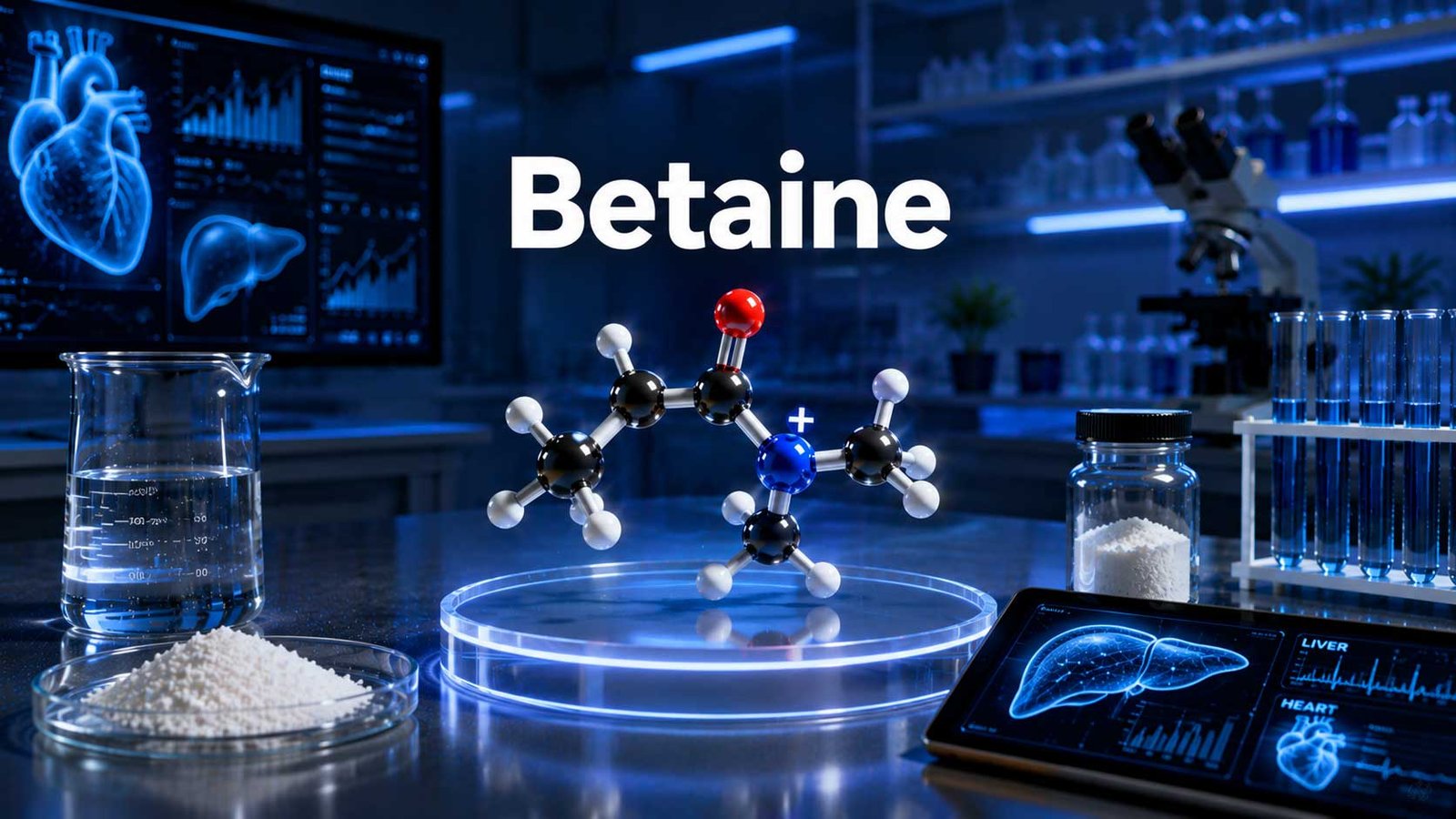
The Quiet Molecule Your Liver Has Been Waiting For
If you’ve spent any time digging through supplement forums or nutrition research, you’ve probably run into betaine at some point, usually tucked into a conversation about homocysteine, fatty liver, or gym performance. And yet, for something so widely discussed in scientific circles, betaine remains oddly under the radar in mainstream nutrition talk. That’s a shame, honestly, because this little compound does some genuinely important work behind the scenes.
Betaine, also known as trimethylglycine or TMG, is not some exotic import from a rainforest or a lab-engineered molecule dreamed up by a supplement company trying to invent the next big thing. It’s a naturally occurring substance found in your own body and in foods you’ve probably eaten this week without thinking twice, beets, spinach, quinoa, whole wheat. The name itself gives away its origin story. Betaine was first isolated from sugar beets in the nineteenth century, hence the name, and it took scientists a good while longer to figure out just how many jobs this molecule was quietly doing inside us.
Table of Contents


Chemically speaking, betaine is glycine, the simplest amino acid, dressed up with three extra methyl groups attached to its nitrogen atom. That structural quirk is what makes betaine so useful. Those methyl groups aren’t just decoration. They’re currency. Your body runs on methylation reactions constantly, for DNA maintenance, neurotransmitter production, detoxification, you name it, and betaine is one of the primary donors that keeps that currency flowing.
Here’s where it gets interesting for anyone paying attention to heart and liver health specifically. Betaine plays a starring role in what’s called the methionine cycle, a metabolic pathway responsible for converting homocysteine, an amino acid byproduct that becomes troublesome in excess, back into methionine. Elevated homocysteine has been associated with increased cardiovascular risk for decades now, and betaine is one of the body’s chief tools for keeping those levels in check. At the same time, in the liver, betaine acts almost like a bodyguard for fat metabolism, helping prevent the kind of lipid buildup that characterizes non-alcoholic fatty liver disease, or NAFLD, a condition that’s become disturbingly common worldwide.
I want to be upfront about something before we go further: betaine is not a miracle cure, and anyone telling you it single-handedly reverses liver disease or eliminates heart risk is oversimplifying a genuinely complex picture. The research is promising in specific areas and mixed or inconclusive in others, particularly around cholesterol effects at higher doses, which we’ll get into later. What betaine does have going for it is a strong mechanistic story backed by decades of biochemistry, plus a growing pile of human trials that, taken together, paint a picture of a nutrient worth understanding, even if it’s not worth obsessing over.
There’s also a practical, almost old-fashioned charm to betaine that I appreciate. Unlike a lot of trendy compounds that require complicated extraction processes or come from obscure botanical sources, betaine is sitting right there in your grocery store. A plate of sautéed spinach, a bowl of quinoa, a beet salad, these aren’t superfoods marketed with flashy labels. They’re humble, everyday foods that happen to be quietly loaded with one of the more functionally important nutrients in human metabolism. That accessibility is part of what makes betaine worth learning about. You don’t need a prescription or an expensive subscription box to start benefiting from it, though, as we’ll discuss, supplementation does have its place for certain goals and certain people.
So where does that leave us? Betaine sits at this interesting intersection of ancient dietary wisdom and modern biochemistry. Farmers have been growing beets and eating leafy greens for centuries without knowing a thing about methionine cycles or homocysteine remethylation. Meanwhile, researchers in white coats have spent the last several decades mapping out exactly why those foods matter at a molecular level. The rest of this article is going to walk through what betaine actually does for your heart and liver, where you can find it in your diet, how much you might reasonably need, and what the real risks look like when people push the dose too high. No hype, no fear-mongering, just a clear-eyed look at a nutrient that deserves more attention than it usually gets.
Key Health Benefits of Betaine for Heart and Liver Function
Let’s get into the substance of what betaine actually does, because the mechanisms here are genuinely fascinating once you dig past the marketing copy.
Homocysteine Regulation and Cardiovascular Support
The single most well-documented role of betaine is its function as a methyl donor in the remethylation of homocysteine back into methionine. This happens primarily in the liver and kidneys, through an enzyme called betaine-homocysteine methyltransferase, or BHMT for short. Think of homocysteine as a kind of metabolic exhaust, a byproduct that accumulates when your body processes methionine from dietary protein. In small amounts, that’s completely normal. But when homocysteine builds up beyond a healthy range, a state called hyperhomocysteinemia, it’s been linked in observational research to a higher risk of cardiovascular events, damage to the vascular lining, and oxidative stress.
Betaine offers your body an alternative pathway to clear that homocysteine, separate from the folate and vitamin B12 dependent pathway most people are more familiar with. A meta-analysis of randomized trials found that betaine supplementation reliably lowers plasma homocysteine in healthy adults, and this effect shows up fairly consistently across the research, even when other cardiovascular markers don’t move as dramatically.
That last part matters, and I don’t want to gloss over it. Lowering homocysteine is not the same thing as proving reduced heart attack or stroke risk. The relationship between homocysteine and actual cardiovascular events is still debated among researchers, some large trials using folate and B vitamins to lower homocysteine haven’t shown the dramatic reductions in heart disease outcomes that early observational data suggested they might. Betaine hasn’t been tested at that same outcome-level scale. What we do know is that betaine reliably does its one job, shuttling methyl groups to homocysteine, quite effectively.
The Cholesterol Complication
Here’s where I’ll push back a little on the more enthusiastic corners of the wellness internet. Several controlled trials and at least one systematic review and meta-analysis have found that betaine supplementation, particularly at higher doses around four grams per day or more, can produce a modest increase in total cholesterol and sometimes LDL cholesterol. This isn’t a universal finding across every study, and the increases reported tend to be modest rather than dramatic, but it’s a real enough pattern that researchers have flagged it repeatedly.
Why would a compound that helps your cardiovascular system in one way potentially work against it in another? The honest answer is that nobody has fully nailed down the mechanism. Some researchers point to betaine’s role in increasing very-low-density lipoprotein production in the liver as part of normal lipid transport, others suggest it may relate to changes in choline metabolism given how tightly linked the two compounds are. Whatever the mechanism, this is a legitimate reason to avoid casually mega-dosing betaine supplements without any oversight, especially if you already have elevated cholesterol or a personal or family history of cardiovascular disease.
Liver Fat Metabolism and NAFLD
Now for the liver side of things, which is arguably where betaine has generated the most excitement in recent years. Non-alcoholic fatty liver disease affects an enormous share of adults globally, driven largely by diets high in refined carbohydrates and sedentary lifestyles, and it can progress toward more serious conditions like steatohepatitis, fibrosis, and eventually cirrhosis if left unaddressed.
Betaine appears to support liver fat metabolism through a few overlapping mechanisms. As a methyl donor, it helps maintain adequate levels of S-adenosylmethionine, a compound essential for the synthesis of phosphatidylcholine, which the liver needs to properly package and export fat as part of very-low-density lipoprotein particles. When methylation capacity runs low, fat tends to accumulate inside liver cells instead of being shipped out, which is one of the driving mechanisms behind fatty liver disease in the first place.
A randomized, placebo-controlled trial in patients with NAFLD found that high-dose betaine supplementation over several months led to measurable improvements in liver histology and reductions in hepatic steatosis compared to placebo, though it’s worth noting the doses used in that kind of research tend to be well above what you’d get from diet alone, and results across different trials haven’t been perfectly consistent. Animal studies have shown more uniformly positive effects, with betaine reducing fat accumulation, decreasing inflammatory markers, and increasing autophagy, the cellular cleanup process, in liver tissue under various models of induced liver stress.
Antioxidant and Anti-Inflammatory Activity
Beyond its methyl-donating duties, betaine appears to have modest antioxidant properties, both directly, by potentially scavenging reactive oxygen species, and indirectly, by supporting the production of glutathione, one of the body’s central antioxidant molecules, through its role in sulfur amino acid metabolism. Chronic low-grade inflammation is a common thread running through both cardiovascular disease and liver dysfunction, so any compound that helps dampen that inflammatory tone earns a reasonable amount of research interest.
Cellular Protection as an Osmolyte
One role that rarely gets mentioned outside of academic papers is betaine’s function as an organic osmolyte. This means it helps cells, particularly in the kidney, liver, and gut, maintain proper hydration and structural integrity under stress conditions like dehydration, heat, or high salt concentrations. It essentially acts as a molecular shock absorber, protecting proteins from denaturing and helping cells hold onto water where they need it. This isn’t directly a “heart and liver” benefit in the way homocysteine regulation is, but it does contribute to the overall resilience of the very organs we’re discussing, particularly the liver and kidneys, which handle a disproportionate share of your body’s metabolic workload.
Put all of this together and you get a nutrient with a genuinely multifaceted profile. It’s not flashy, it’s not going to transform your health overnight, but the accumulated evidence across mechanism studies, animal research, and a handful of solid human trials suggests betaine deserves a place in the conversation about metabolic and cardiovascular wellness, provided you approach the dosing with a bit of common sense, which we’ll cover shortly.
Dietary Sources of Betaine
One of the more reassuring things about betaine is that you don’t need to hunt down obscure ingredients to get a meaningful amount into your diet. It’s distributed fairly widely across common foods, though the concentration varies enormously depending on what you’re eating and how you prepare it.
Grains, the Unsung Champion
If there’s one category that dominates betaine intake for most people eating a Western-style diet, it’s grains, particularly whole grains. Wheat bran and wheat germ are consistently reported as among the richest sources of betaine of any food, often containing well over a thousand micrograms per gram of dry weight. Whole wheat flour, wholegrain bread, and wholegrain pasta all carry substantially more betaine than their refined counterparts, sometimes two to four times as much, because milling strips away the bran and germ layers where betaine concentrates.
Quinoa deserves a specific mention here too. As a pseudocereal, it’s not technically a grain, but it behaves like one in the kitchen and turns out to be an excellent betaine source, rivaling or even exceeding wheat bran in some analyses. Amaranth, another pseudocereal gaining popularity in health food circles, shows similarly high concentrations. If you’re already leaning toward whole grains and ancient grains for general health reasons, you’re likely getting a solid betaine intake without even trying.
Vegetables: Beets and Spinach Lead the Way
Given that betaine literally takes its name from beets, it should come as no surprise that beetroot is one of the standout vegetable sources. Fresh beets and beet products, including canned beets and beet juice, provide substantial betaine content, and this is part of why beetroot juice has become popular in athletic circles, though the performance benefits attributed to beets are more commonly credited to their nitrate content than their betaine.
Spinach is right up there alongside beets, delivering comparable or even higher betaine levels per serving in some analyses. Other leafy greens like silverbeet, also called Swiss chard, show up with respectable amounts too, though most other common vegetables, think carrots, broccoli, cabbage, contain only trace amounts by comparison.
Seafood and Shellfish
Marine invertebrates in particular concentrate impressive amounts of betaine, functioning as osmolytes for the organisms themselves. Mussels, oysters, clams, and scallops all rank among the higher betaine foods you can eat, sometimes reaching several thousand micrograms per gram. Fish generally contain more moderate amounts, with some variation depending on species; monkfish, for instance, shows notably higher levels than something like tuna or salmon.
A Practical Note on Cooking Losses
Here’s something that trips people up: betaine is highly water-soluble, which means boiling can strip a substantial portion of it right out of your food and into the cooking water. Some research estimates that boiling can cause a loss of anywhere from sixty to eighty percent of a food’s betaine content. If you’re specifically trying to maximize betaine intake through diet, steaming, roasting, sautéing, or eating vegetables raw preserves considerably more than boiling does. Cooking pasta is a good example too, cooked pasta shows meaningfully lower betaine content than the uncooked product, simply because a chunk of it leaches into the pot.
A quick, practical list of betaine-friendly choices:
- Raw or lightly sautéed spinach rather than boiled
- Roasted or raw beets instead of boiled beetroot
- Wholegrain breads, pastas, and cereals over refined versions
- Quinoa and amaranth as regular grain substitutes
- Shellfish like mussels, scallops, and oysters when seafood is on the menu
- Wheat bran stirred into oatmeal or baked goods for a concentrated boost
Typical Intake Levels
Estimates of average daily betaine intake vary depending on the population studied and dietary pattern, but figures in the range of roughly one hundred to a few hundred milligrams per day are common for people eating a fairly typical Western diet, with those who regularly eat whole grains, seafood, and leafy greens landing toward the higher end, sometimes reaching a gram or more daily. Diets low in whole grains and heavy on refined carbohydrates tend to fall well short of that. This variability is exactly why some people turn to supplements when they’re specifically targeting therapeutic homocysteine or liver-related goals, since reliably hitting several grams a day through food alone requires a fairly deliberate and grain-heavy eating pattern that not everyone finds practical or appealing.
It’s also worth remembering that your body doesn’t rely purely on dietary betaine. It can synthesize betaine internally from choline, another nutrient found in eggs, liver, and soybeans, through a two-step oxidation process that happens mainly in the liver and kidneys. This internal production isn’t usually enough to cover the body’s full needs on its own, which is part of why dietary intake, from either betaine-rich or choline-rich foods, still matters quite a bit.
Betaine Dosage and Deficiency Considerations
Because betaine isn’t classified as an essential nutrient the way vitamin C or certain amino acids are, there’s no official recommended daily allowance in the way you’d find for something like iron or vitamin D. That said, researchers and clinicians have developed a reasonably clear picture of what different dose ranges tend to accomplish, based on both dietary intake studies and clinical trials.
Dietary Intake Ranges
As mentioned, typical dietary betaine intake sits somewhere in the neighborhood of a few hundred milligrams to around one to two grams daily for people eating varied diets rich in whole grains and vegetables. This baseline level appears to be adequate for general metabolic function in most healthy people, particularly when combined with sufficient folate and B12 status, since these nutrients work along a parallel pathway for homocysteine clearance.
Supplemental Doses Used in Research
When researchers move into supplementation territory, meaning doses beyond what typical food intake provides, the numbers climb considerably higher than what you’d get from even a betaine-heavy meal plan. Studies targeting homocysteine reduction in healthy adults have generally used doses in the range of about two to six grams per day, with several grams often needed to produce a measurable, consistent drop in homocysteine levels. Trials investigating athletic performance and body composition have tended to use somewhat lower doses, often in the neighborhood of one and a half to two and a half grams daily.
On the medical side, betaine is used at much higher, carefully controlled doses for an entirely different purpose: treating homocystinuria, a rare genetic disorder in which the body cannot properly process homocysteine due to enzyme deficiencies. In that context, prescription-grade betaine anhydrous is administered under close physician supervision, often at doses considerably higher than anything used in general wellness supplementation, because the clinical goal there is fundamentally different, correcting a serious metabolic disorder rather than nudging a healthy system in a favorable direction.
I’d gently steer you away from assuming that “more is better” here. Given the cholesterol-related concerns discussed earlier, doses at the higher end of the research range, generally four grams a day and up, come with a greater likelihood of measurable increases in total cholesterol. If you’re considering supplementation for general cardiovascular or liver support rather than addressing a diagnosed medical condition, working with more moderate doses and monitoring your lipid panel periodically is a far more sensible approach than reaching straight for the highest dose you can find on a supplement label.
Signs of Inadequate Betaine Status
True “betaine deficiency” in the classic sense, the way we talk about a vitamin deficiency, isn’t really a recognized clinical entity for otherwise healthy people, largely because your body can synthesize betaine from choline when dietary intake runs low. That said, chronically low betaine and choline status, particularly when paired with inadequate folate and B12 intake, has been associated in research with elevated homocysteine levels and disrupted methylation capacity more broadly. People eating heavily processed diets low in whole grains, vegetables, and seafood are more likely to fall into this lower range, even if it doesn’t manifest as an obvious, easily diagnosed deficiency syndrome.
Certain populations may have elevated needs or benefit more noticeably from attention to betaine status. This includes people with genetic variants affecting the MTHFR enzyme, which is involved in the alternative folate-dependent pathway for homocysteine clearance, individuals with kidney disease, where betaine levels tend to run low and are associated with worse outcomes, and people with existing liver conditions, where the demand for methyl donors to support fat metabolism may be elevated. None of this is a call to self-diagnose or start supplementing aggressively based on assumptions, it’s simply useful context for understanding who researchers tend to focus on when studying betaine’s clinical relevance.
A Word on Individual Variation
As with most nutrients involved in methylation, individual genetics play a real role in how much betaine someone might benefit from. People with certain MTHFR polymorphisms, for example, may rely more heavily on the betaine-dependent pathway for homocysteine remethylation because their folate-dependent pathway runs less efficiently. This is part of why blanket dosing recommendations don’t fit everyone equally well, and why anyone considering betaine supplementation for a specific health concern, rather than just general dietary adequacy, is generally better served discussing it with a knowledgeable healthcare provider who can look at their actual homocysteine levels, lipid panel, and relevant genetic factors before landing on a dose.
Toxicity and Risks Associated with Betaine
For the most part, betaine has a favorable safety profile. It’s classified as Generally Recognized as Safe in the United States, and it has regulatory approval for use in food within the European Union as well. That said, “generally safe” doesn’t mean “risk-free at any dose,” and there are several considerations worth understanding before you start treating betaine supplements like candy.
The Cholesterol Question, Revisited
I brought this up earlier, but it deserves a fuller treatment here because it’s genuinely the most consistently reported concern in the human research. Multiple systematic reviews and meta-analyses examining betaine supplementation, particularly at doses of four grams daily or higher, have found modest but statistically meaningful increases in total cholesterol, and in some cases LDL cholesterol as well. This effect doesn’t show up in every single trial, and the magnitude tends to be moderate rather than severe, but the pattern is consistent enough that researchers routinely flag it as a caveat.
For someone with already elevated cholesterol, existing cardiovascular disease, or a strong family history of heart disease, this is a genuinely important consideration before jumping into high-dose betaine supplementation. It doesn’t necessarily mean betaine is off the table entirely, but it does mean any decision to use it at therapeutic doses should probably involve periodic lipid panel monitoring and, ideally, a conversation with a healthcare provider rather than a solo decision based on an enthusiastic product description.
Gastrointestinal Effects
At higher doses, betaine supplements have been associated with digestive discomfort in some users, including nausea, diarrhea, and mild stomach upset. This tends to be dose-dependent, meaning it shows up more at the higher end of supplemental ranges rather than at typical dietary intake levels, and starting with a lower dose and gradually increasing tends to reduce the likelihood of these effects for people who want to experiment with supplementation.
Body Odor
This one sounds minor, but it comes up frequently enough in both anecdotal reports and some clinical literature that it’s worth mentioning. Betaine metabolism can, in some individuals, particularly at higher doses, contribute to a fishy body odor. This relates to trimethylamine metabolism, and it’s worth noting explicitly that people with a rare genetic condition called trimethylaminuria, sometimes called fish odor syndrome, should avoid betaine supplementation altogether, since their bodies cannot properly break down trimethylamine, and betaine can worsen the characteristic odor associated with the condition.
Interactions and Special Populations
People taking medications that influence homocysteine metabolism, lipid levels, or kidney function should be cautious about adding betaine supplements without medical guidance, since the combined effects haven’t been thoroughly mapped out in every scenario. Pregnant and breastfeeding individuals should also approach supplementation cautiously, not necessarily because there’s strong evidence of harm, but because research in these populations remains genuinely limited, and the standard, sensible approach in the absence of good safety data is caution rather than assumption of safety.
People with kidney disease represent another population worth flagging. While low betaine status has been associated with worse outcomes in chronic kidney disease in some research, self-supplementing without medical oversight in the context of impaired kidney function is not something I’d casually recommend, given how central the kidneys are to betaine’s metabolic handling in the body.
The Homocystinuria Exception
It’s worth clarifying the difference between general wellness supplementation and the pharmaceutical use of betaine for homocystinuria. In that medical context, betaine is administered as a prescription product at doses and under monitoring protocols specifically designed for that rare genetic disorder. The safety and dosing considerations there are entirely different from someone picking up an over-the-counter TMG supplement to support general cardiovascular health, and one context shouldn’t be used to draw conclusions about the other.
Quality and Sourcing
Because betaine supplements can come in different forms, most commonly betaine anhydrous, the purified form typically used for cardiovascular and liver-related goals, versus betaine hydrochloride, which is chemically distinct and used primarily as a digestive aid to increase stomach acidity, it’s worth double-checking labels carefully. These two forms serve genuinely different purposes and shouldn’t be used interchangeably based on a vague sense that “betaine is betaine.” Choosing products from manufacturers who provide third-party testing and clear labeling reduces the risk of contamination or mislabeled potency, which, unfortunately, remains a real concern across the broader supplement industry.
None of this is meant to scare you away from betaine altogether. The overall safety profile, especially at moderate doses and especially when it comes from whole foods rather than concentrated supplements, is quite reassuring. But treating any bioactive compound, even a “natural” one your body already produces, with a bit of respect and situational awareness is simply good practice, and betaine is no exception to that rule.
Putting Betaine in Its Rightful Place
So, where does all of this leave us? Betaine isn’t a wonder nutrient, and it’s certainly not going to headline a health transformation story on its own. But dismissing it would be a mistake too. It’s a genuinely functional compound with a well-mapped biochemical role in two of the body’s most consequential systems, cardiovascular health through homocysteine regulation, and liver health through fat metabolism and methylation support. That’s not nothing. In a supplement landscape crowded with compounds riding on hype rather than mechanism, betaine’s case is built on decades of steady, unglamorous biochemistry.
What I’d encourage you to take away from this isn’t a rush to order the highest-dose TMG supplement you can find. It’s more of an invitation to look at your plate differently. That spinach salad, that bowl of quinoa, that beet you’ve been avoiding because you’re not quite sure what to do with it, these aren’t just filler ingredients. They’re delivering a compound your liver and cardiovascular system genuinely use, quietly, every single day, without asking for credit.
If you’re dealing with a specific concern, elevated homocysteine that’s shown up on a lab test, a fatty liver diagnosis, or a family history that has you thinking more seriously about prevention, betaine is a reasonable thing to bring up with a healthcare provider, alongside the broader picture of your diet, your folate and B12 status, and your existing lipid profile. It’s not a substitute for medical care, and it’s definitely not a free pass to ignore other lifestyle factors like alcohol intake, physical activity, or overall dietary pattern, all of which matter enormously for both heart and liver health.
For most people without a specific diagnosed concern, the simplest and most sustainable path is dietary. Lean into whole grains instead of refined ones, keep spinach and beets in regular rotation, don’t boil the betaine out of your vegetables if you can help it, and let your body do what it’s been doing since long before anyone had a name for trimethylglycine. Supplementation has its place for targeted goals, but it works best as a considered decision rather than a reflexive one, especially given the cholesterol caveat that keeps showing up in the higher-dose research.
Betaine’s story, in the end, is a good reminder that not every nutrient worth understanding needs to be exotic or expensive to be genuinely important. Sometimes the most useful molecules are the ones that have been sitting in your grocery cart the whole time, waiting for someone to actually explain what they’re doing once they get inside you.
Article Sources
At AncientHerbsWisdom, our content relies on reputable sources, including peer-reviewed studies, to substantiate the information presented in our articles. Our primary objective is to ensure our content is thoroughly fact-checked, maintaining a commitment to accuracy, reliability, and trustworthiness.
- Abdelmalek, M. F., Sanderson, S. O., Angulo, P., Soldevila-Pico, C., Liu, C., Peter, J., Keach, J., Cave, M., Chen, T., McClain, C. J., & Lindor, K. D. (2009). Betaine for nonalcoholic fatty liver disease: Results of a randomized placebo-controlled trial. Hepatology, 50(6), 1818-1826. https://doi.org/10.1002/hep.23239
- Arumugam, M. K., Paal, M. C., Donohue, T. M., Jr., Ganesan, M., Osna, N. A., & Kharbanda, K. K. (2021). Beneficial effects of betaine: A comprehensive review. Biology, 10(6), 456. https://doi.org/10.3390/biology10060456
- Ashtary-Larky, D., Bagheri, R., Ghanavati, M., Asbaghi, O., Tinsley, G. M., Mombaini, D., & Wong, A. (2022). Effects of betaine supplementation on cardiovascular markers: A systematic review and meta-analysis. Critical Reviews in Food Science and Nutrition, 62(23), 6516-6533. https://doi.org/10.1080/10408398.2021.1902938
- Cholewa, J. M., Guimarães-Ferreira, L., & Zanchi, N. E. (2014). Effects of betaine on performance and body composition: A review of recent findings and potential mechanisms. Amino Acids, 46(8), 1785-1793. https://doi.org/10.1007/s00726-014-1748-5
- Craig, S. A. S. (2004). Betaine in human nutrition. American Journal of Clinical Nutrition, 80(3), 539-549. https://doi.org/10.1093/ajcn/80.3.539
- Dobrijević, D., Pastor, K., Nastić, N., Özogul, F., Krulj, J., Kokić, B., Bartkiene, E., Rocha, J. M., & Kojić, J. (2023). Betaine as a functional ingredient: Metabolism, health-promoting attributes, food sources, applications and analysis methods. Molecules, 28(12), 4824. https://doi.org/10.3390/molecules28124824
- McRae, M. P. (2013). Betaine supplementation decreases plasma homocysteine in healthy adult participants: A meta-analysis. Journal of Chiropractic Medicine, 12(1), 20-25. https://doi.org/10.1016/j.jcm.2012.11.001
- Schwahn, B. C., Hafner, D., Hohlfeld, T., Balkenhol, N., Laryea, M. D., & Wendel, U. (2003). Pharmacokinetics of oral betaine in healthy subjects and patients with homocystinuria. British Journal of Clinical Pharmacology, 55(1), 6-13. https://doi.org/10.1046/j.1365-2125.2003.01717.x
- Truitt, C., Hoff, W. D., & Deole, R. (2021). Health functionalities of betaine in patients with homocystinuria. Frontiers in Nutrition, 8, 690359. https://doi.org/10.3389/fnut.2021.690359
- Zawieja, E. E., Zawieja, B., & Chmurzynska, A. (2021). Betaine supplementation moderately increases total cholesterol levels: A systematic review and meta-analysis. Journal of Dietary Supplements, 18(1), 105-117. https://doi.org/10.1080/19390211.2019.1699223

- Phosphatidic Acid: Supporting Muscle Growth and Strength - July 31, 2026
- Ceramides: Supporting Healthy Skin From Within - July 31, 2026
- Synbiotics: Combining Prebiotics and Probiotics Together - July 31, 2026