
The Amino Acid Nobody Talks About (But Maybe Should)
If you’ve spent any time reading about amino acids, you’ve probably run into the usual suspects. Leucine gets all the attention from the muscle-building crowd. Tryptophan has its whole “sleepy turkey” mythology. Glutamine shows up in every gut-health conversation. And then there’s ornithine, sitting quietly in the background, doing a job that’s arguably more fundamental than any of them, and almost nobody brings it up at dinner.
Here’s the thing about ornithine: it’s not even one of the twenty standard amino acids your body uses to build proteins. It’s what’s called a non-proteinogenic amino acid, which is a fancy way of saying it doesn’t get stitched into the muscle fibers or enzymes you’re familiar with. Instead, it works behind the scenes in a process called the urea cycle, essentially your body’s built-in ammonia disposal system. Every time you eat protein, your body breaks those proteins down into amino acids, and one of the byproducts of that breakdown is ammonia. Ammonia is toxic. Left unchecked, it builds up in the bloodstream and starts causing real problems, particularly for the brain and nervous system. Ornithine is one of the key players that converts that ammonia into urea, which then gets flushed out through your kidneys.
Table of Contents


I remember the first time this concept really clicked for me. I was reading through some older exercise physiology literature and came across the idea that intense exercise itself generates a measurable spike in blood ammonia. That’s not something people talk about at the gym. Everyone’s obsessed with lactate and delayed-onset soreness, but there’s this quieter metabolic stress happening too, and ornithine sits right at the center of managing it.
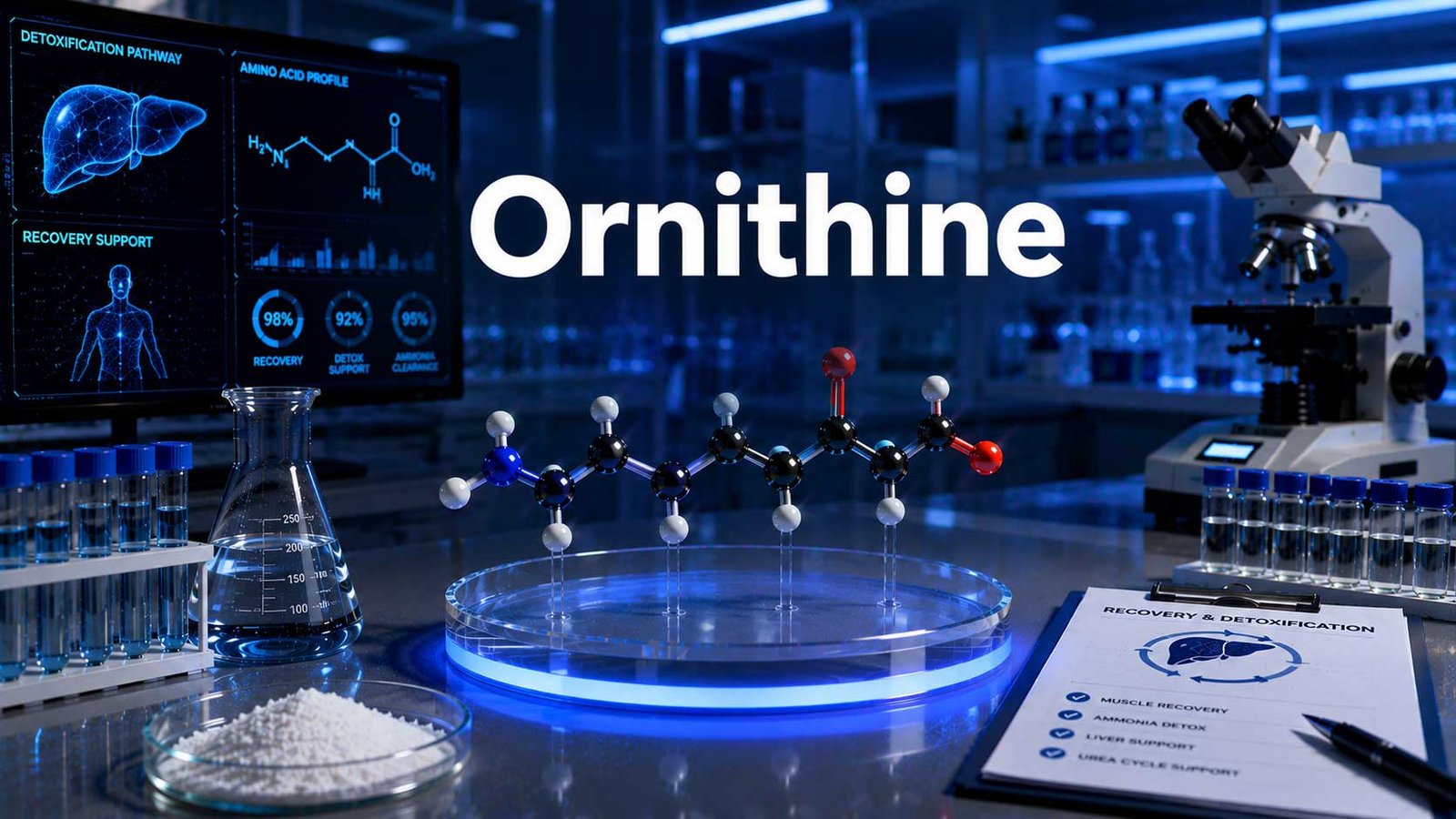
So what does that mean for recovery and detoxification, the two words sitting right there in the title? Recovery, in this context, isn’t just about sore muscles feeling better by Thursday. It’s about how efficiently your body clears the metabolic waste that builds up from physical exertion, illness, or even just the normal wear and tear of being alive. Detoxification, likewise, isn’t the pseudoscientific juice-cleanse version of the word. It’s the actual, unglamorous biochemistry of turning a neurotoxic compound into something your kidneys can handle.
Your liver produces ornithine on its own, mostly by converting another amino acid, arginine, through an enzyme called arginase. Because of this, true ornithine deficiency in healthy people is genuinely rare. But “rare” isn’t the same as “irrelevant,” and there are specific situations, illness, intense training blocks, poor dietary variety, where the body’s demand for ornithine can outpace what it’s naturally producing or getting from food. That gap is where a lot of the interest in ornithine supplementation comes from, particularly among endurance athletes and people managing chronic fatigue.
There’s also a structural role worth mentioning briefly, since it tends to get lost in the recovery-and-detox conversation. Ornithine is a precursor to polyamines, compounds involved in cell growth and tissue repair, and it also feeds into the production of proline, which your body uses to build collagen. So even outside the urea cycle, this amino acid is quietly involved in how your tissues rebuild themselves after damage. That’s not a minor side note. If you’ve ever wondered why some supplement companies pair ornithine with wound-healing or skin-health claims, this is the biochemical thread they’re pulling on.
I want to be upfront about something before we go further: the research on ornithine is real, but it’s not enormous. We’re not talking about vitamin D or omega-3 fatty acids, where you’ve got thousands of studies to draw from. Ornithine research is a smaller, more specialized field, much of it coming out of Japan, where interest in amino acid supplementation for fatigue and stress has a longer history than it does in Western sports nutrition circles. That doesn’t make the findings less legitimate, but it does mean I’ll be careful throughout this piece to represent what the studies actually show rather than stretching them into broader claims.
What I find genuinely compelling about ornithine is how it sits at this intersection of two things people care about deeply but rarely connect: physical recovery and internal detoxification. Most of us think about these as separate categories. You’ve got your recovery routine, foam rolling, stretching, maybe an ice bath if you’re feeling ambitious, and then you’ve got your detox routine, which for a lot of people means expensive juice or a supplement with a green label. Ornithine doesn’t fit neatly into either bucket because it’s actually doing both jobs simultaneously, at the biochemical level, whether you’re paying attention to it or not.
Over the next several sections, I’m going to walk through what the actual science says about ornithine’s health benefits, where you can get it from food, how much people typically use when supplementing, and what happens when things go wrong, either from too little or, in rare genetic cases, too much. My goal isn’t to convince you that ornithine is some miracle compound you’ve been missing out on. It’s to give you a clear, honest picture of what this amino acid does, backed by the research that actually exists, so you can decide for yourself whether it deserves a spot in your routine.
Key Health Benefits
Let’s get into what ornithine actually does inside the body, because this is where things get interesting, and also where I think a lot of supplement marketing tends to oversimplify.
Supporting the Urea Cycle and Ammonia Clearance
This is ornithine’s home turf, so it makes sense to start here. The urea cycle is a five-step biochemical loop that happens primarily in the liver, and ornithine is both the starting point and the ending point of that loop. Ammonia, generated from protein breakdown, combines with carbon dioxide to form a compound that eventually reacts with ornithine to produce citrulline. Citrulline then goes on to become arginine, and arginine gets broken back down into urea and, you guessed it, ornithine again. It’s a closed loop, which is honestly a pretty elegant piece of biochemistry when you sit with it for a minute.
Why does this matter for you, practically speaking? Ammonia is genuinely dangerous to the central nervous system when it accumulates. This isn’t a marketing claim, it’s basic clinical toxicology. People with impaired urea cycle function, whether from liver disease or rare genetic enzyme deficiencies, experience confusion, lethargy, and in severe cases, coma, precisely because ammonia isn’t being cleared properly. Most healthy people never think about this because their urea cycle handles the job invisibly, but supporting that pathway with adequate ornithine availability is, quite literally, supporting your body’s core detoxification machinery.
Physical Fatigue and Exercise Recovery
This is probably the most researched application of ornithine supplementation, and it’s genuinely interesting. A double-blind, placebo-controlled crossover study published in Nutrition Research had healthy volunteers take either L-ornithine or a placebo before undergoing a two-hour fatigue-inducing cycling protocol. he researchers found that oral l-ornithine administration promoted lipid metabolism and activated the urea cycle, evidenced by changes in serum triacylglycerol, ketone bodies, free fatty acids, and blood ammonia levels. More notably, participants receiving ornithine reported significantly less subjective fatigue during recovery compared to when they took the placebo.
What I appreciate about this study is that the researchers didn’t just measure how people felt, they also looked at actual physical performance. In female participants specifically, the decline in maximum pedaling speed over the course of the trial was smaller in the ornithine group compared to placebo. The proposed mechanism is that ornithine helps the body use fat for energy more efficiently while simultaneously clearing the ammonia that exercise generates, essentially attacking fatigue from two angles at once.
One caveat worth mentioning, because I think it’s genuinely useful information rather than a footnote: the researchers noted that ornithine is a free amino acid that isn’t particularly abundant in meats or fish, making it difficult to get fatigue-fighting amounts through diet alone. That’s part of why this particular benefit tends to be discussed in the context of supplementation rather than food.
Stress Response and Sleep Quality
Here’s a benefit that surprised me when I first came across it, because it’s not the angle most people associate with amino acid supplements. A randomized controlled trial published in Nutrition Journal gave 52 healthy Japanese adults, all of whom reported some baseline stress and fatigue, either 400 milligrams of L-ornithine daily or a placebo for eight weeks. The results showed that serum cortisol levels and the cortisol-to-DHEA-S ratio were significantly decreased in the ornithine group compared to placebo, and participants also reported reduced anger and improved sleep quality.
Think about what that actually implies. Cortisol is your primary stress hormone, and a persistently elevated cortisol-to-DHEA-S ratio is generally viewed as a marker of chronic stress burden on the body. The fact that a relatively modest daily dose, 400 milligrams is genuinely small compared to some of the multi-gram doses used in exercise studies, showed measurable hormonal shifts over two months is worth paying attention to.
The sleep piece connects back nicely to the recovery theme running through this whole article. Poor sleep undermines basically every other recovery process your body is trying to run, muscle repair, immune function, cognitive restoration. If ornithine is genuinely nudging stress hormones in a favorable direction and improving perceived sleep quality, that’s a downstream benefit that touches almost everything else on this list.
Growth Hormone and Tissue Repair
You’ll see a lot of bodybuilding forums from the 1990s and early 2000s claiming ornithine spikes growth hormone dramatically. I want to be careful here, because the evidence for this specific claim in humans is thin and somewhat contradictory. Some earlier research suggested oral amino acid combinations, including ornithine and arginine, could stimulate pituitary release of growth hormone, but subsequent, more rigorous trials in trained individuals largely failed to replicate meaningful increases in serum growth hormone from realistic oral doses. I’m not going to pretend this is a settled, robust benefit, because it isn’t.
What’s more solidly grounded is ornithine’s role as a building block for polyamines and proline, both of which are directly involved in cellular growth and collagen synthesis. Collagen is the structural protein your body relies on for skin, connective tissue, and wound repair. So while I’d be cautious about anyone promising you a growth hormone surge from an ornithine capsule, the tissue-repair angle has a more direct and less speculative biochemical basis.
Liver Support in Clinical Settings
I’d be doing this topic a disservice if I didn’t mention that ornithine, often combined with aspartate as L-ornithine L-aspartate, has an established clinical history in managing hyperammonemia associated with liver disease, particularly hepatic encephalopathy. This is a distinct use case from general wellness supplementation, and it typically involves medical supervision and different dosing than what you’d find in an over-the-counter recovery supplement. I bring it up because it reinforces the underlying theme of this whole section: ornithine’s core value proposition is ammonia management, whether that’s happening in a hospital setting for someone with compromised liver function, or in a much subtler, everyday way for someone recovering from a hard training block.
Dietary Sources
Given how central ornithine is to the urea cycle, you might expect it to be splashed across every “top amino acid foods” list out there. It isn’t, and there’s a good reason for that.
Why Ornithine Is Different From Other Amino Acids
Most of the amino acids people track through diet, things like leucine, lysine, or tryptophan, are proteinogenic, meaning they’re directly incorporated into the protein structures found in food. When you eat a chicken breast, you’re getting those amino acids as part of the protein matrix itself. Ornithine doesn’t work that way. Because it’s not used to build proteins, it exists in food in much smaller free-form quantities, and a meaningful portion of your body’s ornithine supply comes from internal conversion of arginine rather than direct dietary intake.
This distinction matters practically. It’s part of why researchers studying ornithine’s fatigue-fighting effects specifically noted that it’s difficult to get meaningful amounts from ordinary meals, even meals that are technically high in protein. You’re not going to “eat your way” to the doses used in most clinical trials, and that’s worth knowing before you go rearranging your grocery list around this one amino acid.
Where Ornithine and Its Precursors Actually Show Up
That said, dietary intake isn’t irrelevant, it’s just indirect in an important way. Since your liver makes ornithine primarily from arginine, foods rich in arginine effectively support your body’s own ornithine production. Here’s how I’d break down the practical food sources:
- Animal proteins – Meat, poultry, fish, eggs, and dairy products are generally considered the richest dietary contributors, both because of small amounts of free ornithine and because they’re excellent arginine sources.
- Shellfish and certain seafoods – Some research has specifically looked at bivalves and shellfish extracts as concentrated sources of free ornithine, though this isn’t something most people are eating in meaningful quantities day to day.
- Legumes and soy – Soybeans in particular are a solid plant-based arginine source, useful if you’re leaning vegetarian or trying to diversify beyond animal protein.
- Nuts and seeds – Peanuts and sesame seeds show up frequently in arginine-focused nutrition discussions, making them a reasonable snack-level contributor.
- Grains – Oats and wheat contain modest amounts and are worth mentioning simply because they’re such a staple in most diets, even if they’re not a concentrated source.
I want to be honest about something here: precise, well-documented values for free ornithine content across common foods are harder to pin down than you’d expect. Nutrition databases are far more thorough for the standard proteinogenic amino acids than for something like ornithine, which sits slightly outside the mainstream of dietary research. So take the food list above as a directionally useful guide rather than a precise intake calculator.
The Case for Whole-Diet Protein Adequacy
Here’s my honest take after digging through this research: for the vast majority of healthy people, worrying about ornithine specifically in your diet is probably misplaced effort. What actually matters is overall protein adequacy. If you’re eating enough total protein, and that protein is coming from a reasonably varied mix of sources, your liver has what it needs to manufacture ornithine on demand. This isn’t like omega-3 fatty acids, where your body genuinely cannot synthesize what it needs and dietary intake becomes non-negotiable. Ornithine sits in a different category, one where the body’s own production usually covers the baseline requirement just fine.
Where this shifts is under conditions of elevated demand: intense or prolonged exercise, illness, recovery from surgery or trauma, or periods of inadequate overall protein intake. In those situations, the gap between what your body needs and what it can produce or extract from a typical diet may widen, and this is exactly the population most of the supplementation research has focused on.
A Quick Word on Supplement Forms
Since dietary intake alone rarely matches research-level doses, most people interested in ornithine specifically for recovery or fatigue purposes end up looking at supplements rather than food. You’ll typically see it sold as L-ornithine hydrochloride, and sometimes combined with arginine or aspartate. I’m not going to recommend a specific product here, that’s not really the point of this section, but it’s worth knowing that the form used in most of the research discussed earlier in this article is the free-form L-ornithine or its hydrochloride salt, not some proprietary blend.
How Cooking and Processing Affect Ornithine Content
One thing that rarely gets mentioned in supplement blogs is how food preparation actually changes free amino acid content, ornithine included. Some research looking at shellfish extracts found that processing conditions, particularly temperature during extraction or cooking, noticeably shifted the measurable ornithine content of the final product. That’s a small, somewhat niche finding, but it points to a broader truth that applies across nutrition generally: the nutrient value listed on a chart isn’t always what ends up on your plate after cooking, storage, and processing have had their say. If you’re the kind of person who tracks this stuff closely, it’s worth remembering that raw nutritional databases are a starting point, not gospel.
Should You Actually Try to Eat More Ornithine-Rich Foods?
Honestly, I think this is the wrong question for most people to be asking. Chasing ornithine specifically through food selection is a bit like trying to optimize your vitamin K2 intake through sheer force of will, technically possible, but not particularly efficient given how the nutrient is distributed and how modest food-based amounts tend to be relative to what’s used in clinical research. A more useful frame is this: eat a genuinely varied, adequate-protein diet, one that includes some combination of animal protein, legumes, and whole grains, and trust that your liver’s own arginine-to-ornithine conversion machinery will handle the baseline requirement.
Where food choices become more relevant is in the context of recovery from illness, surgery, or heavy training blocks, situations where overall protein and amino acid turnover increases substantially. In those windows, leaning a little harder into complete protein sources, the meat, fish, eggs, and soy I mentioned earlier, isn’t really about chasing ornithine specifically. It’s about giving your body the broader raw material it needs to keep up with elevated metabolic demand, ornithine production included. That’s a more honest and more useful way to think about the food side of this equation than treating any single ingredient as a magic ornithine delivery vehicle.
I’ll also add, because it’s easy to overlook: hydration status and overall kidney function play a quiet supporting role here too. Urea, the end product of the cycle ornithine helps run, needs adequate fluid intake to be efficiently excreted. You can have all the ornithine in the world doing its job upstream, but if the downstream plumbing isn’t well supported, you’re not getting the full benefit of that metabolic effort. It’s a small, practical reminder that no single compound operates in isolation from the rest of your physiology.
Dosage & Deficiency
This is probably the section people skip to first, so let’s get into the actual numbers, along with some necessary context around them.
What the Research Actually Used
Dosing in ornithine studies varies quite a bit depending on what outcome researchers were chasing. On the lower end, the stress and sleep quality trial used just 400 milligrams per day over eight weeks and still found measurable hormonal changes. That’s a notably modest amount compared to what shows up in exercise-focused research.
For fatigue and physical performance, the crossover study I mentioned earlier used 2,000 milligrams daily for seven days, followed by a single higher dose of 6,000 milligrams on the eighth day, timed around the fatigue-inducing exercise protocol. This step-up approach, moderate daily dosing with an acute higher dose around a specific physical demand, seems to reflect how a lot of sports nutrition researchers think about amino acid timing generally.
Broader clinical and safety literature tends to describe a wider range. General references on ornithine typically cite human research using somewhere between 5 and 10 grams per day, occasionally combined with arginine, for various fatigue and metabolic outcomes. A subchronic tolerance study examining graded oral doses of ornithine hydrochloride in healthy adults found that ornithine did not produce significant effects on mental fatigue or sleep quality at any of the doses tested, which is a useful reminder that not every study lines up neatly with the more promising findings elsewhere in the literature. Science rarely does.
So What’s a Reasonable Starting Point?
If I had to summarize the range you’ll see across product labels and research protocols, it typically falls between 1 and 6 grams daily for general use, with the lower end, in the 400 milligram to 2 gram range, more associated with stress and sleep-focused outcomes, and the higher end more associated with exercise recovery and fatigue research. I’d encourage starting conservatively, particularly if you’re new to amino acid supplementation generally, and paying attention to how your digestive system responds before pushing toward the higher end of that range.
It’s worth being straightforward about something: this is a supplement space where dosing guidance is genuinely more art than precise science, at least compared to something like vitamin D, where you’ve got robust dose-response data. The studies exist, but they’re not extensive enough to give you a single, confident, universally applicable number. Talking to a healthcare provider before starting, especially if you have any existing liver or kidney condition, isn’t just boilerplate advice here, it’s genuinely relevant given ornithine’s role in ammonia and nitrogen metabolism.
Deficiency: Genuinely Rare, But Not Impossible
True dietary ornithine deficiency in an otherwise healthy person is uncommon, largely because the body’s own arginine-to-ornithine conversion pathway is fairly robust. That said, there are situations where relative deficiency, or at least reduced availability relative to demand, can become clinically relevant.
Severe malnutrition, significant physical trauma, major surgery, and certain catabolic states can all increase the body’s demand for ornithine beyond what normal dietary intake and endogenous production comfortably supply. Growth periods in children and pregnancy have also been noted as times when ornithine and arginine requirements shift. In these contexts, some clinicians and researchers refer to these as “conditional deficiencies,” meaning the amino acid isn’t intrinsically essential under normal circumstances, but circumstances can change that equation temporarily.
There’s also a much rarer, and considerably more serious, category worth mentioning: genetic enzyme deficiencies affecting the urea cycle itself. Ornithine transcarbamylase deficiency, for instance, is an inherited condition where the enzyme responsible for converting ornithine (combined with carbamoyl phosphate) into citrulline doesn’t function properly. This is actually the most prevalent genetic disorder among urea cycle disorders, characterized by X-linked inheritance with variable severity depending on the individual. This isn’t something you supplement your way out of, it’s a distinct medical condition requiring specialized dietary management and clinical care, and I mention it here purely so the broader urea cycle context makes sense, not as something relevant to typical supplement decisions.
Who Tends to Fall Into the “Increased Need” Category
Beyond the acute situations already mentioned, a few groups show up repeatedly in the research and clinical literature as having elevated ornithine or arginine turnover. Endurance athletes going through heavy training blocks are one obvious example, given how much of the fatigue research centers on exercise-induced ammonia production. People recovering from significant illness or surgical procedures are another, since tissue repair and immune activation both place extra demand on amino acid pools generally, ornithine included. Older adults, too, sometimes show reduced efficiency in various amino acid conversion pathways, though the data here is less specific to ornithine than it is to protein metabolism broadly.
None of this means these groups are walking around in a state of clinical deficiency. It simply means the margin between supply and demand narrows, and that narrowing is part of why researchers have been curious enough to run the trials discussed throughout this article in the first place. If you fall into one of these categories and you’re already eating an adequate, varied diet, you’re probably not in any danger. But it’s a reasonable context in which someone might look at supplementation as a targeted, temporary tool rather than a permanent daily habit.
Practical Takeaways on Dosing
If you’re trying to translate all of this into something actionable, here’s roughly how I’d summarize it:
- For general wellness, stress, and sleep-related goals, doses in the 400 milligram to 2 gram daily range appear in the research showing measurable effects.
- For exercise recovery and fatigue specifically, studies have used doses in the 2 to 6 gram range, sometimes with a higher acute dose timed around intense physical activity.
- Doses above roughly 10 grams daily start showing up more frequently in reports of digestive discomfort, so there’s little reason to push past that threshold without a specific, well-supported reason.
- Consistency over weeks, rather than a single large dose, seems to be how most of the positive findings in this research were actually achieved.
None of these numbers should be treated as rigid prescriptions. They’re a reflection of what’s actually been tested, which is the most honest guidance I can offer without pretending there’s more precision in this field than there really is.
Toxicity & Risks
No honest discussion of any supplement is complete without covering what happens when things go sideways, so let’s talk about it directly.
General Tolerability
The good news, relatively speaking, is that ornithine has a fairly favorable safety profile in the doses typically studied. Research suggests ornithine is possibly safe when used at doses up to 500 milligrams daily for as long as eight weeks, and at doses up to 12 grams daily for shorter four-week periods. That’s a reasonably wide window, and it lines up with what I found across the clinical literature more broadly.
That said, “generally well tolerated” doesn’t mean “risk-free at any dose,” and gastrointestinal side effects are the most commonly reported issue. Digestive discomfort, loose stools, and general stomach upset tend to show up as intake climbs, particularly past the 10-gram-per-day mark. If you notice this kind of reaction, it’s a pretty clear signal to scale back rather than push through.
The Genetic Wildcard: Hyperornithinemia
Here’s where things get genuinely important to understand, even though it applies to a small population. There’s a rare inherited condition called ornithine aminotransferase deficiency, more commonly known by the name of its most visible consequence: gyrate atrophy of the choroid and retina. In this condition, a deficiency in the enzyme ornithine aminotransferase leads to elevated ornithine levels in the blood, and clinically the condition tends to present initially as poor night vision that progresses slowly toward total blindness.
What’s striking about this condition, and genuinely useful context if you’re weighing supplementation, is how the body’s ornithine metabolism, when it’s already impaired at the enzyme level, becomes so sensitive to ornithine and arginine intake specifically. Evidence supporting the idea that ornithine accumulation itself drives the underlying pathology comes from the fact that visual function has been shown to improve or stabilize in patients whose plasma ornithine was reduced through an arginine-restricted diet. In other words, for people with this specific, rare genetic condition, dietary and supplemental ornithine and arginine intake isn’t a neutral choice, it’s actively managed and restricted as part of treatment.
I want to be careful not to overstate the relevance of this to the general population. This is a rare autosomal recessive condition, meaning it requires inheriting the affected gene from both parents, and most people reading this have no reason to think it applies to them. But it’s a useful illustration of a broader principle: because ornithine sits at such a central metabolic junction, genetic variability in how it’s processed can meaningfully change what’s “safe” for a given individual. It’s part of why blanket dosing recommendations always come with the caveat of checking with a healthcare provider, especially if there’s any personal or family history of metabolic or liver conditions.
Interestingly, animal research adds a bit of nuance here too. One study found that long-term supplementation of extremely high doses of L-ornithine, roughly one hundred times the typical recommended dose for healthy humans, did not induce retinal damage in rats without the underlying enzyme deficiency. That’s a helpful data point suggesting the risk is fairly specific to the impaired-enzyme population rather than a general toxicity concern for everyone else, though it’s animal data, so I’d hold it loosely rather than treat it as the final word.
Liver and Kidney Considerations
Because ornithine’s whole job is intertwined with nitrogen and ammonia processing, anyone with existing liver dysfunction or significant kidney impairment should treat ornithine supplementation as something to discuss with a physician rather than self-prescribe. This isn’t me being overly cautious for the sake of it, it’s a direct extension of how the compound works biologically. In clinical settings, ornithine-based compounds are actually used therapeutically for certain liver conditions, but that use happens under medical supervision with specific formulations and dosing, not as a casual over-the-counter decision.
Drug Interactions and Special Populations
The interaction data for ornithine specifically is fairly limited, which is honestly true of a lot of amino acid supplements compared to more heavily studied compounds. Pregnant and breastfeeding individuals should be particularly cautious with any amino acid supplementation given the shifting metabolic demands during those periods and the general lack of robust safety data specific to those populations. Similarly, if you’re taking medications that affect liver function or nitrogen metabolism, that’s a conversation worth having with a pharmacist or doctor before adding ornithine into the mix.
The Bottom Line on Risk
Put plainly: for a healthy adult without underlying metabolic or liver conditions, ornithine at commonly studied doses appears to carry a relatively low risk profile, with digestive upset being the main practical concern at higher intakes. The more serious risks are concentrated almost entirely in a small population with specific genetic enzyme deficiencies, where ornithine metabolism itself is compromised. That’s not a reason for the general population to be fearful of this amino acid, but it is a good reason to respect dosing guidance and loop in a healthcare provider if anything about your personal health history gives you pause.
Where Ornithine Actually Fits Into the Bigger Picture
After spending this much time with the research, here’s where I land on ornithine: it’s not a flashy compound, and it’s never going to have the cultural cachet of creatine or the mainstream household recognition of protein powder. But there’s something genuinely satisfying about an amino acid that does its job so quietly and so consistently that most people never think about it, right up until something goes wrong with the system it supports.
I’ve spent a fair amount of time in this piece pointing out where the evidence is thinner than I’d like, and I don’t think that undermines the case for ornithine, I think it makes the case more trustworthy. A lot of the supplement world operates on confident overstatement, and ornithine, refreshingly, doesn’t need that kind of exaggeration to be worth understanding. Its value isn’t in some dramatic before-and-after transformation story. It’s in a handful of modest, well-designed trials showing measurable, physiologically sensible effects on fatigue, stress hormones, and sleep quality, layered on top of a biochemical role that’s about as well established as anything in human metabolism.
The recovery angle holds up reasonably well under scrutiny. The exercise fatigue research, while not enormous in scale, is consistent and mechanistically sensible, ornithine supports fat metabolism and ammonia clearance during physical exertion, and people report feeling less wrecked afterward. The stress and sleep findings add another layer that I didn’t expect going into this, hormonal shifts from a relatively modest daily dose are worth paying attention to, especially for anyone whose recovery struggles are as much about chronic stress as they are about physical training load.
The detoxification piece is really the foundation everything else rests on. This is where ornithine’s biology is most firmly established, not as a trendy wellness claim, but as basic, textbook human physiology. Your body needs to clear ammonia, and ornithine is structurally central to how that happens. Everything else, the fatigue reduction, the tissue repair support, the liver applications in clinical medicine, traces back to this core function in one way or another.
If you’re considering adding ornithine to your routine, I’d encourage a practical approach rather than a dramatic one. Start with a conservative dose, pay attention to how your digestion responds, and be honest with yourself about what you’re actually trying to solve. If it’s exercise recovery, the research gives you a reasonable, evidence-informed starting point. If it’s sleep and stress, the lower-dose protocol used in that eight-week trial is worth knowing about. And if you fall into a category with existing liver, kidney, or metabolic concerns, this is squarely a conversation for your doctor before it’s a decision you make on your own.
What I keep coming back to is that ornithine represents a broader lesson about nutrition science generally: some of the most important biochemical work happening in your body isn’t the stuff getting hyped on social media. It’s the unglamorous, cyclical, background processes, ammonia in, urea out, that keep everything else functioning well enough that you never have to notice them. Give ornithine its due, understand what it actually does and doesn’t do, and let that inform a grounded, sensible decision rather than a hyped-up one.
A few practical takeaways worth holding onto as you move forward:
- Ornithine’s core, best-supported role is ammonia clearance through the urea cycle, everything else builds outward from that foundation.
- The exercise fatigue and stress-and-sleep research, while modest in scale, is consistent and mechanistically coherent, not just marketing dressed up as science.
- Food alone rarely gets you to research-level intakes, so if you’re targeting a specific outcome, supplementation is the more realistic route, taken thoughtfully and at a conservative starting dose.
- The genuinely serious risks are concentrated in a small population with specific genetic conditions affecting ornithine metabolism, not in the general healthy adult population.
- As with most things in this space, the honest answer is rarely “always take this” or “never touch it.” It’s “understand what it does, match it to an actual need, and check in with a professional if your health history calls for it.”
That’s really the most I can offer honestly, and I’d be skeptical of anyone claiming more certainty than that. Ornithine isn’t a miracle, but it isn’t nothing either. It’s a small, quietly essential piece of how your body handles the metabolic mess that comes from simply being alive, exercising, eating, healing, and it deserves a clear-eyed look rather than either dismissal or hype.
Article Sources
At AncientHerbsWisdom, our content relies on reputable sources, including peer-reviewed studies, to substantiate the information presented in our articles. Our primary objective is to ensure our content is thoroughly fact-checked, maintaining a commitment to accuracy, reliability, and trustworthiness.
- Miyake, M., Kirisako, T., Kokubo, T., Miura, Y., Morishita, K., Okamura, H., & Tsuda, A. (2014). Randomised controlled trial of the effects of L-ornithine on stress markers and sleep quality in healthy workers. Nutrition Journal, 13, 53. https://doi.org/10.1186/1475-2891-13-53
- Sugino, T., Shirai, T., Kajimoto, Y., & Kajimoto, O. (2008). L-ornithine supplementation attenuates physical fatigue in healthy volunteers by modulating lipid and amino acid metabolism. Nutrition Research, 28(11), 738-743. https://doi.org/10.1016/j.nutres.2008.08.008
- Nagayama, C., Hamada, Y., Kamemoto, K., Hasumura, T., Minegishi, Y., Matsui, Y., Ota, N., & Miyashita, M. (2025). The effects of acute and chronic oral tea catechins and ornithine supplementation on exercise-induced ammonia accumulation and cycling performance in healthy young men: a randomized, double-blind, cross-over, placebo-controlled trial. European Journal of Applied Physiology, 125(11), 3351-3362. https://doi.org/10.1007/s00421-025-05833-y
- Sasaki, H., et al. (2022). Subchronic tolerance trials of graded oral supplementation with ornithine hydrochloride or citrulline in healthy adults. PMC. https://pmc.ncbi.nlm.nih.gov/articles/PMC9791970/
- National Organization for Rare Disorders. (2026). Ornithine transcarbamylase deficiency. https://rarediseases.org/rare-diseases/ornithine-transcarbamylase-deficiency/
- StatPearls. (2024). Ornithine transcarbamylase deficiency. NCBI Bookshelf. https://www.ncbi.nlm.nih.gov/books/NBK537257/
- MedLink Neurology. (2025). Hyperornithinemia. https://www.medlink.com/articles/hyperornithinemia
- Deshpande, A. J., et al. (2023). Liver-directed gene therapy for ornithine aminotransferase deficiency. EMBO Molecular Medicine. https://www.ncbi.nlm.nih.gov/pmc/articles/PMC10086579/
- WebMD. (2026). Ornithine: Overview, uses, side effects, precautions, interactions, dosing and reviews. https://www.webmd.com/vitamins/ai/ingredientmono-200/ornithine

- Phosphatidic Acid: Supporting Muscle Growth and Strength - July 31, 2026
- Ceramides: Supporting Healthy Skin From Within - July 31, 2026
- Synbiotics: Combining Prebiotics and Probiotics Together - July 31, 2026