
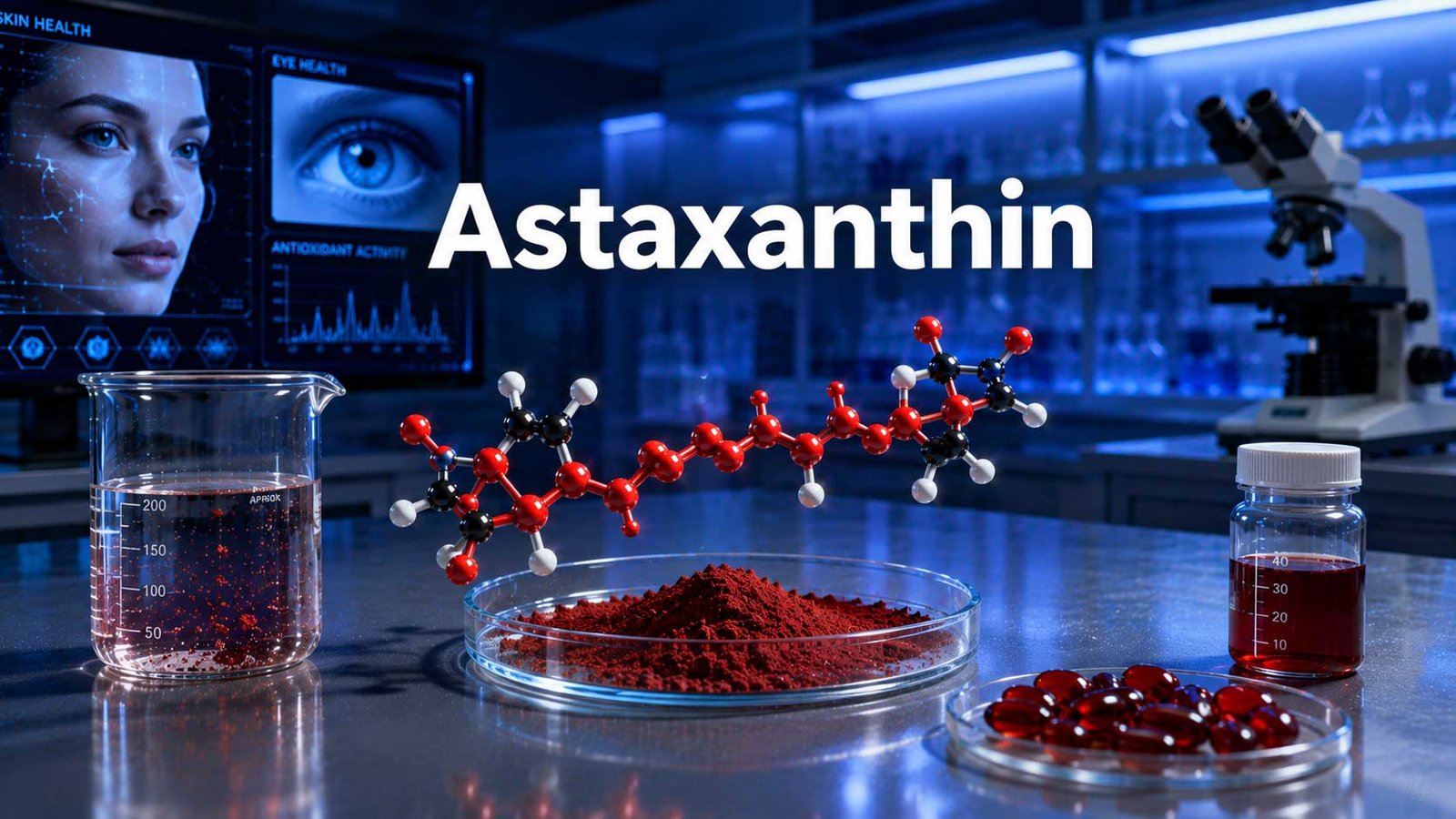
The Red Pigment Hiding in Plain Sight
Ask most people what gives salmon its pink-orange color and you’ll get a shrug, maybe a guess about “fish food dye.” The real answer is astaxanthin, a reddish carotenoid that salmon, trout, shrimp, and even flamingos owe their color to. I’ve spent more years than I’d like to admit poking around the research on carotenoids, and astaxanthin is the one that keeps surprising me. It’s not flashy in the way vitamin C or collagen are flashy. It doesn’t have a marketing department the size of turmeric’s. And yet, quietly, it’s become one of the more interesting antioxidants in the supplement world, mostly because of what it does for skin and eyes.
Here’s the short version, before we get into the weeds: astaxanthin is a xanthophyll carotenoid produced primarily by the microalga Haematococcus pluvialis. When that algae is stressed — dry conditions, intense sunlight, low nutrients — it produces astaxanthin as a kind of internal sunscreen, a molecule that soaks up oxidative damage so the algae’s cells don’t fall apart. Crustaceans and fish that eat the algae (or eat things that ate the algae) accumulate the pigment in their tissue, which is why wild sockeye salmon is such a deep, almost unnatural shade of red. Farmed salmon, incidentally, is often supplemented with astaxanthin or a synthetic analog specifically so it doesn’t come out looking gray, which tells you something about how central this molecule is to what we think of as “healthy-looking” seafood.
Table of Contents

What’s less obvious, and more interesting to me, is what happens when humans eat it. Astaxanthin doesn’t behave like a typical carotenoid once it’s in the body. Its molecular structure — it has hydroxyl and keto groups at both ends of its ring structure — lets it sit inside a cell membrane and span the whole thing, working on both the water-facing and fat-facing sides simultaneously. Beta-carotene and lutein, by comparison, tend to work at just one side of the membrane. This structural quirk is part of why researchers have clocked astaxanthin’s antioxidant capacity as dramatically higher than other well-known antioxidants in laboratory assays, with some comparisons putting its free radical-quenching activity well beyond that of vitamin E based on oxygen radical absorbance capacity testing that shows astaxanthin outperforming other carotenoids and alpha-tocopherol by wide margins.
I want to be upfront about something before we go further: a lot of astaxanthin marketing overreaches. You’ll see claims that it cures everything from wrinkles to cognitive decline, and frankly, the research doesn’t support that kind of sweeping language. What the research does support — reasonably well, in a growing number of human trials, not just petri dishes — is a more modest but still genuinely useful story about skin resilience and eye comfort. That’s the story I want to walk through here.
Skin is a logical place for astaxanthin to matter, because skin is under constant oxidative assault. UV radiation generates reactive oxygen species in skin cells almost continuously during daylight hours, and that oxidative load is a major driver of visible aging — the fine lines, the loss of elasticity, the uneven tone that shows up as we get older. Eyes face a related problem. The retina is one of the most metabolically active tissues in the body, using enormous amounts of oxygen and constantly exposed to light, which makes it a hotspot for oxidative stress too. Astaxanthin, notably, is one of the few carotenoids capable of crossing the blood-retinal barrier, which gives it a kind of backstage access that most dietary antioxidants don’t have.
None of this makes astaxanthin a miracle. It makes it a molecule worth understanding on its own terms — where it comes from, what the clinical evidence actually shows, how much you’d need, and where the real risks (modest as they are) start to show up. That’s what the rest of this article digs into. I’ll be honest about what’s well-established and what’s still preliminary, because I think that distinction matters more than most supplement content is willing to admit.
One more thing worth mentioning before we move on: astaxanthin is fat-soluble, like vitamin A, D, E, and K. That single fact ends up shaping almost every practical recommendation later in this article, from how you should take it to why a spoonful of olive oil with your salmon isn’t just a flavor choice. Keep that in the back of your mind. It’ll come up again.
Key Health Benefits
I’ll organize this around the two areas the title promises — skin and eyes — because that’s where the human clinical evidence is strongest, even though astaxanthin’s proponents will tell you it does a lot more than that (joint comfort, cardiovascular markers, exercise recovery, and so on). I’m sticking to what’s been tested directly in people, with a bias toward randomized, placebo-controlled work.
What Happens to Skin
The clearest human data on astaxanthin and skin comes out of Japan, where researchers have been running trials on this since the early 2000s. One randomized, double-blind, placebo-controlled study enrolled healthy women between 35 and 60 years old with visible wrinkling around the eyes and tracked them over 16 weeks of oral astaxanthin supplementation alongside blood chemistry monitoring for safety using a wrinkle grading system administered by a trained expert on 65 healthy female participants. Studies like this tend to measure a cluster of things: wrinkle depth, skin elasticity, moisture content, and something called transepidermal water loss, which is basically a proxy for how well your skin barrier is holding onto hydration.
The mechanism researchers keep circling back to is UV protection at the cellular level. When skin is exposed to ultraviolet light, it triggers a cascade — oxidative stress, inflammatory signaling, and the activation of enzymes called matrix metalloproteinases that break down collagen. Astaxanthin appears to interrupt that cascade at multiple points. It’s been shown to blunt the release of inflammatory cytokines and to dial back the expression of the specific metalloproteinase responsible for collagen degradation after UV exposure. In practical terms, this shows up in trials as things like a higher minimal erythema dose, meaning skin can tolerate more UV exposure before turning red, along with reduced water loss through the skin barrier and improvements in how rough or smooth skin feels to the touch, generally over supplementation periods of roughly ten to sixteen weeks at doses in the single-digit milligram range.
I want to flag something here, because I think it gets glossed over in a lot of astaxanthin content: these are not “your wrinkles will vanish” studies. They’re modest, statistically significant improvements measured against a placebo group, on a specific set of biomarkers. That’s meaningfully different from a cosmetic transformation, and if anyone tells you otherwise, they’re stretching the evidence further than it’s built to go.
There’s also a growing interest in topical astaxanthin, applied directly to skin rather than swallowed. Formulations combining it with vitamin C and other antioxidants have shown improvements in overall skin quality — fine lines, radiance, evenness of tone — in open-label studies, and there’s reasonable biological logic for why a topical antioxidant cocktail might complement what’s happening from the inside in a formulation combining vitamin C, astaxanthin, fermented turmeric, and vitamin E designed to counter free radical damage and improve skin quality. I’d treat topical use as a genuinely promising but earlier-stage area compared to oral supplementation, which has a longer track record.
What Happens to Eyes
Eye fatigue — the heavy-lidded, hard-to-focus feeling that comes from staring at screens too long — turns out to be one of the best-studied applications of astaxanthin, and it’s honestly the benefit I find most immediately relatable. Who hasn’t finished a long day of screen work and felt like their eyes need a nap separate from the rest of them?
The foundational trial here divided volunteers over 40 into four groups taking either a placebo or 2, 4, or 12 milligrams of astaxanthin daily for 28 consecutive days, then measured uncorrected visual acuity and how quickly their eyes could shift focus between near and far objects assigning subjects a near visual task after supplementation and measuring accommodative function and subjective eyestrain symptoms before and after the task. The results showed measurable improvement in both visual acuity and accommodation speed at the 4 and 12 milligram doses, with no meaningful change in the placebo group. Follow-up studies using around 6 milligrams a day found reductions in subjective eye fatigue complaints, along with improvements in things people described as a “heavy head” feeling and general visual comfort.
The proposed mechanism is a combination of things. Astaxanthin appears to support blood flow to the ciliary body — the ring of muscle tissue responsible for changing the shape of your eye’s lens as you focus — which may be part of why accommodation speed improves. There’s also work suggesting astaxanthin can cross the blood-retinal barrier and exert direct antioxidant effects within ocular tissue itself, something most carotenoids simply aren’t structurally equipped to do. More recent trials have extended this line of research to digital eye strain specifically, including work in school-aged children using screens regularly, with reductions in both chronic and acute measures of digital eye fatigue over roughly twelve weeks of supplementation.
Beyond fatigue, there’s a smaller but intriguing body of research on tear film stability and ocular surface comfort — essentially, dry eye symptoms — with combination formulations showing improvements in tear stability and quality-of-life measures tied to visual tasks. I’d call this an emerging area rather than settled science, but it fits the broader pattern: wherever oxidative stress is a meaningful contributor to a tissue’s dysfunction, astaxanthin research tends to show up with modest, generally positive findings.
A few practical observations from looking at this body of research as a whole:
- Most positive skin and eye trials use doses somewhere between 4 and 12 milligrams daily
- Benefits tend to appear gradually — think weeks, not days — which tracks with how carotenoids accumulate in tissue
- Nearly every clinical trial in this space monitored blood chemistry for safety, and none reported meaningful adverse findings at these doses
- The research is heavily weighted toward Japanese research groups and Japanese astaxanthin sources, which is worth knowing if you’re trying to track down the original papers
If there’s a theme running through all of this, it’s that astaxanthin’s benefits for skin and eyes aren’t about correcting a deficiency — most people aren’t “astaxanthin deficient” in any meaningful sense, since it’s not classified as an essential nutrient. It’s about supplementing an antioxidant defense system that’s under chronic, low-grade oxidative pressure from sun exposure, screen time, and ordinary metabolic activity, and giving it a bit more capacity to keep up.
Dietary Sources
If you want astaxanthin from food rather than a capsule, your options come almost entirely from the ocean, and the concentrations vary more than you’d expect from one source to the next.
Wild Salmon, Especially Sockeye
Wild sockeye salmon is the standout here, and it’s not particularly close. Sockeye typically contains somewhere in the range of 26 to 38 milligrams of astaxanthin per kilogram of flesh, which is meaningfully higher than other wild salmon species like coho, which tends to run around 10 to 21 milligrams per kilogram with wild sockeye salmon showing the highest astaxanthin content among Oncorhynchus species compared to lower levels found in chum salmon. Farmed Atlantic salmon lands considerably lower, generally around 6 to 8 milligrams per kilogram, and often gets there through supplemented feed rather than a natural algae-based diet, since farmed fish typically don’t have access to the same wild food chain.
Doing the rough math, eating roughly 150 to 165 grams of wild sockeye salmon — a reasonably normal dinner portion — gets you somewhere in the neighborhood of 3.5 to 4 milligrams of astaxanthin, which lands right at the lower end of the dose range used in most clinical trials. That’s a genuinely useful amount from a single meal, which is more than I can say for most “superfood” claims I come across.
Other Seafood
Shrimp, crab, lobster, and krill all contain astaxanthin, though the amount that ends up in the parts people actually eat is often less than the marketing suggests. Shrimp flesh contains meaningfully less astaxanthin than the shell and head, where concentrations run several times higher — which matters if you’re the type of home cook who tosses shrimp shells straight in the trash instead of using them for stock. Krill oil supplements are popular partly because krill accumulate astaxanthin as part of their position near the base of the marine food chain, though the actual astaxanthin content of a given krill oil product can vary substantially by brand, so it’s worth checking a label rather than assuming.
Trout is another reasonable source, particularly larger trout raised for markets that specifically supplement astaxanthin-rich feed. Crab tends to be on the lower end of the seafood spectrum for this particular nutrient, so I wouldn’t count on it as a primary source even though it does contain some.
Microalgae, the Original Source
Here’s a fact I find genuinely wild: the microalga Haematococcus pluvialis, under stress conditions, can accumulate astaxanthin at concentrations dramatically higher than anything found in fish — potentially thousands of times more concentrated by weight than salmon. This is precisely why virtually every astaxanthin supplement on the market, regardless of brand, traces back to this same algae as its source material, whether it’s grown in outdoor ponds or closed photobioreactor systems. If you’ve ever wondered why supplement labels almost universally cite “Haematococcus pluvialis extract,” now you know why — it’s not a marketing choice, it’s simply the most efficient natural source by a wide margin.
A Practical Note on Absorption
Because astaxanthin is fat-soluble, eating it alongside some dietary fat meaningfully improves how much your body actually absorbs, rather than how much passes through unused. This is one of those genuinely practical, low-effort tweaks: a piece of salmon cooked in olive oil, or served with avocado, is likely to deliver more usable astaxanthin than the same piece of fish eaten completely fat-free. It’s a small detail, but it’s the kind of thing that separates “technically consumed” from “actually absorbed,” and I think it deserves more attention than it usually gets in casual nutrition advice.
If you’re someone who eats seafood a few times a week and leans toward wild-caught salmon when you can get it, there’s a reasonable chance you’re already getting a modest, semi-regular astaxanthin intake without ever having thought about it. Supplements exist mainly for people who want a more consistent, higher, and more precisely dosed intake than diet alone reliably provides — which brings us to the question of how much is actually appropriate.
Dosage & Deficiency
Let’s deal with the second half of that heading first, because it’s quick: there is no established deficiency syndrome for astaxanthin. It isn’t classified as an essential nutrient the way vitamin C or iron are, meaning your body doesn’t have a defined minimum requirement and there’s no recognized clinical condition tied to “not enough” astaxanthin. That distinguishes it from something like vitamin D, where deficiency has clear, well-documented consequences. Astaxanthin is better thought of as a supplemental antioxidant — something that can meaningfully support existing physiological processes, rather than something the body absolutely requires to avoid dysfunction.
Dosage, on the other hand, is where things get genuinely useful to understand, because the research gives us a fairly clear picture.
What the Clinical Trials Actually Used
Across the human research on skin and eye benefits, most trials cluster in a dose range of about 4 to 12 milligrams per day. Lower doses, around 2 milligrams daily, have shown some effect in longer trials, particularly for skin moisture and elasticity over six or more weeks. The eye fatigue research tends to converge on 6 milligrams daily as something of a sweet spot, with some trials pushing to 12 milligrams for more pronounced acuity improvements. There isn’t strong evidence that going meaningfully higher than 12 milligrams produces proportionally greater benefit for skin or eye outcomes specifically — the dose-response relationship seems to plateau rather than climb indefinitely, which is a pattern worth knowing if you’re tempted to assume more is automatically better.
Regulatory Guidance
Here’s where it gets a little tangled, because different regulatory bodies have landed in different places. The European Food Safety Authority set an acceptable daily intake of 0.2 milligrams per kilogram of body weight in 2019, which works out to roughly 14 milligrams a day for a 70-kilogram adult replacing an earlier, lower acceptable daily intake that had been set by EFSA’s animal feed panel in 2014. Separately, when evaluating astaxanthin specifically as a novel food ingredient in supplement form, the same regulatory body has generally assessed safety at supplemental intakes up to 8 milligrams daily taking into account the overall cumulative intake of astaxanthin a person might receive from all food sources combined, which is a more conservative, practically-oriented number than the theoretical acceptable daily intake.
A broader academic review examining approved dose levels across many countries found recommended or approved doses ranging from 2 to 24 milligrams, and after reviewing 87 human studies, found no safety concerns associated with natural astaxanthin supplementation, including in more than 30 studies using doses of 12 milligrams a day or higher with none of the reviewed human trials identifying safety concerns tied to natural astaxanthin use. That’s a reassuring track record, though it’s worth noting this specifically concerns natural astaxanthin derived from algae, not the synthetic version used more commonly in aquaculture feed, which has a much thinner human safety literature behind it.
A Sensible Range
Pulling this together, if you’re looking at a supplement, something in the 4 to 12 milligram daily range aligns well with both the clinical evidence for skin and eye benefits and the regulatory safety assessments. Taking it with a meal that includes some fat is a smart move given astaxanthin’s fat-soluble nature — this isn’t a supplement you want to take on an empty stomach if you’re hoping to actually absorb it. And because the benefits documented in trials tend to build gradually, expecting a noticeable difference within a few days is probably setting yourself up for disappointment. Give it six to twelve weeks before drawing conclusions about whether it’s doing anything for you.
One more practical note: pregnant or breastfeeding individuals, and children, generally aren’t well represented in the astaxanthin research, so the dosing guidance above is really written with healthy adults in mind. If you fall outside that group, or you’re managing a health condition or taking regular medication, this is exactly the kind of decision worth running by a doctor or pharmacist rather than working it out from a supplement label alone.
Toxicity & Risks
I appreciate when an ingredient has a genuinely boring safety profile, and astaxanthin, for the most part, qualifies. That said, “boring” doesn’t mean “risk-free,” and there are a few things worth knowing.
The Acute Toxicity Data
Animal toxicology studies have consistently failed to find serious harm even at extremely high doses. In one acute oral toxicity study, rats were given a single massive dose — 12,000 milligrams per kilogram of body weight — and researchers observed no deaths and no significant behavioral or clinical abnormalities over a two-week observation period with no rats dying and no clinical signs or behavioral alterations noted during the fourteen-day post-treatment observation, and body weight gain unaffected. That’s an enormous safety margin by any reasonable comparison, and it’s part of why regulatory bodies have generally been comfortable with astaxanthin as a food and supplement ingredient.
Longer-term studies tell a similarly reassuring story for genotoxicity and mutagenicity — meaning astaxanthin hasn’t shown evidence of damaging DNA or being carcinogenic through that particular mechanism across the toxicological studies reviewed by regulatory panels.
Where the Caution Actually Lives
The one finding that regulators took seriously enough to shape their guidance came from a two-year rat carcinogenicity study using very high, sustained doses — around 40 milligrams per kilogram of body weight daily over two years — which found an increased incidence of a specific liver cell abnormality called multinucleated hepatocytes with regulators applying an uncertainty factor to that finding when establishing the acceptable daily intake for astaxanthin. To be clear, this is the kind of dose that’s wildly disproportionate to anything used in human supplementation or found in food — we’re talking about a sustained daily intake many multiples higher than what any human trial has used. But it’s the finding that underlies the more conservative end of regulatory dosing guidance, and it’s worth knowing it exists rather than assuming the safety profile is entirely spotless.
In actual human trials, the most commonly reported effect of higher-dose supplementation is cosmetic rather than dangerous: a subtle yellowish-to-reddish tint that can develop in skin at sustained high intakes, similar to what happens with excessive carotene consumption from carrots. This discoloration is harmless and reverses once intake is reduced, though it’s a reasonable signal that you’ve overshot a sensible dose if you notice it.
Interactions and Special Populations
Because astaxanthin has mild blood-thinning properties through its effects on platelet aggregation, it’s worth flagging for anyone already taking anticoagulant or antiplatelet medications — this is exactly the kind of combination where checking with a doctor or pharmacist makes sense rather than assuming supplements and prescriptions play nicely together by default. People with shellfish allergies should also be cautious with astaxanthin sourced from krill or shrimp byproducts specifically, even though the compound itself isn’t the allergen — cross-contamination in sourcing is the actual concern there, and algae-derived astaxanthin sidesteps that issue entirely.
Beyond that, the honest summary is this: astaxanthin has one of the cleaner safety profiles among popular antioxidant supplements, backed by a genuinely substantial body of human trials without significant adverse findings at commonly used doses. That doesn’t mean unlimited amounts are automatically fine, and it doesn’t mean it’s appropriate for every single person without exception — but as these things go, it’s a comparatively low-risk supplement when used at the doses the research actually supports.
The Quiet Case for a Loud-Colored Molecule
There’s something almost fitting about the fact that one of the more genuinely well-supported antioxidants out there comes wrapped in such an unmissable color. Astaxanthin doesn’t need hype — the deep red of a sockeye salmon fillet is doing plenty of visual marketing on its own, and unlike a lot of supplement trends, this one has a reasonably solid stack of human clinical trials behind the specific claims that get made about it.
What I keep coming back to, after spending real time in this research, is how consistent the story is across skin and eyes. Both tissues face relentless oxidative pressure — one from UV exposure, the other from the sheer metabolic demand of vision — and astaxanthin’s unusual ability to sit across a cell membrane and work on both sides at once seems to give it a genuine mechanistic edge over more common antioxidants in exactly these contexts. That’s not nothing. It’s also not a miracle cure, and I’d be doing you a disservice if I let this article drift toward that kind of language.
If you’re weighing whether to bother with this one, here’s how I’d frame it practically. Eating wild salmon a couple of times a week gets you a meaningful, if modest, intake without any supplement at all — and pairing it with a source of fat, since astaxanthin needs that for absorption, isn’t just a culinary preference, it’s functionally relevant. If you want a more consistent and higher dose than diet alone reliably delivers, a supplement in the 4 to 12 milligram range, taken with food, aligns well with both the clinical evidence and the regulatory safety guidance we’ve covered. And if you’re the patient type, give it real time — six to twelve weeks, not six days — before deciding whether it’s doing anything for you.
What I wouldn’t do is treat astaxanthin as a replacement for sunscreen, or assume it eliminates the need for regular breaks during long screen sessions. It’s a support, not a substitute. Used that way, with realistic expectations and a sensible dose, it’s one of the more evidence-backed additions you could make to either a skincare-from-within routine or an eye-comfort strategy. That’s a genuinely useful thing for a small red pigment to offer, and honestly, more than most trendy supplements can say for themselves.
Article Sources
At AncientHerbsWisdom, our content relies on reputable sources, including peer-reviewed studies, to substantiate the information presented in our articles. Our primary objective is to ensure our content is thoroughly fact-checked, maintaining a commitment to accuracy, reliability, and trustworthiness.
- Ambati, R. R., Phang, S.-M., Ravi, S., & Aswathanarayana, R. G. (2014). Astaxanthin: Sources, extraction, stability, biological activities and its commercial applications—A review. Marine Drugs, 12(1), 128–152. https://doi.org/10.3390/md12010128
- Brendler, T., & Williamson, E. M. (2019). Astaxanthin: How much is too much? A safety review. Phytotherapy Research, 33(12), 3090–3111. https://doi.org/10.1002/ptr.6514
- Davinelli, S., Nielsen, M. E., & Scapagnini, G. (2018). Astaxanthin in skin health, repair, and disease: A comprehensive review. Nutrients, 10(4), 522. https://doi.org/10.3390/nu10040522
- European Food Safety Authority Panel on Nutrition, Novel Foods and Food Allergens (NDA). (2020). Safety of astaxanthin for its use as a novel food in food supplements. EFSA Journal, 18(2), e05993. https://doi.org/10.2903/j.efsa.2020.5993
- Nakamura, A., Isobe, R., Otaka, Y., Abematsu, Y., Nakata, D., Honma, C., Sakurai, S., Shimada, Y., & Horiguchi, M. (2004). Changes in visual function following peroral astaxanthin. Japanese Journal of Clinical Ophthalmology, 58(6), 1051–1054. https://pure.fujita-hu.ac.jp/en/publications/changes-in-visual-function-following-peroral-astaxanthin/
- Tominaga, K., Hongo, N., Fujishita, M., Takahashi, Y., & Adachi, Y. (2017). Protective effects of astaxanthin on skin deterioration. Journal of Clinical Biochemistry and Nutrition, 61(1), 33–39. https://www.ncbi.nlm.nih.gov/pmc/articles/PMC5525019/

- Phosphatidic Acid: Supporting Muscle Growth and Strength - July 31, 2026
- Ceramides: Supporting Healthy Skin From Within - July 31, 2026
- Synbiotics: Combining Prebiotics and Probiotics Together - July 31, 2026